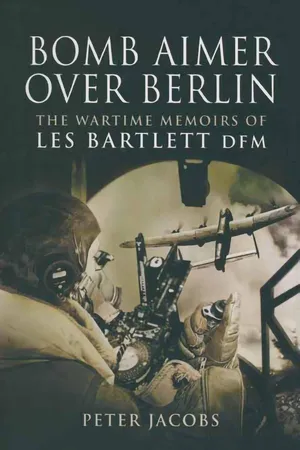
The English pharmacist-turned-RAF-aircrew-member recounts his missions fighting against the Third Reich during World War II.
Les Bartlett has become one of the great characters of World War II history. He flew as bomb aimer with the then Flying Officer Michael Beetham, who later became Marshal of the Royal Air Force. At that time he was a sergeant but gained his commission in April 1944 and flew his tour, including twenty-seven raids over Germany and France between November 1943 and May 1944. On his second operation his aircraft was attacked by a Ju 88, leaving it with no flaps or brakes—a crash landing at Wittering ensued. At the end of his third mission they found the whole of Lincolnshire fogbound and eventually landed at RAF Melbourne in Yorkshire just before that airfield was closed also because of the fog. His aircraft was hit in the wing by a 30lb incendiary bomb dropped by another Lancaster flying above them on his sixth operation—but they survived. On his twelfth operation to Leipzig he used the nose guns to destroy a Ju 88 night fighter, for which he was awarded the DFM. In February 1944 the port outer engine caught fire and the crew baled out. Les was then posted as Assistant Adjutant to RAF Thornaby.
- 224 pages
- English
- ePUB (mobile friendly)
- Available on iOS & Android
eBook - ePub
About this book
Trusted by 375,005 students
Access to over 1.5 million titles for a fair monthly price.
Study more efficiently using our study tools.
Information
Contents
Introduction
1A Willing Volunteer
2South Africa
3So Much to Learn
4The Big City
5Operations at Last
6To Berlin and Back, Again and Again and Again…
7A New Year But The Same Old Story
8On the Edge
9Not Berlin Again!
10A Change of Emphasis
11Life Would Never be The Same Again
Appendices
1Bomber Command Order of Battle, November 1943 to the Battle of Berlin
2Major Bomber Command Raids on Berlin November 1943–March 1944
3Operational Sorties Flown by Les Bartlett
Index
Introduction
Les Bartlett’s wartime experience, and indeed his life, would have been so different had he stayed in the world of pharmacy. Having qualified as a pharmacist soon after the outbreak of the Second World War, he was in a reserved occupation and exempt from military duty. The idea behind reserved occupations was that certain jobs and skills across the country were considered too valuable to the overall war effort and a male workforce was held back rather than being called forward for service in the armed forces. However, the increasing number of casualties as the war progressed soon led to the situation being reviewed. By the end of 1940 more than 5 million women were in employment all across Britain. Whilst most of these were employed in occupations such as factory work, working on the land or driving vehicles, the precedent had been set and the door opened for Les. Like many young men, he was keen to join up and ‘do his bit for King and Country’ and so he volunteered for service as aircrew in the Royal Air Force during 1941.
Les completed his tour of operations as a bomb aimer with No. 50 Sqn Bomber Command during the long, hard winter of 1943/4. Based at RAF Skellingthorpe near Lincoln, he began his tour as a sergeant and ended it as a pilot officer, having been awarded the Distinguished Flying Medal for gallantry along the way. Ten of his operational sorties were flown against Berlin during the bombing offensive that later became known as the Battle of Berlin.
Statistically there was never an easy time to do a tour of operations with Bomber Command. Its offensive against Germany lasted from the opening day of the Second World War and continued without rest until the end of the war in Europe. During that time Bomber Command lost over 55,000 men dead, the majority of whom were killed on operations; taking the number of wounded and prisoners of war into account, the total number of Bomber Command casualties was nearly 74,000. This is extremely high when one considers that 125,000 aircrew served in Bomber Command during the Second World War; in other words, each individual faced a 40 per cent probability that he would be killed or a 60 per cent probability that he would be killed, wounded or taken as a prisoner of war.
Les was one of the 40 per cent who survived unscathed, apart from having memories of those who were not so lucky, and after the war he returned to pharmacy, the profession he had left when he volunteered for active service. By contrast his pilot, Mike Beetham, stayed in the post-war RAF and went on to become Marshal of the Royal Air Force Sir Michael Beetham GCB CBE DFC AFC.
I had a chance meeting with Les one Sunday morning in June 1989. At the time I was a flight lieutenant navigator instructor at Finningley. Having finished a tour on the Phantom at Coningsby, I had bought a house on a residential estate in Lincoln as it was likely that I would soon return to Coningsby and Lincoln was mid-way between the two stations. I was in my car and on my way to buy a newspaper at the local newsagent when the Lancaster ‘City of Lincoln’ from the Battle of Britain Memorial Flight passed directly overhead at ‘flypast height’. A few moments later I noticed that the road ahead was closed and there were many people gathered around talking. I parked the car and strolled down to take a closer look at what was going on. Amongst the gathering I noticed a number of men proudly wearing their medals and admiring a most impressive memorial.
I knew a bit about medals and approached one wearing the Distinguished Flying Medal; it turned out to be Les. So began a long friendship, which has lasted to this day. Les and I have so much in common; not only do we both understand flying in the RAF, albeit in somewhat different circumstances, but Les lives close to my home near Southampton. From my conversations with him during those first meetings, I soon learned what the memorial was all about and about the existence of the Nos 50 and 61 Squadrons Association. I also learned that my house was on the former site of RAF Skellingthorpe, from which both squadrons had operated Lancasters during the Second World War.
I found myself becoming more and more fascinated by the whole story. Les had been on the Association’s Memorial Committee and he explained to me that there were plans to produce a Roll of Honour and that the Association was about to pay a large sum of money to a professional historian to complete the work. As I had an interest in RAF history, and this was all happening at a time when I was just beginning to get started in writing, I offered to do the work for nothing apart from the expenses incurred travelling to and from the Air Historical Branch in London.
The Roll of Honour, which includes the names of 1,976 aircrew and ground personnel killed whilst serving with the two squadrons during the Second World War, was dedicated at a service held at the memorial in 1991. By then I had got to know Les well and had written other articles on him and his crew. The reason I was able to do this was because Les had provided me with much original material that he had kept from during the war, including his diary from his tour of operations. Despite wartime restrictions, Les had had the presence of mind to record his experiences as they were happening at the time, and it was apparent to me how special his diary was.
Incidentally, my interest in RAF Skellingthorpe and its two wartime squadrons increased as I got to know more of those who flew from the airfield during the Second World War. Although there is a long-standing saying in the military, ‘never volunteer for anything’, my initial passing interest in the Association led to me eventually becoming its Chairman, something, I consider to be an honour and a privilege. Furthermore, I get a great deal of pleasure seeing Les back with the two other surviving members of his wartime crew, Sir Michael Beetham and Reg Payne, at the Association’s annual reunion at the former site of RAF Skellingthorpe.
Throughout the last few years it has become increasingly obvious to me that Les’s story should be told; not because it is particularly different from those of others serving in Bomber Command at the time, but because his diary represents what all those young men went through during the difficult period of the Battle of Berlin in the winter of 1943/4. Therefore, it is Les’s diary that forms the basis of this book.
At the time of writing, Les is approaching his ninetieth birthday. My family has welcomed him into our home so many times over the past eighteen years and we have all got to know him so well. Indeed, it has been an education for my children to learn about what happened during the Second World War on the site where we now live. Les Bartlett is a remarkable man with a remarkable story. Enjoy the book!
CHAPTER ONE
A Willing Volunteer
The son of an engineer, Les Bartlett might well have been born in Russia. His father, Albert Bartlett, had been working for the Tsarist Government since 1913, and had helped establish a canning factory in the Omsk region of Siberia. His work in Russia proved successful and so the Government, keen to retain his services, paid for his girlfriend, Beatrice Rudge, to travel out from her home in Gloucester to join him and the couple were married in the Evangelical-Lutheran Church in Omsk on 12 January 1915. Having previously lost a baby daughter after just four months, the couple decided to take no chances second time around and Beatrice returned to Gloucester, where she gave birth to Albert Leslie Bartlett on 17 September 1917. By then the Russian Revolution was gathering momentum and so his father left Russia soon after to rejoin the family in Gloucester, although he had to leave his wealth behind in Russia.
Sadly, Les’s father died of pneumonia in 1919 having never recovered from rescuing a woman who had fallen into the River Severn. His mother bought a small newsagent and confectionery business in Gloucester to make ends meet. For the next few years Les grew up in Gloucestershire. On his sixth birthday he came across the word ‘Berlin’ for the first time. Amongst the presents he received for his birthday, one aroused his curiosity more than the others. It was a shallow wooden box about 8 inches by 6 inches and about 1 inch deep. The top was a sheet of glass through which he could see inside. There was a winding channel cut into the inside of the base, which meandered from side to side starting at the bottom left-hand corner and eventually ending at the top right-hand corner. The idea was to negotiate a ballbearing past a number of holes in the channel in order to get it to the top of the game. Beside each hole there was the name of a city. It was a German toy and therefore all the cities were in Germany. The aim of the game was to get the ballbearing up to the top hole called ‘Berlin’. Not surprisingly, being only six years old, that was the first time Les had heard of Berlin and he could never have imagined the significance it would have later in his life, although he never forgot that first encounter.
A few years later his mother met and eventually married a ship’s engineer called Hornsey Gamlen. The family moved north-east to where the ship-building companies were located and initially settled in Hartlepool in 1927 before moving to Billingham, near Stockton-on-Tees, a year later. They settled in Roseberry Road, Billingham, but the next few years do not have fond memories for Les. His half-brother, Fred, was born in 1927 and Les found himself feeling very much like excess baggage; in his own words, he could not wait to get away.
Aeroplanes had first caught his eye as a young boy during the 1920s, when he noticed them on the back page of the Daily Express. He sent away for a glider, which he paid for with his pocket money, and cut out the pictures from the newspaper and spread them across his bedroom wall, much to the annoyance of his mother. Photographs in daily newspapers were not the only influence on the young Les Bartlett. Pictures of aeroplanes on the billboards at the entrance to the local Billingham Picture House promoting Howard Hughes’s 1930 film about pilots in the First World War called Hell’s Angels, which starred Ben Lyon and James Hall and featured a starring debut by a young Jean Harlow, led to Les seeing the film three times during the following week! It had been the most expensive film to make at that time and included some spectacular flying sequences, but what Les would not have known then, and it might well have put a thirteen-year-old boy off, was that three pilots had been killed during the making of the film; such were the hazards of aviation at the time.
Like many young boys, pictures in newspapers or films of aeroplanes were never going to be enough for him. In March 1930, No. 608 (North Riding) Sqn formed at nearby Thornaby airfield as an Auxiliary Air Force day-bomber unit. The site had been used as a second class landing ground during the First World War and was developed during the late 1920s. Although the airfield had very few facilities, the squadron’s Westland Wapitis began to arrive in June 1930. This, understandably, created much interest in the local area. Although the airfield was 6 miles away from his home, the bike ride was well worth it and Les’s mind was made up, it simply had to be the RAF.
At the time Les was studying at Stockton Secondary School for Boys and it was to be three more years before he was able to take his desire to join the RAF one step further. At sixteen years old he saw an advertisement in the local paper – ’Examinations will be held for boy entrants into the RAF at Stockton Town Hall.’ This was his chance to join the RAF and he sat the examination. On 29 December 1933 he received a brown envelope containing a letter to say that he had passed the examination and enclosing a travel warrant to RAF Halton. In the early period after the First World War, aircraft maintenance was becoming increasingly technical and the RAF needed to train a number of personnel in a wide variety of trades. Lord Trenchard had developed the idea of a Boy Mechanics Training School, which had been set up at Halton in 1917 to produce riggers for the Royal Flying Corps and was renamed No.1 School of Technical Training in 1920. Halton received its first entry of boys in January 1922 and the rank of aircraft apprentice was adopted. During the 1920s each entry was typically 500 strong but by the early 1930s this had reduced by half. However, from 1934 the numbers steadily increased as the RAF expanded with the increasing instability in Europe.
It was against this background that Les arrived at Halton a few days later; he was delighted. However, his elation was not to last long and his enthusiasm for the RAF disappeared almost immediately; two weeks after his arrival he was on his way home again! His short experience of ‘bossy corporals’, whitewashing stones, polishing lino and continual drill were more than sixteen-year-old Bartlett could take. His commanding officer gave him a progress report at the end of the second week. Contrary to what might normally have been expected of a young recruit, Les decided to make his own views known and took the opportunity to give the commanding officer the benefit of his opinion. Seen as a potential trouble maker and a bad influence on the rest of his flight, he was on his way back to the north-east with a one-way travel warrant in his hand; it was probably the best outcome at the time for both Les and the RAF!
It was still ...
Table of contents
- Cover
- Half Title
- Full Title
- Copyright
- Dedication
- Acknowledgements
- Foreword
- Contents
Frequently asked questions
Yes, you can cancel anytime from the Subscription tab in your account settings on the Perlego website. Your subscription will stay active until the end of your current billing period. Learn how to cancel your subscription
No, books cannot be downloaded as external files, such as PDFs, for use outside of Perlego. However, you can download books within the Perlego app for offline reading on mobile or tablet. Learn how to download books offline
Perlego offers two plans: Essential and Complete
- Essential is ideal for learners and professionals who enjoy exploring a wide range of subjects. Access the Essential Library with 800,000+ trusted titles and best-sellers across business, personal growth, and the humanities. Includes unlimited reading time and Standard Read Aloud voice.
- Complete: Perfect for advanced learners and researchers needing full, unrestricted access. Unlock 1.5M+ books across hundreds of subjects, including academic and specialized titles. The Complete Plan also includes advanced features like Premium Read Aloud and Research Assistant.
We are an online textbook subscription service, where you can get access to an entire online library for less than the price of a single book per month. With over 1.5 million books across 990+ topics, we’ve got you covered! Learn about our mission
Look out for the read-aloud symbol on your next book to see if you can listen to it. The read-aloud tool reads text aloud for you, highlighting the text as it is being read. You can pause it, speed it up and slow it down. Learn more about Read Aloud
Yes! You can use the Perlego app on both iOS and Android devices to read anytime, anywhere — even offline. Perfect for commutes or when you’re on the go.
Please note we cannot support devices running on iOS 13 and Android 7 or earlier. Learn more about using the app
Please note we cannot support devices running on iOS 13 and Android 7 or earlier. Learn more about using the app
Yes, you can access Bomb Aimer Over Berlin by Les Bartlett,Peter Jacobs in PDF and/or ePUB format, as well as other popular books in History & Military Biographies. We have over 1.5 million books available in our catalogue for you to explore.