"Fascinating insight into the early development of the B-17 Flying Fortress . . . undoubtedly outshines other books on this significant WWII aircraft." —Air Mail
The Boeing B-17 was the first American heavy bomber to see action in World War II when it was supplied to the RAF. The design originated in 1934 when the US Air Corps was looking for a heavy bomber to reinforce air forces in Hawaii, Panama and Alaska. For its time, the design included many advanced features, and Boeing continued to develop the aircraft as experience of the demands of long-distance flying at high altitude was gained.
When the United States entered WWII, production of the aircraft was rapidly increased and it became the backbone of the USAAF in all theaters of war. This book describes how it was built and utilizes many hitherto unpublished photographs from the design studio and production lines. It illustrates and explains the many different roles that the aircraft took as the war progressed. Heavy bomber, reconnaissance, antisubmarine, and air-sea rescue operations; there were few roles that this solid design could not adopt.
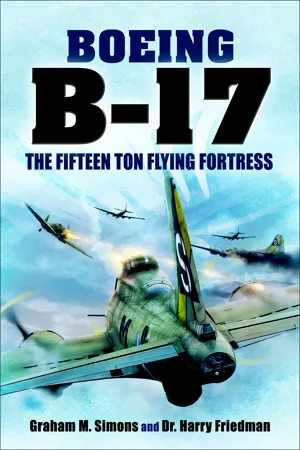
- 256 pages
- English
- ePUB (mobile friendly)
- Available on iOS & Android
eBook - ePub
About this book
Information
MODIFICATION AND EXPERIMENT
The lessons learned with the hurried modifications required on the B-17Cs required for the RAF and the myriad of modifications demanded on the B-17E once the United States found itself at war, revealed that production should not be hindered by introducing changes at that stage. Even a relatively simple change could slow a production line, its introduction posing additional problems with materials and labour skills. The answer was to carry out the changes at a special centre after an aircraft had been accepted from the factory, thus allowing their introduction to take place where this could be achieved without disruption to primary production. Many changes were only required for aircraft going to a particular war theatre - a cold-protected aircraft heading for operations in Alaska needed different equipment and modifications than a B-17 operating in the heat of the Philippines.
Providing such modification centres was not easy, as the facilities and special skills and equipment could not be brought together quickly. The solution was enlisting the help of the civil airlines, who already had maintenance bases with staff and tools, and these became the basis of modification centres. They were set up in January 1942, the United Airlines facility at Cheyenne, Wyoming, being earmarked principally for B-17 work. The Douglas plant at Tulsa, Oklahoma, became a secondary location for B-l 7 modifications, usually the more specialised tasks.
The list of modifications required for B-17s sent to Cheyenne varied almost from week to week as new items were added and others removed once they had been accepted on the production line. Although aircraft within each production block were intended to incorporate the same changes, which was not always the case with those made at modification centres. Nor did modification centres always indicate the special changes they had made to a particular model by amending the existing block number on the aircraft.
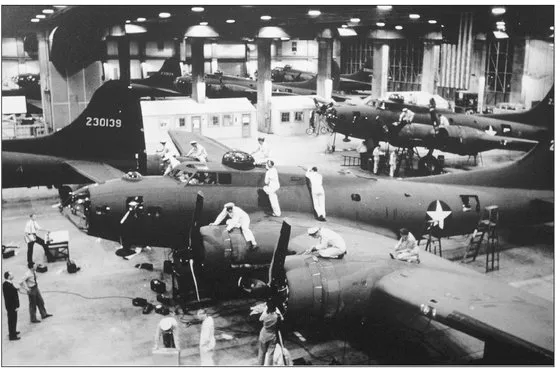
A number of B-17s inside the Cheyenne Modification Center. According to the records, 42-30139 was at the centre between 15 and 25 April 1943 before going overseas to the 545th BS, 384th BG where it was named ‘Snuffy’ (USAAF)
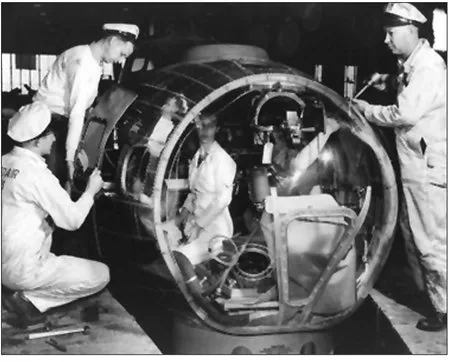
Obviously a posed photograph of technicians ‘working’ on a B-17 in the one of the modification centres.
Literally hundreds of different changes made to wartime B-17s, although many were of no great significance from an operational standpoint. Indeed, it is often said that the B-l 7 was the most modified of all USAAF aircraft and it is almost certainly the case when looking at the additional modifications done at field level that no two B-17s were the same!
USAAF air depots specialising in the repair of B-17s in the USA were set up at Fairfield, Oklahoma City and Warner Robins airfields. Their customers were aircraft from the dozen B-l 7 training bases in the Second and Third Air Force areas.
Requirements from the SWPA
Most modification requirements came from the experiences of B-l 7 operatives in combat areas, the first coming from the South West Pacific Area (SWPA), the official term for the theatre of operations which included northern Australia, New Guinea and the Philippines. Surviving B-17Ds were withdrawn from operational use at an early date and B-17Es and Fs served in small numbers until replaced by B-24s.
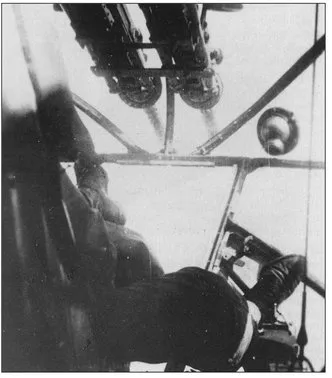
The main complaint was poor frontal defence and the need for a powered turret in the nose. The Brisbane Air Depot in Australia partly met the demand for improved forward firepower by replacing the .30-calibre machine guns, in ball-and-socket mounts offset 18 inches from the centreline of the nosepiece, with twin .50-calibre weapons firing through an aperture made in the upper part of the plexiglas. The recoil of these weapons made them difficult to handle and the heavy supports required impeded the bombardier. For this reason B-17Es and Fs so equipped were normally flown as wing aircraft and dropped bombs on the signal of the leading aircraft which had a bombsight. Alternative arrangements included a single .50 in the upper nose aperture and another positioned to fire through the nose ventilating door to cover the downward area that the higher gun could not reach, but the field of fire was very limited. The displaced .30-calibre gun was often used in a ball-and-socket mounted in a spider frame replacing the forward escape hatch, although this was not popular owing to the updraught it created.
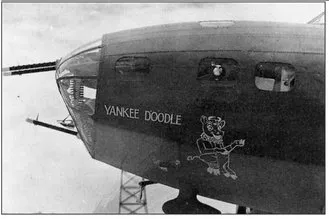
SWPA field-improvised mountings of three .50-calibre guns in B-17E 41-2463 of the 19th BG. Original ball-and-sockets for .30 weapons were bored to take the wider barrels.
Other modifications were done on Fortresses at Brisbane. B-17E ammunition boxes at the waist guns were found impracticable due to the small quantity of ammunition they held. To increase the supply, boxes able to hold 300 rounds was designed with a false bottom and used in conjunction with ammunition feed guides. The spring-mounted false bottom raised the ammunition as it was used, reducing the drag and weight which would otherwise be added to the feeding mechanism. Similar modifications were made to the ammunition feed for early B-17F waist guns.
The Sperry upper turret was thought to be the most effective defensive position but the early turrets had some difficulties highlighted in combat. The ammunition sometimes failed to feed when the guns were elevated at high angles. This was corrected by a coiled spring and a roller extension in the ammunition box. The original cables that charged the guns continually broke through being too small. Brisbane replaced these with a very flexible but larger diameter cable, that was also an inch longer, to allow the gun to return into function before the charging handle hit its stop. The opening and shutting of the machine-gun cover caused the firing solenoid cable to wear, and this was corrected by the use of a 90-degree cannon plug.
Interior view of paired .50-calibre guns in the nose of a 19th BG B-17E. Intensive use fractured the Plexiglas,so internal bracing supports were added to prevent this. (both USAAF)
The Sperry ball turret also had its problems. The ammunition trace links jammed in the chutes that guided them out of the turret, causing gun stoppage. The chutes had to be enlarged to let the links fall freely.
The door of the ball turret was the back rest for the gunner and the hinges were not robust enough. Twisting the hinges made the door difficult to close and occasionally the door came open during flight, leaving the gunner held only by his safety straps. The Brisbane depot overcame this weakness by making new hinges out of heavy steel and both bolting and welding the hinge to the turret armour plate. Scorching of aircraft skin through gunfire brought the installation of blast tubes on turret guns. Telescopic sights fitted to the flexible guns on B-l 7Es were impracticable through limited vision and misting. These were replaced with simple ring-and-post sights.
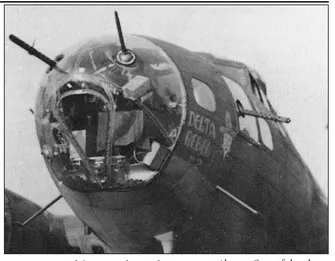
One of the three ball-and-socket fittings, intended for .30- calibre weapons was often machined out to take a .50, as on 42-5077 Delta Rebel 2 of the 91st BG
Brisbane also carried out modifications to improve bomb-related problems. As designed, the bomb rack selector switch, situated in the bomb bay, had to be changed manually if an auxiliary fuel tank was being carried and there was a requirement to jettison it in an emergency. A situation could arise where there was insufficient time for a crew member to go into the bomb bay to operate this switch. It was relocated on the bombardier’s panel in the aircraft’s nose. Much trouble was also experienced with the A-2 model release units failing to release bombs, although this could only be prevented by careful maintenance and ground checks to see that they functioned properly. The failure of bomb bay doors to open was traced to the grease on the operating screws freezing at high altitude. All grease was removed and replaced with graphite powder lubricant.
B-17s in the ETO
The United Kingdom was the main location of B-17 deployment for the European Theatre of Operations (ETO) and an extensive programme of modifications was carried out throughout the aircraft’s period of use. The main centre for this work was Burtonwood, near Liverpool, which eventually had facilities comparable to a factory installation with a staff of some 16,000. The first B-17Es arrived in the UK in July 1942 and were immediately given radio modifications to permit them to conform with British communication procedures. These included the fitment of Mk 2 IFF (Identification Friend or Foe) and SBA (Standard Beam Approach) receivers. SBA, based on the Lorenz system used in the US, was available at many UK airfields and it was only necessary to remove the marker beacon antenna on the B-17 and install the SBA antenna in its place. The RAF had already listed fourteen items on the B-17E which needed installation or modification. Apart from radio equipment, they said the bomb racks should be capable of holding British bombs, that downward recognition lights should be fitted and that fire extinguishers and additional equipment for the liferaft should be added.
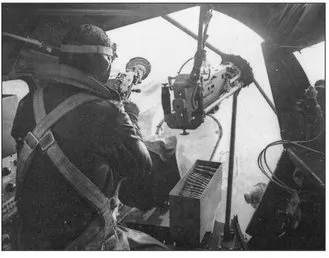
The bombardier’s view from 42-5077, with a .30 gun on the left and a .50 on the right. To avoid damage to the Plexiglas from the recoil of the more powerful weapon, three tubular support struts held the mounting. A banjo cord or strap kept the gun out of the bombardier’s way when not in use. (USAAF)
The first few missions using B-17Es clearly showed a number of weaknesses; the lack of enough forward firepower, a tail-heavy balance condition, difficulties with the...
Table of contents
- Title Page
- Copyright Page
- Table of Contents
- ACKNOWLEDGEMENTS
- INTRODUCTION
- ORIGINS
- THE MODEL 299 AND YB-17
- THE FIRST BIG CHANGE- THE B AND C
- FROM SMALL TO BIG TAILS - THE D AND E
- The B-17F
- MODIFICATION AND EXPERIMENT
- THE G MODEL... AND ABOVE
- YOU BEND ‘EM - WE MEND ‘EM
- IN COMPARISON
- FROM THE COCKPIT
- INDEX
- BIBLIOGRAPHY
Trusted by 375,005 students
Access to over 1.5 million titles for a fair monthly price.
Study more efficiently using our study tools.
Frequently asked questions
Yes, you can cancel anytime from the Subscription tab in your account settings on the Perlego website. Your subscription will stay active until the end of your current billing period. Learn how to cancel your subscription
No, books cannot be downloaded as external files, such as PDFs, for use outside of Perlego. However, you can download books within the Perlego app for offline reading on mobile or tablet. Learn how to download books offline
Perlego offers two plans: Essential and Complete
- Essential is ideal for learners and professionals who enjoy exploring a wide range of subjects. Access the Essential Library with 800,000+ trusted titles and best-sellers across business, personal growth, and the humanities. Includes unlimited reading time and Standard Read Aloud voice.
- Complete: Perfect for advanced learners and researchers needing full, unrestricted access. Unlock 1.5M+ books across hundreds of subjects, including academic and specialized titles. The Complete Plan also includes advanced features like Premium Read Aloud and Research Assistant.
We are an online textbook subscription service, where you can get access to an entire online library for less than the price of a single book per month. With over 1.5 million books across 990+ topics, we’ve got you covered! Learn about our mission
Look out for the read-aloud symbol on your next book to see if you can listen to it. The read-aloud tool reads text aloud for you, highlighting the text as it is being read. You can pause it, speed it up and slow it down. Learn more about Read Aloud
Yes! You can use the Perlego app on both iOS and Android devices to read anytime, anywhere — even offline. Perfect for commutes or when you’re on the go.
Please note we cannot support devices running on iOS 13 and Android 7 or earlier. Learn more about using the app
Please note we cannot support devices running on iOS 13 and Android 7 or earlier. Learn more about using the app
Yes, you can access Boeing B-17 by Graham M. Simons,Harry Friedman in PDF and/or ePUB format, as well as other popular books in History & Military & Maritime History. We have over 1.5 million books available in our catalogue for you to explore.