![]()
1
Bury St Edmunds (Rougham) — Station 468
Two miles east of Bury St. Edmunds and sandwiched between the old A45 (now A14) and Bury—Thurston roads, Rougham airfield was typical of the USAAF bases in the area, being constructed mainly by Richard Costain Ltd to the standard Class ‘A’ pattern with three intersecting runways, thirty hardstandings and two T2 hangars. The base was handed over to the Eighth Air Force in the autumn of 1942, although then not fully completed. The 47th Bomb Group (Light) with A-20B medium bombers first used the field during September-October 1942 but moved out to Horham after a month and thence to North Africa as part of the 12th Air Force. The first unit to fly operations from Rougham was the 322nd Bomb Group (Medium) equipped with B-26B Marauders, arriving in December 1942. The 322nd Group’s first mission was not flown until 14 May 1943 when a Dutch power station near Ijmuiden was the target. Due to poor bombing, the Group was assigned the same target along with another at Haarlem on 17 May. This low-level strike turned out to be a total disaster when the entire force of ten aircraft to reach Holland was lost to enemy action and collisions. About that time a rumour was going around concerning a young blonde lady spy who was said to have had a hand in this tragedy, but this has never been substantiated. To add to the despondency at Rougham a B-26 crashed into a hangar there on 29 May. As a result of the losses sustained on unescorted low-level missions it was decided by HQ Eighth Air Force to switch to medium altitude bombing and from then on the B-26 groups’ fortunes improved. A further decision was made to redeploy the 322nd Bomb Group to Andrews Field, Essex, in exchange for a heavy bomb group and the 322nd was subsequently assigned to the Ninth Air Force. One of the Rougham-based Marauders, Flak Bait, survived the war and is now an exhibit at the Smithsonian Museum in Washington DC.
The B-17Fs of the 94th Bomb Group first flew into Rougham on Sunday 13 June 1943 following a tough mission to Kiel during which they lost nine aircraft. The 94th had previously been stationed at Earls Colne, Essex, and while the Forts were out attacking Kiel, the ground personnel moved in with all essential equipment. This group, comprising the 331st, 332nd, 333rd and 410th Bomb Squadrons, was part of 4th Combat Bombardment Wing, 3rd Bomb Division. They flew B-17F and later the chin-turreted G versions and carried the code letter A in a black square on the fin. A month after arriving at Rougham, a new Commanding Officer, Colonel Frederick W. Castle, was appointed to succeed Colonel Moore. At first this change was resented by the crews, but Colonel Castle soon gained the respect of the Group, which he led until April 1944, during which time he welded the 94th into one of the most efficient of the Eighth Air Force.
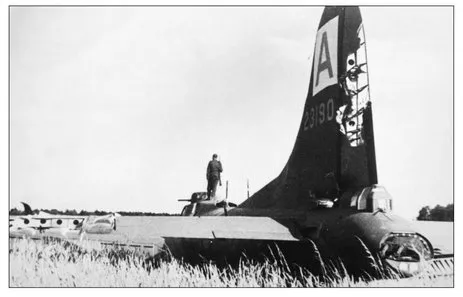
B-17F-35-DL 42-3190, 331st Bomb Squadron, which pilot Captain Kee Harrison crash-landed in a French wheat field with its bomb load intact after being shot up on the Paris-Le Bourget mission on 14 July 1943. Harrison and three others evaded and later returned safely to England. Four others were taken prisoner. (via Zdenek Hurt)
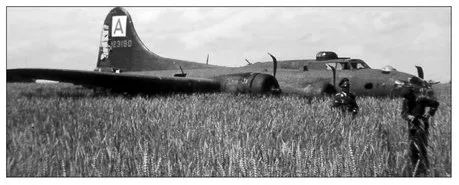
B-17F-35-DL 42-3190, 332nd Bomb Squadron, shot down by Oberstleutnant Egon Mayer Kommandeur, III./JG 2 on 14 July 1943. (Harry Holmes)
Rougham offered good Rest & Recuperation (R&R) prospects for the 94th Bomb Group, with a day at the races at Newmarket available on occasion and Thetford, birthplace of Thomas Paine, a radical 18th Century thinker and political writer. He was born in White Hart Street, Thetford in 1737. He was educated at the Grammar School in Bridge Street and then moved to London in 1737, writing a series of books and leaflets advocating social and political change. Paine played a prominent part in the French and American revolutions and became the unofficial American Ambassador in 1787, publishing The Rights of Man in 1791. He was accused of sedition and left England never to return. His works were banned and his effigy burned in many towns. A statue of Thomas Paine now stands outside the Kings House in Thetford and there is a permanent display in the Ancient House Museum. (A B-17 in the 388th Bomb Group at Knettishall bore Thomas Paine’s name). Also, Culford Hall, six miles from Bury St. Edmunds was built by the Marquis of Cornwallis whose surrender at Yorktown in 1781 had meant victory for the Americans in the War of Independence. On the base there was other entertainment. An American concert party gave a show on 29 June 1943. Star of the show was Bob Hope, supported by female vocalist Frances Langford, comedian Jerry Colonna (of the high-pitched voice and rolling eyes) and Jack Pepper.
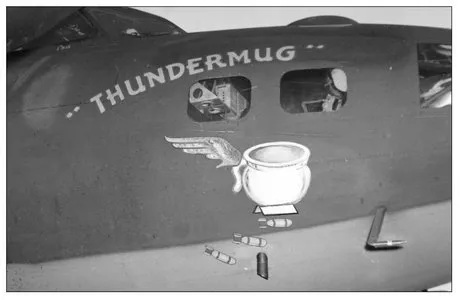
B-17F-65-BO 42-29670 Thundermug, formerly in the 333rd Bomb Squadron, was transferred to the 544th Bomb Squadron, 384th Bomb Group. It was one of seven in the Group that were lost on 25 July 1943 when it crashed at Hamburg. Two of Lieutenant Kelmer J. Hall’s crew were KIA while eight were taken prisoner. (Richards)
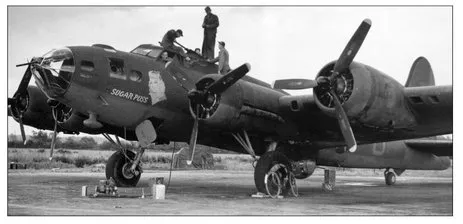
B-17F-25-DL 42-3088 was assigned to the 410th Bomb Squadron at Rougham in January 1943 and was transferred to the 544th Bomb Squadron, 384th Bomb Group on 12 July. Sugar Puss was one of seven 384th Bomb Group B-17s lost on the mission to Hamburg on Sunday 25 July 1943. Six of the losses were from the 544th Bomb Squadron. Four of Lieutenant Clarence R. Cristman’s crew were KIA and six survived to be taken prisoner. (USAF)
Targets attacked during 1943 included Wilhelmshaven, Stuttgart, Emden, a number of French targets, the famous shuttle raid on the ball-bearing plant at Regensburg when they flew on to North Africa and for which they were awarded a Distinguished Unit Citation, and the notorious raid on Schweinfurt on 14 October. 2nd Lieutenant Roy G. Davidson, one of the pilots in the 333rd Bomb Squadron recalls:
When the covers were withdrawn on the route map, it showed that the fighter escort only went a short way with us to the target. We would have a long way from France onwards without fighter cover and on the way back too. We knew that we were in for a pretty rough time but we had no idea just how rough it was going to be. We had not been on the first Schweinfurt raid and didn’t realize how bad Schweinfurt was. Despite this I really looked forward to the mission because I thought the accomplishment would be great. It never crossed the minds of the crew that we would not complete our twenty-five missions. A telegram was read out telling us that this was one of the most important missions of the war. When we had knocked out the ball-bearing plants the war would come to a halt. We felt we were really going to contribute a lot towards winning the war. I was flying in the low squadron as last man — the most vulnerable spot in the entire formation. But we felt safe because even though we were the last aircraft in a string of over 200 bombers, there were going to be a whole lot of Liberators following right behind us. This would really put us right in the middle of the whole string, which seemed to be a pretty good spot to be in.
My position in the group formation as ‘tail-end Charlie’ really put us in the centre of the whole shooting match. We went into the target amid very heavy flak and fighter attacks. The fighters continued to attack us right through to the target area. They even flew through their own flak with no let up at all. But we were able to fight them off all the way to the target and out. Carl F. ‘Hoot’ Gibson, ball turret gunner, shot down a Bf 109 and the boys were really excited about this. But pretty soon the fighters came in thick and fast and everyone was getting to do a lot of shooting. By the time the fight was over I think most of the gunners aboard were out of ammunition. Fred Krueger, in the top turret, ran out and never did get to reload. We went into the target, dropped our bombs and had started back out, when the fighters made passes through the middle of the formation. We outfought the fighters but a Bf 110 pulled in close and fired rockets at us. One of the missiles exploded right under our plane. It felt as if we were on an elevator; it lifted us up and did all kinds of damage. It wasn’t long before we had a Bf 109 off each wing about 50 yards out. We had no ammunition left and anyway, three men had baled out and the rear gunner was wounded. They took it in turns to shoot at us, turning in directly from 3 o’clock.
Eventually, Davidson’s third engine cut out and he was forced to make a wheels-up landing in a cow pasture near the village of La Chappele-sur-Orbais. Davidson’s crew was one of six 94th Bomb Group crews lost.
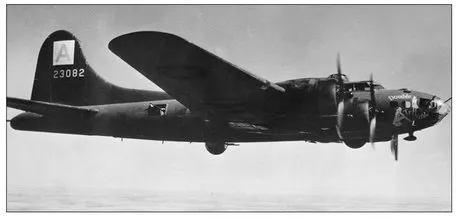
B-17F-25-DL 42-3082 Double Trouble in the 333rd Bomb Squadron. The pilot, Lieutenant Bill Winnesheik, aborted the mission to Bremen on 25 June 1943 after fighters knocked out two engines and he landed in England despite a full bomb load. On 4 October 1943, during a mission to St. Dizier, France, fighters knocked out the No. 3 engine and the propeller refused to feather but the crew managed to crash-land at Margate. Vance Van Hooser the assistant engineer/waist gunner, who was on his 23rd mission, was hit in the head by 20mm shell fragments and never flew again. (USAF)
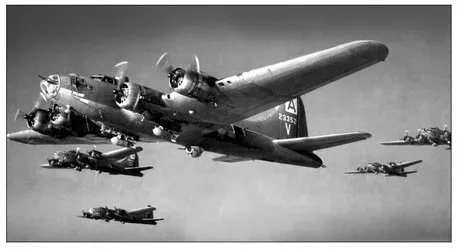
B-17F-50-DL 42-3352 Virgin’s Delight in the 410th Bomb Squadron. Virgin’s Delight and 2nd Lieutenant Walter Chyle’s crew FTR on 29 November 1943 when the aircraft was ditched in the North Sea with the loss of all the crew. (USAF)
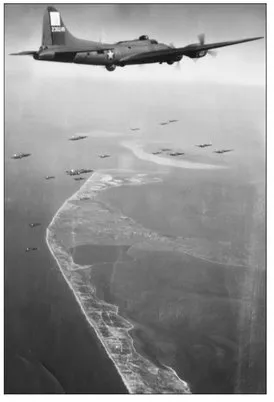
B-17F-95-BO 42-30248 was assigned to the 410th Bomb Squadron, on 2 June 1943 and was named The Southern Queen. In August this aircraft joined the 333rd Bomb Squadron and it was renamed The Buzzard, later becoming The Prodigal Son before finally becoming Lassie Come Home. 42-30248 and Lieutenant Robert C. Randall’s crew FTR from the mission to Brunswick on 11 January 1944. Two of the crew were killed and eight survived to be taken prisoner. (USAF via Geoff Ward)
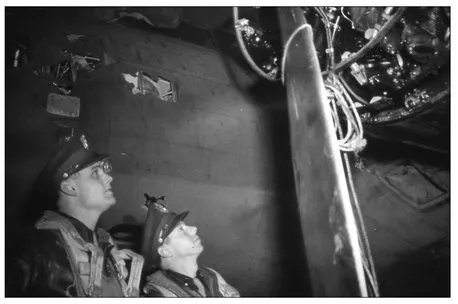
1st Lieutenant William F. Cely, pilot and 2nd Lieutenant Jabez I. Churchill, co-pilot in the 333rd Bomb Squadron, inspect their badly damaged B-17G-1-VE 42-39775/K Frenesi. They brought the B-17 home to Rougham from Brunswick on 11 January 1944 with three wounded gunners after five crew and a cameraman had baled out over enemy territory. Cely added the Silver Star to his DFC and Air Medal for bringing Frenesi back. The aircraft was so badly damaged that it was scrapped, but five of the crew fought another day in Frenesi II (43-38834). (via Ian McLachlan)
One of the 94th’s characters was Captain Franklin ‘Pappy’ Colby who at the age of 42 in September 1943 was the oldest combat pilot in the Eighth Air Force. He was awarded the Air Medal, the first to be gained by the 94th Group, On 1 April 1943. At the end of June he was promoted to Major and given command of the 410th Bomb Squadron. ‘Pappy’ Colby completed his tour of twenty-three missions on 30 November 1943.
Another DUC was awarded to the 94th Bomb Group for their part in the attack on Brunswick on 11 January 1944 when over 570 B-17s and B-24s bombed industrial targets at Oschersleben, Halberstadt and near Brunswick. It was reported that fighter opposition was the heaviest since the Schweinfurt mission the previous October. Andy J. Coroles, a bombardier in the 331st Squadron, 94th Bomb Group, flew the mission to Brunswick:
This was the deepest penetration this group had made into Germany unescorted since Schweinfurt. Our group was heavily hit by Me 110s and Fw 190s and lost eight ships and crews. Our squadron lost three crews: Butler, Rubin and Service. The weather over England was very bad when we took off and assembled. The mission was recalled about the time we left the English coast but Lieutenant Colonel Louis G. Thorup did not receive the message. As a result, our Wing and two others that did not receive the message apparently went on into the target, not knowing the mission had been scrubbed and the fighter escorts recalled. It was a costly mix-up and cost us several go...