eBook - ePub
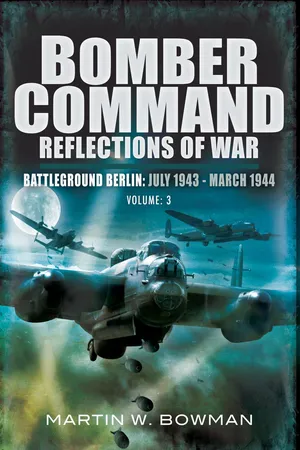
Bomber Command: Reflections of War, Volume 3
Battleground Berlin, July 1943–March 1944
- 256 pages
- English
- ePUB (mobile friendly)
- Available on iOS & Android
eBook - ePub
Bomber Command: Reflections of War, Volume 3
Battleground Berlin, July 1943–March 1944
About this book
This massive work provides a comprehensive insight to the experiences of Bomber Commands pilots and aircrew throughout World War Two. From the early wartime years when the RAFs first attempts to avenge Germanys onslaught were bedeviled by poor navigation and inaccurate bombing, to the final winning onslaught that finally tamed Hitler in his Berlin lair, these volumes trace the true experiences of the men who flew the bombers. Hundreds of first-hand accounts are punctuated by the authors background information that put each narrative into wartime perspective. Every aspect of Bomber Commands operational duties are covered; day and night bombing, precision low-level strikes, mass raids and operations throughout all wartime theaters. Contributions are from RAF personnel who flew the commands different aircraft from the early Blenheims and Stirlings to the later Lancasters and Mosquitoes. Each volume is full of accounts that tell of the camaraderie amongst the crews, moments of sheer terror and the stoic humor that provided the critical bond. The five volumes of this work provide the most vivid and comprehensive work on the outstanding part played by RAF Bomber Command in their vital role in the destruction of the Third Reich.
Information
CHAPTER 1
The Way to the Stars
It was some time before we realised the importance of Peenemünde. It was engaged in the development of the V-1 and V-2 rockets. At least, on the night of 17 August 1943, we must have delayed their programme somewhat and ensured that London did not receive as many of them as Hitler would have liked. As an afterthought to the raid, I suppose it was useful to the US space programme that we missed Werner von Braun.
Pilot Officer (later AVM) D J Furner CBE DFC AFC
In Jack Furner’s log book his total number of Stirling flights on 214 Squadron is 120, of which 25 were operational. Jack Dixon and his crew and John Verrall’s were the only two crews to survive the whole period March to September of 1943.1 In between Furner’s first op on 4/5 April 1943 and the final one, the last on Berlin on 31 August, came most of the targets in the Ruhr, some repeatedly – names like Duisburg, Dortmund, Düsseldorf and Wuppertal; and Hamburg (several); Turin; Krefeld; Mülheim and Nurnberg. There were also mining sorties in the Baltic, off the Friesians and in the mouth of the Gironde River. If pressed to describe specific raids, Furner’s highlights would be: Wuppertal on a brilliant night seemingly going up in one awful pillar of smoke (‘come and look at this, nav!’); all the other Ruhr towns confused in one’s mind; the chaos below of Hamburg’s ‘firestorm’ and the extraordinary beauty of the Alps in moonlight en route to Turin on 12 August. But the one that stands out above all others would be Peenemünde ‘and for a number of reasons’ as will be seen.
It is well nigh impossible to describe in detail each one of the nightly battles – and battles they were. It happens inevitably that so many things are blurred, except for a few really dramatic moments. I can more easily picture in my mind and try to describe in writing, a typical – or average – operation, rather than any one specific instance.
The average or typical begins with the briefing. Navigators always had a lot more preparatory work to do than other crewmembers and would have to assemble for their detailed planning of log and chart a good hour before the remainder of the crew came in. By the time complete crews were sitting to hear target details, outline of route markings, weather, defences, bomb load, fuel, signals, encouragement from Commanders and any visiting brass, the navigators would have log flight plan and chart ready. Always at the specific request of my Skipper I would have the fighter-belt pencilled in: he would wish to corkscrew all the way through it, regardless of whether there had been any sightings. Assemble all kit – parachute, Mae West (what fame!), sextant and navigation bag with log, charts, maps, star data, protractor, Dalton ‘computer’(!) – simply a graphic representation of the triangle of velocities – dividers, parallel rule. Out to the aircraft at dispersal a good hour before take-off. Run engines. Thorough checks all round each member. I check all navigation equipment – compasses, Gee, H2S, air position indicator, astrograph (a star map), sextant. Shut down. Last smoke and symbolic pee on the tail wheel. Back into that storeys’-high cabin of the Stirling. Smells of petrol and oil and hot metals. Engines – pilot and bomb aimer go meticulously through take off checks. Line up – await green Aldis. Go. Down the runway, all four engines roaring and spitting flame, rotate. Climb at planned rate, with flight plan indicated airspeed and on planned course adjusted for magnetic variation and compass deviation.
Cross UK coast at planned exit point and at planned height. Change course. Continue climbing across North Sea. Test guns. Passing through 10,000 feet, oxygen masks on. Keep continuous log on pro forma, monitor airspeed and course, get fixes on Gee, check wind. Announce enemy coast ahead. Get fix from bomb aimer crossing coast if cloud and visibility allow, check wind. Prepare Skipper for fighter belt: corkscrew: accept that accurate recording of navigational path is now more difficult, as well as stomach more queasy. Other crewmembers report searchlights ahead or off route, or flak, or fighter activity, or ours going down. If somebody were to have switched daylight on at this stage, Heaven knows what we would have seen! Better this individual navigation, though, than the American way all in enforced formation. Too soon the Gee goes – jammed by Jerry. H2S remains but very difficult to decipher inland whilst corkscrewing. Trust to Dead Reckoning and Path Finder markers at points along the route and at the target. Change course as demanded by flight plan. Reckon to be two minutes early over target? Make a triangle – 60° left for two minutes, 120° right for two minutes, resume track. (The rest of the crew hated that – understandably.) Fighter! – call from rear gunner – much more violent evasive action to throw him off. Target approaches, markers, fires if visible; well lit cloud with markers above if not. Pilot responds to Bomb aimer: left – left or right or steady – interminable steady – come on, come on! – Bombs gone. Course home. Caught in searchlight – brilliantly lit up, we’re vulnerable, frightening – violent manoeuvres – hold breath until darkness again. John’s got us out of it. Try to assess average airspeed and course during manoeuvres. Lots of flak but we’re lucky, not a hit. Same thing all the way out back to the coast – only even more vigilant, fighters more evident. Comparative calm of North Sea, course for home base, descending, oxygen mask off, dirty mark around face, familiar red pundit light flashing, turn to land, breathe wonderful East Anglian summer air – ‘Another one tucked away, skip’ shouts the rear gunner. Cigarette, debrief, meal, try to sleep, the sun comes up.
The new recruits to the Squadron were able at briefings to judge the difficulties to be faced by the reaction of the more experienced crews. The groans would be loudest in the briefing room for those demanding a long and deep track over occupied territory – e.g. Berlin and Nurnberg. The next worse would be all the Ruhr targets – much shallower penetration but fiendishly defended. And I suppose the lightest reaction would be for a peripheral target, like Kiel (our first) and Hamburg. This all makes sense when you consider that the chance of survival is least with a long defended track. (I’m not counting the low-level mining trips to the Baltic and the Gironde estuary – but they often had some pretty tracer stuff defending them and there were losses even from those sorties.)
In between operations there would be a lot of local flying – air tests, circuits and bumps, practice bombing, simulated sorties, fighter affiliation, familiarization with new aids and so on. The most significant was H2S airborne radar with a rotating parabolic dish inside a bulge under the fuselage, which interpreted the ground beneath on a cathode ray tube at the navigator’s station, differentiating between dark (no response) for sea, some bright response for land and brighter response still for built up areas. It was a marvel to see but it was crude and because it was transmitting, it drew attention to itself. This airborne radar came onto the Squadron at the beginning of July and Furner was chosen to train other navigators on it.
Summer 1943 was hectic. There were frequent losses: faces would come and go only too quickly but there was little point in dwelling on that. We young men wouldn’t wonder until we were some years older what the resulting sad administration was doing to our kindly ‘uncle’, the Squadron Adjutant George Wright. It was he who would be charged with informing relatives, dealing with personal effects and clearing rooms ready for later arrivals.
But life was not all flying and operations. Crews were granted a week’s leave every six weeks, which Furner believes was unique amongst all the Services. ‘Harris insisted on it.’ While on operations crews took advantage of the Nuffield Leave Scheme. The Foundation paid for accommodation at many hotels in England. On base in the Mess on evenings without flying, an extremely casual and happy-go-lucky atmosphere pervaded, particularly since Chedburgh was a temporary, wartime only station with semi-circular corrugated iron Nissen huts for all offices and accommodation.
There were favourite pubs in Bury St. Edmunds, to which one or other of our broken-down jalopies would carry us; one of the pubs looked exactly like the studio version in The Way to the Stars.
On 8/9 July it was Cologne again. At Syerston 1st Lieutenant Gene Rosner’s crew were on the Battle Order for their 19th operation and they were told that they would be taking R-Robert and a ‘second dickey’. The met forecast was that there would be cumulonimbus clouds up to 20,000 feet over the target. Their trip over the North Sea was uneventful and sure enough, over the Belgian coast they were over the clouds as forecast. Six Mosquitoes on 109 Squadron accurately marked with Oboe sky-marking and another successful raid followed. Warrant Officer Fred Smooker, Rosner’s bomb aimer recalls:
The white flare was dropped at some point north of Cologne where we turned south of the target. Then things began to happen. Searchlights turned the clouds into a dazzling white sea of snow. We began to see that we were not alone on our journey of destruction; in front and to either side could be seen the black silhouettes of our accompanying Lancasters, from whom no help was possible in the event of a disaster. The sea of dazzling white was now beginning to be splashed with jagged cherry-red flashes which disintegrated into red-hot coals. The green flare appeared directly ahead. We were right on track and so was the flak. The jagged flashes were now all around us and I could feel my inside begin its usual churning and my flesh and skin began to tighten, whilst all my instincts told me to cringe and curl up into a ball. The red flare appeared ahead; the pilot told me our airspeed and altitude over the intercom, while I busied myself setting the special adjustments to the bombsight. By now we had ceased our continuous climbing and diving, weaving to port and starboard and were flying straight and level over a white shiny carpet mottled with an angry red glow. One felt that one could get out and walk on it.
Over 280 Lancasters of 1 and 5 Groups devastated the north western and south western sections of the city and a further 48,000 people were bombed out, making a total of 350,000 people losing their homes during the series of three raids in a week. Twenty-four II./NJG1 crews manned the Himmelbett boxes in eastern Belgium and despite being hampered by thick layers of cloud destroyed three Lancasters and claimed another seven Feindberührungen (‘encounters with the enemy’). Seven Lancasters were lost, worst hit being 106 Squadron at Syerston, which accounted for three of the missing aircraft. Fred Smooker got R-Robert’s five tons of HE bombs and incendiaries away and they left the holocaust behind as they headed south. They turned onto a westerly heading and were at 22,000 feet when the starboard outer began heating up. Near Cambrai (Nord) at about 03.30 a fighter attacked and set their starboard inner on fire. On intercom Rosner said ‘Hey you guys, we gotta bail out. Somebody get me my parachute. Bail out, bail out, bail out ...’ The two screaming port engines suddenly stopped dead and the aircraft went down. Only Fred Smooker got out. Rosner and the six others died in the aircraft. They were laid to rest on 11 July. Smooker was not caught by the Germans until after mid-September and did not arrive in PoW camp until about 15 November. For 56 days he was held in solitary confinement in a Paris prison.2
R5573, better known as Admiral-Foo-Banc V and flown by 20-year-old Sergeant Kenneth Hector ‘Wally’ McLean RCAF was shot down by a night fighter NNE of Liége. Because the Squadron often dropped sea mines on Gardening operations and at the time naval officers were attached to the unit, several of the aircraft displayed Admiral-prefixed characters. McLean, from Vulcan, Alberta was on his first trip with his crew, who all died on the Lancaster, one of several specially fitted with bulged bomb doors for the carriage of 8,000lb bombs. Funerals were held on 10 July. The third Lancaster on the squadron that was lost crashed on fenland near Wisbech in Cambridgeshire with the loss of five of the seven-man crew.
It was on 9/10 July that the next Main Force raid was directed to Gelsenkirchen. Thirteen ‘Musical Mosquitoes’ again marked with Oboe sky-marking but the equipment failed to operate in five of the Mosquitoes. A sixth Mosquito dropped sky-markers in error ten miles north of the target and the raid was not successful. Seven Halifaxes and five Lancasters went missing from a force of 418 aircraft.
Even at 5,000 feet in the spruce forests and meadows on the slopes of the Rhône River valley in the Swiss Alps, 12 July was a very warm day. It was the summer holiday season and many families with children like 14-year-old Frédéric Haldimann were enjoying the stimulating mountain air in villages perched in the valleys running south along the Rhône. Sion, the capital of the canton of Valais with its population of about 10,000 and the adjoining airfield occasionally used by the Swiss Air Force lay amongst the vineyards shimmering in the July heat. On more than one occasion during that spring and summer, the deep quiet of the nights had reverberated from the deep and regular drone of aircraft engines, a constant reminder of Switzerland’s close proximity to Germany and Italy. Dusk that evening brought the usual marked drop in temperature as the western horizon was invaded by menacing clouds. The air was sultry and it was more difficult than usual to marshal into bed the children in the Haldimann’s small summer house, but finally the candle had been snuffed and a deep quiet had once again descended on the mountains. A few hours later Frédéric was awakened by the distant rumbling of an approaching storm. Gradually the humming drone of hundreds of aircraft engines could be heard in between the thunder. After a short sojourn in Main Force operations, 295 Lancasters of 1, 5 and 8 Groups were heading for Turin again. Their outward route was directly across occupied France to a turning point marked by PFF over Lake Annecy south-west of Geneva in France and from there on an easterly heading across the French/Italian Alps to the target in the Po Valley. Adverse conditions forced 16 Lancasters to abort the operation rather than trying to climb over the Alps. The rest continued on, but at Lancaster operating altitudes, the upper winds had shifted from northwesterly tailwinds to south-west and picked up speed, so a number of aircraft drifted over Switzerland across the Jura Mountains towards the foothills of the Swiss Alps and into more developing thunderstorms. Suddenly, the night was rent by a flash of intense light followed by a sound, which seemed sharper than the previous thunderclaps. With eyes wide open but heavy with sleep, ...
Table of contents
- Cover
- Title Page
- Copyright
- Contents
- Acknowledgements
- Chapter 1 The Way to the Stars
- Chapter 2 The Road to Berlin
- Chapter 3 Silver Wings in the Moonlight
- Chapter 4 An Orchestrated Hell
Trusted by 375,005 students
Access to over 1.5 million titles for a fair monthly price.
Study more efficiently using our study tools.
Frequently asked questions
Yes, you can cancel anytime from the Subscription tab in your account settings on the Perlego website. Your subscription will stay active until the end of your current billing period. Learn how to cancel your subscription
No, books cannot be downloaded as external files, such as PDFs, for use outside of Perlego. However, you can download books within the Perlego app for offline reading on mobile or tablet. Learn how to download books offline
Perlego offers two plans: Essential and Complete
- Essential is ideal for learners and professionals who enjoy exploring a wide range of subjects. Access the Essential Library with 800,000+ trusted titles and best-sellers across business, personal growth, and the humanities. Includes unlimited reading time and Standard Read Aloud voice.
- Complete: Perfect for advanced learners and researchers needing full, unrestricted access. Unlock 1.5M+ books across hundreds of subjects, including academic and specialized titles. The Complete Plan also includes advanced features like Premium Read Aloud and Research Assistant.
We are an online textbook subscription service, where you can get access to an entire online library for less than the price of a single book per month. With over 1.5 million books across 990+ topics, we’ve got you covered! Learn about our mission
Look out for the read-aloud symbol on your next book to see if you can listen to it. The read-aloud tool reads text aloud for you, highlighting the text as it is being read. You can pause it, speed it up and slow it down. Learn more about Read Aloud
Yes! You can use the Perlego app on both iOS and Android devices to read anytime, anywhere — even offline. Perfect for commutes or when you’re on the go.
Please note we cannot support devices running on iOS 13 and Android 7 or earlier. Learn more about using the app
Please note we cannot support devices running on iOS 13 and Android 7 or earlier. Learn more about using the app
Yes, you can access Bomber Command: Reflections of War, Volume 3 by Martin W. Bowman in PDF and/or ePUB format, as well as other popular books in History & Military & Maritime History. We have over 1.5 million books available in our catalogue for you to explore.