- 256 pages
- English
- ePUB (mobile friendly)
- Available on iOS & Android
eBook - ePub
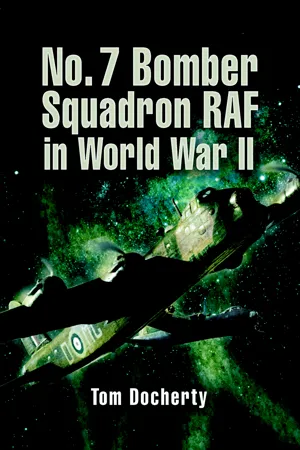
No. 7 Bomber Squadron RAF in World War II
About this book
This is the story of one of the RAF's oldest and most distinguished heavy bomber squadrons in WW2, although an outline history of the unit since it was formed in WW1 and its post-war history are included. It was the first operational Stirling Squadron, the RAF's first four engine heavy bomber, and flew the first long-distance raids into the heart of Nazi Germany. This new aircraft was a break-through in terms of range and bomb load but it was also an aircraft that suffered from many teething problems. Long-distance navigation was also a black art before the introduction of radio navigation systems and the squadron suffered many fatalities in those early wartime years. Having gained expertise in their task the unit was the first to be equipped with the H2S navigational aid and eventually became one of the original elite Pathfinder squadrons. When the Lancaster came into service the Squadron re-equipped and joined 8 Group and had the dubious reputation of suffering the third greatest loss of aircraft in Bomber Command. It did however participate in more Lancaster raids than any other 8 Group squadron.
Information
CHAPTER ONE
TRAINING AND RE-EQUIPMENT SEPTEMBER 1939 – DECEMBER 1940
No. 7 Sqn went to war under the command of W/Cdr L.G. Nixon and comprised 251 officers and men equipped with eight Hampdens and eight Ansons. It was tasked with the training, to operational standard, of crews for No. 5 Group squadrons. Doncaster was not an easy airfield to fly from. It was small, it had limited night-flying facilities and the shortage of accommodation for the squadron personnel was acute. Spares for both the Hampden and Anson were also difficult to obtain. Whilst there the squadron had its first wartime loss when P/O Playfair, flying alone, crashed Hampden L4161 at Cockwood Farm, near Cantley on 5 September. On 8 September S/Ldr N.B. Norris, commanding B Flt was replaced by S/Ldr M.H. Kelly. The following day the first five observers were posted in for training.
Ray Curdy went to Doncaster with the squadron.
We moved to Doncaster airport – part of the Bomber Command dispersal programme. Nothing much happened there but I recall rumours were rife about a move to France and the undersides of the aircraft were to be painted ‘duck egg blue’ for daylight ops. The odd squadron chaps, fitters and riggers, did get marching orders, but the aircraft and crews remained at Doncaster.
Ted Brightmore was among those who moved to Doncaster and he was thrown into a period of uncertainty and chaos.
Then came war, Sunday 3 September 1939. The station tannoy ordered everyone to listen to the PM’s broadcast at 11.00 a.m. Consciously we had all been expecting it for months, but subconsciously most of us thought something might happen and all would be well. However, here it was, we were at war and it took time to sink in. Then started the flap! That very afternoon the whole Squadron was transported to Doncaster Airport, our ‘scatter’ station. There were two squadrons at Finningley, No. 7 and the other, No. 76. Doncaster was not prepared to receive us. The civil airlines had barely moved out. My section was given a workshop in what had been the KLM hangar. They had left in a hurry, leaving all sorts of things behind; including a bundle of clean, white overalls with KLM emblazoned on the back. These were, of course, donned by those who found them.
Doncaster accommodation was non-existent. There were some unfinished huts, intended as offices, which we occupied. Some bedding was brought from Finningley and I made do with a door on two trestles with ‘biscuit’ mattresses and some blankets. Around midnight the air-raid sirens wailed. We tumbled out of bed thinking, ‘This is it.’ Having dug slit trenches that afternoon, we now stood by them, shivering with cold and possibly fright! The trenches had water lying on the bottom. The prospect of leaping in and lying flat was only slightly less chilling than that of being blown to pieces! But nothing happened. ‘All ‘clear’ allowed us back to bed.
We stayed almost two weeks at Doncaster Airport. A couple of times we were on standby, once as far as donning flying kit. This readiness lasted almost an hour and we were walking around in flying kit festooned with gas mask, gas cape and tin hat. We were supposed to fly with all this stuff, although very soon they ruled out the gas cape and tin hat, but we still had to take the gas mask. Eventually we were stood down. The only flying that was done during those few days was some solo circuits and bumps. We lost another Hampden, however, engine cut and the usual flat spin. P/O Playfair was killed.
The difficulties of operating at Doncaster forced a move to Finningley on 15 September, but the squadron was not to remain there long. A week later it was transferred to No. 6 Group (at that time a training group and not, as later in the war, a Royal Canadian Air Force (RCAF) group) and moved to Upper Heyford in Oxfordshire, an air party moving in on the 21st. The rest of the squadron moved by road and rail.
During September the squadron flew 332 hours despite only having an average serviceability of three Hampdens and four Ansons. It would remain here in the training role until 4 April 1940 when it combined with No. 76 Sqn to form No. 16 Operational Training Unit (OTU). On 1 October it was reorganized into a flying flight under S/Ldr Kelly and a maintenance flight, commanded by S/Ldr A.W. Sawyer, the Chief Ground Instructor. WO J.B. McGinn was the NCO in charge of Maintenance Flight. On 2 November three aircraft were detached to Squires Gate to work with the Towing Flight at this station until the 6th.
On 25 October the squadron had its first accident at Upper Heyford, when Hampden L4170 had its port wheel fold up whilst night flying. The pilot, P/O E.J. Hewitt, was uninjured but the aircraft had to have the port wing and propeller changed. The first loss at Upper Heyford was on 6 November 1939 when P/O A.C. Manaton hit a tree on the approach on a training sortie. He escaped unhurt. Just over two weeks later, on 24 November, P/O C.D.P. Price escaped uninjured after an accident in Hampden L4158. He had selected the port undercarriage up accidentally. On 28 November W/Cdr Nixon was posted to No. 52 Sqn and his place was taken by W/Cdr A.E. Paish.
Ray Curdy was involved in the move to Upper Heyford.
We all moved to Upper Heyford, still awaiting battle orders. The term OTU was being bandied about, but whether the squadron was officially disbanded as such, I don’t know. I was a lowly airman at the time and the CO, quite rightly, kept such information to the higher ranks.
Ray left his post as a squadron armourer at Upper Heyford to train as an air gunner and completed a tour of operations on Wellingtons with No. 148 Sqn before going on to become Gunnery Leader with 467 and 44 Squadrons.
On 13 December S/Ldr Kelly and his crew had a lucky escape when landing in Anson N5013. It touched down on a ridge on the airfield and the port tyre burst, causing a violent swing to port and the port undercarriage collapsed. The crew escaped uninjured. Four days later Sgt M.P. Murray had to make a forced landing at Barnstaple airport in Anson N5015. Approaching to land the port wheel struck a tree stump on the airfield boundary and the aircraft came to rest, with the crew uninjured, on its port wing.
New Year’s Day 1940 saw the squadron lose another Hampden. P/O Horace M. McGregor flew into Snaefell on the Isle of Man. The pilot and two of his crew, Sgt Thomas Dennis and Sgt R.J. Bailey, were killed. The only survivor, who was badly injured, was Cpl P. ‘Ted’ Brightmore. He recalls his miraculous escape: ‘I remember a terrific thump and tearing sound, being drenched in petrol and rolling down a slope and into some snow, which must have put out my personal fire and saved my life.’ He made his way down the mountain after the crash. Mrs Jessie Cottier walked 2 miles in the snow to raise the alarm. Harry Jacobson, an airman at nearby RAF Jurby, recalls his involvement in the search for the crashed aircraft.
It all came about on New Year’s Day, 1940. I was at RAF Jurby, No. 5 BGS [Bombing and Gunnery School], as a flight mechanic on short-nosed Blenheims. Our airfield was shut down on account of snow. It was so bad there was no flying. A 7 Sqn Hampden, P1260, was flying out of Upper Heyford on a navigational exercise. The pilot was Horace McGregor; Sgt Thomas Dennis was navigator and Sgt Robert Bailey a trainee navigator. They left about ten o’clock that morning on a training exercise for the trainee navigator. The crash occurred at around 11.30 a.m.
We were all in the mess at midday and a corporal came rushing in and said, ‘All out, as you are.’ We only had overalls on. We all baled out into the 3 and 5 ton RAF trucks and made our way up to where the TT course road crosses the railway track. They split us into groups of five and gave us instruction to walk in a straight line, in the snow on the mountainside, for one hour. No matter where we were in one hour we were to turn round and come back. With the mist up there you could get lost. We did not know what we were looking for, nobody knew.
After two hours we finished up back at the trucks. We were stood about; lads were smoking, waiting for the rest to return. We had a small floodlight on the truck lighting up the mountain. As we were about to leave for base a woman came down the railway track and said she thought there was smoke on top of Snaefell. She told us to stick to the railway as we went up, otherwise we would get lost. A group of us set off immediately up the railway track. When we got to the top we saw the burnt-out Hampden on top of the track.
The aircraft was completely burnt out and there were three bodies inside. What happened next made me very sick. The medical orderlies got the bodies out of the aircraft and in order to put them on the stretchers they stood on them, to straighten them out. They were all burnt to a crisp. It was my first experience of burnt bodies and being only eighteen it was a shock.
We returned to camp and three days later I caught pneumonia. I was the only one in a four-bed ward. A medical orderly told me I was soon to have company. This chap came in and I was sick again. It was Ted Brightmore, the surviving crew member. He had virtually no face, his arms were badly burnt and he was being treated with Vaseline about every three hours. Eventually we made friends. Archibald McIndoe spent three years rebuilding his face and he remained in the RAF.
During January the very poor weather had severely hampered the training programme and all of the high-level training exercises had to be cancelled. This forced an extension of the training courses from six to nine weeks in order to complete the syllabus. The training was also hampered by a lack of dual-control Hampdens for instrument training. Night-flying training was also restricted, but despite all the difficulties the squadron was still providing crews trained to pre-war standards.
Flying during February was severely restricted by bad weather and the squadron reported that the standard of the new pilots coming through for training was lower than their pre-war contemporaries. It sent a detachment to Newton on 4 March for air-firing and bombing training, but it was still being reported that standards were lowering and the latest intake had to have their flying hours increased in order to pass the course. On 29 March 1940 P/O J.E. Newton-Clare suffered an engine failure on a training sortie, but he managed to force land the Hampden at Brackley airfield, he and his crew escaping unhurt.
It seemed as though No. 7 Sqn would take no part in the war but it was informed on 4 April that it would re-form as an operational squadron at Finningley. The original squadron was to combine with No. 76 Sqn to become No. 16 OTU on 22 April. In the event it re-formed at Leeming, Yorkshire, on 7 August 1940, equipped with the first of the new four-engined heavy bombers, the Short Stirling. The Stirling was a great leap forward in capability compared to the Hampdens, Whitleys and Wellingtons then in service, but it did suffer from a limitation which would cost the squadron dear in the years to come. Due to a requirement for the aircraft to fit into the standard RAF hangars the wingspan was limited to 100 feet, a limitation which resulted in an aircraft which had a severely limited operational ceiling. The benefit of the short wing was that it endowed the Stirling with excellent manoeuvrability.
With the advent of the Stirling the squadron adopted the code letters MG. The first person to arrive at Leeming on 1 August was P/O Roberts, as squadron adjutant. He was followed two days later by the CO, W/Cdr P.I. Harris DFC. The initial complement of aircraft was to be one flight of eight Stirlings, but this was increased to two flights of eight on 5 August. G/Capt R.W. Cox DSO DFC AFC (Retd) recalls the first Stirlings supplied to the squadron.
During the first part of the war I was posted from the Bomber Performance Testing Squadron at A&AEE [Aeroplane & Armament Experimental Establishment] Boscombe Down and I tested the first Stirling at Oakington. We firstly formed a development flight and then re-formed the squadron in 3 Group. I remember taking a Stirling to RAF Northolt for an inspection by the Prime Minister. After our introduction Churchill said, ‘I know a lot about this bitch, but she has to fly.’ – It did.
The early days of Stirling operation were to highlight both the improvements over the previous bomber types, but also some of the deficiencies that would plague the aircraft throughout its service. Crew member Roy Jackson recalls the first Stirlings operated by the squadron.
The squadron was re-formed at Leeming and I joined it as part of that process. We had two crews and one aeroplane. My pilot was F/Lt Bradley; the observer was Sgt Griffin. We had finished an operational tour on Whitleys, we had just bombed Turin and Milan and my last Whitley operation was a pretty useless raid on Berlin. As WOp/AG [wireless operator/air gunner] I had the same R1082/ T1083 and TR9 radios as on the Whitley. The engines were radial, whereas we had come to revere our Merlins. However, the big sleeve valves were a long cry from the dreadful Armstrong Siddeley Tigers we had known, the horrible 14-cylinder, 845 horsepower that scorched its ignition harness while idling and blew pots off at the most inconvenient times!
The Stirling seemed to me to be a cross between a flying boat and an erection of scaffolding, but it flew beautifully and very fast. There were no dorsal turrets, but the Blenheims sent to affiliate with us just could not catch us in level flight. Handling was good in the air but on the ground it was ridiculous. With the three-stage undercarriage and the centre of gravity way above the ground the aircraft swung horribly on take-off. We developed a technique that got some 80 miles per hour airspeed before the outer starboard engine was opened up. Landing tail down was the drill, but that gave us a fantastic angle of attack and one always feared that the trelliswork separating us from the wheels would bend! The aircraft was a mass of electrically operated bits; gill motors were a nuisance, I remember. However, the Frazer Nash turrets were to be fitted and this I approved of. The development programme was bedevilled by problems of ancillary failure and a huge modification programme.
With the arrival of the Stirling a new breed of aviator entered service with the RAF – the flight engineer. Essentially a ‘pilot’s mate’ he was responsible for engine handling, fuel-flow maintenance and a host of other engineering responsibilities, thus releasing the second pilot to fill the seat in another bomber. John Prentice was one of the first flight engineers to be trained and arrived at Leeming in August 1940.
After returning from the debacle in Norway and now an LAC, I was posted in August 1940 to Leeming Bar, in Yorkshire, to join No. 7 Squadron, just then re-equipping with Stirlings. Like many ex-Brats [Halton apprentices] I hankered after pilot training, but things were not looking too promising in that direction, so very shortly after joining 7 Squadron when the call came for volunteers from fitters II for aircrew duties I volunteered. We were to be known as fitter II air gunners, soon to be changed to flight engineer. Two other volunteers and I were sent on a course at the Austin factory at Longbridge and on returning to Leeming Bar we were given gunnery instruction, followed by gunnery practice in the air at Stradishall.
The Isle of Man was an unlucky place for the squadron. Having lost a Hampden there in January 1940 they were to lose another aircraft when Stirling Mk I, N3640, flown by F/O T.P.A. Bradley DFC, was hit by anti-aircraft fire over the island on 29 September. The aircraft was crash-landed at Hodge Branding, near Kirkby Lonsdale. Roy Jackson was a member of this crew.
We were at about 10,000 feet and the anti-aircraft gunners thought we were a Focke Wulf Kurier. We fired the colours of the day but that didn’t help. I think they damaged the two port engines and we made for base losing height. We were unable to make it and on landing hit a wall and the aircraft was wrecked. Luckily the crew escaped serious injury. We came down wheels up and killed some livestock. The farmer was peeved because he did not get the right price for them – they had not been slaughtered under the prescribed conditions and by approved methods! That was the end of my time with the squadron, very short, not very productive. I never liked the machine, although I admired the engines and the wing looked right, but it was never meant to be anywhere near the ground that aeroplane!
This was the first Stirling to be written off in Bomber Command service.
The squadron moved to Oakington on 29 October and came under the control of No. 3 Group. Six officers and 142 airmen arrived with two Stirlings. The remainder of the Stirlings arrived the following day and on the last day of the month all of the airmen were medically examined. By 1 November the remainder of the squadron had arrived from Leeming. Another accident occurred on 28 November when Stirling N3638 had to make a forced landing near Edinburgh with engine trouble. P/O R.W. Cox managed to land the aircraft, undamaged, on the small Turnhouse airfield.
Teething troubles with the new Stirlings severely hampered the tr...
Table of contents
- Title Page
- Copyright Page
- Table of Contents
- PREFACE
- INTRODUCTION
- CHAPTER ONE - TRAINING AND RE-EQUIPMENT SEPTEMBER 1939 – DECEMBER 1940
- CHAPTER TWO - JANUARY – DECEMBER 1941
- CHAPTER THREE - JANUARY – DECEMBER 1942
- CHAPTER FOUR - JANUARY – DECEMBER 1943
- CHAPTER FIVE - JANUARY – DECEMBER 1944
- CHAPTER SIX - JANUARY – SEPTEMBER 1945
- CHAPTER SEVEN - THE SQUADRON POST-WAR
- APPENDIX I - AIRCRAFT OPERATED BY NO. 7 SQUADRON
- APPENDIX II - THE OPERATIONAL RECORD
- APPENDIX III - COMMANDING OFFICERS 1939 – 45
- APPENDIX IV - SQUADRON BASES 1939 – 45
- APPENDIX V - NAMELESS CREWS
- GLOSSARY AND ABBREVIATIONS
- BIBLIOGRAPHY
- ACKNOWLEDGEMENTS
- INDEX
Trusted by 375,005 students
Access to over 1.5 million titles for a fair monthly price.
Study more efficiently using our study tools.
Frequently asked questions
Yes, you can cancel anytime from the Subscription tab in your account settings on the Perlego website. Your subscription will stay active until the end of your current billing period. Learn how to cancel your subscription
No, books cannot be downloaded as external files, such as PDFs, for use outside of Perlego. However, you can download books within the Perlego app for offline reading on mobile or tablet. Learn how to download books offline
We are an online textbook subscription service, where you can get access to an entire online library for less than the price of a single book per month. With over 1.5 million books across 990+ topics, we’ve got you covered! Learn about our mission
Look out for the read-aloud symbol on your next book to see if you can listen to it. The read-aloud tool reads text aloud for you, highlighting the text as it is being read. You can pause it, speed it up and slow it down. Learn more about Read Aloud
Yes! You can use the Perlego app on both iOS and Android devices to read anytime, anywhere — even offline. Perfect for commutes or when you’re on the go.
Please note we cannot support devices running on iOS 13 and Android 7 or earlier. Learn more about using the app
Please note we cannot support devices running on iOS 13 and Android 7 or earlier. Learn more about using the app
Yes, you can access No. 7 Bomber Squadron RAF in World War II by Tom Docherty in PDF and/or ePUB format, as well as other popular books in History & Military & Maritime History. We have over 1.5 million books available in our catalogue for you to explore.