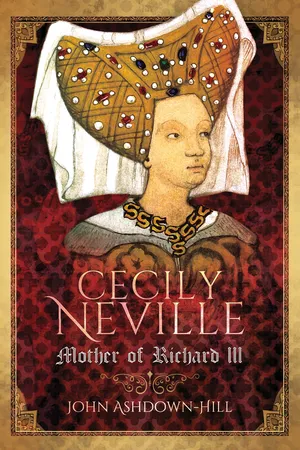
An intriguing new biography of the fifteenth-century Duchess of York and mother to two kings of England.
Wife to Richard, Duke of York, mother to Edward IV and Richard III, and aunt to the famous Kingmaker, Richard, Earl of Warwick, Cecily Neville was a key player on the political stage of fifteenth-century England.
She is rumored to have been known as the Rose of Raby because of her beauty and her birth at Raby Castle, and as Proud Cis because of her vanity and fiery temper, But Cecily's personality and temperament have actually been highly speculated upon. In fact, much of her life is shrouded in mystery. Aside from Cecily's role as mother and wife, who was she really?
Matriarch of the York dynasty, she navigated through a tumultuous period and lived to see the birth of the future Henry VIII. From seeing the house of York defeat their Lancastrian cousins; to witnessing the defeat of her own son, Richard III, at the battle of Bosworth, Cecily then saw one of her granddaughters become Henry VII's queen consort. Her story is full of controversy, and the few published books on her life are full of guesswork. In this highly original history, Dr. John Ashdown-Hill—renowned for his role in locating the long-lost remains of Richard III in 2012—seeks to dispel the myths surrounding Cecily using previously unexamined contemporary sources.
Includes illustrations
- 312 pages
- English
- ePUB (mobile friendly)
- Available on iOS & Android
eBook - ePub
About this book
Information
Chapter 1
Cecily’s Family Background
Cecily Neville is generally said to have been born on 3 May 1415 at Raby Castle. For example, one recent account states that:
Cecily Neville was born on 3 May 1415. … As she lay in her cradle at Raby Castle that summer, alternatively rocked and suckled by her nursemaids, a fleet of wooden ships filled with soldiers crossed the Channel and landed on the coast of Normandy.[1]
However, the author cites no source, either for the alleged date or for the alleged location.
Even the most serious modern published accounts of Cecily’s life generally fail to offer any contemporary source for her alleged birth date. For example, in his portrayal of her, written for the ODNB, Christopher Harper-Bill certainly assumes that Cecily was born on 3 May 1415, but he cites no source for that claim.[2]
The only source I have been able to find for the date in question is the version of William Worcester’s Annales published by Stevenson. This reads :
1415. … Hoc anno nata est Caecilia, uxor Ricardi, ducis Eboraci, filia comitis Westmerlandiae, iij die Maii.[3]
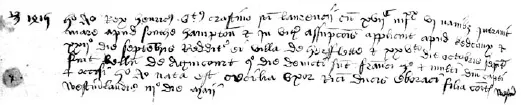
William Worcester’s record of the birth of Cecily Neville. The final sentence of the record for 1415 dates Cecily’s birth as 3 May. College of Arms Arundel MS 48, f. 124v. Reproduced by permission of the Kings, Heralds and Pursuivants of Arms.
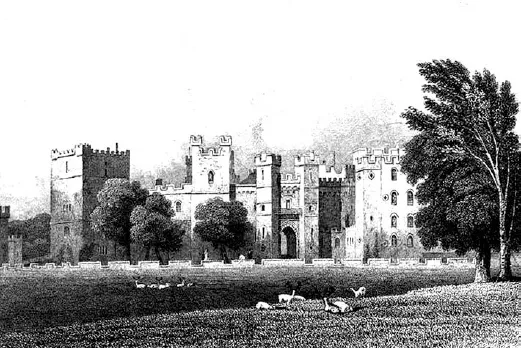
Raby Castle, Durham.
Unfortunately, as will emerge in Chapter 3, this particular version of Worcester’s Annales can be shown to contain apparent errors in respect of some of its later asserted dates – and places – relating to the births of Cecily’s children. It must therefore remain questionable whether its alleged birthdate of Cecily herself is correct, given that no other surviving fifteenth-century evidence has been found.
Fortunately, in spite of accepting her suggested birth date of 3 May 1415, Harper-Bill did not assert in his ODNB account that Cecily had been born at Raby Castle.[4] Presumably, therefore, he was aware of the fact that the story in question was concocted in the late eighteenth century. At that time the nickname ‘Rose of Raby’ was apparently invented for Cecily by the historical novelist, Agnes Musgrave – just as the label ‘Wars of the Roses’ was apparently invented by Sir Walter Scott thirty-four years later, in 1829.[5]
Musgrave employed the phrase ‘Rose of Raby’ as a subtitle for her four volume novel about the Duchess of York. However, her book consisted entirely of fantasy (see below: Appendix 4). In the novel she presented Cecily herself as asserting that ‘my infantine years were principally spent at the Castle of Brancepeth and Raby’.[6] It is entirely possible that the little girl did reside at each of those northern castles at certain points during her childhood. However, it is by no means certain that they were her only residences during her infancy. Nor is there any evidence available to prove that she was born at Raby Castle.
It is normally said that Cecily was the last of the twenty-two known children of Ralph Neville, first Earl of Westmorland. The statement that she was the youngest of Ralph’s offspring may well be correct. Cecily’s mother, Joan Beaufort, was the Earl’s second wife. Thus, eight of her father’s known children were only the little girl’s half-brothers and half–sisters. Apparently the relationship between Cecily’s mother, Joan, and her step-children may not always have been a good one. Ralph’s grandson (and his heir in terms of his title), Ralph Neville, second Earl of Westmorland, apparently believed that an earlier will drafted by his grandfather had favoured the children of his first marriage, because in his inheritance disputes with Joan Beaufort and her children ‘he sought unsuccessfully to have its contents made public’.[7] The situation was not an entirely unusual one. Later in the fifteenth century a similar situation occurred in the family of John Talbot, first Earl of Shrewsbury.[8] More recently something similar occurred three generations back in the maternal line of the present author! In addition, the eldest of Cecily’s half-siblings were some thirty years older than she was, so it is somewhat doubtful how well she would have known them (but see below, Chapter 9).
Her father was probably in his early fifties when Cecily was born. Subsequently he died a few months after what is claimed to have been her tenth birthday.
Through Ralph, Cecily was descended from the Anglo-Norman Neville, Percy, Clifford and Clare families. She was also descended from the Norman-Welsh / Anglo-Irish Fitzgerald family. Through the Fitzgeralds Cecily was of royal Welsh descent.
Ralph Neville held substantial inherited lands in Durham and North Yorkshire. He did not, however, inherit any major title. The earldom of Westmorland, which he acquired on 29 September 1397, was created for him by King Richard II, whose cause Ralph had supported against that king’s manipulative uncle, Thomas of Woodstock, Duke of Gloucester.
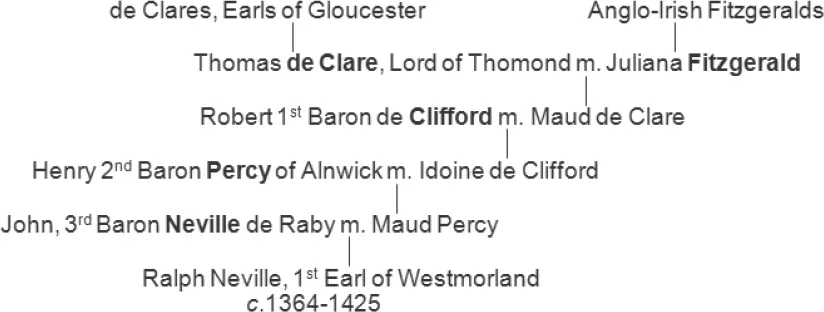
The Ancestry of Cecily’s Father
Ralph’s acquisition of his earldom occurred more than a year after the demise of his first wife, Lady Margaret Stafford. Margaret had died on 9 June 1396. She therefore never enjoyed the title of countess. However, her successor, Ralph’s second wife, had already been joined to her husband when he received his earldom. Thus he became the first Earl of Westmorland and she became the first Countess.
The second of Ralph’s two wives was some fifteen years younger than her husband. The precise date of Ralph’s second marriage is not on record, but it probably took place in the autumn of 1396. ‘It had taken place by 29 November, and was unlikely to have occurred before the bull of legitimation, which was issued on 1 September, had been received in England.’[9] When the couple married, Ralph was in his early thirties. His second wife was about half his age – in her mid teens.
As we have seen, the girl in question was Joan Beaufort. For Joan, as for Ralph Neville, their partnership constituted her second marriage. She had first been married at the age of twelve to Robert Ferrers, Baron Boteler of Wem. In spite of her young age, Joan had produced two daughters for Robert prior to his decease. Intriguingly, on his mother’s side, Robert Ferrers was the second cousin of Ralph Boleter, later Baron Sudeley. Thus, one curious result of her first husband’s Boteler family relationship, and of Joan Beaufort’s partnership with him, was that she thereby acquired quite a close connection by marriage with Eleanor Talbot, Lady Boteler , who later played a significant role in the lives of two of Joan’s royal grandsons (see below).
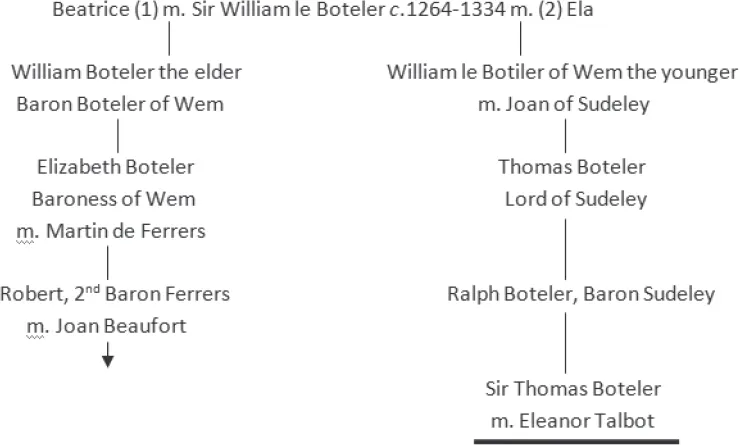
The Boteler Family (simplified)
Incidentally, Cecily Neville also had a connection with Eleanor’s father, John Talbot, first Earl of Shrewsbury, on her own father’s side. A younger brother of Ralph Neville, first Earl of Westmorland, was Thomas Neville, Baron Furnival. Maud Neville, Cecily’s first cousin, and Thomas’ daughter by his first wife, became the first wife of John Talbot – who was also her step-brother, because her father took as his second wife John’s mother, Ankarette Lestrange.

Cecily’s connection with John Talbot, later first Earl of Shrewsbury.
Joan Beaufort was the daughter of John of Gaunt, Duke of Lancaster, by his third wife, Catherine de Roët. However, her parents had not been married when Joan was born, so that technically she and her siblings, the Beauforts, were initially royal bastards. Indeed, it was only a few months prior to Joan’s own second marriage to Ralph Neville that her parents finally became a legally united couple.[10] A papal bull legitimising the couple’s children was then issued (see above). The marriage of her parents also led to Joan and her elder brothers being recognised as legitimate by their cousin, King Richard II.
Joan was of mixed European descent. On her mother’s side her family (probably both parents) came from the Low Countries. As for her father, his royal ancestors included the Norman and Angevin royal houses of England, the royal houses of France and of Castile, and the ruling family of Hainault – once again in the Low Countries.
In spite of the fact that he was raised to the earldom of Westmorland by King Richard II, Ralph Neville later abandoned that king. He had long been one of the retainers of Richard’s uncle, John of Gaunt, Duke of Lancaster. And of course his second marriage united him more closely to John of Gaunt, who thus became his father-in-law. As a result, in 1399 Ralph supported the rebellion of John of Gaunt’s son and heir, King Richard II’s cousin, the Lancastrian usurper, Henry, Earl of Derby (Henry IV). Henry was the much...
Table of contents
- Cover
- Title
- Copyright
- Contents
- Introduction Confronting the problems
- Chapter 1 Cecily’s Family Background
- Chapter 2 Cecily’s Childhood and Marriage
- Chapter 3 Cecily’s List of Children
- Chapter 4 Wife and Mother in France
- Chapter 5 Wife and Mother in Ireland
- Chapter 6 The End of Maternity
- Chapter 7 Through the Menopause, into Custody
- Chapter 8 The Blue Velvet Carriage to Bereavement
- Chapter 9 The First Reign of Edward IV
- Chapter 10 Cecily’s Sons in Conflict
- Chapter 11 The Blaybourne Bastardy Myth
- Chapter 12 The Second Reign of Edward IV
- Chapter 13 The Accession of Richard III
- Chapter 14 The Reign of Henry VII
- Chapter 15 Cecily’s Bequests, and what they Reveal
- Chapter 16 Cecily’s DNA and her Dental Record
- Appendix 1 Alphabetical List of the Manors granted by Edward IV to his mother in 1461
- Appendix 2 Members of the Entourage of Cecily Neville
- Appendix 3 The Fifteenth-century Abbots of Colchester
- Appendix 4 Lucy Fraser, ‘Synopsis of Cicely; or the Rose of Raby. An Historical Novel (1795)’
- Appendix 5 The allegiance of Cecily’s siblings in the 1450s and beyond
- Appendix 6 Where Cecily appears to have been living or staying on specific dates
- Acknowledgements
- Endnotes
- Bibliography
- Plate section
Trusted by 375,005 students
Access to over 1.5 million titles for a fair monthly price.
Study more efficiently using our study tools.
Frequently asked questions
Yes, you can cancel anytime from the Subscription tab in your account settings on the Perlego website. Your subscription will stay active until the end of your current billing period. Learn how to cancel your subscription
No, books cannot be downloaded as external files, such as PDFs, for use outside of Perlego. However, you can download books within the Perlego app for offline reading on mobile or tablet. Learn how to download books offline
Perlego offers two plans: Essential and Complete
- Essential is ideal for learners and professionals who enjoy exploring a wide range of subjects. Access the Essential Library with 800,000+ trusted titles and best-sellers across business, personal growth, and the humanities. Includes unlimited reading time and Standard Read Aloud voice.
- Complete: Perfect for advanced learners and researchers needing full, unrestricted access. Unlock 1.5M+ books across hundreds of subjects, including academic and specialized titles. The Complete Plan also includes advanced features like Premium Read Aloud and Research Assistant.
We are an online textbook subscription service, where you can get access to an entire online library for less than the price of a single book per month. With over 1.5 million books across 990+ topics, we’ve got you covered! Learn about our mission
Look out for the read-aloud symbol on your next book to see if you can listen to it. The read-aloud tool reads text aloud for you, highlighting the text as it is being read. You can pause it, speed it up and slow it down. Learn more about Read Aloud
Yes! You can use the Perlego app on both iOS and Android devices to read anytime, anywhere — even offline. Perfect for commutes or when you’re on the go.
Please note we cannot support devices running on iOS 13 and Android 7 or earlier. Learn more about using the app
Please note we cannot support devices running on iOS 13 and Android 7 or earlier. Learn more about using the app
Yes, you can access Cecily Neville by John Ashdown-Hill in PDF and/or ePUB format, as well as other popular books in History & Historical Biographies. We have over 1.5 million books available in our catalogue for you to explore.