- 128 pages
- English
- ePUB (mobile friendly)
- Available on iOS & Android
eBook - ePub
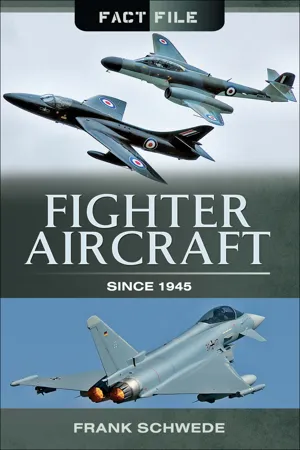
Fighter Aircraft Since, 1945
About this book
The world's first jet engines were already available shortly before the end of the Second World War, but they had not been developed to a high enough standard to take part. This changed after 1945 when, on both sides of the Iron Curtain, one technological development surpassed the others and records tumbled almost every week. The era of the piston engine was finally over and jet fighters now dominated the skies. By the mid-1950s their speed had already reached double that of the speed of sound; an achievement which a few years earlier, would have sounded to many like science fiction.
Information
United States Of America
Convair F-102 Delta Dagger and F-10 Delta Dart
The Delta fighter-family of F-102 and F-106 were begun at the Convair Works, San Diego, California. Convair Aircraft was founded on 17 March 1943 by means of one of the first large industrial mergers, the fusion of Consolidated and Vultee. It is noteworthy in this respect that the former production aims of both concerns could not have been more different. Consolidated concentrated in the main on building large aircraft, Vultee dive-bombers, but one thing they had in common was that neither in all their long histories had ever designed or built a fighter.
The merger would change that at a stroke. Two years after it took effect, and more or less coinciding with the end of the Second World War, Convair engineers came by chance into possession of captured documents and project studies of the Horten brothers who had been mainly involved in designing flying wings for the Third Reich. Convair was convinced that these plans would be the basis for the development of an interceptor-fighter with outstanding flying performance. In the same year the manufacturer presented the XF-92, a simple project study of the outward form only. It was a narrow tube with delta wings and tailplane with a combined rocket/ramjet propulsion. The maiden flight of the prototype took place in September 1948, and this was also the first flight of a so-called delta-winged aircraft. From that point to series production there was a long way to go, however. The US Air Force was convinced of the concept. They considered it already fully developed and planned a very early series run of limited numbers so as to nip in the bud any defects coming to light during intensive testing.
| Aircraft Type: | Convair F-102A Delta Dagger |
| Crew: | 1 |
| Engine: | 1 x Pratt & Whitney J57-P-25 jet engine, 7,800 kg thrust (with after-burner) |
| Wingspan: | 11.62 m |
| Length: | 20.84 m |
| Height: | 6.46 m |
| Weight empty: | 8,777 kg |
| Max. take-off weight: | 14,187 kg |
| Wing surface: | 61.45 m2 |
| Top speed: | 1,304 km/hr |
| Max. rate of climb: | 66 m/sec |
| Service ceiling: | 16,764 m |
| Range: | 2,173 km |
| Max. weapons payload: | 2,400 kg |
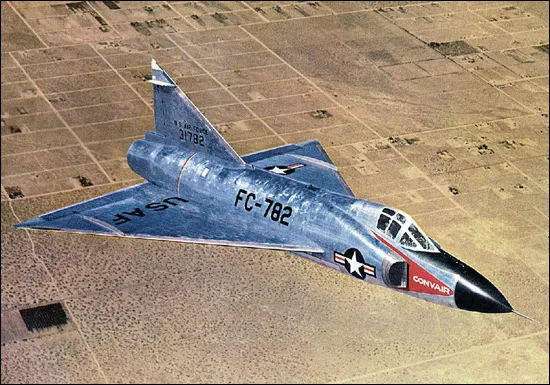
A narrow tube with delta wings and tail unit: the YF-102 on its maiden flight on 24 October 1953. Its performance initially failed to live up to expectations. (USAF)
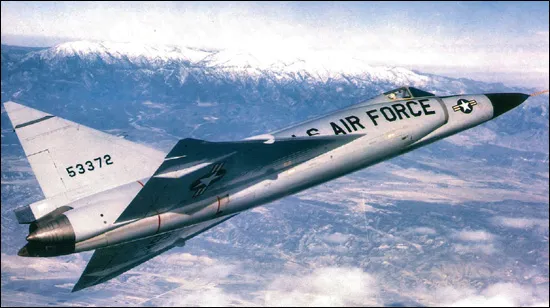
The problems of performance of the YF-102 were resolved on the F-102A amongst other by the application of the so-called area ruling. The result was the Delta Dagger with “wasp waist”.
The maiden flight of the prototype meanwhile redesignated YF-102 took place on 24 October 1953 under a baleful star, for the crew failed to fly the machine through the sound barrier in horizontal flight although Mach-1 was one of the main criteria of the USAF. Not until the discovery of the so-called “area ruling” by Dr. Richard Whitcomb was success obtained in December 1954 with Mach 1.2. The design of the 873 fighters of this Model-series remained virtually unchanged, the only exception being the armed trainer TF-102A with broadened fuselage forward for the seats in tandem. In order not to negatively influence the aerodynamics, the F-102 became the first fighter to be fitted with an internal weapons bay for up to six AIM-4A radar-guided or AIM-4C (infra-red-guided) missiles. Later, numerous units had nuclear warheads. The first unit entered service in April 1956 with 327th Fighter Interceptor Squadron, where the Delta Dagger soon became the backbone of the air defence system. Numerous F-102s spent long years of service with the National Guard before the last one was decommissioned in 1977. The Pentagon decided upon using 200 of these machines as unmanned PQM-102 drones for use as targets for rockets and inboard weapons. The former US President George W.Bush was attached to the Delta Dart crew during his active service with the National Guard.
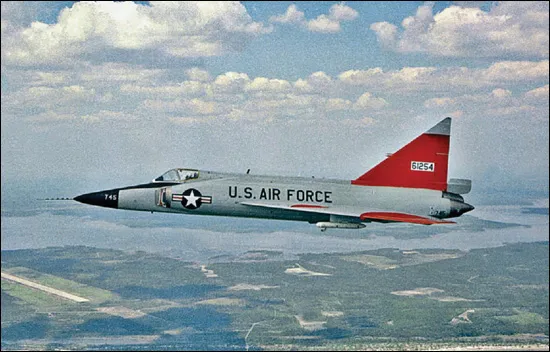
The Pentagon later used more than 200 Delta Daggers as unmanned PQM-102 drones for target practice. (USAF)
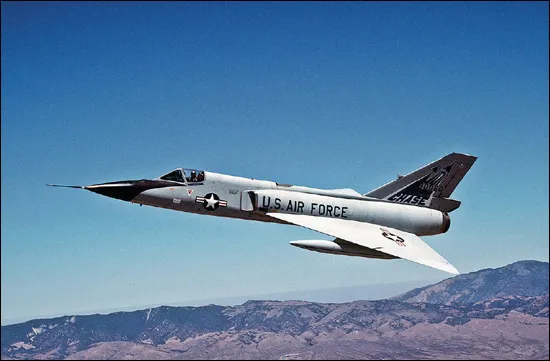
The F-106 Delta Dart differed from its predecessor by its trapeziform lateral stabilizer fins and an even slimmer waist. (John McDoewell)
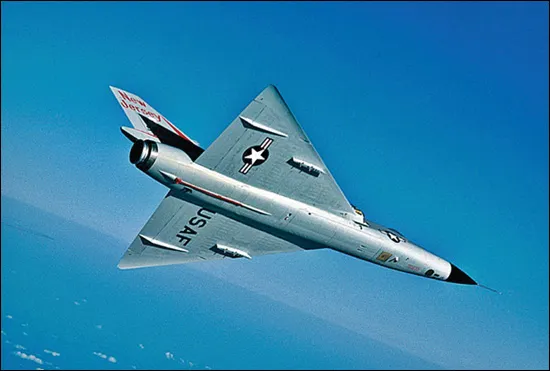
Its aerodynamically favourable shape enabled the F-106 to reach Mach 2 with a rate of climb of 13,045 m/min. In the weapons bay the aircraft carried AIM-4 missiles, and also MB-Genius rockets with nuclear warhead. (Ernest Sealing)
When series production of the F-102 began, Convair was already working on the development of an improved successor. This was not without good cause, for the USAF had considered the F-102 as an interim solution from the beginning. This new development was not a problem for the F-102 could already be taken as the basis. Therefore on 26 December 1956 the prototype YF-106 made its maiden flight. In May 1959 the new fighter entered service with the USAF as F-106 Delta Dart.
Outwardly it differed from it predec...
Table of contents
- Cover
- Title
- Copyright
- Contents
- Foreword
- Introduction
- USA
- Europe
- Soviet Union/Russia
- The People’s Republic of China
Trusted by 375,005 students
Access to over 1.5 million titles for a fair monthly price.
Study more efficiently using our study tools.
Frequently asked questions
Yes, you can cancel anytime from the Subscription tab in your account settings on the Perlego website. Your subscription will stay active until the end of your current billing period. Learn how to cancel your subscription
No, books cannot be downloaded as external files, such as PDFs, for use outside of Perlego. However, you can download books within the Perlego app for offline reading on mobile or tablet. Learn how to download books offline
Perlego offers two plans: Essential and Complete
- Essential is ideal for learners and professionals who enjoy exploring a wide range of subjects. Access the Essential Library with 800,000+ trusted titles and best-sellers across business, personal growth, and the humanities. Includes unlimited reading time and Standard Read Aloud voice.
- Complete: Perfect for advanced learners and researchers needing full, unrestricted access. Unlock 1.5M+ books across hundreds of subjects, including academic and specialized titles. The Complete Plan also includes advanced features like Premium Read Aloud and Research Assistant.
We are an online textbook subscription service, where you can get access to an entire online library for less than the price of a single book per month. With over 1.5 million books across 990+ topics, we’ve got you covered! Learn about our mission
Look out for the read-aloud symbol on your next book to see if you can listen to it. The read-aloud tool reads text aloud for you, highlighting the text as it is being read. You can pause it, speed it up and slow it down. Learn more about Read Aloud
Yes! You can use the Perlego app on both iOS and Android devices to read anytime, anywhere — even offline. Perfect for commutes or when you’re on the go.
Please note we cannot support devices running on iOS 13 and Android 7 or earlier. Learn more about using the app
Please note we cannot support devices running on iOS 13 and Android 7 or earlier. Learn more about using the app
Yes, you can access Fighter Aircraft Since, 1945 by Frank Schwede in PDF and/or ePUB format, as well as other popular books in History & Military & Maritime History. We have over 1.5 million books available in our catalogue for you to explore.