An analysis of the impact of new communication technology on early 20th century British society, with comparisons to the digital revolution of today.
We are all familiar with the digital revolution that has swept across the developed world in recent years. It has ushered in an age of smartphones, laptop computers and ready access to the internet. A little over a century ago, a similar explosion took place in the field of information and communication technology. This revolution was not digital but analogue, and it saw the birth of mass media such as newspapers, cinema and radio.
In
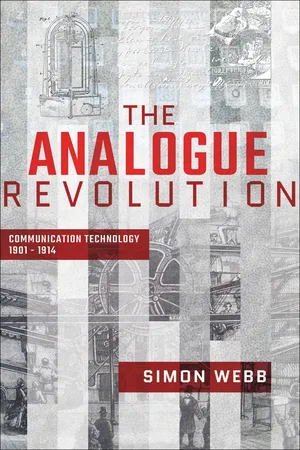
The Analogue Revolution, Simon Webb examines the impact that developments in printing, photography, wireless telegraphy, gramophones and moving pictures had in the years preceding the First World War, and shows how the modern world was shaped by the media used to record it. From the first mass-circulation newspapers to cameras so cheap that everybody could afford them, from early experiments in radio broadcasting to cinema films in color,
The Analogue Revolution charts the history of the first information revolution of the twentieth century. The parallels with the modern world are uncanny, ranging from anxiety about the use of new technology to distribute pornography, to worries about children losing interest in reading because they prefer to watch films.
For anybody wishing to understand the modern world, this book is an essential primer in the nature of information revolutions and the way in which they affect the world.
- 168 pages
- English
- ePUB (mobile friendly)
- Available on iOS & Android
eBook - ePub
About this book
Information
Print ISBN
9781526715371
Subtopic
20th Century HistoryChapter 1
The Edwardian World
L.P. Hartley famously observed that, ‘The past is a foreign country; they do things differently there’. This may make for a neat sound bite, but it is not really true. People in any age have much the same urges and desires; they hanker after what are essentially the same things. They all want security, a home of their own, sufficient resources that they will not go hungry, the opportunity to start a family of their own and perhaps to be given the chance to avail themselves of some of the luxuries of the day. Of course, the particular objects of their desires, beyond these bare essentials, will change radically from century to century. For an Anglo-Saxon peasant, glass in his windows and a hot bath once a week would have been unimaginable luxury, whereas today we might dream of the latest iPhone or a fairy-tale wedding in a Scottish castle. What we consider as luxuries may vary dramatically over the decades and centuries, but the basic wish for a home of our own, food on the table and a secure life have remained unchanged for thousands of years.
From this perspective, we can begin with the assumption that the men and women in Edwardian Britain were not so very different from us. That period is close enough in time to make their world recognizable to us, as many of what we have come now to regard as the basic necessities of life, things such as electricity, telephones and cinema films, were already in existence. In fact, the Edwardian world has a great deal in common with our own. Their reactions to things such as exciting new developments in technology are almost certainly going to be easy for us to understand. It was a time when the world in general, and Britain in particular, was going through great upheavals and social changes, many of which would be all too familiar to us today. Not only this, but the Edwardians were in the midst of an information revolution, with every day bringing forth improvements and new developments in the ways that people communicated with each other or stored data. It was very similar to the so-called digital revolution which is still going on around us, but in the case of the Edwardians, this revolution was not digital, but analogue.
In later chapters, we shall be examining in detail the effect that the Analogue Revolution had upon British society, but to begin with it might be helpful if we look at the world of the Edwardians and see how they lived and what sort of problems they were facing. Doing this will show enormous and uncanny similarities to our own time, with many of what we believe to be modern anxieties and worries already present over a century ago.
The first thing to grasp about Edwardian Britain is that it was a time of great change, with old certainties thrown into the melting pot and ordinary men and women clamouring for a new order, a fresh way of dealing with the problems which had beset the country for many years. The new information and communications technology, which was appearing everywhere at the time, helped to accelerate this process of demand for a new society.
Everywhere at that time was a feeling that life was proceeding at an ever-increasing pace and that the old order was changing with astonishing rapidity. There was a frenzied and hectic air about those years leading up to the First World War and it was this sense of urgency and speed which comes across most clearly when reading descriptions of that period in British history. Key to this haste was the new ways in which people could now communicate with each other. Postcards were being sent by the billion in the first years of the century and T. Corkett, of the largest postcard company in Britain, Raphael Tucker and Sons Ltd, had this to say, ‘The postcard is part and parcel of the busy, rushing, time-saving age in which we live.’ Novelist James Hilton summed the case up neatly when he wrote of, ‘that frenzied Edwardian decade, like an electric lamp which goes brighter and whiter just before it burns itself out’. In short, the defining features of this period were the speed of everyday life and the great changes which were taking place wherever one looked.
This is not at all the image that we many of us have of this period in British history. The very word ‘Edwardian’ conjures up thoughts of stability and suggests subliminally the idea that we are talking about the high-water mark of the British Empire; a kind of tranquil, golden era, which was soon to be shattered by the terrible events of the First World War. When we describe something as ‘Victorian’, there is often a faintly pejorative air about our use of the word. We mean unenlightened, stiff, formal and prudish; Victorian workhouses, Victorian attitudes to sex, Victorian hypocrisy. There are no such negative connotations attached to ‘Edwardian’. Our mind drifts unbidden to thoughts of grand garden parties, Henley Regatta, Elgar’s symphonies, Land of Hope and Glory, high society and richly-dressed ladies carrying parasols. Illustration 3 shows two Edwardian ladies at ‘Glorious Goodwood’. This is the sort of image which many of us associate with Edwardian Britain.
Many of our views and opinions on the nature of Edwardian society come of course not from history books, but rather television programmes such as Downton Abbey and Upstairs, Downstairs. Stability and order are the chief features of the Edwardian world when viewed from the perspective of such programmes. In films too, Edwardian Britain is a well-to-do place, with even the poor knowing their place and being cheerful about their lives. One thinks of that classic film Mary Poppins, with the delightful life of the Banks family. There is a poor man in this film, Bert the chimney sweep, but he is even happier than Mr Banks and his family. He may not have much money, but Bert is forever larking about and having wonderful adventures. We have subliminally absorbed this vision of Edwardian life and unless we take the trouble to seek out the historical reality, that is how we are liable to see this chapter of British history. The truth was very different.
Mary Poppins, which has as a backdrop a delightful, peaceful and picturesque London, was set in 1910. We know this from the words of one of the film’s songs. The real London of that year was in the throes of the greatest political and social upheaval seen in Britain for centuries. The confrontations and strikes known as the ‘Great Unrest’ were reaching their climax and within twelve months the capital would become an armed camp. Over 12,000 troops would be quartered in the parks of central London and in the north of England, and the army would be shooting down men like Bert the chimney sweep as what amounted to martial law was imposed upon the provinces. In Ireland, not at that time an independent country but an integral part of Great Britain, a civil war was brewing. Why then, with so many disturbing things going on, do we persist in viewing Edwardian Britain as a golden era?
There is something dramatically satisfying about comparing the supposedly prosperous and peaceful world of Edwardian Britain in the run-up to 1914, with the massacre of the country’s youth at Passchendaele and the Somme. It provides such a stark contrast and serves to underline and accentuate just how horrible the First World War was. In fact, British society in the years preceding the outbreak of war was anything but prosperous and peaceful; many at the time thought that the nation was on the brink of revolution and civil war and the social conditions of millions of people living in Britain at that time were atrocious.
During the nineteenth century, Britain had been the richest country in the world, but of course the wealth was by no means evenly or equitably distributed. Fortunately for those who were well-off, there was still a lingering belief, supported by the Church, that people should be content with their station in life and not seek to rise higher in the social scheme of things than their birth and family circumstances warranted. We hear an echo of the supposedly Divine backing for the existing order in the Victorian hymn All Things Bright and Beautiful. One verse sums the matter up in a nutshell, by declaring;
The rich man in his castle,
The poor man at his gate,
God made them high and lowly,
And ordered their estate.
By the time of Queen Victoria’s death in 1901, this old notion of patient resignation to one’s situation in life was becoming a little threadbare and with the dawn of a new century, many of the poorer people in Britain were agitating for change. The old certainties were breaking down and when the Liberals swept to power in the landslide victory of 1906, Henry Campbell-Bannerman, the newly-elected Prime Minister, had already promised that things were going to change. He said his aim was to make the country, ‘less of a pleasure-ground for the rich and more of a treasure-house for the nation’.
The inequalities at that time really were appalling. During the Boer War, fought in South Africa between 1899 and 1902, there was a surge of patriotic fervour in Britain and a desire to rally to the flag. Of the men who tried to join the army at that time, no fewer than 40 per cent were found to be physically unsuitable; chiefly through being malnourished and undersized. A large proportion of the population were living practically on the edge of starvation. At the turn of the century, Seebohm Rowntree, the Quaker industrialist and social researcher, published the results of his investigations into the conditions of working-class people in the city of York. Called Poverty; A Study of Town Life, the report analysed the lives of two-thirds of the population of York. It was found that roughly a third of the people living in York did not have enough food, fuel and clothing to keep them in good health. Even if they carefully spent every single penny, there was still not enough coming in to allow them to live a healthy life. The picture was the same throughout the whole of the country. It was this dreadful situation that the Liberals hoped to tackle.
The popular newspapers, which were now being read by an increasing number of working-class people, made information about things such as Rowntree’s study of poverty freely available to everybody. Those struggling to survive knew that they were not isolated cases and that almost the entire working class in Britain was in a desperate position. It also became widely known among such readers that the rich lived lives which were almost inconceivably different from theirs. Reading about, seeing photographs in the newspapers and films at the music hall showing how extravagantly the upper stratum of society was living, could not fail to provoke envy and anger in those struggling to survive perpetually on the edge of starvation.
J.B. Priestley, the well-known author and playwright, gives a vivid description of breakfast at in an upper-class home when guests were staying for a weekend shooting party. This, it must be borne in mind, was at a time when many families were surviving on little more than bread and dripping, that is to say bread smeared with a little animal fat, and a cup or two of tea each day:
There were pots of coffee and of China and Indian tea, and various cold drinks. One large sideboard would offer a row of silver dishes, kept hot by spirit lamps, and here there would be poached or scrambled eggs, bacon, ham, sausages, devilled kidneys, haddock and other fish. On an even larger sideboard there would be a choice of cold meats – pressed beef, ham, tongue, galantines – and cold roast pheasant, grouse, partridge, ptarmigan. A side table would be heaped with fruit – melons, peaches, nectarines, raspberries. And if anybody was hungry, there were always scone and toast and marmalade and honey and specially imported jams.
The effect of reading about such profligacy by somebody barely able to afford sufficient food to stave off the pangs of hunger is impossible to imagine.
Despite his good intentions Campbell-Bannerman and his successor Henry Herbert Asquith found it easier said than done to transform society. In real terms, wages were falling, but wealthy and aristocratic individuals hardly seemed to notice this. They certainly weren’t affected by the depression. Ascot, Henley Regatta and garden parties at Buckingham Palace continued much as they had during Victoria’s reign. The difference now was that ordinary working-class people were able to see this conspicuous consumption for themselves.
During the period that Victoria was on the throne, there was every bit as much inequality as was to be found after her son’s coronation in 1901. There was one vital difference though. Poor people in the 1850s were largely illiterate and would in any case have been unlikely to have enough money to spare for buying a newspaper. Photography was a novelty and no method yet existed for mass-producing copies of photographs and printing them in newspapers. We shall examine this point at length in a subsequent chapter. Needless to say, there were no cinemas. The result was that men and women working in factories in the north of England or farms in the West Country would have no idea at all what a day out at Ascot actually looked like. Nor would they know whether their own lives were typical of the labouring classes or whether they were just unfortunate enough to be worse off than average.
By the time of the 1906 general election though, tabloid newspapers costing only a halfpenny were circulating widely and they had photographs on their front page, pictures which showed clearly how the ‘other half’ lived. It was possible now for an errand boy to see just how rich people dressed at Henley and to read also what sort of things they got up to. Celebrity gossip was then, as it is now, a topic of enduring interest to those whose lives are not so showy or exciting. Not only could the people who were feeling the squeeze of falling wages see photographs of tycoons driving motor cars or aristocrats at play, they could even watch moving pictures of them.
When films began to be shown in Britain, towards the end of the nineteenth century, they were typically presented at the end of music-hall shows and consisted in the main of short news items, rather than fictional narratives. These would come later. Those producing these early newsreels thought that viewers would probably prefer to see something a little different from their day-to-day lives and so took their cameras out and about. It was only natural that, in general, ostentatious events such as society weddings and a day out at Ascot would be more likely to be recorded than the interior of a sweatshop or slum tenement. In this way, working men and women were exposed to scenes of luxury and affluence such as they could scarcely imagine. Some of these scenes of upper-class life were even in colour, which must have made them even more impressive. The funeral of Edward VII on 20 May 1910 was filmed by the Natural Colour Kinematograph Co and a spectacular occasion it was too, with no fewer than nine kings being present.
Being able to see what sort of lives were being led by their social superiors helped to create a sense of dissatisfaction among the urban proletariat in particular. It was patently unfair that that while they and their families were going hungry and older relatives were ending up in the workhouse, others in the country were living in such outrageous and unabashed luxury. The emerging phenomenon of the mass media of newspapers and cinema thus served to stoke social unrest. This and other grievances were brought about as a direct consequence of innovations in printing and photography. To see how this process worked, we cast our minds back to the reign of Elizabeth I in the sixteenth century.
In November 1588 a traveller from London arrived at a tavern in an outof-the-way village in Somerset and discovered to his amazement that those drinking there had no idea what had happened after the Spanish Armada had clashed with the English fleet over three months earlier. The villagers had heard that an invasion fleet had been sighted off the Devon coast in July, but had not the faintest idea what had happened after that. For all they knew to the contrary, King Philip of Spain might now be occupying the throne of England, rather than Queen Elizabeth. With no newspapers and most people spending their whole lives within a few miles of their village or town, news travelled at a snail’s pace.
Over the next 300 years, the speed at which news spread across the country increased a little, although most people still relied upon rumour and hearsay to know what was going on in their own country. Victorian newspapers such as the Times were not only expensive, but were also very heavy going and anybody with indifferent literacy skills would have found it all but impossible to plough through the verbatim accounts of Parliamentary debates and extract the salient points. Jumping now to the beginning of 1911, and it is at once possible to see how things had changed by then, by looking at another aspect of life in Britain at that time.
Immigration and terrorism were in 1911, just as they are today, matters of great concern to the man and woman in the street. Then, as now, they were linked in the public mind, most terrorists in Britain at that time having been born abroad. How did this become generally known? The answer is of course that the new mass media, to which a great number of working people were now exposed, told them so. After all, nearly all the immigrants in Britain during the opening years of the twentieth century concentrated themselves in specific parts of the big cities such as London and Manchester. People living in the West Country or on the south coast would be unlikely ever to meet one of these foreigners. They knew all about them though from articles in the new popular newspapers which began appearing at about that time. These newspapers put news into simple and straightforward terms and illustrated it with photographs. The Daily Mirror and Daily Sketch, which began respectively in 1903 and 1909, gave people a highly simplified and sometimes tendentious version of what was going on in the world.
The illustrated newspapers combined with an entirely new mass medium, that of the cinema film, to ensure that every person, even the illiterate, could now see what was going on at the other end of the country in a matter of hours. In doing so, these new media found that they were not only informing readers and viewers; they were at the same time shaping their opinions.
In December 1910 a gang of asylum seekers were breaking into a jeweller’s shop in the city of London one night, when they were disturbed by a group of police officers. The burglars were trying to raise funds for a terrorist group and were well-armed. They shot their way out of trouble, killing three police officers in the process. Even without encouragement, most people would have taken a dim view of such antics, but the Daily Mirror did not help matters by shrieking, ‘Who are these fiends in human form?’ The paper offered a reward of £500 for the capture of the murderers. When the killers were finally tracked down to a house in Sidney Street in the East End of London, they fired on the police who came to arrest them. A stand-off developed, which became known as the Siege of Sidney Street or the Battle of Stepney. Troops were called in by Home Secretary Winston Churchill, who also summoned artillery to the scene with a view to having the house where the assassins were hiding shelled. As it was, they were killed in the gun battle with the soldiers, following which the...
Table of contents
- Cover
- Title
- Copyright
- Contents
- List of Plates
- Introduction
- Chapter 1: The Edwardian World
- Chapter 2: Information Revolutions and How They Change the World
- Chapter 3: The Birth of the Mass Media – Newspapers
- Chapter 4: The Coming of Cinema
- Chapter 5: How ‘Wireless’ Began
- Chapter 6: The Analogue Revolution at Home
- Chapter 7: How the Analogue Revolution Changed Edwardian Society
- Chapter 8: Two Architects of the Analogue Revolution
- Chapter 9: The Roots of Modern Technology
- Chapter 10: The Enduring Legacy of the Analogue Revolution
- Endword
- Bibliography
- Plate section
Trusted by 375,005 students
Access to over 1.5 million titles for a fair monthly price.
Study more efficiently using our study tools.
Frequently asked questions
Yes, you can cancel anytime from the Subscription tab in your account settings on the Perlego website. Your subscription will stay active until the end of your current billing period. Learn how to cancel your subscription
No, books cannot be downloaded as external files, such as PDFs, for use outside of Perlego. However, you can download books within the Perlego app for offline reading on mobile or tablet. Learn how to download books offline
Perlego offers two plans: Essential and Complete
- Essential is ideal for learners and professionals who enjoy exploring a wide range of subjects. Access the Essential Library with 800,000+ trusted titles and best-sellers across business, personal growth, and the humanities. Includes unlimited reading time and Standard Read Aloud voice.
- Complete: Perfect for advanced learners and researchers needing full, unrestricted access. Unlock 1.5M+ books across hundreds of subjects, including academic and specialized titles. The Complete Plan also includes advanced features like Premium Read Aloud and Research Assistant.
We are an online textbook subscription service, where you can get access to an entire online library for less than the price of a single book per month. With over 1.5 million books across 990+ topics, we’ve got you covered! Learn about our mission
Look out for the read-aloud symbol on your next book to see if you can listen to it. The read-aloud tool reads text aloud for you, highlighting the text as it is being read. You can pause it, speed it up and slow it down. Learn more about Read Aloud
Yes! You can use the Perlego app on both iOS and Android devices to read anytime, anywhere — even offline. Perfect for commutes or when you’re on the go.
Please note we cannot support devices running on iOS 13 and Android 7 or earlier. Learn more about using the app
Please note we cannot support devices running on iOS 13 and Android 7 or earlier. Learn more about using the app
Yes, you can access The Analogue Revolution by Simon Webb in PDF and/or ePUB format. We have over 1.5 million books available in our catalogue for you to explore.