"A book that looks deeply into the lives of some of the convicts who were sentenced in court to be transported to Botany Bay." —
Pirates and Privateers
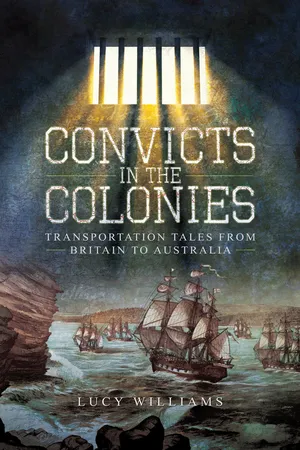
In the eighty years between 1787 and 1868 more than 160,000 men, women and children convicted of everything from picking pockets to murder were sentenced to be transported beyond the seas. These convicts were destined to serve out their sentences in the empires most remote colony: Australia. Through vivid real-life case studies and famous tales of the exceptional and extraordinary,
Convicts in the Colonies narrates the history of convict transportation to Australia—from the first to the final fleet.
Using the latest original research,
Convicts in the Colonies reveals a fascinating century-long history of British convicts unlike any other. Covering everything from crime and sentencing in Britain and the perilous voyage to Australia, to life in each of the three main penal colonies—New South Wales, Van Diemen's Land, and Western Australia—this book charts the lives and experiences of the men and women who crossed the world and underwent one of the most extraordinary punishments in history.
"An easily read, fascinating history, telling the tales of the 'recidivist' convicts in the 18th and 19th centuries." —The Essex Family Historian
- 224 pages
- English
- ePUB (mobile friendly)
- Available on iOS & Android
eBook - ePub
About this book
Information
Chapter 1
Sentencing, Selection, and the Wait: Pathways to Australia
If transportation to Australia were a television drama, scenes would cut in quick succession as our convicts progressed through the criminal justice system and from Britain’s docks, to sandy beaches at the other side of the world. The judge would bang his gavel, sentence some poor soul in the dock to be transported for the term of their natural lives, and the screen would cut to the day they hustled in chains aboard a vessel to begin their voyage. But the lives of convicts, and certainly British justice, was not as neat as centuries of creative licence would have us believe. Far from being the final word in a convict’s fate, the passing of sentence was but an early step in a long and twisting journey with few guarantees of a new life in the colonies.
From the courtroom, a convict might endure years of incarceration at home before being selected for a voyage. That’s if they ever were. Not every convict sentenced to transportation during our period arrived in Australia. At different moments during the life of the Australian penal colonies, as few as thirty per cent of convicts sentenced to transportation actually arrived in Australia. Even at its height, only around seventy-five per cent of sentenced convicts arrived. Particularly earlier in the period, but as late as the 1860s, there were a range of alternate fates that might await our transportees.
This chapter, before those that will take us across the world, examines some of the fundamental questions about some of the most famous prisoners in British history. Who were the men and women sentenced to be transported and what crimes had they committed to warrant such justice? We’ll look at the alternative fates that claimed convicts as they made their way from court to port, and gain a little insight into what a sentence of transportation meant to the men and women on the receiving end.
The worst of the worst?
When transportation meant a voyage across the Atlantic to the American colonies in the seventeenth and early eighteenth centuries, the sentence was often greeted with relief. During these centuries, the worst crimes (and often even the seemingly insignificant) would be punished with a long drop at the end of a short rope. Transportation might be used for those whose crimes were minimal, for first time offenders, or for those who through mitigating circumstances managed to avoid execution. However, somewhere in the few decades between American transportation and the new colonies in Australia, public perception, and that of convicts themselves, shifted. In its earliest years, transportation to Australia was often portrayed as the fate that awaited the worst and most wretched of criminals.
The poor reputation of transportation to Australia was not based on the calibre of convicts alone. In the late eighteenth century, as the First and Second Fleets set sail, life in Australia was a much more uncertain prospect than America had been, and the land a greater unknown. Not to mention the damage done to the reputation of penal transportation by the disastrous British experiment in West Africa just a decade or so before. However, the idea of transportation as the fate awaiting the most villainous and wicked of criminals remained long into the nineteenth century, after most immediate dangers had passed. Until, that is, positive reports of life in the antipodes began to trickle back from former convicts, and the system, no longer a deterrent, began its slow closure, one penal colony at a time. Certainly, the idea of transport ships being packed with thieves and ruffians, prostitutes, drunkards, and murderers is one that has had a lasting impact on our own perception of penal transportation (Image 1). But how accurate is it? What crimes and what criminals warranted the sentence of transportation?
Undoubtedly, prostitutes, drunkards, gamblers, and brawlers all found their way across the seas as British convicts, but it was not these crimes that took them there. Crimes against public order, like drunkenness, breaking the peace, and prostitution were amongst the most common offences dealt with in British courts. However, these offences, tried by magistrates at Petty Sessions, did not carry serious sentences. Breaches of public order (unless part of riots which could result in the most extreme of sentences) were usually met with little more than a fine or a few days in a local lock up. Low level violent crimes – fights between neighbours, drunken brawls, and injuries caused without danger to life or the use of a weapon – were likewise commonly punished with a short term of imprisonment. It was only more serious ‘indictable’ crimes, heard at higher courts, for which a sentence of transportation could be passed. When prostitutes and drunks did find their way on board convict vessels, it was as a result of a connected offence. The drunkard whose intoxication ended in a fatal argument or accident, the prostitute who picked the pocket of the wrong customer. Whatever else transported convicts were in their lives at home and abroad, the convicts sent to Australia can be described rather reliably as thieves and swindlers, fraudsters, violent criminals, murderers and rapists.
Thieves, burglars, receivers, coiners, shopbreakers and fraudsters
Offenders convicted of property crimes made up by far the biggest proportion of those sentenced to be transported. Theft was the largest category of all property crimes and covered an enormous range of individual offences. All thefts could be tried as felonies, but the specifics of a trial and sentence usually came down to the particulars of the offence, such as the value of the theft, the location of the theft, and the manner in which the theft was carried out. The higher the value of the theft, the more likely it was that a felony charge would be brought. Until 1827 (forty years into transportation to Australia) thefts could be broadly divided into two categories, of ‘petty’ and ‘grand’ larceny.
Petty larceny was the charge brought for thefts under the value of a shilling. If defendants were lucky, this offence would be tried by a local magistrate rather than a higher court, meaning a summary conviction and an escape from more serious punishment. However, while it was never punishable by death, petty larceny could still be tried as a felony and carry a sentence of transportation if the context of the crime was thought to warrant it. In 1825, Mary Edwards, a twenty-year-old Londoner, was found guilty of stealing twelve yards of ribbon. The value of the ribbon was only sixpence, but the manner of the theft – in which she worked with an accomplice – saw her sentenced to be transported for seven years.
Grand larceny was a felony charge used in cases of theft over the value of a shilling. Not only did a conviction for grand larceny warrant a sentence of transportation, it could also carry a sentence of death. Although capital sentences were uncommon as grand larceny denoted a theft with no aggravating circumstances such as violence or breaking into private property. Fourteen-year-old Ann Maloney committed grand larceny when in February 1822 she stole a coat (valued at eight shillings) from Ann Richardson, a lodger in her mother’s house. Ann pawned the coat and took the money. She, like Mary Edwards, received seven years of transportation. After 1827, both these categories of theft were replaced by ‘simple’ larceny, a category of offence which removed the one shilling barrier between the two former offences. This resulted in all thefts without aggravating circumstances constituting the same offence. After the Criminal Justice Act was passed in 1855, an increasing number of simple larceny cases were tried in lower courts, making them no longer eligible for transportation. This change came too late for the more than 150,000 individuals that had already been shipped to New South Wales and Van Diemen’s Land.
Other than generic larcenies, there were many other ways of stealing that ended with a sentence of transportation. Any theft in which violence was used, such as highway robberies, were automatically felonies, and eligible to receive capital (death) sentences. However, as the eighteenth century gave way to the nineteenth, executions were usually only carried out in cases of murder. William Challinor, a nineteen-year-old from Staffordshire, was sentenced to ten years transportation when he was found guilty of beating pensioner William Graham about the head on the night of 17 June 1847, and stealing from him a silver watch and chain. Burglary was another aggravating circumstance which immediately placed even thefts of small value in line for a sentence of transportation. In a society in which the sanctity of home was absolute, breaking and entering private premises, or stealing from a private home, even if the said property was empty at the time, was a serious offence. Thomas Allen and his family were away from home in May 1837 when Edward Rodwell broke into their house in Shouldham, Norfolk. Rodwell took a few razors and a microscope from the empty house, but when apprehended was sentenced to be transported for fourteen years. Pickpocketing, shoplifting, and thefts by servants were popular forms of theft for women and children, who often lacked the physicality for offences like robbery with violence or breaking and entering, which also end in a sentence of transportation.
A litter of other property offenders were sentenced to transportation too. Receiving stolen goods, for which Ikey Solomon was indicted, cementing his place in both history and literature, (see Chapter four) and feloniously disposing of the same could both carry sentences of transportation. Producing and uttering counterfeit currency, especially coins, was a royal offence, again technically worthy of a capital sentence, which saw many shipped across the seas. There was also a range of what we would now call ‘white collar’ crimes, for which a number of educated upper and middle-class felons, like James Hardy Vaux, (see Chapter three) were transported. Those who embezzled, committed frauds and large forgeries ensured that a surprising social mix of convicts made transport lists.
Violence, murder and mayhem
Theft might have been the most common offence which saw offenders sentenced to transportation, but it was violent and sensational crimes which helped shape transportation’s fearsome reputation and captured the popular imagination. Yet the proportion of offenders sentenced to transportation for violent crimes was tiny when compared to the number of property offenders. Cases of rape very rarely made it to eighteenth and nineteenth century courts and those that did often ended in acquittal due to lack of evidence. Convictions for rape, depending on the parties involved and the circumstances of the case, might end in a few months’ imprisonment for the perpetrator, or transportation. The outcome heavily depended on how the judge interpreted the severity of the case. Rapists were a minority of those sentenced to transportation, but as the period wore on sexual offences against children were treated with increasing severity by the courts. In the 1850s and 1860s especially, those convicted of sexual offences against children were increasingly given sentences of transportation, and shipped out to Western Australia. Other violent offences such as murder, and manslaughter, serious assaults, and wounding (assaults in which a weapon was used) could all, technically, be met with a sentence of transportation, and some were. James Baird and James Meikle were both convicted separately at the same Fife Sessions for an ‘assault to the danger of life’, and were punished with seven and nine years of transportation respectively. However, even acts of violence that we would consider significant today were often tried at summary courts, resulting in short terms of imprisonment. Those acts of violence thought serious enough to be felonies often skipped lower punishments and proceeded straight to the death sentence.
Dead men… sailing
Murder, manslaughter, and other forms of unlawful killing or serious wounding remained the only crimes still continuously eligible for capital sentences throughout the period. Yet even by the late eighteenth century, large volumes of hangings were waning, and transportation provided a suitably serious, but non-lethal, alternative to the death penalty. As such, convicts of this nature were far more common in the Australian colonies than they had been in previous penal colonies. Some of those on trial for murder or manslaughter might be found not guilty on account of insanity, but for those found guilty and in possession of their full faculties, it was far more likely that they would initially face a black-capped judge who sentenced them to hang. At the same time, however, in many capital cases, mercy was later recommended, and convicts were brought back to the courtroom and offered pardons on the condition that they be transported for a term of between seven years and the rest of their natural lives. Thus, a significant proportion of those in the ‘transportation pool’ who left court and began their wait for a voyage actually received transportation as a secondary sentence.
Elizabeth Hinchcliff, a fourteen-year-old London servant, poisoned her mistress and two of her mistress’s lodgers with arsenic in September 1810. She was not successful in killing them, but for the attempt alone she was sentenced to death. Elizabeth was recommended by the jury to mercy on account of her young age. She later had her initial sentence commuted on the condition that she be transported for life, which she was. She sailed on the Minstrel to New South Wales in May 1812. Francis Fernandez, a twenty-year-old sailor, joined Elizabeth on board the Minstrel. He had been tried at the same court as Elizabeth the following year, in May of 1811, charged with stabbing John Clare and Thomas Day with the intent to kill them. Fernandez was sentenced to death, but given mercy two months later on the condition that he be transported for life.
Of course, the above are only broad categories of offences commonly punished by transportation. In the cities, towns, and villages of Britain and Ireland, in their houses and streets, their pubs, shops and alleyways, there were at any given moment all kinds of crimes and misdemeanours for which men and women might eventually find themselves living on the other side of the world. The eighty years in which transportation to Australia occurred spanned a period in which justice and punishment was evolving. Transportation spanned a period which saw the iconic threat of the gallows and savage punishments of the bloody code diminish, and the modern prison system emerge. Likewise, no two crimes, and no two criminals were quite the same, and from high treason to pocket picking, the subjective way in which courts dealt with offenders meant individuals could never be entirely sure of what the outcome of their trial would be.
Subjective sentencing
Even though they changed as the decades rolled on, the rules for sentencing convicts at British courts during the transportation era were fairly clear. Some crimes were eligible for a sentence of transportation, and some were not. Under the right circumstances, a death sentence could be substituted for one of transportation. Judges knew their trade, and stuck, fairly rigidly, to matching up particular offences with their prescribed tariffs. Yet crime alone was not the only factor judges had to consider in passing a sentence. In some cases it could be as much about who a convict was as about what they had done when it came to sentencing. Age, criminal record and personal circumstances could all impact how well a defendant fared in the dock.
Offenders old and new
When it came to property crime, having previous convictions of a similar nature greatly increased a convict’s likelihood of being sentenced to transportation. The knowledge of a previous conviction could be used in the court as proof that the defendant was a bad character (just the kind Britain wanted shipped from her shores forever). A criminal record might also be interpreted by the judge as a sign that more lenient punishments like short terms of imprisonment, admonishments and fines had not been effective in teaching an offender a lesson. An ‘old offender’, as defendants with criminal pasts were often termed in the dock and the press, was twice as incorrigible as a first timer and could expect less mercy when it came to their sentence, even in cases where the value of their crime was relatively low. The young, who in less than a century would face special institutions for juveniles rather than the full force of adult justice, could be ‘old’ offenders during this period, with recidivist children as young as eleven and twelve regularly sentenced to be transported. At the Bristol Quarter Sessions of summer 1832, ten defendants under the age of twenty were sentenced to varying terms of transportation for a range of seemingly small offences.
George King, aged sixteen, and Edward Storer, aged fifteen, were charged with stealing a single silk handkerchief from a Mr G. Hillhouse at a market. Storer was sentenced to twelve months of imprisonment with hard labour, but King, ‘being an old offender’, was sentenced to seven years transportation. George’s previous offences, though not listed, were likely to have been minor, but even a single teenage transgression might have been enough to seal his fate. Likewise, Thomas Player, a youth of just fourteen, was found guilty of stealing a handkerchief on Bristol bridge. Also known to the court as an old offender, Player was sentenced to fourteen years’ transportation. Within a year, Thomas had sailed for Van Diemen’s Land, where he lived for the rest of his life, in all likelihood having few memories of the country that cast him out as a child.
George Evans, a boy of just eleven, was given seven years’ transportation for the theft of a half crown. A child of George’s age could usually expect some mercy from the court but, unluckily for him, George had appeared at the previous Quarter Sessions a few months earlier to answer for a similar offence. Notably, George Evans received no recommendation to mercy, making it unlikely his sentence would be commuted. John McCafrey, aged twelve, was found guilty of stealing a handkerchief from John Harris and ‘though so young, [had] been repeatedly before the magistrates’. In the dock John seemed to fare better than George. He was initially given a sentence of transportation, but the court ‘said this sentence was passed upon him in mercy, as he would be placed on board a vessel set apart by government for the reception of juvenile offenders, where he would be taught a trade’. Given the conditions on such training ships, it is difficult to say which of the boys ultimately had the better fate. In contrast, 49-year-old Joseph Mapstone, whose embezzlement of ten shillings from his employer, was a crime far greater in value than the half crowns and handkerchiefs taken by the children who appeared in the same dock, was given twelve months of imprisonment with hard labour for the crime. Joseph was an adult, but he was also a first-time offender.
Of course, more adults were transported than children. Not only were grown offenders likely to receive less sympathy in court, but adults also had far more opportunity to amass a string of criminal convictions before committing the crime that would ultimately see them transported. What the Bristol Sessions of summer 1832 show us is simply that there was no consistent collection of factors guaranteeing a sentence of transportation. Age and criminal history could be important, gender and class could also play a role. The crime itself might be the deciding factor. Any one of these factors mi...
Table of contents
- Cover
- Title
- Copyright
- Contents
- Acknowledgements
- Introduction: The Lives of the ‘Lagged’
- Chapter 1: Sentencing, Selection, and the Wait: Pathways to Australia
- Chapter 2: Disease, Danger, and Death: The Voyage to Australia
- Chapter 3: Bound for Botany Bay: New South Wales 1787–1850
- Chapter 4: Sent Down South: Van Diemen’s Land 1803–1856
- Chapter 5: The Hothouse of Humanity on the Swan River: Western Australia 1850–1868
- Conclusion
- Appendix
- Tracing Transportees: Resources for the Reader.
- Suggested Reading
- Plate section
Trusted by 375,005 students
Access to over 1.5 million titles for a fair monthly price.
Study more efficiently using our study tools.
Frequently asked questions
Yes, you can cancel anytime from the Subscription tab in your account settings on the Perlego website. Your subscription will stay active until the end of your current billing period. Learn how to cancel your subscription
No, books cannot be downloaded as external files, such as PDFs, for use outside of Perlego. However, you can download books within the Perlego app for offline reading on mobile or tablet. Learn how to download books offline
Perlego offers two plans: Essential and Complete
- Essential is ideal for learners and professionals who enjoy exploring a wide range of subjects. Access the Essential Library with 800,000+ trusted titles and best-sellers across business, personal growth, and the humanities. Includes unlimited reading time and Standard Read Aloud voice.
- Complete: Perfect for advanced learners and researchers needing full, unrestricted access. Unlock 1.5M+ books across hundreds of subjects, including academic and specialized titles. The Complete Plan also includes advanced features like Premium Read Aloud and Research Assistant.
We are an online textbook subscription service, where you can get access to an entire online library for less than the price of a single book per month. With over 1.5 million books across 990+ topics, we’ve got you covered! Learn about our mission
Look out for the read-aloud symbol on your next book to see if you can listen to it. The read-aloud tool reads text aloud for you, highlighting the text as it is being read. You can pause it, speed it up and slow it down. Learn more about Read Aloud
Yes! You can use the Perlego app on both iOS and Android devices to read anytime, anywhere — even offline. Perfect for commutes or when you’re on the go.
Please note we cannot support devices running on iOS 13 and Android 7 or earlier. Learn more about using the app
Please note we cannot support devices running on iOS 13 and Android 7 or earlier. Learn more about using the app
Yes, you can access Convicts in the Colonies by Lucy Williams in PDF and/or ePUB format, as well as other popular books in Social Sciences & British History. We have over 1.5 million books available in our catalogue for you to explore.