- 160 pages
- English
- ePUB (mobile friendly)
- Available on iOS & Android
eBook - ePub
About this book
Explore 800 years of lust, love, and loss.The author takes the reader on a journey from medieval courtly love, through to the sexual license of the Restoration, and Victorian propriety. Pick up historical 'dating tips', from how to court (or be courted); write romantic love letters, give and receive gifts, propose and pose as a sighing swain. A historical approach to the problem of finding a mate, with case studies of classic romantic mistakes and plenty of unusual tales. In the fourteenth century young men tried to impress the ladies with their footwear, donning shoes with pointed toes so long that they had to be secured with whalebone presumably because size mattered!
Information
Subtopic
Social HistoryIndex
HistoryChapter One
Love at First, Second or Third Sight
Making new acquaintances and signalling your interest
L et’s blame the ancient Greeks for it. The notion that we should fall madly in love at first sight can probably be attributed to all those Greek myths featuring Eros and his arrows of love; the idea being that within the most romantic of love stories you should be ‘struck’ by an instant flash of passion. However, this doesn’t leave much room for getting to know one another before ‘falling in love’. And what of childhood sweethearts who have known each other since birth? Is their love or passion in some way diminished because they didn’t get the opportunity to meet each other’s eyes across a room and declare themselves instantly smitten?
It is easy to forget how far the technological advances of the last century have opened up the world to us, especially in terms of love and romance. Before the Victorian railway boom, the time and expense involved in travelling even relatively short distances meant that most people stayed close to home, choosing a mate from among their acquaintances and family friends. While the upper echelons may have moved around more, even the relationships they formed were constrained by the circles they moved in.
The best a poor village girl in the pre-industrial age could hope for by way of a glamorous stranger was a travelling craftsman looking for work. But this did not stop the idle speculation of youth, and a young maid might turn to childhood rhymes and superstitions in the hope of divining her fate.
The famous ‘Tinker, Tailor, Soldier, Sailor’ rhyme has its origins in the fifteenth century and was used to predict whom the questioner would marry. The words ‘Tinker, Tailor, Soldier, Sailor, Rich Man, Poor Man, Beggar Man, Thief ’ were chanted as cherry stones or petals on a daisy were counted out. Further verses revealed when you’d marry, your position in married life, what you’d wear on your wedding day, how you’d obtain this clothing, how you’d get to church, and even where you might live afterwards. This provided a harmless diversion to while away a summer afternoon.

This 1906 photographic print by E.W. Kelley shows a young woman playing the ‘he loves me, he loves me not’ game with daisy petals, while a man watches with amusement in the bushes behind her. (Library of Congress)
Summer is also when the cuckoo’s call would be heard. According to an old tradition the number of consecutive cuckoo calls you hear equates to the number of years until you will marry. These ‘fateful’ signs could be one way of predicting a positive future, but the more enterprising took matters into their own hands and engaged in activities to push forward contact with their true love. Tucking an ivy leaf into your bosom ensured that the next man who spoke to you would be your beloved – or so tradition dictated. If while shelling peas, you found a pod with nine perfectly shaped peas inside, it was believed to be a sign of good luck. According to superstition, if an unmarried girl should hang the empty pod over the lintel of the front door, the first man to cross the threshold would be her future husband.

This photographic print from the late nineteenth century is entitled ‘Waiting For Him’ and depicts a young lady waiting for a gentleman caller. (Boston Public Library)
These homely superstitions exhibit a longing to know when and whom it would be a girl’s destiny to marry. The fact that their intended is expected to appear imminently suggests that most people were aware that they would not marry exotic strangers, but someone with whom they already came into daily contact.
The Victorian explorer Sir Samuel White Baker, for example, at the tender age of twenty-two, chose as his wife, Henrietta, his childhood playmate and the daughter of the local rector, while his brother John picked her sister, Elizabeth. Samuel provides an excellent example of both idealised manners in which we think of love blossoming: childhood sweethearts and the big romantic ‘love at first sight’. Henrietta was a childhood companion who later became a loving wife and the mother of his children. However, after her untimely death, Samuel quite remarkably diverged from the usual course of courting within upper class circles and married Florence Barbara Maria, a Hungarian refugee whom he had bought in a slave market on the Danube.
Michael Brander writing in his biography of the great hunter and explorer, The Perfect Victorian Hero, says that while stranded in Widdin awaiting the go-ahead for a hunting expedition in 1858, Samuel visited a local slave market. There ‘Sam saw this beautiful young Hungarian girl, who, on the death or marriage of her erstwhile nurse, had fallen into unscrupulous hands’. She was put up for sale and he outbid all the wealthy Turkish merchants at the auction, bought her, and subsequently married her. It seems strange that Samuel’s more sedate, predictable courtship happened when he was in the first flush of youth, while the wild, exotic romance occurred much later in his life.
Yet, this exceptional Victorian case was not the way most British people met a prospective love interest in the past. Even if a young person was in a position to come into contact with strangers, they could not simply wander up to them and engage them in conversation. Or at least those deemed to be ladies and gentlemen could not do so.
In the Regency era, a strict etiquette codified how one was to make a new acquaintance among gentlefolk. Until one had been introduced to an unknown person, it was not considered proper to begin a conversation with them. Upon entry to a new neighbourhood a family could expect to have their neighbours, or more exactly the heads of the local households, call upon them to allow an acquaintance to be formed.
Kidnapping a bride
Many of these rules can be traced back to the historic function of marriage as a contract for increasing wealth. Marriages between members of the monied classes have always been seen as a way to increase one’s position in society, either through acquiring advantageous connections or property. In such cases, protecting the maidenheads of womenfolk was supremely, in fact economically, vital.
Historically heiresses could be kidnapped, forced to marry under threat of rape, and sold off to the highest bidder by guardians. A high profile kidnapping occurred on 2 of September 1487, when Robert Bellingham, a nobleman who found favour with King Henry VII for having thwarted one of the pretenders to his throne, nevertheless annoyed the sovereign by abducting the wealthy heiress Margery Beaufitz. Her father had not favoured Bellingham’s proposal of marriage, and so the would-be suitor with a band of accomplices broke into the family’s home and carried Margery away. Bellingham was imprisoned for flouting the law that Henry had passed against the abduction of women earlier that same year. However, a few months later the case was dropped when an agreement was reached between Bellingham and Margery’s father. The couple subsequently married and Bellingham once again found himself in the King’s good books.
‘An Act Against Taking Away of Women Against Their Will’ of 1487 was not some great feminist measure against violence toward women. In fact it was put in place to ensure that the Crown did not lose the revenues it gained through the orphaned wealthy heirs of their tenants. For any child in such a situation was automatically a ward of the monarch, who could decide to pass on that wardship to a favoured courtier or sell it to a guardian wishing to invest in the hope of future profit.

Charles Brandon, Duke of Suffolk, scandalously married his ward in order to get her estate for himself. (Portrait by Jan Gossaert, c.1516, Public Domain)
Charles Brandon, the 1st Duke of Suffolk, chose not to wait for future dividends from his wards and made a bit of a habit of trying to marry them himself. He had to annul the first marriage contract he entered into with a ward when a better wife came along. Elizabeth Grey, an orphaned viscountess, was ditched in favour of Mary Tudor, the sister of Henry VIII. When Mary died in June 1533, Brandon then married his fourteen-year-old ward, Catherine Willoughby, Baroness Willoughby of Eresby. She had been betrothed to his son, but the boy was too young to marry and Brandon did not want to risk losing her substantial estate through a lengthy engagement in a time of high mortality.
Heiress kidnapping was still a problem over a century later, as shown by the case of Elizabeth Malet, granddaughter of Lord Hawley. On 26 May 1665, the 2nd Earl of Rochester, John Wilmot, lived up to his reputation as a libertine and kidnapped the wealthy Elizabeth after she had turned down his proposal of marriage.
Here is Samuel Pepys’s diary entry on the matter:
‘Thence to my Lady Sandwich’s, where, to my shame, I had not been a great while before. Here, upon my telling her a story of my Lord Rochester’s running away on Friday night last with Mrs. Mallett, the great beauty and fortune of the North, who had supped at White Hall with Mrs. Stewart, and was going home to her lodgings with her grandfather, my Lord Haly, by coach; and was at Charing Cross seized on by both horse and foot men, and forcibly taken from him, and put into a coach with six horses, and two women provided to receive her, and carried away. Upon immediate pursuit, my Lord of Rochester (for whom the King had spoke to the lady often, but with no successe) was taken at Uxbridge; but the lady is not yet heard of, and the King mighty angry, and the Lord sent to the Tower. Hereupon my Lady did confess to me, as a great secret, her being concerned in this story. For if this match breaks between my Lord Rochester and her, then, by the consent of all her friends, my Lord Hinchingbroke stands fair, and is invited for her. She is worth, and will be at her mother’s death (who keeps but a little from her), 2500l. per annum.’

Samuel Pepys kept a diary that recorded many of the scandals and trysts of seventeenth century London, as well as his own lascivious behaviour. (Wellcome Collection)
The chivalry Lord Rochester showed in having two ladies to receive the kidnapped lady must have sat well with Elizabeth as she later agreed to marry him against her father’s wishes.
Scandal and Elopements
Nevertheless there were occasions when such extreme measures to initiate ‘love’ simply didn’t need to be taken. Much to the chagrin of the Church, if you did not have any wealth or land to worry about, you could quite easily get betrothed and move in together with your beloved, without any outside interference. This was shockingly libertarian in the eyes of the clergy, who saw marriage as a sacrament and were keen to reduce the prevalence of ‘sin’, aka sex outside marriage. There was also the biblical diktat of ‘let no man put asunder’ what God has joined together.
Annoyingly for the Church, if the correct vows of fidelity and marriage were made between a couple of marriageable age (over the age of fifteen for a ‘man’ and over twelve for a ‘woman’), their marriage was deemed to have been legally binding, with or without the consent of their parents or the presence of clergy. In the words of historian George Gordon Coulton, ‘In Chaucer’s time, the whole world was a vaster and more commodious Gretna Green.’
Strangely enough, the binding nature of private vows made the Church an unlikely ally in some love stories. The Paston Letters, private documents that span three generations of the Paston family of Norfolk from the fifteenth to the early sixteenth centuries, give a juicy insight into a case in which the Church upheld an informal marriage. The daughter of the family, Margery Paston, fell in love with her father’s bailiff, Richard Calle. They secretly married in 1469, angering her parents who set the matter before the bishop. Upon enquiring of the young couple how they had entered into the married state, the clergyman could find no fault with the union and so it stood. The family attempted to dismiss Calle from his post, but his knowledge of their finances and his ability to secure funds from their tenants meant they had to reinstate him.
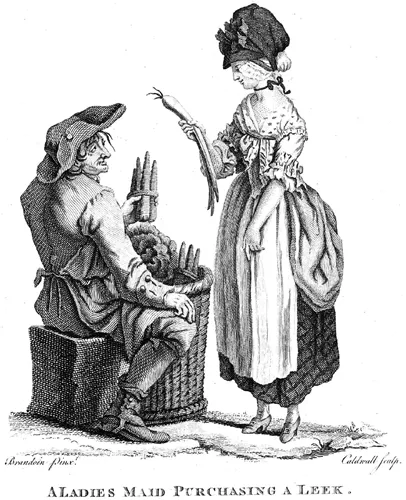
Servants might meet a beau in the course of their daily duties, which is why many mistresses banned a maid from having followers. (This 1772 print entitled A Lady’s Maid Purchasing A Leek is by James Caldwall, Library of Congress)
This case shows that love will thrive wherever there is opportunity. One method of attempting to thwart undesirable matches was to do away with any chance young people had of privacy. Medieval noble women had retainers and ladies-in-waiting to ensure that they were always chaperoned. (The efficacy of chaperons will be described in more detail within Chapter Five.)
By comparison couples from the working classes and the rural poor had a tremendous amount of freedom, with many seeking out their privacy in the lanes and woods outside a cramped communal home. When huge fortunes weren’t at stake, it also occasionally made sense to have sex before marriage to ‘test’ the bride’s fertility and many couples tied the knot with the proof of the groom’s virility clear for all to see. There were also rural traditions around the seasonal calendar and Pagan hangovers such as May Day celebrations that allowed men and women to freely mix and often resulted in pairings, even if they failed to get these unions legally consummated.
However, on occasion a lack of propriety could lead to a marriage, with the approval of the couple’s parents. The practice of ‘bundling’ which was frowned upon in later, more puritanical years, was deemed a sensible way of allowing couples to get to know each other before marriag...
Table of contents
- Cover
- Title
- Copyright
- Contents
- Acknowledgements
- Introduction
- Chapter 1 Love at First, Second or Third Sight
- Chapter 2 Beauty & Seductive Items of Clothing
- Chapter 3 Love Tokens and Gifts
- Chapter 4 Coxcombs and strumpets
- Chapter 5 In Praise of Chaperons
- Chapter 6 Love Songs, Letters and Poems
- Chapter 7 How to be a Good Life Partner
- Conclusion
- Further Reading
Trusted by 375,005 students
Access to over 1.5 million titles for a fair monthly price.
Study more efficiently using our study tools.
Frequently asked questions
Yes, you can cancel anytime from the Subscription tab in your account settings on the Perlego website. Your subscription will stay active until the end of your current billing period. Learn how to cancel your subscription
No, books cannot be downloaded as external files, such as PDFs, for use outside of Perlego. However, you can download books within the Perlego app for offline reading on mobile or tablet. Learn how to download books offline
Perlego offers two plans: Essential and Complete
- Essential is ideal for learners and professionals who enjoy exploring a wide range of subjects. Access the Essential Library with 800,000+ trusted titles and best-sellers across business, personal growth, and the humanities. Includes unlimited reading time and Standard Read Aloud voice.
- Complete: Perfect for advanced learners and researchers needing full, unrestricted access. Unlock 1.5M+ books across hundreds of subjects, including academic and specialized titles. The Complete Plan also includes advanced features like Premium Read Aloud and Research Assistant.
We are an online textbook subscription service, where you can get access to an entire online library for less than the price of a single book per month. With over 1.5 million books across 990+ topics, we’ve got you covered! Learn about our mission
Look out for the read-aloud symbol on your next book to see if you can listen to it. The read-aloud tool reads text aloud for you, highlighting the text as it is being read. You can pause it, speed it up and slow it down. Learn more about Read Aloud
Yes! You can use the Perlego app on both iOS and Android devices to read anytime, anywhere — even offline. Perfect for commutes or when you’re on the go.
Please note we cannot support devices running on iOS 13 and Android 7 or earlier. Learn more about using the app
Please note we cannot support devices running on iOS 13 and Android 7 or earlier. Learn more about using the app
Yes, you can access A History of Courtship by Tania O'Donnell in PDF and/or ePUB format, as well as other popular books in History & Social History. We have over 1.5 million books available in our catalogue for you to explore.