- 312 pages
- English
- ePUB (mobile friendly)
- Available on iOS & Android
eBook - ePub
Explorers and Their Quest for North America
About this book
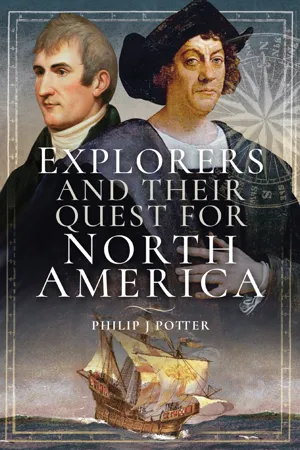
On 11 October 1492 the sun set on a clear Atlantic Ocean horizon and the night was cloudless with a late rising moon. As the lookouts high in the riggings of Christopher Columbus three ships strained their eyes into the golden light of the moon, near two oclock in the morning the watchman on the Pinta shouted out, Land, land igniting the era of exploration to the New World. The Age of Discovery became an epic adventure sweeping across the continent of North America, as the trailblazers dared to challenge the unknown wilderness to advance mankinds knowledge of the world.Explorers Discovering North America traces the history of the discovery, exploration and settlement of the western hemisphere through the comprehensive biographies of fourteen explorers, who had the courage and inquisitiveness to search the limits of the world.The book features many famous adventurers including Hernan Cortes whose victorious battles against the Aztecs conquered Mexico for Spain, Henry Hudsons sea voyages in search of the Northwest Passage led to the colonization of New York and exploration of the Hudson Bay in Canada, while Meriwether Lewis journey across the Louisiana Purchase began the mass migration of settlers to western America. Among the lesser known explorers discussed in the work are Vitus Bering whose discovery of Alaska established Russias claim to the region and Alexander Mackenzies 107-day trek across western Canada that opened the frontier to settlement, commerce and development of its natural resources.From Columbus to Lewis the exploration of the New World became one of humankinds greatest quests that altered history forever.
Information
Christopher Columbus
In April 1492, Christopher Columbus was issued a charter by the Spanish crown for an expedition to reach the riches of China by sailing to the west. After recruiting his crews and preparing his fleet, on 3 August 1492 his small ships departed from the port of Palos in south-west Spain, heading into unknown seas that many Europeans believed were occupied by horrible monsters. By early October, the crewmen on Columbus’ vessels had been out of sight of the land for over twenty days and were growing increasingly mutinous. As the seamen talked of turning back to Spain, on 7 October large flocks of birds were seen flying overhead. Encouraged by the sightings of the birds, Columbus altered his western course, steering his ships south-west. The trade winds blew stronger two days later, and there were the first signs of land when the sailors spotted tree branches with green leaves. The Spanish flotilla ploughed forward into the pitching deep blue ocean. On 11 October, the sun set on a clear horizon and the night was cloudless, with a late rising moon. As the lookouts high in the riggings strained their eyes into the golden light of the moon, around two in the morning, Rodrigo de Triana onboard the Pinta shouted out, ‘Land, land’. In the morning, the white beach was clearly visible and Columbus went ashore in the early afternoon, naming the island in the Bahama chain San Salvador to ignite the age of discovery and exploration in the New World.
Christopher Columbus was born in the independent Italian Republic of Genoa in the second half of 1451, the first son of Domenico and Susanna Fontanarossa Columbus. He was raised in a middle class tradesman’s family with his three younger brothers and one sister. Domenico was a master weaver and owned a prosperous wool business in Genoa. He was a member of the local weaver’s guild and was active in the city’s politics. In recognition of his political loyalty, Domenico was appointed warden for the Porta dell Olivella Gate. Christopher received little if any formal education and was occupied working in his father’s shop as a weaver. As a Genoese boy living on the coast of the Mediterranean, he had frequent contacts with sailors, ships’ captains and travellers from foreign lands, and was drawn to the sea. Around age 10, Columbus began making short voyages close to Genoa, while continuing to work in the family’s weaving business. Several years later, he started taking longer journeys, gaining an education and experience in seamanship and navigation. In 1470, when King Rene II of Anjou hired a mercenary fleet for his war against John II, king of Aragon, Columbus served as a seaman on a Genoese warship taking part in a brief naval battle against the Spanish.
While Columbus continued to work in his father’s cloth shop, in late May 1476, he was employed as a seaman on the Flemish ship Bechalla as part of an armed convoy carrying valuable cargo to England and the Low Countries. As the fleet passed the southern coast of Portugal, it was attacked by French pirates. During the ensuing sea battle, the Bechalla was sunk and Columbus thrown into the sea. He grabbed a large piece of floating debris, making his way to shore. After reaching land, he was found by local Portuguese and provided with food and shelter. There was a large community of Genoese immigrants in Lisbon, and Columbus soon travelled to the city. He settled with his compatriots, while continuing to sail on merchant vessels.
At the time of Columbus’ arrival in Lisbon, the kingdom of Portugal was at the centre of discovery and exploration along the west coast of Africa, and its sailors were exposed to the latest techniques in navigation and map-making. From these seamen and his associations with Genoese merchants, Columbus studied mathematics and astronomy, learning to read and write Portuguese, Castilian and Latin. He expanded his education by reading books on geography, history, philosophy and geometry, while becoming skilled in cartography. In Portugal, he renewed his commercial sea voyages, becoming involved in the Iberian trade network. Columbus made numerous journeys in the Mediterranean region and later travelled to the known western limits of the Atlantic Ocean at Iceland. By 1478, Columbus had risen to the rank of captain and first piloted a merchant vessel to Maderia in the eastern Atlantic off the coast of Morocco. As Columbus continued to sail for various Genoese and Portuguese tradesmen, he served as ship’s officer on a voyage down the western shores of Africa to the fortified trading enclave at St George of the Mine on the Gold Coast, increasing his knowledge of seamanship, currents, winds, weather and navigation during the long journey.
In 1479, Columbus expanded his influence and access to the Portuguese royal court with his marriage to Dona Filipa de Perestrelo Moniz, who was from a minor noble family with hereditary rights to the island of Porto Santo in the Madeira chain. Shortly after the marriage, they moved to Porto Santo, where their only child, Diego, was born. Dona Filipa died of unknown causes in Porto Santo in 1484.
Before Christopher Columbus’ arrival in Lisbon, Portuguese sea captains had been steadily pushing down the west coast of Africa in search of an eastern passage to the trading riches of the Indies, which in the fifteenth century included China, Japan and India. As Columbus continued to sail the waters of the South Atlantic, expanding his knowledge of seamanship and navigation, talking to Portuguese sailors and map-makers and studying the writings of ancient and medieval geographers, he became convinced that a shorter route to the Indies was possible by navigating west. Beginning with Prince Henry in 1418, the monarchy of Portugal had financially supported and encouraged voyages of discovery to Asia down the west African coast, and in 1484, Columbus was granted an audience with King John II to promote his Indies expedition. During his discussions with the king, Columbus requested vessels to sail west to the island of Japan. John II referred him to his maritime committee, which dismissed his petition as folly.
Undeterred by his first rejection, Columbus was now totally committed to securing financial support for his Indies expedition. In May 1485, he sailed to Spain to seek ships and crews from Queen Isabella of Castille. After entering the kingdom, he stayed at a Franciscan monastery and through a monk received a letter of introduction to the Duke of Medina Sidonia, who referred him to a relative, Luis de la Cerda, Count of Medina Celi. After discussing his expedition with the count, he was sent to meet Queen Isabella at Cordova. When Columbus arrived in the town, he was compelled to wait for the queen’s return to court. Cordova had a large Genoese enclave, and Columbus made friends with many of his compatriots. He met Diego de Harane, and through him was introduced to his cousin, Beatriz Enriquez. Columbus and Beatriz were attracted to each other, and she soon became his mistress. As a result of this relationship, she bore Columbus his second son, Ferdinand. Columbus remained in Cordova for over four months before the queen arrived in May 1486, and with his recommendation from Luis de la Cerda, he was received at court. He met with Isabella, promoting his voyage to the Indies, but she deferred a decision to a special commission. The members of the committee debated their answer for over six months, failing to reach a judgment. While the board continued its deliberations, Columbus was granted a retaining fee, enough to support himself.
As the Castilian commission continued its talks, Columbus wrote to king John II of Portugal in 1488, again promoting his Indies expedition. When Columbus was granted a second audience with the king, he travelled back to Lisbon. While he waited to meet with the king, Bartholomew Diaz returned to Portugal after rounding the southern tip of Africa and sailing up the coast to open the eastern trade route to the Indies. Following Diaz’s successful voyage, John II quickly lost interest in Columbus’ project and the Genoese captain was forced to return to Spain.
By 1489, Columbus had returned to Spain and his quest for the Indies expedition with the Castilian crown. While he waited for a reply from the queen’s commission, his brother, Bartholomew, sailed to England and later France to promote the venture. During the following year, Columbus continued to expand his knowledge of cosmology, reading numerous works on astronomy, geography and geology, while supplementing his income by selling books and for a short period serving in the Spanish Army against the Moors at the siege of Baza. Late in 1490, the committee finally issued its report, rejecting Columbus’ proposal. However, the queen sent a message to Columbus, telling him he could reapply after the Moors were defeated. Columbus spent another year without an interview before deciding to join his brother in France. Before leaving, he wrote to Isabella asking for an audience, and she replied by summoning him to court. In late December 1491, Columbus appeared at court with his maps, diagrams and exhibits to promote his Indies expedition again. A new commission reviewed the proposal, which was again rejected as too costly. The Genoese captain had demanded the title of admiral, appointment as governor for the new lands discovered and 10 per cent of the trade. He refused to lower his demands and prepared to join Bartholomew in France. As Columbus left the queen’s court at Santa Fe, he was overtaken by a royal messenger with the news that the throne was finally prepared to finance the voyage to prevent him from sailing under the flag of England or France.
After the charter with the crown was signed and sealed in April 1492, Columbus travelled to the port of Palos on the Rio Tinto River in southwestern Spain to assemble his crews and vessels. Under the agreement with Isabella, the expedition was promised three equipped ships and provisions for two months. The town of Palos was under orders from the Castilian regime to provide two caravels, and the inhabitants delivered the Nina and Pinta, while Columbus chartered the Santa Maria. The Santa Maria was a 100-ton carrack with three masts, developed by the Portuguese for use in the Atlantic, and the two caravels were around 70 tons each, also with three masts. After first arriving in Spain, Columbus had become friends with the Pinzon family of Palos, who were shipowners and builders of caravels. They were experienced sailors and well-respected sea captains and navigators. Columbus appointed Martin Alonso Pinzon as captain for the Pinta and his brother, Vicente Pinzon, captain of the Nina, while he took command of the Santa Maria. The expedition’s ninety-man crew was recruited with the help of the Pinzon brothers from the towns of Andalusia, and soon began to gather in Palos. By early August 1492, the small fleet of three vessels was ready to navigate west and ignite the age of discovery in the New World.
As the orange glow of the morning sun began to spread its light over the harbour on 3 August, the three vessels left Palos, heading down the Rio Tinto River to the Atlantic Ocean and the sailors’ first destination, the Canary Islands. During the voyage, the Pinta encountered rudder problems and, after reaching the islands, repairs were made, while the sail riggings on the Nina were changed to a three-masted square and lateen combination. Before leaving the Canaries, the crews took on additional provisions and the water barrels were refilled. On 6 September, the small fleet steered west into the Atlantic under the royal flag of Castile and the expedition’s banner of a white background with a green cross in the centre, and the letter F for the queen’s husband, Ferdinand II of Aragon, on the left side, and Y for Isabella on the right, topped with two crowns. Sailing into unknown waters posed new problems for Columbus with the navigation and control of the flotilla. The ships travelled at different speeds, and the captain-general ordered his two captains to close up on the Santa Maria at sunrise and sunset to prevent losing contact with them. Columbus and the pilots of the two caravels navigated by dead reckoning, using compasses, time and estimated speed to determine their position and distance navigated, while meeting frequently to compare calculations.
They steered into fair weather, with calm seas and constant winds. Life on the ships was monotonous for the crews, with the daily routine of keeping the decks clear and clean, setting sails, scrubbing the rails, repairing gears and ropes and standing watch, while enduring cramped space and poor food. On the evening of 25 September, an island was sighted and Columbus altered his direction to the south-west. However, by the next morning, without finding land, he ordered his flotilla to resume its western course. The seamen had been out of sight of land for over twenty days, and on 3 October the men on the Santa Maria began demanding the captain-general turn back for Spain. To quell the growing dissent, Columbus met with the Pinzon brothers, asking their opinion. The Pinzons were totally supportive of continuing the journey, and the three vessels kept sailing to the west. Columbus was highly religious and strongly believed God had given him the mission to bring His word to the heathen people of the Indies. He was obsessed by the quest to explore the west and open Asia to Christianity.
As the three ships ploughed through the blue waters of the Atlantic and the seamen talked increasingly about returning to Spain, during the evening of 7 October, large flocks of birds were seen flying toward the south-west. Believing the sightings to be an indication of nearby Asia, Columbus ordered his vessels to change course to the south-west. After three days there was still no land and the sailors became more mutinous. To subdue the growing unrest, Columbus agreed to turn back after several more days if the Indies were not discovered. With the assistance of the Pinzon brothers, the crews agreed and the expedition continued into the unknown.
The eastern winds now blew stronger, carrying the fleet faster through the pounding dark blue waters as the sailors began to see the first signs of land when tree branches with green leaves were sighted. In the twilight of 11 October, the sun set on a clear horizon as the north-eastern winds continued to blow harder. As the evening watches took their posts, Columbus encouraged them to keep a sharp lookout. The night was cloudless, with a late-rising moon. The ships pushed forward through the tossing and battering sea as the lookouts high in the riggings strained their eyes in the golden light of the moon. Around 2 am on 12 October, Rodrigo de Triana on the Pinta saw a white sandy beach and shouted, ‘Land, land’. In the early morning light, the island was plainly visible to the crewmen, while Columbus guided his flotilla around the southern tip of the landmass, finding a shallow bay on the western coast to anchor his vessels. The newly discovered island was located at 74° 40’ west longitude and 24° north latitude in the Bahama Archipelago. As the captain from Genoa prepared to set foot on a New World, he believed his expedition had reached the outer islands of Asia.
Columbus assembled a landing party and in the early afternoon was rowed ashore carrying the royal flag of Castile, while the Pinzon brothers held the expedition’s banner. Reaching the beach, Columbus claimed the island in the Bahamas chain for the Spanish crown and named it San Salvador, while assuming the title Admiral of the Ocean Sea. The land was inhabited by natives from the Arawak tribe, who slowly came out of the tropical forest to greet the strange foreigners. Columbus assumed he was near India and called the naked inhabitants with bodies painted red, white or black, Indians. The Arawaks were friendly and eager to trade any of their possessions. The Spanish took special notice of the natives’ gold ear ornaments. For two days, the Spaniards explored San Salvador, while trading glass beads and hawks’ bells with the Arawaks. The land was flat and covered by a dense forest of trees and underbrush, but no gold or spices were discovered. Columbus needed to take back to the queen’s court large amounts of gold or tradeable commodities to make his voyage a success, and the Indians assured him by sign language that there were sizeable quantities of the precious metal on other islands.
After spending two days exploring San Salvador, on 14 October the Spanish fleet departed with six local guides to search for other lands. During the next several days, as the seamen sailed south, additional islands were found, but they were similar to San Salvador. The Indians kept assuring the admiral that the next one would have great quantities of gold. As the flotilla continued looking for the precious metal, Columbus learned of a large island called Cuba and became convinced that it must be Japan or part of China. With the Arawaks guiding his ships, he made his way to the large island, and on 23 October anchored in a beautiful harbour ringed with trees covered with flowers and fruits. He sent a landing party ashore to look for signs of the Japanese or Chinese and gold, but the Spanish were unsuccessful. The next day he renewed his quest, steering along the eastern shoreline and stopping at present-day Puerto Gibara. The expedition remained on the Cuban coast for the next twelve days as Columbus searched for the Asians. The admiral continued to talk with the local natives through sign language, and believed he had been told that the Great Khan could be found in the interior. He sent a small delegation to the imperial city with his royal letters from the Spanish monarchs and gifts to announce his presence. While his men were gone, the crews were ordered to collect plants that could be used for trading. The sailors gathered specimens of what they thought were aloe, cinnamon and gum mastic. Following a four-day wait, the members of the embassy returned on 5 November, reporting they had only located a village of about fifty huts but no signs of the Khan or gold.
Undeterred by the report of his ambassadors, Columbus renewed his search for gold, which the Cubans said was in large quantities on an island called Babeque to the east. As he explored the coast of Cuba, Martin Alonso Pinzon took the Pinta without authorization, sailing to look for Babeque. The admiral continued along the shoreline with his two vessels, stopping in numerous harbours reconnoitring for gold and signs of the Asians. Throughout his explorations, Columbus found the local Taino tribe to be friendly and noted in his diary that ‘the Indians ought to make good and skilled servants and can easily be made Christians for they seem to have no religion’. Early in the morning of 5 December, the two ships reached the easternmost point of Cuba and Columbus pushed on, crossing the Windward Passage to discover the large island of Hispaniola On 6 December, he anchored the Santa Maria and Nina at the harbour of modern-day St Nicolas.
Following a brief stay at St Nicolas, Columbus resumed his voyage, reconnoitring the northern shoreline, while observing the beautiful tropical forest and vegetation. The westward wind carried the Spanish into Moustique Bay, where Columbus anchored his two ships. A search party was sent ashore and found a large village with over 1,000 inhabitants, but no gold. As the Spanish renewed their exploration, on 16 December, Columbus was visited by the local chief, escorted by hundreds of his natives. The chief boarded the Santa Maria to meet Columbus while the vessels remained moored off the beach. They shared some food and exchanged gifts of friendship in the admiral’s cabin, Columbus being impressed by the noble behaviour and dignity of the chief.
The Santa Maria and Nina renewed their explorations, anchoring on 20 December at Acul Bay. As the ships stayed in the bay, Columbus received a message from Guacanagari, chief of the Cacicazgo tribe in the Marien region of modern-day north-western Haiti, inviting the Spanish to visit him in his capital at Caracol Bay. Guacanagari was one of five chiefs who ruled and governed the island. On 24 December, the two vessels set out for the chief’s village. However, the winds were calm and little progress was made. During the night, disaster struck the expedition when the Santa Maria drifted into a coral reef, becoming grounded. As the ship remained on the reef, holes were ripped into its bottom, with water rushing in. The crews, with help from the warriors sent by Guacanagari, tried to free the Santa Maria from the reef, but could only salvage some equipment, ...
Table of contents
- Cover
- Dedication
- Title
- Copyright
- Contents
- Preface
- Christopher Columbus – Discoverer of the New World
- John Cabot – First European to Reach and Explore the North American Mainland
- Hernan Cortes – Conqueror of Mexico
- Jacques Cartier – Founder of New France
- Hernando de Soto – Explorer of American South-east and Discoverer of the Mississippi River
- Francisco Coronado – Laid the Foundation for the Spanish Colonization of the American South-west
- Samuel de Champlain – Father of French Canada
- Captain John Smith – Mercenary Soldier, Governor of the Jamestown Colony and Explorer of the American Coastline
- Henry Hudson – Explorer of the Hudson River Valley and Canadian Arctic
- Robert Cavelier de La Salle – Explorer of the Great Lakes and Mississippi Valley
- Vitus Bering – Discoverer and Explorer of the Coastline of Alaska
- Daniel Boone – Frontiersman and Pioneer in the Ohio Valley
- Sir Alexander Mackenzie – Pathfinder of Western Canada
- Meriwether Lewis – Captain of the Corps of Discovery Expedition Across the Louisiana Purchase
- Conclusion
- Maps
- Bibliography
Trusted by 375,005 students
Access to over 1.5 million titles for a fair monthly price.
Study more efficiently using our study tools.
Frequently asked questions
Yes, you can cancel anytime from the Subscription tab in your account settings on the Perlego website. Your subscription will stay active until the end of your current billing period. Learn how to cancel your subscription
No, books cannot be downloaded as external files, such as PDFs, for use outside of Perlego. However, you can download books within the Perlego app for offline reading on mobile or tablet. Learn how to download books offline
Perlego offers two plans: Essential and Complete
- Essential is ideal for learners and professionals who enjoy exploring a wide range of subjects. Access the Essential Library with 800,000+ trusted titles and best-sellers across business, personal growth, and the humanities. Includes unlimited reading time and Standard Read Aloud voice.
- Complete: Perfect for advanced learners and researchers needing full, unrestricted access. Unlock 1.5M+ books across hundreds of subjects, including academic and specialized titles. The Complete Plan also includes advanced features like Premium Read Aloud and Research Assistant.
We are an online textbook subscription service, where you can get access to an entire online library for less than the price of a single book per month. With over 1.5 million books across 990+ topics, we’ve got you covered! Learn about our mission
Look out for the read-aloud symbol on your next book to see if you can listen to it. The read-aloud tool reads text aloud for you, highlighting the text as it is being read. You can pause it, speed it up and slow it down. Learn more about Read Aloud
Yes! You can use the Perlego app on both iOS and Android devices to read anytime, anywhere — even offline. Perfect for commutes or when you’re on the go.
Please note we cannot support devices running on iOS 13 and Android 7 or earlier. Learn more about using the app
Please note we cannot support devices running on iOS 13 and Android 7 or earlier. Learn more about using the app
Yes, you can access Explorers and Their Quest for North America by Philip J. Potter in PDF and/or ePUB format, as well as other popular books in History & British History. We have over 1.5 million books available in our catalogue for you to explore.