- 224 pages
- English
- ePUB (mobile friendly)
- Available on iOS & Android
eBook - ePub
About this book
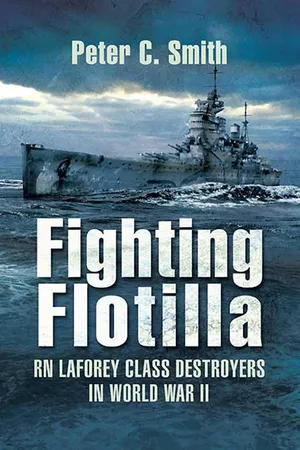
The Laforays were the largest, most powerfully armed and successful ships of this type to see frontline action with the Royal Navy in WWII. They were also the handsomest warships to see service and presented a perfect combination of power and speed. They were assigned to the most dangerous theaters of war including Force H, sailing between Gibraltar and Malta, from where they operated against the German supply lines to North Africa. They escorted minelayers into the German backyard in the North Sea and their convoy escort work in the North Atlantic proved them to be highly effective hunter killers of the U-Boat packs that threatened every cargo ship carrying vital supplies to the UK. Such was the pace of their war, that out of the eight ships of the class only one survived the war.The book also includes chapters on their origin, planning and building, wartime operations and indices cover weapon systems, general fittings and complements and battle honors for each ship in the class.
Chapter 1
The Origins of the Laforeys
By the late 1930s British disarmament policies brought about by bowing to American pressure at the Washington Conference and subsequent further futile retrenchments, had forced the Royal Navy to throw away a long established lead in the field of destroyer design and it was facing a difficult problem in attempting to make up for many years of neglect beyond its control. From the destroyer’s first inception with the little Havock of 1893, up to the superb ships of the V and W Classes, which joined the fleet towards the end of the First World War in 1918, it had been British destroyers that had been taken as the pattern for development by navies the world over, and this design had proved itself eminently satisfactory. True, during this long period, Germany had adopted several radical features for her destroyers which, on paper at least, gave their designs a better edge, but in the hard testing ground of war the British flotillas had proved to be in every way superior ships, both in their fighting ability and in their sea-worthiness.
However, in the aftermath of the Washington Naval Treaties of 1922, British destroyer design, stifled of funds, appeared to stagnate compared with new developments elsewhere. Restricted as the Admiralty was by these treaties and the further adoption of the myopic ‘Ten Year Rule’, instituted while Churchill was at the Treasury and which envisaged no major war for that period (and was further made doubly dangerous by a ‘receding’ clause so that this period of no foreseeable conflict stretched forward into infinity despite the rise of dictatorships in Europe), the Admiralty was forced to fight tooth and nail with the other two services for the limited scraps reluctantly made available by an all-powerful Treasury. Whatever monies came their way had to be carefully spread over the whole of the naval reconstruction programme and destroyers came behind capital ships and the 8-inch cruiser programme.
Therefore it was a policy directed to replacing over-age tonnage rather than any increase in power or numbers that was adopted, with the cheapest and most reliable form of torpedo carrier as its main spring. This enabled an annual programme to be initiated, after some testing of the two prototypes, Amazon and Ambuscade built in 1927, of eight destroyers and an enlarged Flotilla Leader. Thus were the A to I Classes produced in the period 1930–37. By the latter date the British Government had become further embroiled with even more limitations in the London Naval Treaties and thus this continuation of the A to I line found further favour in providing numbers of small destroyers and leaving special developments to the province of the heavier units of the fleet.
The average destroyer of this period then carried four single 4.7-inch guns in open shield mountings very little changed from the old V and W boats of two decades earlier. Arrangements of the most primitive kind had allowed the elevation of this weapon to be increased from 30 degrees to 40 degrees but they were designed as surface weapons and were therefore naturally of only limited value against aircraft. For close-range defence it had been decided to reject the 40-mm Bofors and the 20-mm Oerlikon quick-firing cannon, both of which appeared in the late thirties and were available to the Royal Navy, in favour of the traditional pom-pom developed during the First World War, and the 0.5-inch multiple machine gun, a weapon with neither range nor weight of shell. It was as torpedo carriers that the ‘Standard’ British destroyer of this era was built and they each carried twin sets of quadruple 21-inch torpedo tubes, but no re-loads.
In view of the criticism to which these flotillas were later put it is perhaps interesting, and not irrelevant to the origins of the Laforeys, to quote the opinion of seasoned destroyer officers who served in these boats, both at the time they were built and during the war. These were the men to whom the Admiralty was to turn when designing the Ls and they were the men who would have to fight the coming war in ships that they designed. The answers to questions on the merits or otherwise of the A to I Class destroyers from a selection of these officers therefore bear some study.
Among those who submitted valuable opinions to me were Admiral Sir Richard Onslow, Admiral Sir Deric Holland-Martin, Rear Admiral C.D. Howard Johnston, Captain Edward Gibbs, Captain F.S. de Winton, Commander The Rt Hon. Sir Allan Noble, Commander W.K. Cornish-Bowden and Commander C.A. de W. Kitcat.
It was my old friend Captain Gibbs who wrote that:
There are three essential qualities in a destroyer; sea-worthiness, battle-worthiness and habitability. In that order. An otherwise battle-worthy ship is useless if she is only a fair-weather ship; a habitable ship is useless unless she is battle-worthy.
With this we must surely agree, and certainly the Italians and Germans greatly neglected sea-worthiness in order to concentrate on heavy guns or higher speeds, and they paid the price with ships that proved of little fighting value. The Americans combined the qualities of habitability and good modern armament with endurance, but their sea-keeping left much to be desired. Likewise the Japanese built the best destroyers in the world, and the most advanced in the 1930s as we will see, but they had the advantage of only having to concentrate on the Pacific Ocean, which made their problems of design much simpler than that which confronted the Admiralty. Nor were their hands tied by treaties as they had the good sense to withdraw from them in the interests of their own national security.
It is a much-quoted fact that British warships were built to fight anywhere in the world and despite becoming a hackneyed saying it none the less still had some validity in the 1930s although not so much as has since been placed on it. It was the opinion of all the above officers then that the current A to I destroyers met this condition by being excellent sea boats. ‘Incomparably better sea boats than the V and Ws’ was one comment.
Their only weakness in this respect lay in the fact that they were too short and heavy for’ard. They could therefore still bump, and very heavily at that, in a head sea and could suffer considerable structural damage unless their speed was most undesirably cut down.
Another officer wrote of how the A to I could be handled in wartime on the North Atlantic convoy routes, their ultimate testing ground.
The experiences of peacetime served me well in the war when I found myself recovering exhausted survivors out of the ocean or off an upturned lifeboat. One had to do it right and there was one moment or all was lost, the half dead men would slip out of reach. Backing up astern and edging in just so and no further did the trick, using the wind to help as all these destroyers flew into the wind when going astern and they had to be held so in one position, whereas with an approach bows-on, once the speed was down to four knots there was no control by the helm and the ships’ bows just fell off with the wind.
With regard to battle-worthiness the following varying opinions were expressed on 1930s destroyer types.
For their day I think the A to I Classes were very fine ships in every respect. Their gun, torpedo and ASDIC equipment, and control thereof, were excellent; their W/T and R/T equipment, their boilers, engines and all-round freedom from any kind of breakdown were excellent; in fact they were, for their day, very fine fighting machines, not as fast as some (as for example the Italians), but better all-round fighting machines in any kind of weather than most, and possessed of a good range of action. By modern standards of course their AA armament was pathetic, 0.5s and Lewis guns, though the 40 degree elevation of their main armament of 4.7s did make long-range barrage fire possible. In this connection however two things should be remembered (a) the aeroplane of those days was not what it later became, and (b) destroyers were designed to work with the fleet where the big ships did have controlled long range AA fire at their disposal.
Another officer wrote: ‘They all remained useless against highflying attackers.’
A third officer writing on this subject was asked whether or not he felt that this lack of AA firepower was discussed in the fleet before the war broke out in any depth, bearing in mind the Japanese system had by this time been developed far beyond what the British were not to achieve until the 1950s. He wrote:
I am sure that at times this was commented on, but no one seems to have taken it seriously. Although the Fleet Air Arm carried out many torpedo attacks it was assumed that the close-range armament was a sufficient defence. The danger of air attack on the fleet, apart from torpedocarrying aircraft, was, I am quite certain, hardly considered by most officers. There may have been far-sighted men who realised the lack of co-ordinated defence, but like some of the minor prophets, their voice was not heard! I remember the whole Mediterranean Fleet at Alexandria in 1936 firing at a ‘Queen Bee’ pilotless aircraft with marked lack of result. I had understood something of high-level bombing having been in 1933–34 at the receiving end in the-target ship Centurion, but I do not think that before the war I had ever heard of the Stukas. I do not suppose that I was alone in that, and I think you can take it that air defence was sadly neglected.
The Stuka dive-bomber certainly was to do more than any other weapon in Germany’s armoury to destroy the ranks of the A to I Class destroyers during the first two years of the war, but it was a short-range aircraft and the thought that France would collapse after only a few days of warfare and thus provide the Luftwaffe with bases on the Royal Navy’s doorstep was of course beyond consideration before the war. However it had already demonstrated its effectiveness against ships in Spanish ports during the Civil War in 1938–39 and it is therefore surprising to learn that although the Navy was caught up on the fringes of this war the potential of the dive-bomber escaped it. AA defence, or rather lack of it, was of course the major fault of these pre-war vessels as it later turned out, but at the time the opinion at command level seems to have been that they were adequately equipped.
Although the Germans, Japanese and Americans had slightly larger destroyers I do not think our ships were really at a disadvantage there as the lighter shell was easier to handle from the shell room to the gun breech and I think our rate of fire compared quite favourably.
The difficulties experienced by the Germans in the Arctic certainly confirmed this viewpoint. The Italians with their closed-in bullet-proof bridges also suffered, the open-topped British bridges being far more suited to night fighting in those pre-radar days as numerous examples showed during 1940–41. In this respect the design of the destroyers was perhaps compensated for by the excellent seagoing training which the pre-war flotillas underwent.
I think the flotilla system provided excellent training and I can confidently say that the manoeuvring ability of the flotillas pre-war was at a high peak pretty well throughout the thirties. A series of brilliant officers commanded the flotillas during that time. It should be noted that the loss of the Flotilla Leaders Codrington, Keith, Exmouth, Grenville and Hardy, all within the first nine months of the war was the main reason for the break-up of the system, which had proved ideal in peacetime. I can’t think of a superior system.
Yet another opinion expressed was:
It has been said that in the early thirties we were preparing to fight World War One all over again. This is an extremely unfair and misleading statement with a germ of truth in its origin. The final objective of a fleet is to fight and destroy another fleet, and it isn’t doing its job if it isn’t prepared to do so. A fratricidal war with the Americans was unthinkable but war with, and a fleet action against, the Japanese was not; and in those days our Home and Mediterranean Fleets were trained and ready for a fleet action. Now, in being ready for this, it should be plain to any thinking man that the battle efficiency of every individual ship must be as near 100% perfect as possible, and that if any given ship is ready for a fleet action then she is ready for any other kind of action as well. In fact, in the last four years or so before World War Two, when it was as plain as a pikestaff that Germany and Italy were going to be our first enemies (and that very soon), emphasis in the Mediterranean Fleet in which I was serving shifted from fleets during fleet exercises to personal initiative and the taking of risks with one’s ship at the highest speed on the darkest of nights. It was splendid training.
However not all aspects could be covered as another officer pointed out when discussing convoy work.
Had we taken convoys seriously between the wars something might have been organised on the lines of the later Escort Groups which developed rather than on flotilla lines, but there is no doubt that convoys wer...
Table of contents
- Front Cover
- Author
- Title Page
- Copyright Page
- Contents
- Foreword
- Acknowledgements
- Introduction
- Chapter 1 The Origins of the Laforeys
- Chapter 2 Planning and Building the Ships
- Chapter 3 The Tradition of Victory
- Chapter 4 The Leaders of the Flotilla
- Chapter 5 The Destroyers go to War
- Chapter 6 Fighting Force ‘K’
- Chapter 7 Sweeping the Med
- Chapter 8 The Final Actions
- Appendix 1 The Original Weapons System
- Appendix 2 The Fire Control System
- Appendix 3 General Fittings and Complements
- Appendix 4 Ships’ Battles, Battle Honours and Commanding Officers
- Glossary
Trusted by 375,005 students
Access to over 1.5 million titles for a fair monthly price.
Study more efficiently using our study tools.
Information
Publisher
Pen & Sword MaritimeYear
2010Topic
HistoryPrint ISBN
9781848842731
Subtopic
Military & Maritime HistoryeBook ISBN
9781844687701
Index
HistoryFrequently asked questions
Yes, you can cancel anytime from the Subscription tab in your account settings on the Perlego website. Your subscription will stay active until the end of your current billing period. Learn how to cancel your subscription
No, books cannot be downloaded as external files, such as PDFs, for use outside of Perlego. However, you can download books within the Perlego app for offline reading on mobile or tablet. Learn how to download books offline
Perlego offers two plans: Essential and Complete
- Essential is ideal for learners and professionals who enjoy exploring a wide range of subjects. Access the Essential Library with 800,000+ trusted titles and best-sellers across business, personal growth, and the humanities. Includes unlimited reading time and Standard Read Aloud voice.
- Complete: Perfect for advanced learners and researchers needing full, unrestricted access. Unlock 1.5M+ books across hundreds of subjects, including academic and specialized titles. The Complete Plan also includes advanced features like Premium Read Aloud and Research Assistant.
We are an online textbook subscription service, where you can get access to an entire online library for less than the price of a single book per month. With over 1.5 million books across 990+ topics, we’ve got you covered! Learn about our mission
Look out for the read-aloud symbol on your next book to see if you can listen to it. The read-aloud tool reads text aloud for you, highlighting the text as it is being read. You can pause it, speed it up and slow it down. Learn more about Read Aloud
Yes! You can use the Perlego app on both iOS and Android devices to read anytime, anywhere — even offline. Perfect for commutes or when you’re on the go.
Please note we cannot support devices running on iOS 13 and Android 7 or earlier. Learn more about using the app
Please note we cannot support devices running on iOS 13 and Android 7 or earlier. Learn more about using the app
Yes, you can access Fighting Flotilla by Peter C. Smith in PDF and/or ePUB format, as well as other popular books in History & Military & Maritime History. We have over 1.5 million books available in our catalogue for you to explore.