eBook - ePub
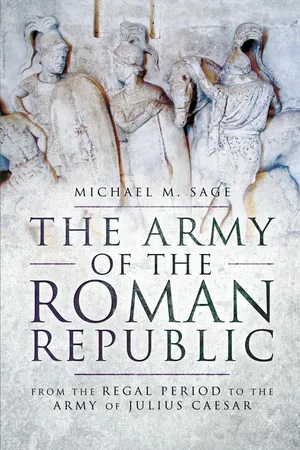
The Army of the Roman Republic
From the Regal Period to the Army of Julius Caesar
- 352 pages
- English
- ePUB (mobile friendly)
- Available on iOS & Android
eBook - ePub
About this book
From the moment its last king was expelled (traditionally in 753) the Roman republic had to fight for its very survival. Centuries of almost continuous warfare saw Romes armies evolve in response to a wide variety of threats which were met with mixed fortunes though always with ultimate success. As defence of the homeland turned to territorial expansion, Roman forces also had to adapt to sustained campaigns in varied terrain and climates, not to mention the changes in the Roman republic itself. Michael Sage traces the development of the republics army from its foundation (having first set the context of their regal antecedents), down to the time of its most famous leader, Julius Caesar. The transition from clan-based forces, through the Servian levy and the development of the manipular and cohortal legion is examined along with the associated weapons, tactics and operational capabilities. We see how the legions shaped up against the challenges of successive enemies from the Celts and Samnites, the Carthaginians and the hitherto-dominant Hellenistic armies based on the Macedonian-style pike phalanx.
Information
CHAPTER ONE
THE SOURCES
Any attempt to trace the history and development of the Roman army during the regal period and the Republic faces serious difficulties, particularly with the literary sources that are fundamental to any reconstruction of the Greek army organization, tactics, and strategy.
The major sources for the history of early Rome and its army are Livy and Dionysius from Halicarnassus in southwestern Asia Minor. The texts of both suffer from a number of gaps. Of the 142 books of Livy, 1 to 10 and 20 to 45 are extant. The founding of the city, the period of the monarchy, the early Republic and the conquest of Italy to 293 are contained in books 1 to 10. Books 21 to 45 narrate the Second Punic War and the expansion of Rome into the Greek world until the middle of the second century.1 The rest is lost, although we do have material that gives us at least some idea of what Livy wrote in the lost books. These include the Periochae, which is a summary of Livy’s work of uneven quality, but does contain material from the lost books. In addition, there is a short summary of books 37 to 40 and 48 to 55 known as the Epitome. Dionysius’ history consisted of twenty books. 1 to 11 have survived. They cover much the same ground as Livy and end in 444.2 The quality of his information in 1 to 11 varies with the sources he used. There are also quotations from the last ten books in the works of later authors, which on occasion supply valuable information. However, there are clear differences between Livy and Dionysius that indicate that, at times, they used different sources.
Both wrote towards the end of the first century under Augustus and at about the same time. They were far removed in time from the events they narrated. And this has had an effect on their presentation of the army. Their picture of the earliest army is basically that of the army of the second century and so whatever their value for other aspects of the beginnings of Roman history, their portrait of the Roman army before 200 is an uncertain value and must be approached with caution.3 A further problem is that for the most part they were uninterested in the technical aspects of warfare, as was the case with ancient history writing in general. There are occasional exceptions to this indifference, but they mostly concern modifications to weapons such as changes in the javelin (pilum) attributed to Marius and Caesar, and seem to be more the product of interest in well-known historical figures than in military weaponry.
Besides Dionysius, the work of another Greek author who covered Rome’s early history survives in part: Diodorus Siculus writing in the late first century. He wrote a ‘universal history’ in forty books.4 Its focus is Sicily and the western Mediterranean, especially Rome. It covered world history from the beginning until about 60. Books 1 to 5 and 11 to 20 have survived. Books 17 to 20 cover events from Alexander the Great’s successors to about 300. There are also citations of the lost books in later authors that are of use. The work is of variable quality as Diodorus was not an original author, but copied earlier historians, many of whose works are now lost. The quality of his information varies with the worth of his source.
History writing in Rome first makes its appearance during the Second Punic War (218–201) with the work of Fabius Pictor. It is indicative of the Greek origin of Roman history writing that he wrote in Greek rather than Latin. He seems to have arranged his work year by year starting with the origin of the city down to his own time. It is no longer extant but was quoted and clearly used by later writers including Livy and Dionysius. The first history in Latin was written by Cato the Elder and did not appear until the 170s. Cato was followed by a series of writers who related the history of the city year by year and are collectively known as the ‘annalists’. Their works were of differing quality. Little of these histories survive beyond quotations in later writers, especially Livy, and it is clear that some of them fabricated many of the events they describe. Almost all of them were senators and tended to enhance the role of the senate in their histories.5
The sources available to these historians were fairly numerous. Among them were narrative histories by non-Romans. There was a Greek tradition stretching back to the end of the fifth century including a mention of Rome’s sack by the Gauls in 390 in Aristotle. Of particular importance was the history of Timaeus from Sicily (356–260). His Histories, in thirty-eight books, formed a crucial basis for later narratives from the early period.6 It primarily focused on the history of Sicily but touched upon events in Italy, Libya, and elsewhere in the west Mediterranean. Timaeus began his history in mythological times and took it down to either the end of the Pyrrhic War in 275 or the beginning of the First Punic War in 264. His interest in Rome is noticeable and seems to stem from the greater interest in Rome in the Greek world as a result of her victory in the war against Pyrrhus (280–275). He accepted the story that Rome was a Greek city and synchronized its founding with that of Carthage. Timaeus is important because of his influence on Fabius and others; his work has not survived, but quotations from it in other writers can be used to partially reconstruct it. There are also other Greek historians who dealt with Rome, whose accounts are also not extant.
Out of these diverse sources the ancient Roman historians forged what was for the most part an internally consistent version of Rome’s early military history. There are variations and contradictions in this account, but the broad outlines of this narrative appear to have been fixed fairly early and have remained essentially unchanged in later writers. That still leaves open the question of its trustworthiness. It is now generally accepted that the main lines of this tradition are valid, but not its details which must be evaluated on their own merits, on the basis of their agreement with other types of evidence, and also on the grounds of their inherent plausibility. This is vital for the history of Rome’s armed forces as military developments and achievements seem to have been particularly subject to later elaboration and falsification.
The most important source for the Roman army of the mid-Republican period is the sixth book of Polybius’ Histories, which chronicles the rise of Rome to a world power and the gradual intertwining of events in the eastern and western Mediterranean.7 The work covered the period from the start of the First Punic War (264) down to 146. Originally in forty books only the first five books have survived intact. The rest have to be pieced together from quotations in other writers. Among them is Livy who depended heavily on Polybius for his account of the Second Punic War and for political events in mid-second century Rome.
Polybius, who lived from 200–118, came from Megalopolis (modern Megalopoli) in Achaea in the central Peloponnese. His father was a leading politician in the Achaean League and Polybius himself had both political and military experience.
After the Roman defeat of the Macedonian king Perseus in 167 in the Third Macedonian War (171–168), Polybius along with a thousand other Achaeans was deported to Rome as a hostage. At Rome, Polybius became close friends with Scipio Aemilianus, the son of the conqueror of the last Macedonian king Perseus and the adopted grandson of Scipio Africanus, the conqueror of Hannibal. Their close relationship gave Polybius access to some of Rome’s most powerful and aristocratic families. In 151 he travelled with Scipio and was present with him during the siege and destruction of Carthage in 146. Polybius is a valuable witness not only because of his military experience (he had already written a work on tactics), but also because of his careful evaluation of the events he covered in his work. His history is far superior to any other source for the army of the mid-Republic.
Also significant is the work of Appian. He was born in Alexandria between AD 90 and 95 and died in Rome in AD 160. He wrote a vast work, which he entitled Roman History, that covered material from the reigns of the Roman kings until the early second century AD. It focused on Roman wars and was organized by the peoples and kings with whom Rome fought, as well as being arranged chronologically. There is also an important section on the Roman civil wars of the last century BC. Extensive fragments of the history have survived. Sometimes they offer invaluable information. For instance, the five books on the civil war period provide the only full and detailed source on this period that is available. In general, the work is useful but must be used with caution and compared with other available sources when possible.8
The first century produced in Julius Caesar’s (100–44) Gallic War and Civil War, the only contemporary account of a Roman war written by the commander himself.9 The Gallic War consists of seven books written by Caesar covering 58–52, with an eighth book added by Aulus Hirtius, who had been a lieutenant of Caesar’s in Gaul. His book took events down to 50 on the eve of the outbreak of the civil war.10 It seems likely that each year’s campaign was written up after the campaigning season ended, and there is no reason to doubt the truth of the events in the Gallic War. Caesar’s lieutenants, his political friends and enemies must have been well informed on the course of the war and could have easily exposed wholesale fabrication. Rather, the work’s purpose is to depict Caesar in the best possible light as an ideal commander. This had a political purpose, which was to convince the Roman public that Caesar’s accomplishments in Gaul merited his election to further office.
Caesar’s Civil War continued the narrative down to 48. Three books survive, the third of which breaks off mid narrative, but there is no reason to think that further work was written and lost. Unlike the Gallic War, the purpose and time of composition are uncertain, but again the narrative presents Caesar as an incredibly effective commander who was ready to pardon his enemies if they ceased to be a threat. The work as a whole is sketchier and less accurate than the Gallic War. It was continued by later writers; Hirtius seems to have added an account of the civil war in Egypt, while the narratives of the wars in Africa and Spain – which are of lower quality – are by unknown writers.
Caesar’s accounts were not formal history but rather written in a form that the Roman called a commentary. Historical works were composed within a moralistic framework and with conscious literary art. The commentary was bare of rhetorical decoration and not directed to the reader’s moral improvement. It developed from memoranda, official dispatches and administrative reports which commanders and governors sent back to the senate to report on their activities. It could serve as a source for the writing of a formal history. A clear example is provided by the request by Cicero to his friend Lucceius to write a history of his consulship. Cicero promises to supply his commentary on his consulship so that Lucceius can use it as a basis for his history.11 By the generation before Caesar, publication of such factual accounts of their achievements by the elite had developed into a means of self-promotion and justification and as a way to enhance the influence and standing of their families.
Besides narrative histories, the lives of Plutarch are a valuable resource. Plutarch lived from AD 45 to sometime after AD 120 in a small town in central Greece. During his life he travelled to Rome and was given an honorary office by the Roman government. His literary output was enormous. He wrote on philosophy, religion and many other topics. From the historical point of view, his most important work is the Parallel Lives. It is a series of forty-six biographies that pair together important Greeks and Romans; their main purpose is the moral improvement of Plutarch’s readers, but they contain valuable historical information. In some cases, these lives are the most detailed sources we have.
Further, we have an account of the war against the Numidian prince Jugurtha (111–105), written by Sallust. During the civil war he had joined Caesar and fought for him in Africa. As a reward Caesar made him governor of one of the African provinces. However, he was charged with extortion and Caesar had to intervene to have the charges dropped. After Caesar’s assassination he dropped out of politics and devoted the rest of his life to writing history. He wrote a number of works but the War against Jugurtha is of special importance in a discussion of the late Republican Roman army.12
The main historical tradition embodied in Livy and Dionysius presents a static picture, based on the army of the second century. Polybius’ history forms a major exception to the general lack of interest shown in the technical side of warfare. His detailed discussion of the organization and equipment of the contemporary Roman army in Book VI, and his comparison of the manipular formation to the Macedonian phalanx in Book XVIII, as well as in his accounts of the major battles and scattered comments throughout the rest of his work, offer detailed information on Roman army organization, weapons and tactics.
Other literary sources are also useful. Plays which began to be shown on the stage in Rome from the middle of the third century provide valuable evidence. These plays, such as Plautus’ Amphitruo (produced around 189), although based on Greek originals, contain important information on the ideological views of war as well as occasional details of army life and individual solders in action. The Amphitruo provides the earliest account we have of a Roman army in battle. Occasional references in poems provide further information, much of it earlier than the extant prose histories. Gnaeus Naevius, who died towards the end of the third century, composed an epic poem on the First Punic War containing the earliest account of a Roman war, and had first-hand experience of the war since he had fought in it. The first extended treatment of Roman warfare was Quintus Ennius’ (239–169) monumental poem the Annales, basically a history of Rome from the founding of the city to 189 in verse. It was written late in life and became almost a Roman national poem. The poem has occasional references to military equipment which are useful in reconstructing the army of the late third and early second centuries.
The surviving quotations from antiquarian writers provide the basis for much of our understanding of early military organization and tactics. They were a product of the last two centuries of the Republic. The greatest antiquarian of them all was Marcus Terentius Varro, who flourished towards the end of the first century.13 Antiquarians were interested in the origins and development of institutions and especially in the history and development of language. They supply much of the evidence for early weapons and army structure. Unfortunately, none of their works survive, but quotations are found in later writers. It is likely that antiquarian sources lie behind the digressions on the sixth century Servian army in Livy, Cicero and Dionysius of Halicarnassus. The fragmentary nature of most of the material and its narrow focus prevents it from offering a coherent account. At most it can serve as a starting point for the ...
Table of contents
- Cover
- Dedication
- Title
- Copyright
- CONTENTS
- Introduction
- 1. The Sources
- 2. The Army of the Kings
- 3. A Time of Troubles
- 4. Recovery and Expansion
- 5. A New Model Army I
- 6. A New Model Army II
- 7. The Army on Campaign I
- 8. The Army on Campaign II
- 9. A Newer Model Army
- 10. The Late Republican Army
- Notes
- Select Bibliography
- Plate section
Trusted by 375,005 students
Access to over 1.5 million titles for a fair monthly price.
Study more efficiently using our study tools.
Frequently asked questions
Yes, you can cancel anytime from the Subscription tab in your account settings on the Perlego website. Your subscription will stay active until the end of your current billing period. Learn how to cancel your subscription
No, books cannot be downloaded as external files, such as PDFs, for use outside of Perlego. However, you can download books within the Perlego app for offline reading on mobile or tablet. Learn how to download books offline
Perlego offers two plans: Essential and Complete
- Essential is ideal for learners and professionals who enjoy exploring a wide range of subjects. Access the Essential Library with 800,000+ trusted titles and best-sellers across business, personal growth, and the humanities. Includes unlimited reading time and Standard Read Aloud voice.
- Complete: Perfect for advanced learners and researchers needing full, unrestricted access. Unlock 1.5M+ books across hundreds of subjects, including academic and specialized titles. The Complete Plan also includes advanced features like Premium Read Aloud and Research Assistant.
We are an online textbook subscription service, where you can get access to an entire online library for less than the price of a single book per month. With over 1.5 million books across 990+ topics, we’ve got you covered! Learn about our mission
Look out for the read-aloud symbol on your next book to see if you can listen to it. The read-aloud tool reads text aloud for you, highlighting the text as it is being read. You can pause it, speed it up and slow it down. Learn more about Read Aloud
Yes! You can use the Perlego app on both iOS and Android devices to read anytime, anywhere — even offline. Perfect for commutes or when you’re on the go.
Please note we cannot support devices running on iOS 13 and Android 7 or earlier. Learn more about using the app
Please note we cannot support devices running on iOS 13 and Android 7 or earlier. Learn more about using the app
Yes, you can access The Army of the Roman Republic by Michael Sage in PDF and/or ePUB format, as well as other popular books in History & Ancient History. We have over 1.5 million books available in our catalogue for you to explore.