- 160 pages
- English
- ePUB (mobile friendly)
- Available on iOS & Android
eBook - ePub
Airfields and Airmen: Ypres
About this book
The Battleground Europe series has helped create a new audience for the story of the desperate battles of World War I, But up to now the series has largely been concerned with the ground war. Popular demand has inspired the editors to create a new series of guides to the air war 1914–1918. The first volume is devoted to the Ypres Salient, the northernmost sector of the Western Front. Here the Royal Flying Corps battled the German Imperial Air Service for supremacy over the battlefield, while the Royal Naval Air Service attempted to intercept Germany's Zeppelins and early long-range bombers before they could reach the skies over London.The airfields, battle and crash sites, and monuments associated with the air war in the Ypres sector are covered with all the then-and now detail expected by battleground Europe readers. The dramatic text is backed up with numerous maps, photographs and an extensive bibliography.
Information
Chapter One
YPRES: THE WESTERN AREA
The first tour of the Ypres area encompasses all elements of the air war from the First Battles of Ypres, namely October 1914, through to the Third Battle of Ypres 1917, thence onto the German offensive of 1918 and to the final Allied advance of late summer 1918. On this tour the places that will be visited, with the principal points of interest, are:
Ypres Reservoir Cemetery - a mid-air collision
Vlamertinghe Military Cemetery - Sergeant Tooms, 41 Squadron
Vlamertinghe New Military Cemetery - Eric Reiher, Jasta 6
Lijssenthoek Military Cemetery - Lieutenant Colonel D S Lewis
Abeele Aerodrome - Lanoe Hawker and the first air combat VC
Bailleul Communal Cemetery Extension - Thomas Mottershead VC
The Bailleul Aerodromes - 1 Squadron and the Nieuport scout
The Huts Cemetery - McCudden’s seventeenth victory
Vlamertinghe Military Cemetery - Sergeant Tooms, 41 Squadron
Vlamertinghe New Military Cemetery - Eric Reiher, Jasta 6
Lijssenthoek Military Cemetery - Lieutenant Colonel D S Lewis
Abeele Aerodrome - Lanoe Hawker and the first air combat VC
Bailleul Communal Cemetery Extension - Thomas Mottershead VC
The Bailleul Aerodromes - 1 Squadron and the Nieuport scout
The Huts Cemetery - McCudden’s seventeenth victory
It is fitting that the tour starts from the centre of Ypres, the Grote Markt.
Leave the Grote Markt to the left of the Town Hall, following Korte Torhoutstraat and then turn left along Lange Torhoutstraat until the left turn down Hoge Wieltjesgracht. A few hundred yards on the left is Ypres Reservoir British Military Cemetery.
Ypres Reservoir Cemetery
It is best to park on the right off the road. The cemetery (5/29) is on a wide leafy road and from its green tranquil acres one can see the Cloth Hall and St Martin’s Cathedral. It is built on the northern edge of what had been the town prison and originally consisted of three cemeteries, which were later combined into one.
Entering by the furthest cemetery gate walk straight ahead to Plot 1 and the fifth row from the back of the cemetery, where are located the graves of Second Lieutenants John MacHaffie and Robert McKergow, both of 29 Squadron RFC. (graves 1 E15 and 1 E16)
29 Squadron and the Nieuport Scout
29 Squadron, who were based at nearby Poperinghe aerodrome, had arrived in France in March 1916 equipped with the De Havilland DH2 scout. A year later they received the French Nieuport scout. Casualties among squadrons during the summer of 1917 were heavy, particularly as 29 Squadron was still flying this aircraft, a fine machine in its day, but now badly outclassed by the faster and more heavily armed German Albatros scout. The Nieuport had developed through the types 16, 17, 23 and 27 but the performance increase had been minimal. Most pilots could not even tell the difference between the type 17 and the type 23. The RFC had also removed the belt fed Vickers machine gun, synchronised to fire through the propeller. They replaced it with an over-wing Lewis gun firing over the propeller, that required hauling down every time a pan of ammunition needed replacing. The strength to push the gun back up the rail against the slipstream was considerable, even without the distraction of combat. The RFC Lewis drums were twice the capacity of the standard infantry version, containing 97 rounds and were very heavy. In theory pilots were supposed to re-stow the empty drums and bring them back for reloading but in practice many simply threw them over the side rather than waste dangerous moments replacing them in the rack.
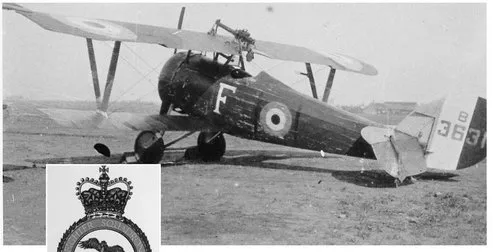
Nieuport Scout B3631 of 29 Squadron at Proven. Note the clumsy over-wing Lewis gun arrangement. This machine had previously flown with 1 Squadron RFC at Bailleul until damaged by a landing Sopwith Triplane.
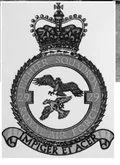
The 29 Squadron crest. Motto: Impiger et Acer (Energetic and Keen).
The rotary engine
Apart from the awkward gun arrangement, the difficulty of operating the fuel and ignition of the Le Rhone rotary engine, must have caused the loss of many an inexperienced pilot. The rotary had its stationary crankshaft bolted to the aeroplane, whilst the cylinders, with the propeller rigidly attached to the engine casing, rotated around it.
In the days of fairly basic engine design and manufacture it gave excellent power output for its size and weight. It was not a simple task, however, to provide ignition, fuel and lubrication to an engine that was whirring around at high speed, all of which made it difficult to control or regulate accurately. The rotary engine was in reality a blind avenue as there was a limit to the size of engine and mass of rotating metal, producing large gyroscopic forces, which an airframe could contain.
MacHaffie and McKergow (I E15 and I E16)
The loss of MacHaffie and McKergow was all the more tragic as it was due to a simple accident.
They had taken off from Poperinghe at 1245 hours in an eight-man patrol led by Lieutenant C W Cudemore during which a Kite Balloon was strafed to little effect and two German formations were observed, but were too far away to engage. The patrol returned after an uneventful hour and a half. Perhaps the relief of returning safely from another mission made them relax and in a moment of inattention they collided and spun to the ground locked together. In the days before parachutes mid-air collisions were nearly always fatal. Both pilots had only been at the front for just a month. McKergow, the son of a Colonel, had been lucky to survive five months as an observer in 1916 with 70 Squadron, at a time when the two-seater Sopwith One-and-a-Half-Strutter squadrons were suffering appalling casualties. MacHaffie hailed from Toronto and was a member of the great Canadian contingent in the British and Empire air services, which was out of all proportion to the number of Canadians serving on the Western Front. Perhaps the pioneering aspect of aviation appealed to the Canadian character, and certainly many of the top aces were Canadian. In the seesaw nature of aerial superiority the RFC struggled through most of 1917 with obsolete equipment and was compelled to hang on until better aeroplanes like the Sopwith Camel, SE5 and Bristol Fighter, arrived later in the year. With them the balance swung again in the Allies favour.
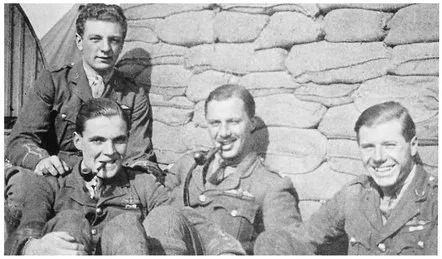
Officers of 29 Squadron at Poperinghe aerodrome in September 1917. Left to right: Captain A G Jones-Williams, Lieutenant H M Ferreira and Lieutenant C W Cudemore. At the rear is Lieutenant J Collier. Cudemore was leading the patrol during which MacHaffie and McKergow collided.
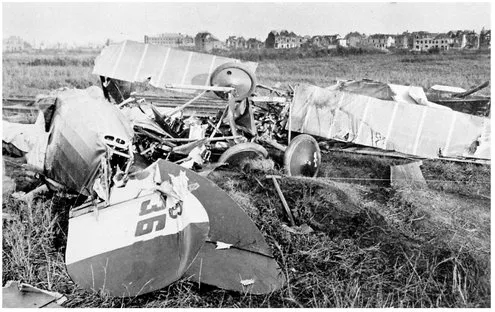
The remains of MacHaffie’s and McKergow’s Nieuport Scouts after their crash on 21 September 1917. The nearest machine, B3634, was that flown by McKergow.
Lieutenant R D G McKergow.

Continue along the road until Maarschalk Haiglaan and turn left to the roundabout and follow signs to Vlamertinghe via the N308. In the centre of Vlamertinghe turn right past the church to Vlamertinghe Military Cemetery, which is only a hundred yards or so on the right.
Vlamertinghe Military Cemetery
The gates of the cemetery (5/111) were donated by Lord Redesdale whose son, Major Mitford, is buried here. The first grave to be visited is that of Sergeant C S Tooms of 41 Squadron (V E15). The fliers’ graves are half way down the cemetery on the right hand side.
The FE8 fighter
In 1915 the British did not have synchronisation gear that enabled a machine gun to fire through the propeller. Two fighter machines were designed to overcome this problem. The first to fly, on 1 June 1915, was the Airco DH2, designed by Geoffrey de Havilland, and this employed a pusher arrangement with the propeller at the rear. The pilot sat ahead of the engine and thus had an unobstructed field of fire for his forward firing machine gun. On this type of machine you definitely did not throw empty Lewis drums over the side as they would fly back and smash the propeller. A severed blade inevitably would slice through one or more of the booms holding the tail on, with potentially lethal results. Even empty cartridge cases from the gun could cause damage to the spinning propeller. The first ever dedicated fighter squadron, No.24, commanded by Major Lanoe Hawker VC, DSO, arrived in France in February 1916 equipped with this type of machine.
FE8 ‘2’ of 41 Squadron. This was the machine belonging to Lieutenant Meredith Thomas (later Air Vice-Marshal).
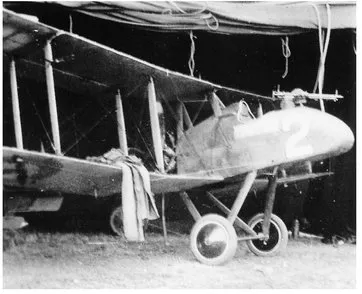
The second design to the same formula was the Royal Aircraft Factory’s FE8 and this was to be their first true single-seater fighter. One innovative feature was that the whole cockpit nacelle was manufactured as a welded steel frame with aluminium skinning instead of traditional wood and fabric. Unfortunately, by the time production was under way and the first unit equipped with it, No.40 Squadron, arrived in France in August 1916, the design was already out of date.
Sergeant C S Tooms of 41 Squadron (V E15)
The second unit to be fully equipped with the FE8 was 41 Squadron, who had arrived in France on 15 October 1916. Despite a number of engagements with the enemy they did not gain a confirmed victory until 24 January 1917, when Sergeant C S Tooms brought down an Albatros scout east of Zonnebeke.
The combat report filed by Tooms after scoring 41 Squadron’s first official victory.
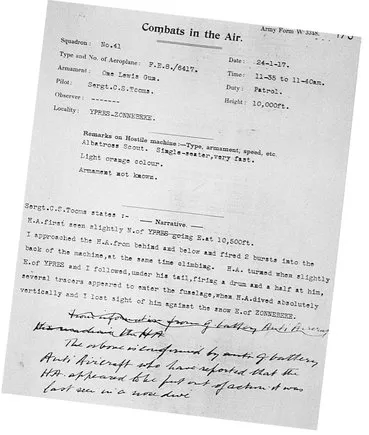
Cecil Stephen Tooms came from Northampton, and had served as an observer in 1 Squadron in early 1916 at Bailleul. He had obtained his Royal Aero Club aviator’s certificate, No.3757, on 26 October 1916. Tragically he would not enjoy the distinction of scoring 41 Squadron’s first victory for very long as only four hours later, while on patrol with Lieutenant C E V Porter, he died in an attack on two enemy scouts. The enemy scouts, identified as Rolands, were much faster. Tooms and Porter succeeded in driving one or other of the enemy off each other’s tail until Porter’s gun jammed and the enemy turned their attention onto Tooms, who was shot down and killed. He was the fifth and final victory of Vizefeldwebel Ulmer of Jasta 8. Porter survived the war and retired from the RAF in 1946 as an Air Vice-Marshal and with a CBE.

Sergeant C S Tooms of 41 Squadron.
Felix-Brown and Nason of 46 Squadron (V B10 and V B11)
Adjacent to Tooms is the crew of C A Felix-Brown and J W W Nason, who on Boxing Day 1916 had the dubious distinction of being the first casualties suffered by 46 Squadron, and were also brought down by Ulmer. They had taken off at 1030 hours from their aerodrome at Droglandt, a few miles north west of Poperinghe, on a photography mission. Perhaps they were too absorbed in their job and failed to see the enemy scout which attacked them from behind. The Nieuport two-seater side-slipped and then nose dived into the ground between the British first and second line trenches at Railway Wood, near Hooge. The wreckage was so close to the enemy line that 46 Squadron’s commanding officer felt it was not worth risking lives to recover it and the remains were abandoned. It was not all one sided however as another crew from 46 S...
Table of contents
- Other guides in the Battleground Europe Series:
- Title Page
- Dedication
- Copyright Page
- Table of Contents
- INTRODUCTION BY SERIES EDITOR
- ACKNOWLEDGEMENTS
- INTRODUCTION
- THE DEVELOPMENT OF MILITARY FLYING
- German ranks and their British equivalent
- Chapter One - YPRES: THE WESTERN AREA
- Chapter Two - YPRES: THE SOUTHERN AREA
- Chapter Three - YPRES: THE NORTHERN AREA
- Further Reading
- INDEX
Trusted by 375,005 students
Access to over 1.5 million titles for a fair monthly price.
Study more efficiently using our study tools.
Frequently asked questions
Yes, you can cancel anytime from the Subscription tab in your account settings on the Perlego website. Your subscription will stay active until the end of your current billing period. Learn how to cancel your subscription
No, books cannot be downloaded as external files, such as PDFs, for use outside of Perlego. However, you can download books within the Perlego app for offline reading on mobile or tablet. Learn how to download books offline
Perlego offers two plans: Essential and Complete
- Essential is ideal for learners and professionals who enjoy exploring a wide range of subjects. Access the Essential Library with 800,000+ trusted titles and best-sellers across business, personal growth, and the humanities. Includes unlimited reading time and Standard Read Aloud voice.
- Complete: Perfect for advanced learners and researchers needing full, unrestricted access. Unlock 1.5M+ books across hundreds of subjects, including academic and specialized titles. The Complete Plan also includes advanced features like Premium Read Aloud and Research Assistant.
We are an online textbook subscription service, where you can get access to an entire online library for less than the price of a single book per month. With over 1.5 million books across 990+ topics, we’ve got you covered! Learn about our mission
Look out for the read-aloud symbol on your next book to see if you can listen to it. The read-aloud tool reads text aloud for you, highlighting the text as it is being read. You can pause it, speed it up and slow it down. Learn more about Read Aloud
Yes! You can use the Perlego app on both iOS and Android devices to read anytime, anywhere — even offline. Perfect for commutes or when you’re on the go.
Please note we cannot support devices running on iOS 13 and Android 7 or earlier. Learn more about using the app
Please note we cannot support devices running on iOS 13 and Android 7 or earlier. Learn more about using the app
Yes, you can access Airfields and Airmen: Ypres by Michael O'Connor in PDF and/or ePUB format, as well as other popular books in History & Military & Maritime History. We have over 1.5 million books available in our catalogue for you to explore.