- 288 pages
- English
- ePUB (mobile friendly)
- Available on iOS & Android
eBook - ePub
About this book
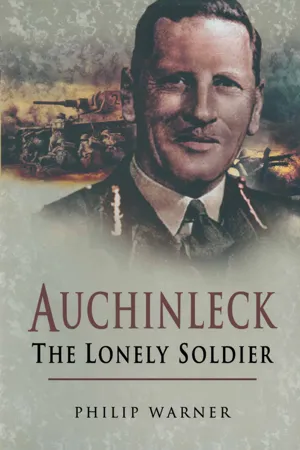
Field Marshal Sir Claude Auchinleck was born in India and raised in conditions of near poverty. Yet his talent ensured his career flourished despite his Indian Army background and he was the first Commander of 8th Army in North Africa. Despite great political interference, he stopped Rommel's Afrika Corps at 1st Alamein only to be sacked by Churchill. After a spell in the wilderness he became C in C India during the dark period of Partition and, ironically, had to preside over the destruction of his beloved Indian Army. A private man of great humour and integrity he refused to be drawn into discussing or criticising his tormentors be they Churchill, Montgomery or Mountbatten. He always argued that history would be his judge. This is a super piece of military biography by one of the most respected post war military historians.
Information
Topic
StoriaSubtopic
Storia africanaCONTENTS
Chronology
Introduction
1 Origins
2 India
3 War—1914–19
4 Unrest in India
5 Appalling Outlook—1938–40
6 ‘This Ramshackle Campaign’—Norway 1940
7 The Defence of England
8 ‘Generally Acclaimed’—C-in-C, India
9 ‘A New, Fresh Figure’—Middle Eastern Command
10 ‘Immensely Heartened’—The ‘Crusader’ Battles
11 ‘You Must Come Home’—Storm in the Desert
12 ‘These Critical Days’—Gazala and Mersa Matruh
13 ‘The Adverse Tide’—El Alamein and Dismissal
14 ‘A Good Day’—India Once More
15 A Changed World
16 The End of an Era
17 A New World
18 The Last of the Indian Army
19 A Long Sunset
20 The Dimbleby Interviews
21 Some Assessments
Appendices:
A Lessons of the Tirah Campaign
B Wellington College
C The Imperial Defence College
D The El Alamein Position
E A Correspondence in The Times
F The Auchinleck-Eadon Correspondence
Sources and bibliography
Index
MAPS
India before Independence
Mesopotamia, 1916–18
Norway, 1940
The Western Desert, 1941–42
Operation ‘Crusader, 18 November 1941–6 January 1942
The Retreat to Gazala, January–February 1942
Gazala, May–June 1942
The Retreat to El Alamein, June 1942
First Alamein, 30 June–27 July 1942
India and Pakistan, 1947
. . . I am become a name;
For always roaming with a hungry heart
Much have I seen and known; cities of men
And manners, climates, councils, governments,
Myself not least, but honour’d of them all;
And drunk delight of battle with my peers,
Far on the ringing plains of windy Troy.
From Ulysses, Alfred, Lord Tennyson
CHRONOLOGY
of the life and career of Field-Marshal
Sir Claude Auchinleck
Sir Claude Auchinleck
21 June 1884 Born at Aldershot 1896–1901 Wellington College
January–December 1902 RMA, Sandhurst
March 1903 Joins KSLI in India while awaiting posting in Indian army
April 1904 Joins 62nd Punjab Regiment
1906–7 Frontier duties at Gyantse, Tibet
1907 Commands 2nd Detachment, Sikkim
1908 Benares
1909 Captain and Adjutant
1912 Assistant Recruiting Officer, North Punjab
4 August 1914 Outbreak of First World War
28 October 62nd sail for France, but diverted to defend Suez Canal
3 February 1915 62nd drive off Turkish attack on Canal
12 July 62nd embark for Aden
21 July Sheikh Othman battle—Turks defeated Operations against Turks and Arabs
31 December 62nd land at Basra for Mesopotamian campaign
7 January 1916 Join forces under Gen Aylmer attempting to relieve Maj-Gen Townshend’s division besieged in Kut-al-Amara
8 January 62nd in Sheikh Sa’ad battle
21 January Attack on Hanna Redoubt. 62nd suffer heavily. A. made Acting Adjutant
8 March Attack on Dujaila Redoubt. After heavy casualties and death of Lt-Col Commanding A. takes command of remaining 12 officers and 235 ORs
29 April Townshend surrenders Kut with 12,000 prisoners
August 1916–March 1917 62nd in operations (now under Gen Maude) to recapture Kut. A. temporary Regimental Commander 8 February 1917. Fall of Baghdad 11 March 1917. Operations north of Baghdad
Summer 1917 A. Brigade Major to 52 Brigade
2 November 1918 Turkey signs Armistice
Summer 1919 GS02 in Mosul
August 1919 GSOl operations in Kurdistan
Late 1919 Promoted Brevet Lt-Col, sent to Staff College, Quetta on 1 year’s course
Late 1920 1 year’s home leave. Married Jessie Stewart of Kinloch Rannoch, Scotland, 1921
1921–25 DAA and QMG, Simla
1925–27 2 i/c 1/1st Punjabis (formerly 62nd Punjabis)
1927 1 year’s course at Imperial Defence College, London
1929–30 CO 1/1st Punjabis. Promoted full Colonel
1930–33 Instructor, Staff College, Quetta
1933–36 Commander, Peshawar Brigade. Operations against Upper Mohmands, 1933. Promoted Brigadier. Operations against Mohmands, 1935
1936–8 DCGS, Army HQ, India. Promoted Major-General
1938 Commander, Meerut District. Member, Expert Committee on the Defence of India (Chatfield Committee), October 1938
January 1939 To London to complete Chatfield report
3 September 1939 Declaration of war. A. in Scotland on leave
October 1939 Resumes command of Meerut District
January 1940 Return to England to take command of IV Corps, destined for France. Promoted Lieutenant-General
April Appointed GOC-in-C, Northern Norway
10 May Sails for Norway
27–28 May Allies capture Narvik
3–7 June Allied evacuation of Norway. Dunkirk evacuation ends on 3rd
9 June Norway surrenders
14 June Takes command of V Corps, Southern Command. Germans enter Paris
19 July-21 November GOC-in-C, Southern Command. Maj-Gen Montgomery takes over V Corps
January 1941 Arrives in India to take over from Gen Cassels as C-in-C, with rank of General and knighthood (GCIE)
April-May Rashid Ali revolt in Iraq. Battle at Habbaniya. Actions against Vichy French in Syria (Vichy surrender in Syria 11 June)
15–18 June Failure of Gen Wavell’s ‘Battleaxe’ offensive in W. Desert. Tobruk still cut off (since April) and Allies driven back to frontier
30 June A. arrives in Cairo to take over from Wavell as C-in-C, Middle Eastern Command
31 July-10 August A. in London for discussions with Churchill and COS
26 September Western Desert Force renamed Eighth Army
18 November 1941–6 January 1942 ‘Crusader’ (Sidi Rezegh) offensive. Rommel pushed back to El Agheila, Tobruk relieved, Benghazi, Bardia and Halfaya retaken, Cyrenaica cleared of Germans.
25 November 1941 Lt-Gen Cunningham replaced by A. during Sidi Rezegh battles; Acting Lt-Gen Ritchie takes over command of Eighth Army
21 January 1942 Rommel counterattacks
29 January Rommel retakes Benghazi. Ritchie falls back on Gazala line. German advance halts on 2 February
7 March A. ordered to London— refuses and continues to refuse
20 March Cripps and Gen Nye visit A. in Cairo on Churchill’s orders. They confirm sense of A.’s plans
26 May Rommel attacks Gazala line
29 May–11 June Ritchie fails to drive Rommel from the Cauldron, and suffers heavy losses. 150 Brigade overrun and Gazala line breached. Bir Hacheim lost
12–14 June ‘Knightsbridge’ box battles— Ritchie orders withdrawal from Gazala line
14 June A. orders line west of Tobruk to be held. Pre-empted by Ritchie, who decides to fall back to frontier. Beginning of ‘Gazala Gallop’
20 June Tobruk cut off—Ritchie decides to fall back beyond frontier to Mersa Matruh
21 June Tobruk captured with loss of 33,000 Allied prisoners
25 June A. dismisses Ritchie and personally takes command of Eighth Army
25–29 June Holding action at Mersa Matruh (falls 29 June). Eighth Army falls back on El Alamein
1–27 July First Alamein. A. checks Rommel then counter-attacks, causing havoc, notably among Italians. British positions strengthened
27 July Eighth Army goes back onto defensive
3 August Churchill, Brooke, Smuts and Wavell arrive in Cairo to discuss Middle East command situation
5 August Churchill decides to replace A. with Gen Alexander as C-in-C, with Maj-Gen Gott in command of Eighth Army
7 August Gott killed. Montgomery chosen as Eighth Army commander
8 August A. notified, by letter, of his dismissal
12 August Montgomery arrives in Cairo. Takes over command of Eighth Army on next day, though official hand-over date fixed for 15th
15 August A. hands over officially to Alexander, and leaves for India
August 1942–June 1943 A. in India without formal position, having refused Iraq-Persia Command
30 August–1 July 1942 Second Alamein (Alam Halfa)
18 June 1943 A. appointed C-in-C India for the second time with effect from the 20th, with Wavell as Viceroy
24 August Formation of SE Asia Command, with Mountbatten as Supreme Commander. Indian Army operations in Burma and other theatres
8 May 1945 Unconditional surrender of Germany
June All-Party Conference in India. Jinnah proposes separate Pakistan
July General Election in Britain. New Labour government formed under Attlee
6 and 9 August A-bombs on Hiroshima and Nagasaki
14 August Unconditional surrender of Japan
November Start of trials in Delhi of former members of Indian National Army
1945–1946 General elections in India confirm desire for independence
January–February 1946 Strikes at RAF stations in India. Mutiny of Royal Indian Navy at Bombay. Rioting in Calcutta in support of ex-INA soldiers
April British Cabinet Mission to India. Publishes proposals in May for transfer of power—rejected by Jinnah
1 June Auchinleck promoted Field- Marshal. Divorce from wife announced.
16 August Muslim League’s ‘Direct Action Day’. Severe rioting in Calcutta and elsewhere. Visit of F-M Montgomery, now CIGS
20 February 1947 Announcement by British government for date for transfer of power—‘not later than June 1948’. Mountbatten succeeds Wavell as Viceroy
March Violence in Punjab. Date for transfer brought forward by Mountbatten to 31 December 1947
4 June Mountbatten advances date again to 14 August 1947
23 June Second visit of Montgomery
18 July Indian Independence Bill becomes law. A. now Supreme Commander of armed forces of India and Pakistan
14/15 August Last Indian Army order. Indian Independence and Partition. Nehru Prime Minister of India, Mountbatten Governor-General. Liaquat Ali Khan Prime Minister of Pakistan, Jinnah Governor-General
August–September Punjab massacres
29 August Dissolution of Boundary Force, the last of the old Indian Army. Opinion in India and Pakistan hardens against post of Supreme Commander. Mount batten writes to A. suggesting he begin to wind up Supreme HQ
27 September A. offered peerage, which he refuses
October A. prevents Jinnah’s attempted take-over of Kashmir, which accedes to India
30 November Supreme HQ closed
1 December A. leaves India
1948–67 A. in Italy, London and Beccles. Moves to Marrakech in 1967
1974 Interviewed by David Dimbleby for BBC TV production The Auk at 90 (1975)
1976 Further interviews with Dimbleby
23 March 1981 A. dies at his home in Marrakech
5 June Memorial Service in Westminster Abbey
INTRODUCTION
In 1884, when a son was born to Colonel John Auchinleck, no one of military background expected the boy to become a general, still less a commander-in-chief. Anyone who thought that either he himself, or his son, might become a field-marshal would probably be considered to have been affected by the sun in one of the less attractive stations of his service. But Auchinleck’s boy, christened Claude John Eyre, was destined to be just that, and more; three times a commander-in-chief, an honoured field-marshal, he would also be, in the eyes of many, the best general of the Second World War.
Yet the man who was to become so skilled at seeing and defeating his country’s enemies would be sadly inept at perceiving and frustrating his own. His nature, however, would be such that he would bear neither resentment nor malice against fate and its instruments. He would be endowed with a magnanimity which would forgive, though not forget, and with a temperament which would exclude any form of self-pity; from his origins and his experience he would fashion a spirit at once humble yet self-sufficient, austere yet tolerant. An honest ambition to excel would bring him some of the richest rewards of service, and it would also bring him three blows each of which, singly, might have broken the spirit of a lesser man.
It might seem that a man who achieves the rank of field-marshal and lives to an advanced age in good health, admired and loved, has no cause for sorrow or regrets, and certainly Auchinleck displayed neither. But it cannot be easy to suffer the frustration of having one’s achievements credited to another while being pushed oneself towards obscurity; to lose one’s wife, after twenty-four years, to a friend and fellow commander; and then to be given the task of presiding over the destruction of an army to which one has given a lifetime. All these might seem ample reasons for bitterness, but there was none.
I have tried to show both the causes and the effects of Auchinleck’s magnanimity. He was not a saint, and would have been horrified to have been thought so; for all his courage and skill he could be obstinate and, perhaps, over-fatalistic, and his kindness to others would lead to the sometimes well-founded charge that he ‘could not pick his subordinates’. Those who hold that belief will cite his choice of Cunningham, Ritchie, Corbett, Dorman-Smith, perhaps forgetting that he also chose de Guingand, that Ritchie retrieved and convincingly won ‘Crusader’, and that under Auchinleck were formed or flourished the Long-Range Desert Group, the ‘Jock Columns’, the Special Air Service, and the Chindits—all of them well established among the legends of warfare.
In the end, Auchinleck was a soldier, an ‘honest-to-God soldier’; in that, perhaps, lie the seeds of his loneliness. Superbly professional, his grasp of a battle, and his command of often ill-trained and ill-equipped— and som...
Table of contents
- Cover
- Half-Title
- About the Author
- Title
- Copyright
- Contents
Trusted by 375,005 students
Access to over 1.5 million titles for a fair monthly price.
Study more efficiently using our study tools.
Frequently asked questions
Yes, you can cancel anytime from the Subscription tab in your account settings on the Perlego website. Your subscription will stay active until the end of your current billing period. Learn how to cancel your subscription
No, books cannot be downloaded as external files, such as PDFs, for use outside of Perlego. However, you can download books within the Perlego app for offline reading on mobile or tablet. Learn how to download books offline
Perlego offers two plans: Essential and Complete
- Essential is ideal for learners and professionals who enjoy exploring a wide range of subjects. Access the Essential Library with 800,000+ trusted titles and best-sellers across business, personal growth, and the humanities. Includes unlimited reading time and Standard Read Aloud voice.
- Complete: Perfect for advanced learners and researchers needing full, unrestricted access. Unlock 1.5M+ books across hundreds of subjects, including academic and specialized titles. The Complete Plan also includes advanced features like Premium Read Aloud and Research Assistant.
We are an online textbook subscription service, where you can get access to an entire online library for less than the price of a single book per month. With over 1.5 million books across 990+ topics, we’ve got you covered! Learn about our mission
Look out for the read-aloud symbol on your next book to see if you can listen to it. The read-aloud tool reads text aloud for you, highlighting the text as it is being read. You can pause it, speed it up and slow it down. Learn more about Read Aloud
Yes! You can use the Perlego app on both iOS and Android devices to read anytime, anywhere — even offline. Perfect for commutes or when you’re on the go.
Please note we cannot support devices running on iOS 13 and Android 7 or earlier. Learn more about using the app
Please note we cannot support devices running on iOS 13 and Android 7 or earlier. Learn more about using the app
Yes, you can access Auchinleck by Philip Warner in PDF and/or ePUB format, as well as other popular books in Storia & Storia africana. We have over 1.5 million books available in our catalogue for you to explore.