eBook - ePub
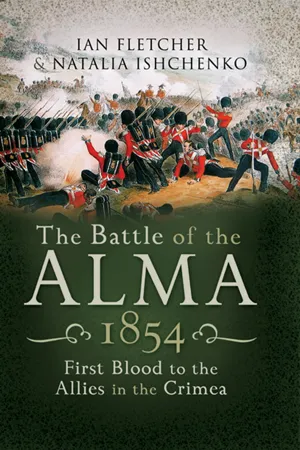
The Battle of the Alma, 1854
First Blood to the Allies in the Crimea
- 256 pages
- English
- ePUB (mobile friendly)
- Available on iOS & Android
eBook - ePub
About this book
On 20 September 1854 the combined British and French armies confronted the Russians at the river Alma in the critical opening encounter of the Crimean War. This was the first major battle the British had fought on European soil since Waterloo almost 40 years before. In this compelling and meticulously researched study, Ian Fletcher and Natalia Ishchenko reconstruct the battle in vivid detail, using many rare and unpublished eyewitness accounts from all sides—English, French and Russian. Their groundbreaking work promises to be the definitive history of this extraordinary clash of arms for many years to come. It also gives a fascinating insight into military thinking and organization in the 1850s, midway between the end of the Napoleonic era and the outbreak of the Great War.
Information
Chapter 1
A Rupture with the Russians
The Crimean War is almost unique in that it has provided generations of historians with a rich source of material on how wars begin. It also demonstrates to political historians how wars can and should be avoided, for it was a war that was a long time in coming. For almost four years politicians around Europe, and particularly in Britain, France, Russia and Turkey, could see the conflict looming on the horizon but they appear to have been helpless in stopping the slow drift towards war, which seemed inevitable once France decided to revive its ancient rights in the Holy Land in 1850. The war is also possibly unique in that not only were negotiations going on prior to the outbreak of war, as politicians and diplomats sought to find a way of avoiding the conflict, but conferences and peace talks were ongoing throughout the war, from the very beginning in 1854 right up to the early days of 1856. Indeed, one might say that the war is unique in having been fought out simultaneously in two very different theatres: in atrocious conditions in the Crimea itself and around various comfortable conference tables throughout Europe. As a result there are literally thousands of documents which provide a wonderful insight into the causes of the tragedy that was the Crimean War. Needless to say, we have no intention of going into too much detail.
On the face of it, the Crimean War may be traced back to Czar Nicholas I and his attempts to achieve Russian supremacy in the Black Sea and access to the Mediterranean. But in order to do this Russia had first to control the Bosphorus and the Dardanelles, the straits which led into the Black Sea. Having failed by peaceful means, Nicholas was given the chance to control the straits following the defeat of Turkey in 1828 and the consequential Peace of Adrianople. But although the peace deprived Turkey of much of the Black Sea coastline, it still did not give Nicholas command of the important straits.
Three years later Nicholas was given a second opportunity following a revolt against the Turks by the Egyptian pasha, Mehemet Ali. Instead of helping Mehemet, Nicholas decided to assist the Turkish sultan, Makhmud, and in 1833 sent a Russian squadron, under the famous Admiral Lazarev, to support the Turks. It was a shrewd move, intended to draw the previously suspicious empires closer. Indeed, the Turks now looked to Russia as a future ally, the consequence being the Unkiar-Skelessi Treaty, which permitted Russian warships to traverse the Bosphorus and the Dardanelles. These straits were now effectively closed to the warships of other countries, something which gave cause for much consternation in London and Paris, which began to seek ways of breaking the influence which Russia enjoyed with Turkey.
In 1839 Mehemet rebelled once again, at which various powers, including Britain, Austria and Prussia, sprang to the Turks’ assistance in an attempt to court favour. The Russians did likewise. Two years later, the London Convention resulted in the loss of many of Russia’s gains from the Unkiar-Skelessi Treaty, in addition to which the Turks, having now apparently resolved their problems with the Egyptians, felt they no longer needed to depend on Russia for future support. In fact, they regarded it more as a burden, and so looked elsewhere for support and assistance in ridding themselves of Nicholas’ influence. This was achieved by the middle of the nineteenth century, largely as a result of French and British help.
Needless to say, Nicholas was not prepared to accept the situation lying down. He knew full well that the Ottoman Empire was in a state of some decline, and the prospect of having two foreign powers, Britain and France, take advantage of the situation so close to the southern borders of his own empire barely warranted thinking about. It was vital, therefore, that Russian influence over Turkey was reasserted, either by diplomacy or war, the latter being the favoured course of action. The problem was that, as yet, Nicholas had no legitimate reason for taking up arms against the sultan’s armies.
That was, however, until a minor squabble arose in the Holy Land between two sets of monks. The dispute was over certain religious rights relating to the possession of the keys to the Church and Grotto of the Nativity in Bethlehem, and to the maintenance of the Church of the Holy Sepulchre in Jerusalem. Under the conditions of a treaty, known as ‘the capitulations’, drawn up in 1740, France had become recognized as the protector of the Latin church in eastern lands, which included custodianship of the Holy Sepulchre. The privileges enjoyed by France had long since ceased to be of any real concern to the French, but the struggle between Mehemet Ali and the sultan in the 1830s enabled Christians to visit the Holy Places for the first time in centuries. As the czar was nominally the protector of Christians in Turkish dominions, Nicholas naturally began to develop a keen interest in Turkish affairs once more. But in 1850 France, taking note of the situation in Turkey and keen to deny Russia a foothold in Turkish domestic affairs, decided to revive its claim, a move that did not go down too well with its Russian rivals. Remarkably, this trivial and seemingly insignificant little quarrel would escalate into something far more serious than a dispute between two sets of monks supported by France and Russia.
The apparently innocuous religious quarrel very soon became the excuse for a major struggle between French and Russian diplomats for influence on the Turkish Empire. The initial dispute was not over the rights to worship in either Orthodox or Catholic churches, since neither was prohibited. The whole sorry business came down to the ungrounded, petty and litigious old dispute between Greek and Catholic monks over who must repair the broken dome in Jerusalem and who must possess the keys to the Bethlehem cathedral, which was not even locked with the keys anyway. There was also a dispute about what star to put in the Bethlehem cave, Catholic or Orthodox. These discussions were absurd even to the most ardent theologian. But for Nicholas I the ‘struggle for the Holy Places’ was a very advantageous and popular cause, and he was quick to seize upon it. With the help of this slogan he began a radical revision of Russian-Turkish relations, although to the rest of Europe it was clear that it was a becoming a battle of wills between the French emperor, Napoleon III, and the Russian czar.
As the situation worsened, both Nicholas and the French emperor sought to harness public opinion, although it required the best diplomatic skills to convince Europe that their respective cause was both legitimate and right. It was a tricky business. On one hand, Napoleon was only too aware that his aggressive attitude might well resurrect the old alliance between Russia, Britain, Austria and Prussia, for it was this same alliance that had defeated his uncle Napoleon I back in 1815. On the other hand, Nicholas tried to court Europe by stating he was under pressure from his own people, who were growing ever more worried about the religious situation in Turkey.
With the prospect of armed conflict a distant but nevertheless real prospect, Nicholas began to weigh up his options. Of the four major powers in Europe, he considered both Austria and Prussia as allies. France, however, presented a threat, but would Napoleon III really risk his somewhat shaky grip on the throne in an armed struggle against Russia? Nicholas thought it unlikely. This left only Britain as the one great danger. It was the one great industrial power in the world, with great resources and, more important, great financial means at its disposal, with a large army and navy. War against Britain must be avoided at all costs. In the event, Nicholas came up with an astonishing idea which he hoped would both allay British fears of Russian expansionism in the Black Sea and Mediterranean, and prevent any conflict between the two empires.
Britain, ever empire conscious, might be lured into his web of intrigue by the attraction of protecting the overland route to its possessions in India. Nicholas’ idea might shock the British, but he hoped they would give it serious consideration. There was, after all, little to lose. And so, between January and February 1853, Nicholas had several meetings in St Petersburg with the British ambassador, Sir George Hamilton Seymour, during which he broached the subject of the state of the Ottoman Empire. He pointed out - if it ever needed pointing out - that Turkey was ‘a sick man’, and that they must consider the probable future collapse of the Ottoman Empire. Britain and Russia, he said, should make arrangements beforehand in order to avoid any disputes over territories that would inevitably follow. It was a proposal akin to disposing of a sick man’s belongings before he was actually dead.
Seymour was somewhat shocked by the bluntness of Nicholas’ approach and by what he was proposing. Moldavia and Wallachia, having already formed a separate state, should continue to exist under Russia’s protection, whilst Serbia and Bulgaria should be allowed to do the same. Nicholas then moved on to Egypt. All too conscious of its importance to Britain, he suggested that Russia would not oppose any move by Britain to take control of the country, adding that Crete might also become a British possession. Seymour listened in stunned surprise as Nicholas reeled off his proposals, and wondered what the response would be in London when he reported back to his political masters.
The reaction in London was, predictably, hostile. The government was quick to see the dangers of allowing Russia control of the Bosphorus and Dardanelles, and the prospect of seeing the Black Sea turned into what virtually amounted to a ‘Russian lake’. Such domination would allow the huge Russian Army to operate close to the Turkish borders and would almost certainly result in a Russian conquest of Turkey. With Turkey swallowed up, Russia would be able to control Persia and, more important from a British point of view, the overland route to India. The concern in London may easily be imagined.
Nicholas’ mistake was in refusing to believe that Britain would form an alliance with its old enemy, France. It was something the British government was well aware of. Indeed, the British did their best to convince him that this would be the likely result should Nicholas move against Turkey. Despite letters written to him personally - rather than sent through official channels - and the goading and provocations of British ministers, Nicholas simply did not appreciate the fact that he was driving Britain closer to France.
Napoleon, on the other hand, found his hand strengthened when he finally won the argument over the Holy Places, following which he personally performed the ceremony of passing the keys to the Jerusalem and Bethlehem churches to the Catholic bishop, something which he did with ‘provocative ostentation’. It was something which left Nicholas feeling more isolated, although it did not deter him from pursuing an aggressive course of action against Turkey, for in February 1853 he sent the 66-year-old Prince Alexander Menshikov to Constantinople, the object of his mission being the reinstatement of Orthodox Church privileges in the Holy Places. Significantly, he was also to demand a protective treaty similar to the Unkiar-Skelessi Treaty, something which Menshikov was to negotiate in secrecy.
Menshikov’s mission, which lasted until 21 May, was a disaster from the very moment of his arrival in Constantinople. His aggressive approach was apparent from the very beginning, when he arrived in a Russian warship. Totally devoid of diplomatic skills, the antagonistic Menshikov succeeded in doing little but upsetting his hosts. He displayed neither respect nor any protocol, his aggressive manner belonging on the battlefield rather than the chambers of the Ottoman emperor. His skills at the negotiating table were less than impressive also, with the far more able Turkish delegates having little trouble in fending off his every move and demand.
Menshikov was also up against the British Ambassador to the Porte (the Turkish government), Lord Stratford de Redcliffe. Known to the Turks as ‘the Great Elchi’, Redcliffe was an experienced diplomat and a man with enormous influence within the Porte. Indeed, there was no man living outside Turkey who knew more about the affairs of the Ottoman Empire and of its society. The Russian envoy’s demand that Nicholas be recognized as protector of all Christians in the Turkish dominions was met with polite but firm rebuttal by both de Redcliffe and the French ambassador, De La Cour. Turkey could not allow a foreign power to wield such influence within the sultan’s realm, although it would nevertheless strive to remove any disadvantages the Christians might have endured and would address any grievances they might have. This response was endorsed on 20 May at a conference of the British, French, German and Austrian ambassadors. Menshikov’s proposal that Turkey conclude a protective treaty with Russia along the lines of the Unkiar-Skelessi Treaty was also flatly rejected. The embittered Menshikov, suspicious in particular of British motives and believing that Turkey was merely a puppet controlled by the British hand, then broke off both negotiations and relations, and sailed away from Constantinople on 21 May.
With Menshikov having achieved nothing for his master, Nicholas raised the stakes by informing the Turks that unless they accepted the proposals put forward by Menshikov he would send Russian troops across the Pruth river and into the Danubian Principalities of Moldavia and Wallachia. In fact, even as negotiations were going on, Nicholas was ordering Prince Gorchakov to prepare his IV and V Corps for the invasion. Such a move had already been anticipated by Britain and France, however, which sent their fleets to Besika Bay, at the entrance to the Dardanelles, which assembled there on 14 June. Eighteen days later Gorchakov crossed the river Pruth and invaded Moldavia and Wallachia. War was now closer than ever.
Despite the gloom and the prospect of war, efforts still continued to be made in London, Paris and Constantinople to block the seemingly inevitable road to war. Austria, too, did its best to help avert war and a conference was held in Vienna with all the major powers in attendance. Austria, in fact, sided with Britain and France, supporting Turkey in its stance against Russia. Notes flew back and forth between the various countries, but as each formula for peace was proposed and then rejected, either by Turkey or Russia, war appeared more inevitable than ever. The most significant of all the communiqués was the famous ‘Vienna Note’ of 31 July 1853, thrashed out between Britain, France, Austria and Prussia, and put before the czar for his approval. This note, which in effect bound Turkey to the conditions of the 1774 treaty of Kuchuk-Kainardji, and to the Adrianople Treaty of 1829, was certainly advantageous to Russia but not to Turkey. Indeed, when the conditions were known to Czar Nicholas he accepted the Vienna Note, giving all concerned renewed hope that a conflict could be avoided. However, they had not considered the influential and crucial views of the British ambassador, Lord Stratford. Furthermore - and more remarkably - none of the four powers had bothered to consider Turkey’s views on the Vienna Note. It was a great error.
Despite the requests from London to Lord Stratford that he recommend the acceptance of the note to the sultan, the ‘Great Elchi’ could not hide his true feelings, and when he presented the note to the sultan he did so with a heavy heart, knowing that it would not be in Turkey’s interests to accept it. Nevertheless, he did what was required of him as a representative of the British government. He did his duty and urged its acceptance. Lord Stratford pointed out to the sultan that all four of the major powers supporting Turkey recommended acceptance of the Vienna Note, and that even Czar Nicholas had agreed to its terms. He also urged the sultan to come to a speedy decision as a delay might prove dangerous to Turkey. But what Lord Stratford did not do was venture his own private opinion, and it was this that the sultan and the Porte really wanted to hear. His opinion was not forthcoming, but the Great Elchi’s look and silence said more than words could ever express.
The Porte studied the Vienna Note carefully before, somewhat predictably, adding some amendments. On 19 August the Porte made it known that unless its amendments were added it would be unable to accept it. Inevitably, these alterations proved unacceptable to Russia. The lengthy negotiations between Britain, France, Austria and Prussia had been in vain. Given the fact that they had not sought the views of the Porte this is not surprising. The sticking point once again was Turkey’s refusal to grant Russia protective rights over the Orthodox Church in the Turkish Dominions. The negotiations had come full circle. The disputants were back where they began, and with little hope of a settlement war was now virtually inevitable.
Another important factor that was leading Europe along the road to war was public opinion. Anti-Russian feelings were already beginning to stir in Britain and France, but in Turkey public opinion was in effect driving the country to war. Indeed, Turkey may well have been dubbed ‘the sick man of Europe’ but its people were demonstrating that there was plenty of life left in the country yet. They were beginning to tire of the manner in which foreign powers were seemingly sitting round discussing their future, whilst the presence of Russian troops in the Danubian Principalities was viewed as a great affront to Turkish honour and prestige alike. Demands for action to be taken against the Russians grew louder by the day. Of course, the cries for a war against Russia were made in the full knowledge that Turkey had the support of both Britain and France, but public opinion and feeling in Turkey should not be underestimated. Whipped into a frenzy by religious leaders, the Turkish people’s clamouring for action would not be assuaged, and on 4 October 1853 Turkey went ahead, despite frantic diplomatic activity, and declared that, unless the czar withdrew his troops from the Danubian Principalities within two weeks, a state of war would exist between the two empires, and with neither side willing to back down the Crimean War can be said to have begun.
Nicholas’ refusal to withdraw his troops from the Pruth river and the subsequent declaration of war by Turkey left the British and French governments in little doubt - as if there ever was any - that war with Russia was inevitable. And yet, even at this late hour politicians made frenzied efforts to prevent the conflict. But all the time the other nations’ priorities seemed to be steering Europe on a course which led to war. Napoleon III, his grip on the French throne already somewhat shaky, looked to use the crisis to enhance French prestige abroad and with it his own estimation in the eyes of the French people. He had lived in exile for some years in England and knew full well how public opinion often influenced British policy making. Therefore, he began to put pressure on Britain to move its fleet forward from Besika and through the Dardanelles, a move which would undoubtedly gain the approval of the British people. The British prime minister, the somewhat reticent Lord Aberdeen, regarded such a demand as premature but, fearful of flying in the face of public opinion and coming under increased pressure from the French ambassador, Count Waleski, he gave in and ordered the fleet to move through the Dardanelles, which it did on 22 September. Such a move was in breach of the 1841 Straits Treaty and, indeed, no sooner had the move begun than the Russian ambassador, Baron Brunnov, protested, citing the very treaty. The protests were waved away, however, at which Count Nesselrode, Russia’s foreign secretary, simply sighed and virtually gave up all attempts at ...
Table of contents
- Cover Page
- Title Page
- Copyright
- Contents
- List of Illustrations
- List of Maps
- Introduction
- Chapter 1: A Rupture with the Russians
- Chapter 2: The Allies Go to War
- Chapter 3: Across the Black Sea
- Chapter 4: Summer in Sevastopol
- Chapter 5: The Landings
- Chapter 6: The Russians
- Chapter 7: Preparations for Battle
- Chapter 8: The French Move First
- Chapter 9: The British Enter the Battle
- Chapter 10: Forward, the Guards!
- Chapter 11: The Drive to Victory
- Chapter 12: End of the Battle
- Chapter 13: Victory and Defeat
- Chapter 14: Aftermath
- Chapter 15: The Battlefield Today
- Plates
- Appendices
- Notes
- Bibliography
- Index
Trusted by 375,005 students
Access to over 1.5 million titles for a fair monthly price.
Study more efficiently using our study tools.
Frequently asked questions
Yes, you can cancel anytime from the Subscription tab in your account settings on the Perlego website. Your subscription will stay active until the end of your current billing period. Learn how to cancel your subscription
No, books cannot be downloaded as external files, such as PDFs, for use outside of Perlego. However, you can download books within the Perlego app for offline reading on mobile or tablet. Learn how to download books offline
Perlego offers two plans: Essential and Complete
- Essential is ideal for learners and professionals who enjoy exploring a wide range of subjects. Access the Essential Library with 800,000+ trusted titles and best-sellers across business, personal growth, and the humanities. Includes unlimited reading time and Standard Read Aloud voice.
- Complete: Perfect for advanced learners and researchers needing full, unrestricted access. Unlock 1.5M+ books across hundreds of subjects, including academic and specialized titles. The Complete Plan also includes advanced features like Premium Read Aloud and Research Assistant.
We are an online textbook subscription service, where you can get access to an entire online library for less than the price of a single book per month. With over 1.5 million books across 990+ topics, we’ve got you covered! Learn about our mission
Look out for the read-aloud symbol on your next book to see if you can listen to it. The read-aloud tool reads text aloud for you, highlighting the text as it is being read. You can pause it, speed it up and slow it down. Learn more about Read Aloud
Yes! You can use the Perlego app on both iOS and Android devices to read anytime, anywhere — even offline. Perfect for commutes or when you’re on the go.
Please note we cannot support devices running on iOS 13 and Android 7 or earlier. Learn more about using the app
Please note we cannot support devices running on iOS 13 and Android 7 or earlier. Learn more about using the app
Yes, you can access The Battle of the Alma, 1854 by Ian Fletcher,Natalia Ishcenko in PDF and/or ePUB format, as well as other popular books in History & 19th Century History. We have over 1.5 million books available in our catalogue for you to explore.