- 256 pages
- English
- ePUB (mobile friendly)
- Available on iOS & Android
eBook - ePub
About this book
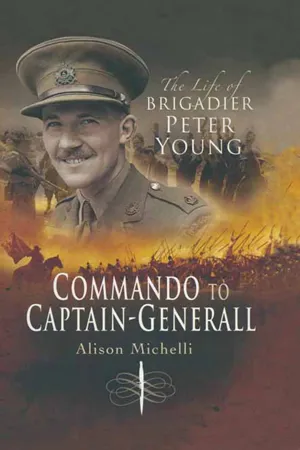
This is the story of Brigadier Peter Young (1915–1988), a highly decorated soldier who was one of the founding members of 3 Commando, rising during WWII from 2 Lt to Brigadier in the space of 6 years. His battle honours include Vaagso, Dieppe, Sicily, Italy, Normandy and Burma. A career soldier, he returned to his parent regiment, the Beds and Herts, after the war and subsequently spent time in Palestine where he commanded the 9th Regiment of the Arab Legion under Glubb Pasha. After Suez he returned to England, retiring from the Army in 1959. He founded the War Studies Department at RMA Sandhurst during the 60s, intending to create there a intellectual centre along the lines of a university faculty for the study of military history and to that end gathered around him some of the finest military historians of the day including Richard Holmes, David Chandler and John Adair amongst others. He was instrumental in the forming of The Sealed Knot and is reverred in re-enactment circles. To publicise a book he had written about the English Civil War he organised a publicity stunt which evolved rapidly into the first re-enactment society: The Sealed Knot. An avid war-gamer, his name is legendary in war-gaming circles. 'The Brig' is still a well-known personality even among those too young ever to have met him.
Information
Contents
| Preface | |
| Acknowledgements | |
| Publisher’s Note | |
| Introduction | |
| Chapter 1 | Beginnings |
| Chapter 2 | Dunkirk Campaign |
| Chapter 3 | ‘Special Service’ |
| Chapter 4 | Troop Command |
| Chapter 5 | Vaagso |
| Chapter 6 | 1942 – Operation Flodden |
| Chapter 7 | North Africa |
| Chapter 8 | Cassibile – Operation Bigot-Husky |
| Chapter 9 | Sicily – Agnone |
| Chapter 10 | Sicily – Life as a Liaison Officer |
| Chapter 11 | Italy – Bova Marina |
| Chapter 12 | Termoli |
| Chapter 13 | Normandy |
| Chapter 14 | From Normandy to the Arakan |
| Chapter 15 | The End of the War and its Aftermath |
| Chapter 16 | Jordan 1953–6 – Jerusalem |
| Chapter 17 | Arabian Nightmare |
| Chapter 18 | An Academic’s Life |
| Chapter 19 | The Sealed Knot is Born |
| Chapter 20 | The Last Hurrah |
| Bibliography | |
| Index | |
Preface
For King or for the Commonwealth –
No matter which they say,
The first dry rattle of new-drawn steel
Changes the world today!
No matter which they say,
The first dry rattle of new-drawn steel
Changes the world today!
Rudyard Kipling, Edgehill Fight
As a child Peter had met Rudyard Kipling: ‘one,’ he wrote, ‘who really understood Old England’. What would Peter, that unreconstructed Royalist – or indeed Kipling – make of the re-enactment scene today?
There is no doubt that, albeit unwittingly, the huge numbers of people who are now involved in re-enactment owe their hobby to a few over enthusiastic war gamers who met at the Mitre Hotel nearly 40 years ago and founded the Sealed Knot. There is, equally, no doubt that what those early pioneers intended was very far from what actually transpired. Never has the expression ‘go with the flow’ been so appropriate (although at times Peter might rather have felt that he was ‘rolling with the punches’). In some ways Peter’s private army created itself, for it very quickly took on its own impetus and rolled inexorably forward. A lesser man might have attempted to wrest control back again; Peter’s genius was to let it go and see what happened.
Some years ago I was taking part in that spectacular pageant known as ‘History in Action’, run at that time by English Heritage at Kirby Hall. At the end of the final day, all the participants – over 2,000 of them – lined up and paraded in front of a delighted crowd who cheered each contingent as it marched across the field. Once out of sight of the public, an extraordinary thing took place. As each unit reached the end of the parade line, it began to form a path through which the succeeding formations passed before itself becoming part of the line. As the weary performers entered this path they were applauded by those already there, and at the end, when all 2,000 or so men and women had walked this path of praise, those who had begun the line themselves led the march off through the lines and received, in their turn, the approbation of their peers.
I was profoundly moved. For it struck me as I walked across the parade ground that without Peter Young this would not be happening. Intentionally or not, he had created the appetite for re-enactment societies and this was surely its apotheosis. What, I wondered, would he have thought if he could have seen this? I remember rather hoping that he was looking down at us and enjoying the spectacle, a historical time line that began with the Romans and ended with some Cold War East German border guards, closely preceded by some Second World War Dutch bicycle troops. Every person in that parade felt so drawn to some particular period of history that they were prepared to go to considerable trouble and expense to kit themselves out in the costume of the period and to give up large amounts of spare time in order to convey to a fascinated public the minutiae of daily life in those bygone days.
This is not what Peter had in mind when he created the Sealed Knot. This is something even more powerful than the ‘private army’ he had, tongue-in-cheek, envisaged. He once said to me that if he had known what he was going to create, he rather thought he might have thought twice about going ahead with it. ‘The tail,’ he told me, ‘is wagging the dog with a vengeance!’
Certainly, the Sealed Knot grew quickly into something far bigger than he had planned, which indicates that he had tapped into some deeply felt need in large numbers of people. Having allowed the organisation to pick up its own momentum to see where it would go he could scarcely have imagined that, thirty-five years after its founding, it would be only one of very many historical re-enactment societies.
Curiously, this remains his most visible legacy to us, but it is not the only one, I fancy, that he would want us to remember him by. What is most extraordinary about Peter is that he is greater than the sum of his parts: the soldier with superb tactical acumen and the gift of supreme leadership qualities demonstrated time and again, not only during the Second World War but in a very different theatre and at a very different time in Jordan; the academic who constructed his own department of War Studies at Sandhurst which outlived him and continues to provide a steady stream of first-rate military historians; the war gamer who decided that the sand table was too small and who wanted to see for himself what musket drill looked like. All these facets of his character, each one a lifetime’s achievement in itself, go to make up a man whose life is so hard to encompass. In the end, like his great hero Prince Rupert, he found he needed a field larger than a piece of paper, and a sword instead of a pen. There is only one word which comes close to explaining the effect of his personality on everyone he met: charisma. Like the grin of the Cheshire Cat, it is what is left when the body has faded away.
There was a great deal more to Peter Young – soldier, historian, writer and bon viveur – than is clear from this final, almost accidental, offering to the cultural life of the nation. I hope that this will become evident in the ensuing chapters.
Acknowledgements
Of all the stories I have started, finished or dreamed about writing, Peter Young’s life loomed largest. It has been the most marvellous adventure, made all the more exciting by the many people who have walked with me down the sometimes twisting road of his life, and who have helped immeasurably with information, wisdom and insights.
In no particular order I must mention specially:
The late Marilyn Caron Delion, Peter’s step-daughter, was unfailingly helpful, kind and patient, and wonderfully generous with her time, recollections and material.
Olive Christopher, widow of Peter’s wartime batman, Sergeant Bob Christopher, has been equally supportive; she allowed me access to her late husband’s unpublished memoir which included many insights into Commando life. In addition, her anecdotes and huge treasure trove of photographs have been an inspiration and I am greatly indebted to her.
Peter’s wartime colleagues were a delight and a ready source of stories; I am indebted to them all: John de Lash, ‘Ossie’ Osborne, Ted Piggott, Keith Ponsford, the late Douglas Johnston, and members of the Southwark Commando Association who welcomed me at their meetings; Stan ‘Scotty’ Scott, Fred Walker, Bill Britnell, Roy Cadman, John White, Doug Roderick and Harry Winch among others.
Peter’s academic colleagues were no less helpful; thanks are due to Dr John Adair, Dr Christopher Duffy, Professor Richard Holmes, Sir John Keegan, Professor Ian Roy and the late Dr David Chandler.
With regard to the birth of the Sealed Knot I am very grateful to the late Dr Alastair Bantock and Stephen Beck, to Andy Gillitt, Peter Bloomfield and Ralph Willatt for all their insights into the beginnings of ‘The Knot’.
Others have very kindly racked their brains on my behalf, amongst whom I must acknowledge Joseph Devines jr, author of a study of the battle of Vaagso, John Robson and Charles Stacey.
There is a huge amount of unpublished material in the Peter Young archive at the National Army Museum. I am extremely grateful to the staff at the Templer Study Centre for all their help during my researches in this treasure trove; their help made my task considerably easier.
I am indebted to Richard Pantall, at one time Peter’s Orderly Room Clerk, who typed up Peter’s own fascinating – and unpublished – account of 3 Commando’s Mediterranean campaign in 1943. He passed this invaluable volume to David Chandler who, in turn, passed it to me.
I have received great editorial support, and owe a debt of thanks to Henry Wilson and Bobby Gainher who have steered me through the pitfalls of the publishing world so that the end result is, I hope, a testimony to their help; as ever, any errors in the final work will be mine!
My friends and family have been superb and I hope they will think that the end result is worth the trips to London and the anguished cries of guilt when the word rate dropped off. John Stallard and Chris Brewer have been a help and support throughout; without John’s encouragement I might never have started at all so I am truly grateful for his faith in my ability to get the words down! Finally, of course, my love and thanks to Neil and Matthew (not forgetting the dogs); without them none of it would be worth the candle.
Publisher’s Note – The Spelling of
‘Captain Generall’
When the Sealed Knot was formed, it was decided to adopt the style and spelling of earlier ranks and appointments dating back to the Civil War. Peter Young, as the first Commander-in-Chief, thus became Captain Generall, roughly equivalent to a modern Army Commander. Despite the obvious risk of being accused of inaccurate proofreading, the Publishers have agreed to retain the archaic spelling.
Introduction
It is October. In a field beside the road which runs between Radway and Kineton a group of uniformed people are gathered for a drumhead service. This is the commemoration of the battle of Edgehill, fought on 23 (Old Style) October 1643, the first major encounter between the forces of King and Parliament in the English Civil War. Standing a little apart is a portly figure clad in ‘civilian’ clothes, sporting lace collar, wide-brimmed hat and bucket boots. He is white-haired and genial. Those who approach him do so with deference and he welcomes them heartily. Then begins the service and, in the fullness of time, the genial figure steps forward to give the address. Behind gold-rimmed spectacles which glint in the autumn sunshine his eyes are steely grey. They are eyes which have reviewed a thousand troops, weighed a thousand men in the balance of wit and courage, eyes which rarely miss anything. When he speaks his voice is melodious and carrying, his delivery confident. He is at ease in his environment. The Sealed Knot is performing its annual homage to the fallen in the battle. And the speaker is Peter Young.
He was known by a variety of names: Bungy, Brig, PY, Captain Generall – even Sir, on occasion. Those closest to him always called him Bear. Retired soldier with a distinguished military career behind him, few of those with whom he came into contact in his later years had any idea of his extraordinary rise from Second Lieutenant to Brigadier in the six years of the Second World War. Or, indeed, that out of 4 million combatants he was the most decorated soldier of the war, one of only twenty-three men to be awarded three Military Crosses in addition to his Distinguished Service Order. Most were aware of his academic achievements, and those who asked for help with their own researches received unstinting and generous support.
Peter Young was the soldier scholar who unwittingly discovered that a truly astonishing number of otherwise normal people enjoy spending their weekends dressed in historical costume, re-enacting battles and camping in muddy fields. Nobody, it is fair to say, was more surprised than he was. ...
Table of contents
- Cover
- Halftitle
- Full Title
- Copyright Page
- Dedication
- Contents
Trusted by 375,005 students
Access to over 1.5 million titles for a fair monthly price.
Study more efficiently using our study tools.
Frequently asked questions
Yes, you can cancel anytime from the Subscription tab in your account settings on the Perlego website. Your subscription will stay active until the end of your current billing period. Learn how to cancel your subscription
No, books cannot be downloaded as external files, such as PDFs, for use outside of Perlego. However, you can download books within the Perlego app for offline reading on mobile or tablet. Learn how to download books offline
Perlego offers two plans: Essential and Complete
- Essential is ideal for learners and professionals who enjoy exploring a wide range of subjects. Access the Essential Library with 800,000+ trusted titles and best-sellers across business, personal growth, and the humanities. Includes unlimited reading time and Standard Read Aloud voice.
- Complete: Perfect for advanced learners and researchers needing full, unrestricted access. Unlock 1.5M+ books across hundreds of subjects, including academic and specialized titles. The Complete Plan also includes advanced features like Premium Read Aloud and Research Assistant.
We are an online textbook subscription service, where you can get access to an entire online library for less than the price of a single book per month. With over 1.5 million books across 990+ topics, we’ve got you covered! Learn about our mission
Look out for the read-aloud symbol on your next book to see if you can listen to it. The read-aloud tool reads text aloud for you, highlighting the text as it is being read. You can pause it, speed it up and slow it down. Learn more about Read Aloud
Yes! You can use the Perlego app on both iOS and Android devices to read anytime, anywhere — even offline. Perfect for commutes or when you’re on the go.
Please note we cannot support devices running on iOS 13 and Android 7 or earlier. Learn more about using the app
Please note we cannot support devices running on iOS 13 and Android 7 or earlier. Learn more about using the app
Yes, you can access Commando to Captain-Generall by Alison Michelli in PDF and/or ePUB format, as well as other popular books in History & Historical Biographies. We have over 1.5 million books available in our catalogue for you to explore.