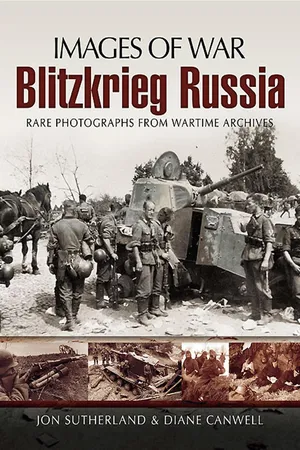
- 144 pages
- English
- ePUB (mobile friendly)
- Available on iOS & Android
eBook - ePub
Blitzkrieg Russia
About this book
The photographs are taken from five unpublished albums focussing on the German invasion of Russia in 1941 Operation Barbarossa. Two of the albums contain shots taken by German infantrymen and include shots of combat, vehicles, knocked-out tanks and prisoners of war. Two of the other albums feature flak and artillery units in the invasion. These include shots of artillery and flak units in action, destroyed Russian aircraft, vehicles and armor as well as Russian prisoners. The final album contains shots taken by a tank destroyer unit. In this set, there are shots of knocked out Russian armor (and abandoned armor), artillery and assault guns in action and a fascinating glimpse into the transition into the first winter. There are many exceptional photographs including rubber boats carrying troops across a river, knocked out monstrous Russian tanks, engineers at work and a range of more casual poses. There are also some interesting studies of uniforms and equipment, abandoned vehicles, vehicles being salvaged and maintained and a host of other subjects.Some are focussed on the early war months with Russia, so there are huge columns of captured Russian prisoners, fraternization with the local peasants and a glimpse of the vast distances involved in the advances made by the Germans in the early months of the conflict.
Information
Chapter 1
Josef Kaloenbach’s Album
The Germans began planning for Operation Barbarossa literally within weeks of the French surrender. By the end of July 1940, planning was nearing completion and the Aufbau Ost (build-up east) had already begun.
The first photograph in this small collection seems to imply that in July 1940 Josef Kaloenbach was at Greifswald in north-eastern Germany, some 150 miles from Berlin. Greifswald was a major railway hub and housed an enormous army garrison. We can therefore make the reasonable assumption that the photographs that belong to this album may well refer to his duties with Army Group North during the operations against Russia.
Army Group North’s target was Leningrad, some 500 miles away. Hoepner’s Panzer Group would provide the cutting edge to slice through the Russian frontier defences and make for the River Dvina and then onward to Opochka. (Hoepner was a career officer and an early supporter of armoured warfare. He was later implicated in the July 1944 plot to assassinate Hitler and was executed in the August.) From then on, depending on the state of Leningrad’s defences, they would advance north or north-east. The 18th Army would be tasked with clearing the Baltic region and the I 6th Army would secure the connection with Army Group Centre.
The Russians wrongly believed that Leningrad would only be under threat from the Finns and the Germans from the north and that the main German attacks would be launched against Moscow. However, in mid-November 1940 they discovered through intelligence sources that the Germans were planning to launch an assault from the west, toward Leningrad. Unfortunately, neither the Russian Baltic Special Military District nor, indeed, the Leningrad Military District did very much to reorganize for this anticipated attack.
The Germans had eleven months to prepare for the invasion. The Russians believed that they would have at least ten to fifteen days’ prior notice before any assault was launched.
Army Group North had some twenty-nine divisions, plus a further five German divisions and fifteen Finnish divisions. A great deal has been written about blitzkrieg tactics, but, in fact, it was the logical successor to the traditional Prussian war of manoeuvre. Blitzkrieg itself can be described as the use of mechanized units, a flexible command structure, the control of units using radio communication and the close support and cooperation of air assets.
In the north, 4th Panzer Group had two panzer corps. Each of the panzer divisions had between two and three panzer battalions, supported by five infantry battalions and three artillery battalions. The motorized infantry were used in close cooperation with the panzer units. The type of tanks being used by the Germans at this stage was a mix of Panzer Ills and Panzer IVs. However, many of the units still had Panzer Us, which were being used as a stopgap measure as the Panzer Ills and IVs were delivered. There were also considerable numbers of 38Ts, which were Czech-built tanks, broadly equivalent to the Panzer III. In fact, the 8th Panzer Division had I 18 of these vehicles. The 6th Panzer Division was also saddled with fairly obsolete 35Ts, with 155 of these vehicles in use.
While many of the mechanized units had either self-propelled artillery or vehicle-towed pieces, most of the infantry divisions’ artillery was horse-drawn. This was inevitably going to be a major problem, particularly for the infantry units trying to keep pace with the faster-moving mechanised units.
Even at this stage of the war, supply was also a major problem. Supposedly, Army Group North was due to receive thirty-four train loads of supplies per day, but the best that was ever achieved was eighteen. Compounding the problem was the vast array of different vehicles. One of the artillery regiments in Army Group North had nearly seventy different types of vehicle, which meant that providing spare parts and carrying out maintenance was incredibly difficult.
The Luftwaffe, in direct support, was using Bf 109 fighters, Ju87 Stuka dive-bombers, Heinkel 111 bombers and Ju52 transport planes. Of the three Luftflotten supporting Operation Barbarossa, Luftflotte I was the smallest. They were supposed to have some support from Luftflotte V, based in Norway, but in practical terms, due to the enormous operational area, very little help was actually given. This meant that the Russian Air Force actually outnumbered the Luftwaffe in Army Group North’s area of operations. They had a seven to one superiority in fighters and a three to one superiority in bombers.
Ground defence units in Army Group North were weak, with only three flak regiments. The only other contribution from the Luftwaffe was the use of the 7th Flieger Division, which had been dropped on Crete and had suffered appalling casualties in May 1941. They were used around Shlisselburg between September and December 1941. The other supporting element was the Kriegsmarine, the German navy. Their Baltic force was not very impressive: four light cruisers, five U-boats, around forty patrol boats and a number of other minelayers and sweepers. There were also a handful of Finnish vessels. The Germans began mining the gulfs of Finland and Riga in mid-June 1941. Their only other responsibility was to prevent Russian vessels from getting out of the Baltic, or being involved in amphibious operations.
The Russians called Army Group North’s area of front the North-West Front. The Russians had twenty-four divisions and five brigades, amounting to nearly 370,000 men. In addition, there were a further nineteen divisions arrayed against the Finns and the Germans.
As we will see in this album and in future photographs, the Russians had an enormous number of tanks. However, the vast majority of them were obsolete by 1941. Having said that, many of them were still equal to what the Germans would field. Initially, the Russians would deploy the majority of their tanks in an infantry support role, rather than concentrating them into mechanized corps. In fact, there had been a great deal of confusion; after Poland had fallen in 1939 the Russians had disbanded their mechanized corps. Once France had fallen in May 1940, they recreated them again. In the six months leading up to the launching of Operation Barbarossa, the Russians were feverishly trying to create twenty new mechanized corps.
The scene was now set for a titanic struggle. During the period in which these photographs were taken there was an almost unbroken run of German victories and humiliating Russian defeats.
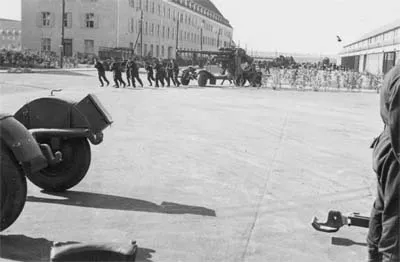
This is a fascinating photograph of a German artillery crew towing, using only their muscles, an 88mm Flak gun toward the parade ground at Greifswald. The photograph is dated July 1940. There is a tantalising glimpse of another artillery piece in the right foreground. The Germans would produce many thousands of these 88mm Flak guns and in due course they would prove to be extremely efficient tank killers. The Flak gun had a characteristic cruciform gun carriage, which allowed the weapon to be fired in all directions. The weapon had been used during the Spanish Civil War, where it had already been noted that it was a useful anti-tank weapon and general artillery piece. It would see extensive service on the Eastern Front and was far more effective than other weapons, particularly in the early stage of the war, when the majority of German tanks could only boast a 37mm or a 50mm gun.
This particular weapon appears to be a Flak 36; it entered service between 1936 and 1937 and had a redesigned trailer, known as the Sonderanhanger 202. It was a new design and had twin wheels on two similarly shaped carriages. It could actually engage ground targets from the trailer mounted position. Its weight was around 7 tons and the weapon had a rate of fire of up to twenty rounds per minute. This particular version does not have the characteristic shield to protect the crew, although the majority of these weapons would later be fitted with them.
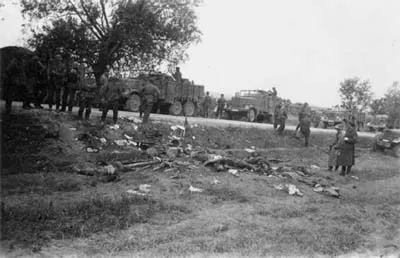
Russian bodies and debris alongside a road are shown here. The German column of supply and infantry trucks has halted. The speed of the advance was crippling; there were long days and short nights and a lot of marching and fighting. As a prime example, the 291st Infantry Division advanced 40 miles on 22 June 1941. Infantry and mechanized units would ride to battle, but fight on foot. For the majority of the German infantry, everything was on foot. The manpower and resources assigned to the German Army more often than not came a poor fourth after the SS, the Luftwaffe and the panzer troops. In many respects, the German infantry that crossed the frontier into war in the east in 1941 were little different from those that had invaded Poland in 1939. Usually, infantry battalions attached to the panzer divisions would be truck mounted and one battalion would be on motorcycles.
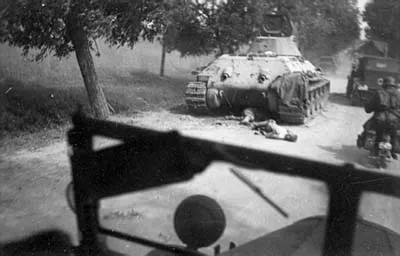
This is a grim but fascinating photograph, which shows a knocked out or abandoned Russian T34 with two dead crewmembers. A large German motorized column is passing along the tree-lined road. The T34/76A had gone into full production in June 1940. It would be the major Russian tank of the Second World War, with many different production models and variants. It was the most advanced design of its time and had the Russians concentrated their armour then the losses that the Germans would suffer would have been even greater. Although it had fully sloped armour, it was very easy to build. In fact, it was fairly unsophisticated and easy to maintain and it also had a low silhouette. Although we cannot see the front of the tank, the early versions had a second machine gun in a turret ball mount. The main armament was a 76.2mm gun. The T34 was virtually impervious to normal 37mm and 50mm anti-tank gun shells. It outclassed the Panzer III and was even as good as the Panzer IV, although later versions of the Panzer IV were arguably slightly better. It would prove to be a serious headache for the Germans.
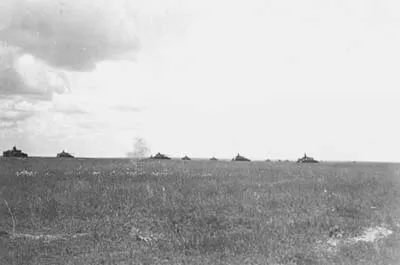
A panoramic shot of German panzers, advancing across a Russian plain, can be seen in this photograph. If we are correct in our assumption that these photographs were taken in the northern sector of the attack, then these are likely to have belonged to the 8th Panzer Division. By the evening of 23 June 1941, the 1st Panzer Division had captured a vital railway bridge at Tytuvenai, and the 6th Panzer Division had outrun its logistical support and was running short of ammunition. In fact, it had failed to force a crossing of the River Dubysa, and instead had to take up defensive positions near Raseiniai in order to fend off over a hundred Russian tanks. The motorcycle infantry battalion was wiped out in twenty minutes. Responding to the danger, the 1st Panzer Division was ordered to halt and head east to support the 6th. This was the spearhead of the Panzer Corps and the Germans battled with KV I s at ranges fewer than thirty yards. The tank battle reached its crucial stage on 25 June; the 1st Panzer Division’s command post was almost overwhelmed, but it was still battling through to save the 6th Panzer Division. Much of the Russian 3rd Mechanised Corps was trapped and the 12th Mechanized Corps was destroyed soon afterwards. In fact, the 12th, which had mustered 690 tanks on 22 June, had barely fifty left by the end of the month.
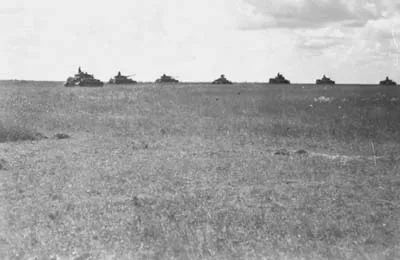
This is a second panoramic shot of German tanks advancing across the Russian plains...
Table of contents
- Cover
- Title Page
- Copyright
- Contents
- Introduction
- Chapter One: Josef Kaloeribach’s Album
- Chapter Two: The Panzergrenadiers
- Chapter Three: An Infantryman’s War
- Chapter Four: Flak and Artillery Collection
- Chapter Five: Towards the First Winter
- Chronology of Operation Barbarossa
- Bibliography
Trusted by 375,005 students
Access to over 1.5 million titles for a fair monthly price.
Study more efficiently using our study tools.
Frequently asked questions
Yes, you can cancel anytime from the Subscription tab in your account settings on the Perlego website. Your subscription will stay active until the end of your current billing period. Learn how to cancel your subscription
No, books cannot be downloaded as external files, such as PDFs, for use outside of Perlego. However, you can download books within the Perlego app for offline reading on mobile or tablet. Learn how to download books offline
Perlego offers two plans: Essential and Complete
- Essential is ideal for learners and professionals who enjoy exploring a wide range of subjects. Access the Essential Library with 800,000+ trusted titles and best-sellers across business, personal growth, and the humanities. Includes unlimited reading time and Standard Read Aloud voice.
- Complete: Perfect for advanced learners and researchers needing full, unrestricted access. Unlock 1.5M+ books across hundreds of subjects, including academic and specialized titles. The Complete Plan also includes advanced features like Premium Read Aloud and Research Assistant.
We are an online textbook subscription service, where you can get access to an entire online library for less than the price of a single book per month. With over 1.5 million books across 990+ topics, we’ve got you covered! Learn about our mission
Look out for the read-aloud symbol on your next book to see if you can listen to it. The read-aloud tool reads text aloud for you, highlighting the text as it is being read. You can pause it, speed it up and slow it down. Learn more about Read Aloud
Yes! You can use the Perlego app on both iOS and Android devices to read anytime, anywhere — even offline. Perfect for commutes or when you’re on the go.
Please note we cannot support devices running on iOS 13 and Android 7 or earlier. Learn more about using the app
Please note we cannot support devices running on iOS 13 and Android 7 or earlier. Learn more about using the app
Yes, you can access Blitzkrieg Russia by Jon Sutherland,Diane Canwell in PDF and/or ePUB format, as well as other popular books in History & Military & Maritime History. We have over 1.5 million books available in our catalogue for you to explore.