eBook - ePub
Bradford Pals
About this book
In the early days of the First World War two volunteer Pals Battalions were raised in Bradford and this is their remarkable story. David Raw's account is based on memoirs, letters, diaries, contemporary newspaper reports, official records and archives, and it is illustrated with many maps and previously unpublished photographs. He recaptures the heroism and stoical humour displayed by the Bradford Pals in the face of often terrible experiences, but he also recounts the tragedy, pain, suffering and grief that was the dark side of war.
Information
Contents
| Introduction and Acknowledgements | |
| Chapter 1 | Worstedopolis |
| Chapter 2 | War |
| Chapter 3 | A Bradford Pals Battalion |
| Chapter 4 | Skipton and a Second Battalion |
| Chapter 5 | Ripon |
| Chapter 6 | Fovant |
| Chapter 7 | The Mysterious East: Eygpt and the Suez Canal |
| Chapter 8 | France: The Western Front |
| Chapter 9 | The International Sportsmen |
| Chapter 10 | Serre, Saturday 1 July, 1916 |
| Chapter 11 | Aftermath |
| Chapter 12 | Shot at Dawn |
| Chapter 13 | Back to the Somme |
| Chapter 14 | Rossignol Wood, 27 February, 1917 |
| Chapter 15 | Gavrelle and Oppy Wood, 3 May, 1917 |
| Chapter 16 | The Long Slog, May, 1917–February 1918 |
| Chapter 17 | Afterwards |
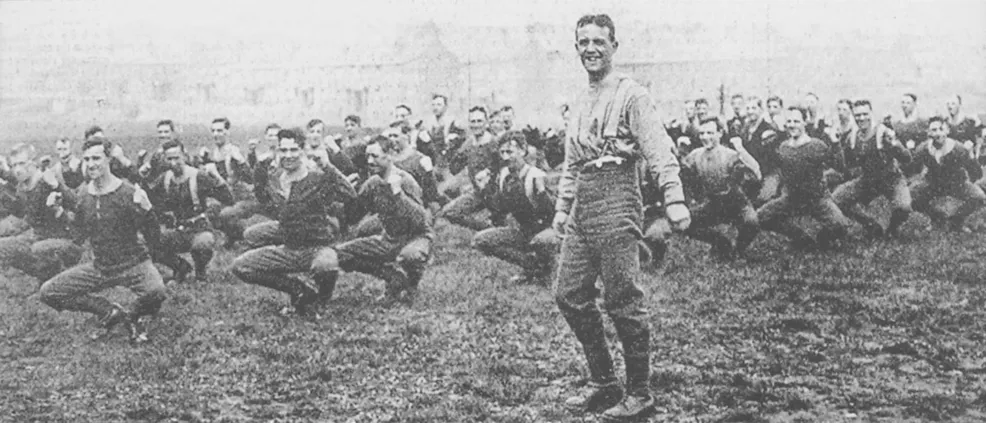
Second Pals Bowling Park May 1915.
Introduction and Acknowledgements
THERE WERE TWO EARLY STRANDS to my awareness of the Bradford Pals. A former Pal was the sole booming bass in the Church choir of which I was a member. This formidable gentleman had a strong West Yorkshire accent, but he nodded towards respectable gentility by lengthening his vowels. To our lasting shame, we young choirboys nudged and winked at a solemn moment in The Creed when the bass voice boomed that Our Lord had ‘Ascended into Heaven’. Later, at Bradford Grammar School, I became aware of so many names and photographs of the Pals generation in the disturbing yet impressive gloom of the School War Memorial chamber. As we of a more fortunate generation passed through to a science lesson, a hushed respectful silence was enforced by Masters with their own memories of both World Wars.
Many years later I was fortunate enough to meet some of the surviving Pals, John McGrath, George Grunwell and Sam Wainwright and to hear their stories. Another Pal, Walter Hare, became a close friend and a remarkably accurate fount of knowledge. He was also a travelling companion to the battlefields many times well into his nineties. My one regret is that I failed to complete this work in Walter’s lifetime, although he read drafts of the events in which he was involved. I dedicate the book to Walter and to his fellow Pals with admiration for their bravery and fortitude. They were ordinary men who, for the most part, did extraordinary things.
My research has taken many years and it has been extremely difficult to decide what to leave out given the publisher’s limit of three hundred and twenty pages. I have much more material than it has been possible to include here, but there are hopes that the publishers will produce a follow up volume with complete medal rolls of both battalions, full casualty lists, and muster rolls of the battalions at break up. In addition there are literally hundreds of photographs which it has not been possible to include.
I would like to thank everyone who has helped by providing material for the book. I am especially grateful to Steve Kerry, formerly of the Bradford Industrial Museum for sharing his own research with me and for allowing me access to the Museum’s oral history and photographic collection. I owe Steve a great deal and his work has made a massive contribution to the book. His colleague Ian Ward has also been more than helpful and taken much trouble on my behalf. The Editor of the Telegraph and Argus has kindly given permission for me to reproduce photographs from their archives. I acknowledge her help and that of her former colleague Bill Berry for the introductions they made. There are many others to thank. Martin Middlebrook, author of the classic First Day of the Somme allowed me to use interview material he collected from the Pals in the 1960’s. Malcolm Brown provided introductions and tape recordings of interviews with the Pals. Laurie Milner of the Imperial War Museum and author of the companion volume, Leeds Pals, cheerfully discussed ideas and shared information. The late Dr. Alf Peacock was generous with his research and always knew somebody who knew where something was. Julian Sykes and Julian Putkowski, co-authors of Shot at Dawn, provided a range of information and technical information, and in Julian P.’s case welcome hospitality and lively conversation during visits to the Public Record Office.
Staff at the Public Record Office, The Imperial War Museum and the Regimental Museum in York took much trouble on my behalf which I would like to acknowledge.
I owe a huge debt of gratitude to the many family members of Pals who entrusted me with much information and material including diaries, letters and photographs. They number almost into three figures and I have acknowledged individual help during the course of notes at the end of each chapter. I hope they enjoy the book and feel that it pays a fitting tribute to their late relatives.
At Pen & Sword, Roni and Sylvia were always kind and patient and always had a technical answer to problems. To First World War buffs, Roni Wilkinson has become a bigger Barnsley institution than Dickie Bird could ever be and I wish him every happiness in his forthcoming retirement. Thanks also to Rupert Harding for his gentle velvet glove diplomacy in getting me to commit pen to paper and to meet deadlines.
Inevitably there will be mistakes or omissions for which I apologise and take full responsibility. It has been a profoundly moving experience to work on the story of the Bradford Pals and I hope my book is worthy of them.
DAVID RAW April, 2005
Chapter One
WORSTEDOPOLIS
If we look around at our mills, our warehouses and our public buildings it
needs no great effort to imagine that Bradford is built of Wool.
THE BRADFORD OBSERVER, 31 December, 1900.
needs no great effort to imagine that Bradford is built of Wool.
THE BRADFORD OBSERVER, 31 December, 1900.
IN THE SUMMER of 1914, Bradford was a bustling self-confident city with a growing population approaching 300,0001. In just over one hundred and fifty years, the city had undergone a rapid and dramatic transformation. In 1750 it was a small market town with a population of only 5,000 and a miniscule textile industry based on the domestic system. Within a hundred years it had grown twenty fold to become a major manufacturing centre with a population of 103,771 in the 1851 Census return. Growth continued throughout the second half of the nineteenth century at a pace exceeded only by Middlesbrough in the United Kingdom.
The pace of change brought wealth for the few and employment for the many. There were also problems of poor housing, health, education and sanitation. In 1845, the German writer George Weerth remarked of Bradford, ‘every other factory town in England is a paradise compared to this hole’. Yet despite this there was an undeniable vitality and in the latter half of the nineteenth century determined local efforts were made to improve conditions.
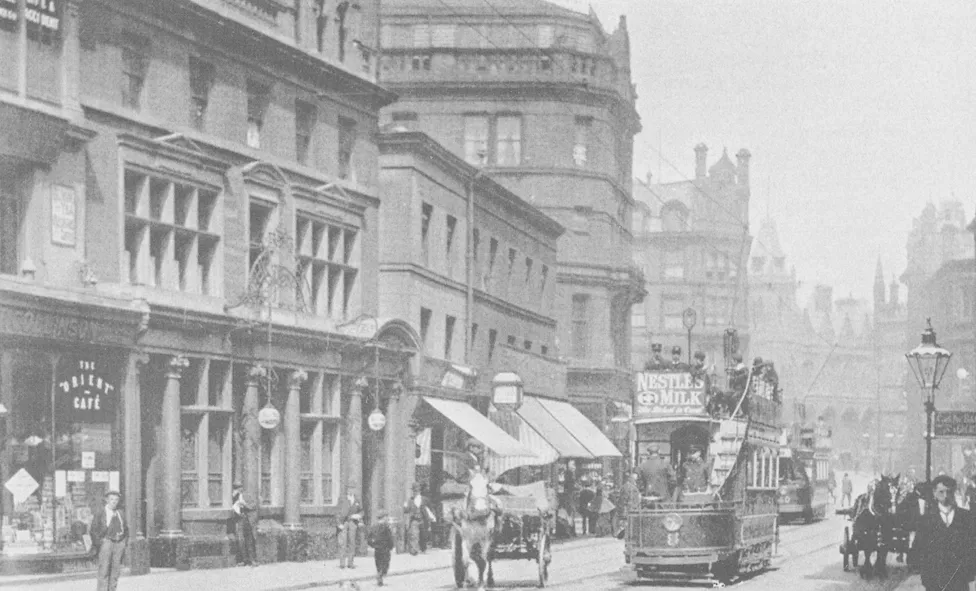
Tyrrel Street, Bradford. Bradford Town Hall can be seen in the distance.
By 1914 the vast majority of the population had a feeling of pride in their city even though many felt there were still enormous social problems to overcome. There were some early signs of the future long-term decline of the textile industry, but this was only apparent to those who looked closely into the matter. For the vast majority, long term confidence in the possibility of social, economic and political progress still remained.
The census of 1911 reveals the dominance of wool. No less than 70,243 persons were directly employed in textile manufacture, with thousands more employed in the engineering, transport and commercial service industries that were dependent on the industry.
Bradford came to regard itself with justification as the world centre of the wool manufacturing industry, particularly in the field of fine worsted stuff. Worsted ‘stuff’, be it noted, not cloth. Worsted was a distinctive fine smooth cloth with a world-wide reputation for excellent quality. In simple terms, in worsted the yarn was made from wool where the short fibres are removed by combing. The long fibres were then laid parallel to produce a smooth even yarn quite different to the intermingled fibre used in the Heavy Woollen district of Dewsbury and carpet manufacture in Halifax.2
To quote J. B. Priestley, an eighteen year old contemporary of the Pals in 1914,
Bradford was very fortunately placed for its own staple trade of worsted and woollen manufacture. It was near some large coalfields, and what was even more important, it had an excellent supply of soft water free from lime, good for both washing wool and dyeing it. All the processes of worsted manufacture – combing, spinning, weaving, dyeing and finishing – are carried on in Bradford. It also deals in alpaca, mohair and silk. Indeed there is nothing that can be spun and woven that does not come from Bradford.4
Worsted, was first introduced in the early 1700s after the Turkey cloth (fabric used to cover chairs and furniture) trade collapsed fo...
Table of contents
- Cover
- Half Title
- Full Title
- Copyright Page
- Contents
Trusted by 375,005 students
Access to over 1.5 million titles for a fair monthly price.
Study more efficiently using our study tools.
Frequently asked questions
Yes, you can cancel anytime from the Subscription tab in your account settings on the Perlego website. Your subscription will stay active until the end of your current billing period. Learn how to cancel your subscription
No, books cannot be downloaded as external files, such as PDFs, for use outside of Perlego. However, you can download books within the Perlego app for offline reading on mobile or tablet. Learn how to download books offline
Perlego offers two plans: Essential and Complete
- Essential is ideal for learners and professionals who enjoy exploring a wide range of subjects. Access the Essential Library with 800,000+ trusted titles and best-sellers across business, personal growth, and the humanities. Includes unlimited reading time and Standard Read Aloud voice.
- Complete: Perfect for advanced learners and researchers needing full, unrestricted access. Unlock 1.5M+ books across hundreds of subjects, including academic and specialized titles. The Complete Plan also includes advanced features like Premium Read Aloud and Research Assistant.
We are an online textbook subscription service, where you can get access to an entire online library for less than the price of a single book per month. With over 1.5 million books across 990+ topics, we’ve got you covered! Learn about our mission
Look out for the read-aloud symbol on your next book to see if you can listen to it. The read-aloud tool reads text aloud for you, highlighting the text as it is being read. You can pause it, speed it up and slow it down. Learn more about Read Aloud
Yes! You can use the Perlego app on both iOS and Android devices to read anytime, anywhere — even offline. Perfect for commutes or when you’re on the go.
Please note we cannot support devices running on iOS 13 and Android 7 or earlier. Learn more about using the app
Please note we cannot support devices running on iOS 13 and Android 7 or earlier. Learn more about using the app
Yes, you can access Bradford Pals by David Raw in PDF and/or ePUB format, as well as other popular books in History & World War I. We have over 1.5 million books available in our catalogue for you to explore.