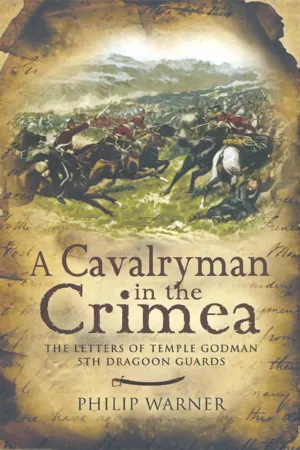
eBook - ePub
A Cavalryman in the Crimea
The Letters of Temple Godman, 5th Dragoon Guards
- 224 pages
- English
- ePUB (mobile friendly)
- Available on iOS & Android
eBook - ePub
About this book
Among the British troops bound for the Black Sea in May 1854 was a young officer in the 5th Dragoon Guards, Richard Temple Godman, who sent home throughout the entire Crimea campaign many detailed letters to his family at Park Hatch in Surrey. Temple Godman went out at the start of the war, took part in the successful Charge of the Heavy Brigade at Balaklava and in other engagements, and did not return to England until June 1856, after peace had been declared. He took three very individual horses and despite all his adventures brought them back unscathed.Godmans dispatches from the fields of war reveal his wide interests and varied experiences; they range from the pleasures of riding in a foreign landscape, smoking Turkish tobacco, and overcoming boredom by donning comic dress and hunting wild dogs, to the pain of seeing friends and horses die from battle, disease, deprivation and lack of medicines.He writes scathingly about the skein of rivalries between the Generals (a good many muffs among the chiefs), inaccurate and highly coloured newspaper reports and, while critical of medical inefficiency, regards women in hospitals as a sort of fanaticism. Yet at other times he will employ the pen of an artist in describing a scene, or wax eloquent on the idiosyncrasies of horses. He is altogether a most gallant and sensitive young cavalryman, and deservedly went on to achieve high rank after the war. Always fresh and easy to read, his letters provide an unrivalled picture of what it was really like to be in the Crimea.
Trusted by 375,005 students
Access to over 1.5 million titles for a fair monthly price.
Study more efficiently using our study tools.
Information
Contents
Introduction
1 Warships to Varna
2 The Brushwood Plain
3 Cholera
4 Charge of the Heavy Brigade
5 The Winter Siege
6 Building for Survival
7 Bombardment of Sebastopol
8 The Attempt on the Malakoff
9 The Fruits of Victory
10 Home from the Field
Index
Introduction
It is ironic that the Crimean War, which was more fully and accurately reported at the time than any previous war, should have been so misrepresented afterwards. Of a remarkable and interesting campaign, quite modern in some aspects, all that seems to persist in the public mind is the Charge of the Light Brigade and the ‘thin red line’. The two incidents together occupied less than thirty minutes; the remainder of the war lasted over two years. There is, of course, interest in Florence Nightingale but she was a long way from the battlefields.
When fighting soldiers eventually read or hear what was supposed to have taken place on campaigns in which they were engaged they tend to smile cynically. Sometimes they consider offering a few corrections, but rarely bother; the task, they often feel, is too large, and scarcely worth the trouble. Fortunately, there are occasions when someone who took an active part has kept records — a diary perhaps — and then a new picture emerges. It may not be the view of the Commanding Officer, or the politicians; it may differ substantially from the official version and may damage a few reputations but it will undoubtedly show what the war was really like. For wars are fought by men, usually tired, cold and hungry, and not by numbers and quaint euphemisms. We tend to forget that ‘an attack at Company strength was repulsed with severe casualties’ probably means that about sixty people were killed or wounded in an unsuccessful venture. As a piece of military history it is of slight interest but for those concerned, the wounded and the survivors, it is an unforgettable experience.
Among the survivors there will be a variety of memories. To some it will be an appalling and futile disaster, to others a moment of great excitement which gave them a feeling of lasting achievement; to yet others a time which gave them an insight into their own character and potential. Of course, there are almost as many views as the number of men involved.
How far we can perceive the feelings of those concerned in the actual fighting depends on the extent of the personal records. A bare narrative which confines itself to the events of the battlefield tells us little; a detailed account covering a wider range of experience gives us a guide to the writer’s mind and the quality of his assessments.
The Temple Godman letters give a valuable insight into the Crimean War for several reasons. One is their completeness. He went out at the start to the Crimea in May 1854 and did not return till two years later, after peace had been declared. Another is their humane perceptiveness. He would write one account for his mother, sparing her the details, and another for his brother whose feelings were presumably less tender. In addition, he is passionately interested in what seem to us relatively unimportant details. This last aspect is perhaps the most valuable for from it we can assess his reactions to other matters. In short, what might seem harsh, inefficient, and unnecessary in the 1970s may have seemed normal, sensible and essential in the 1850s.
Not for a moment did Temple Godman wish to be anywhere else than the Crimea. He missed his home comforts but did not wish to be at home to enjoy them. Many soldiers engaged in hazardous and strenuous activities simply cannot be bothered to make a record of them; they would rather have a sleep or a game of cards, or just forget them. Later, if they change their minds and try to piece the story together their memories have lost some of the details. In hindsight they may feel some self-pity.
There is nothing of that in Temple Godman. He is intelligent and imaginative so he knows quite well the dangers which surround him, and they are many. Some soldiers are too stupid to understand the situation in which they find themselves and therefore appear to be brave; their deficiencies become apparent when the battle demands cool, swift, constructive thought. Cardigan of the Light Brigade was undoubtedly one of these. His orders had been ‘to advance rapidly to the front and try to prevent the enemy carrying off the guns’. He was not, however, told to advance in a manner which would guarantee his brigade would be virtually wiped out.
The Charge of the Heavy Brigade, in which Godman took part, was a great success and was just as courageous as the Charge of the Light Brigade. Unfortunately few people have ever heard of it. It is a curiosity of the British character that we take more pleasure in dwelling on our disasters than our successes. Everybody has heard of Dunkirk, Dieppe and Arnhem but what is known of Mareth, Sittang and Falaise?
But even the Charge of the Heavy Brigade was no more than an incident. A disaster there would not have lost the campaign although it would have been a serious setback. When it took place we had already won the Battle of the Alma — and made very poor use of it — and soon afterwards we would win the Battle of Inkerman, which was a very fine performance indeed. And then with all the famous glamorous battles over, the army would settle down for nearly two years and win the war. It would be achieved by solid deeds of courage and endurance, many of them performed by unnamed men. Every opportunity of a quick victory had been frittered away by the ineptitude of the Higher Command. For the long months ahead we had opponents who were renowned for their stoicism and endurance.
THE WAR
How, one might ask, had all this come about, and what had brought the twenty-two-year-old Richard Temple Godman into the thick of it?
The root causes of the war may be summarized fairly briefly. Long before the discovery of oil or the establishment of small nationalist states, the eastern end of the Mediterranean was clearly of enormous importance to any country aspiring to Great Power status. Britain, for example, regarded it as vital to her communications with India; France regarded it as essential to what she hoped would be an expansionist policy; Russia regarded it as highly important as a window on the west. Russia’s ambitions were mixed with apprehensions. She knew that the decaying Turkish Empire which still sprawled over a vast area — reaching as far as Egypt — might collapse at any moment and she was desperately anxious to ensure that when it did, she herself would be one of the beneficiaries. Unfortunately her efforts to safeguard existing interests and further others caused her to behave with such heavy-handed ineptitude that she aroused fear and hostility on all sides. Her fears of what the Turks might or might not do with their unwieldy inheritance brought her to war with Turkey four times in the 19th century. The immediate causes which touched off the Crimean War do not concern us here. Suffice to say that after a series of acts which the Russians thought were legitimate defensive moves, and which the Turks, French and British thought were blatant examples of aggression, Turkey, France and Britain declared war on Russia on 28 March 1854.
Whatever the justice of the cause it was an awkward moment for Britain. The army had been run down and neglected since Waterloo in 1815 and, in thirty-seven years, parsimony and neglect can do a lot of damage to any army. Even under the best conditions there can be administrative breakdowns. The miracle of the Crimean War was that in fighting a campaign 3,000 miles away on virtually unknown territory there were not more.
The aim of Britain and France in 1854 was to capture and immobilize Sebastopol, the Russian port and naval base in the Black Sea. The Russian plan was to prevent this occurring and, in due course, to push westwards and capture Constantinople (Istanbul), thereby gaining control of the ingress to the Black Sea. There were minor activities in other areas, such as the Baltic, but the centre of the war was the Crimea, a peninsula jutting into the Black Sea. As the Allies were soon to discover, the Crimea had a climate of extremes, very hot and dusty in the summer and bitterly cold in the winter. Diseases of all sorts flourished in the region, but the most deadly was cholera, a waterborne infection which can kill within hours. Neither the causes nor the cure of cholera were known and it was to exact an appalling toll.
In order to reach Sebastopol the Allies had to establish a base at Varna, in what is now Bulgaria, and cross the Black Sea to a suitable landing point in the Crimea. Initially they were able to land unhindered on the Crimean peninsula north of Sebastopol. On the march south they encountered the Russians on the slopes by the river Alma and won the ensuing battle by the sheer bravery of their exhausted and cholera-stricken troops. Lord Raglan, supposedly in overall command, isolated himself and had no influence on the outcome.
After the victory at the Alma the Allies made a controversial move by marching right round Sebastopol instead of attacking it from the north. This gave them the poor-quality port of Balaklava but they lost so much time that the Russians were able to improve their fortifications considerably. Every week that passed made the position of the Allies worse and the situation of the Russians stronger. The Battle of the Alma had not taken place till 20 September 1854, and it had been followed by an incomplete blockade. The Allies had manoeuvred themselves into a most unsatisfactory position, six miles from the port of Balaklava and at the same time isolated from the interior. Added to this their equipment was old, faulty and unsuitable, as well as being insufficient. Clothing and food were inadequate; there was hardly any fuel. Cholera was the major killer but there were other illnesses too; the nearest hospital was at Scutari, near Constantinople, 300 miles across the Black Sea. Conditions in that ‘hospital’, some of which was built over a cesspool, defied belief.
The cavalry battles, which comprised the Charge of the Heavy Brigade and the Charge of the Light Brigade, became known as the Battle of Balaklava. This also included the episode known as the ‘thin red line’ when the 93rd (Argyll and Sutherland Highlanders) stood between a Russian cavalry advance and the port of Balaklava and deflected the four Russian squadrons.
The Charge of the Light Brigade has been too often reported to need much space here. Raglan intended the Light Brigade, a force numbering 673, to advance on the Russians who were trying to draw away some Turkish guns they had captured earlier in the day. From their position in the valley neither Lord Lucan, the Cavalry Division Commander, nor the Earl of Cardigan, commanding the Light Brigade, could see the guns Raglan wished them to recapture. All they could see was a formidable array of Russian guns a mile up the valley. With magnificent courage they reached those guns, sabred some of the gunners but then retired as they had no means of holding their hard-won objective. One hundred and thirteen men ...
Table of contents
- Cover
- Half Title
- Title Page
- Copyright
- Contents
Frequently asked questions
Yes, you can cancel anytime from the Subscription tab in your account settings on the Perlego website. Your subscription will stay active until the end of your current billing period. Learn how to cancel your subscription
No, books cannot be downloaded as external files, such as PDFs, for use outside of Perlego. However, you can download books within the Perlego app for offline reading on mobile or tablet. Learn how to download books offline
Perlego offers two plans: Essential and Complete
- Essential is ideal for learners and professionals who enjoy exploring a wide range of subjects. Access the Essential Library with 800,000+ trusted titles and best-sellers across business, personal growth, and the humanities. Includes unlimited reading time and Standard Read Aloud voice.
- Complete: Perfect for advanced learners and researchers needing full, unrestricted access. Unlock 1.5M+ books across hundreds of subjects, including academic and specialized titles. The Complete Plan also includes advanced features like Premium Read Aloud and Research Assistant.
We are an online textbook subscription service, where you can get access to an entire online library for less than the price of a single book per month. With over 1.5 million books across 990+ topics, we’ve got you covered! Learn about our mission
Look out for the read-aloud symbol on your next book to see if you can listen to it. The read-aloud tool reads text aloud for you, highlighting the text as it is being read. You can pause it, speed it up and slow it down. Learn more about Read Aloud
Yes! You can use the Perlego app on both iOS and Android devices to read anytime, anywhere — even offline. Perfect for commutes or when you’re on the go.
Please note we cannot support devices running on iOS 13 and Android 7 or earlier. Learn more about using the app
Please note we cannot support devices running on iOS 13 and Android 7 or earlier. Learn more about using the app
Yes, you can access A Cavalryman in the Crimea by Philip Warner in PDF and/or ePUB format, as well as other popular books in History & Military Biographies. We have over 1.5 million books available in our catalogue for you to explore.