eBook - ePub
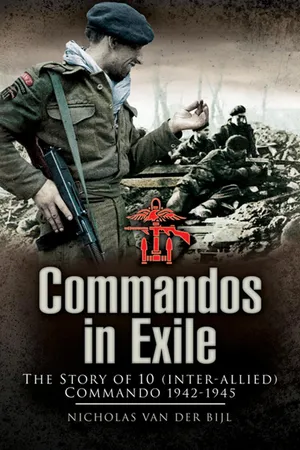
Commandos in Exile
The Story of 10 (Inter-Allied) Commando, 1942–1945
- 224 pages
- English
- ePUB (mobile friendly)
- Available on iOS & Android
eBook - ePub
About this book
Formed from members of Free Forces who had escaped from German occupation, 10 (Inter-Allied) Commando was one of the most unusual units in WW2. All members had to pass the Green Beret commando course at Achnacarry in Scotland and the book begins by describing this training. With no less than six national troops, plus X Troop drawn from exiled Jews, 10 Commando never fought as an entity but loaned troops for specific operations, such as One Troop (French) taking part in the Dieppe Raid, 2 Troop (Dutch) fighting at Arnhem, 5 Troop (Norwegian) raiding the Lofoten Islands etc. At other times groups played a key intelligence role questioning POWs, translating captured documents, conducting reconnaissance patrols and intelligence gathering on the D-Day beaches. The history of X Commando, made up of escaped Jewish individuals is especially interesting.The book also reviews the growth of post-war national Commando forces.
Information
Topic
HistoireSubtopic
Les femmes dans l'histoireChapter 1
The Commandos
By the beginning of 1942, the war for Great Britain was not going well and we were under economic pressure as U-boat wolf packs tore into fragile convoys crossing the Atlantic. The appearance of General Rommel and the Afrika Korps brought depressing news from North Africa, while in the Far East, Hong Kong had fallen to the Japanese after a gallant defence, but in Malaya, the defence of Singapore wilted. The Battle of Britain was followed by the Blitz, and the retaliation by bombers trundling across Europe at night was seeing significant losses in aircraft and men. There was, however, hope. The entry of the United States after the Japanese attack on Pearl Harbour on 7 December 1941 promised almost endless support and commitment in terms of men and supplies, although their battle experience was limited. Chancellor Adolf Hitler's volte-face and his attack on the Soviet Union had produced advances deep into the communist republics but the seasons were showing that ‘General Winter’ was the Soviets' best ally.
The well-publicized exploits of the Commandos as the only ground forces taking the war to Occupied Europe reinforced public morale from 1940 to 1942 in a period of hardship, uncertainty and danger. The name ‘commando’ became a byword for stealthy raiding and it soon seemed all the Armed Forces wanted a slice of the action. By 1945, the Royal Navy had formed Beach Commandos to land in the first assault waves and control beach operations, while RAF Servicing Commandos serviced aircraft on airfields still under enemy artillery fire and threatened by attack. At least one Home Guard battalion, the 47th (24th General Post Office Birmingham) Warwickshire Battalion, created an unofficial commando company for guerrilla training. The 24th South Staffordshire (Tettenhall) Battalion created an assault course which included a river crossing and cliff climbing.
The origins of the Commandos can be traced to March 1938 when Admiral ‘Quex’ Sinclair, then head of Military Intelligence 6 (MI6), otherwise known as the Security Intelligence Services, was lent Major Lawrence Grand, Royal Engineers, from the War Office to establish Section D and develop plans to degrade the performance of an enemy through clandestine and covert operations. At the same time, but unknown to Sinclair, Major Joseph Holland was working with General Staff (Research) (GS(R)) at the War Office developing irregular warfare. Also a Royal Engineer, he had studied British internal security operations in Ireland and Palestine, and was an acknowledged expert in unconventional warfare. When his ideas were studied by Military Intelligence, GS(R) was absorbed into MI (Research) where Holland developed the concept of tying down large numbers of troops by small forces. With war imminent, the Chief of the Imperial General Staff (CIGS) noticed the work of Section D and MI(R) and from it created, on 23 March 1939, the Special Operations Executive (SOE). However, the two majors were chalk and cheese and when Holland returned to the War Office, he took with him a like-minded Royal Artillery officer, Major Sir Colin McV. Gubbins. Every army has challengers to military conventions and, by spring 1940, Gubbins and Holland had persuaded the War Office to establish ten Guerrilla Companies. However, in a Regular Army imbued with conservatism, the units were retitled first to Special Infantry Companies and then to Independent Companies in accordance with their self-sufficient role of operating from their own ships, usually former ferries equipped with landing craft. On 20 April, No. 1 Independent Company was formed from Territorial Army volunteers supported by a few Regular Army from the 52nd (Lowland) Division. This was followed by nine more companies raised from infantry divisions, such as No. 10 Independent Company from 66th (Lancashire and Border) Division. The establishment of each company was twenty-one officers and 270 ORs.
When the Germans invaded Norway, Brigadier Gubbins commanded four Independent Companies in northern Norway from HMS Royal Ulsterman on 13 May 1940 and a fifth with a strategic role to cut the supply of Swedish iron ore to Norway. The Independent Companies had proved their worth, although Gubbins did commit the career-limiting sin of sacking a Guards officer close to the Crown for incompetence. While the Dunkirk evacuation was underway, MI(R) demonstrated the value of raiding when three officers blew up 200,000 tons of fuel at Harfleur on 2/3 June and then, collecting an Army straggler, rowed 13 miles out to sea to be collected.
On 4 June, when Prime Minister Winston Churchill asked the CIGS if there was there any reason why Great Britain should not retaliate, that evening Lieutenant Colonel Dudley Clarke (Royal Artillery), who was the Military Assistant to General Sir John Dill, the CIGS, proposed establishing a raiding force. When submitted next day, Churchill was enthusiastic:
Specially trained troops of the hunter class who can develop a reign of terror down the enemy coast . . . I look to the Chiefs of Staff to propose measures for a ceaseless offensive against the whole German-occupied coastline leaving a trail of German corpses behind.
Mindful of the dire straits that the Nation was in after Dunkirk, he stipulated that no units should be diverted from opposing invasion and the force would have to do with the minimum of weapons.
Two days later, after a meeting between Dill and Churchill, Clarke's proposals were accepted and a raid was to be mounted as soon as possible under the operational co-ordination of Military Operations 9 (MO9), which had been established the same day to organize raids. When Clarke proposed the new force be known as ‘Commandos’, it appealed to Churchill's fertile imagination from the long British military tradition of raiding, and his experiences during the Second Boer War when columns of mounted Boers hit hard and ran. The word ‘commando’ is thought to have been introduced into Africa by the Portuguese and was used by the Boers to describe mounted conscripts serving with the armed forces of the republics of Transvaal and Orange Free State. On 12 June, Lieutenant General Sir Alan Bourne (Royal Marines) was placed in charge of raiding operations from the Admiralty. When Churchill then instructed Lord Hankey, who was Secretary to the Cabinet, to co-ordinate unconventional and irregular warfare, next day, Majors Holland and Grand were told that raiding and subversive operations would be co-ordinated by a single Minister, Dr Hugh Dalton, Minister of Economic Warfare, independent of War Office control.
Ten Commandos were raised from the five Independent Companies that had been in Norway and the Territorial Divisions in Great Britain – for instance No. 2 Commando, originally formed in July 1940, became No. 11 Special Air Service Battalion, forerunner to the Parachute Regiment, however lack of aircraft led to the Commando being reformed. No. 3 Commando, raised in Plymouth in July 1940 from a high proportion of Dunkirk veterans who had fought against the Waffen-SS, refused to acknowledge the Special Service nomenclature. No. 8 Commando was raised by Lieutenant Colonel Robert Laycock (The Blues) in July 1940 from the Household Cavalry, the Guards, Somerset Light Infantry, Royal Artillery, Royal Engineers and some Royal Marines. No. 10 Commando was disbanded after Northern Command failed to find sufficient volunteers. Orders were then despatched from MO9 on 20 June seeking volunteers for hazardous duties:
Able to swim, were immune from air and sea sickness, able to drive motor vehicles . . . with courage, physical endurance, active, marksmanship, self-reliance and an aggressive spirit towards war . . . and must become experts in the military use of scouting . . . to stalk . . . to report everything taking place . . . to move across any type of country, day or night, silently and unseen . . . and to live off the land for considerable periods.
The response from the Army, defeated at Dunkirk, was overwhelming and the commanding officers appointed by the War Office to form Commandos chose their officers, who in turn selected the about 530 all ranks that made up the Commando establishment. Brigadier Peter Young (Bedfordshires and Hertfordshires), who commanded No. 3 Commando, later said, ‘We only wanted maniacs in the Commandos . . . friends.’ Lieutenant Colonel John Durnford-Slater (Royal Artillery) raising No. 7 Commando selected Dunkirk veterans, former Independent Company men and Spanish Civil War veterans, although the latter were screened for their loyalties, just in case they took ‘guerrilo’ concept too seriously. Retaining their cap badges, they were administered by their corps or regiments and were billeted with local families. Within three weeks of Dunkirk, Major Ronnie Tod and 115 men from Nos 6 and 8 Independent Companies formed into the fictitious ‘No. 11 Commando’ and raided France in Operation Collar. Fortuitously, Captain S.G. Garnons-Williams DSC RN had gathered launches and RAF rescue boats in the Hamble and manned them with a mixed bunch of Regular and Reserve sailors. Of the four raids that comprised Operation Collar, one party encountered nothing of interest, the second failed to land, and the third went ashore near Tocquet and killed two Germans guarding a dance hall. The fourth ran into a German cyclist patrol and in the ensuing fight, the only British casualty was Lieutenant Colonel Dudley Clarke whose ear was clipped by a bullet. When one group returned to Folkestone, they were arrested by the Military Police for being dirty and dishevelled first thing in the morning. During Operation Ambassador on occupied Guernsey during the night of 14 July, a lesson learnt was the value of swimming in amphibious operations. Somewhat unrealistically, Churchill envisaged tanks landing and although he called the raids fiascos, they had considerable propaganda value for a country bracing itself for invasion.
In July, Admiral of the Fleet Sir Roger Keyes was appointed as Director Combined Operations and retained Lieutenant General Bourne as his deputy. When MI(R) was reformed as Combined Operations HQ and placed under command of GHQ Home Forces, it envisaged 200-strong units remaining ashore for a day and examined operations in support of conventional forces. On 19 July, Churchill ordered SOE to ‘set Europe ablaze’ by mobilizing the Resistance from its Baker Street offices, however internecine rivalry blighted co-ordinated intelligence activities, quite apart from the Abwehr and Gestapo working hard to undermine Allied planning.
On 11 November, after the immediate threat of invasion was reduced by the Battle of Britain, as an anti-invasion measure, Brigadier John Haydon assembled the Commandos and surviving Independent Companies into the Special Service Brigade. Although some senior officers preferred the term ‘Special Service’, in spite of the link with the Schutz Staffel (SS), ‘Commando’ did not and both terms coexisted until late 1944. Nos 7, 8 and 11 Commandos were formed into LAYFORCE under the command of Lieutenant Colonel Laycock and sent to the Middle East to join Nos 50 and 52 Commando, which had been raised from British troops serving in the Middle East. In deteriorating situations, the Commandos were frequently used as infantry, particularly when Crete was overrun, a decision that infuriated Churchill. The survivors were formed into the Middle East Commando until it was disbanded in early 1942 with most men transferring to the 1st Special Air Service Regiment.
The year 1941 saw a gradual increase in raids against Europe, in particular Occupied Norway. In April 1940, the Royal Norwegian Legation in London had laid the foundations for an army-in-exile by registering English-speaking Norwegians willing to serve as liaison officers with the British in Norway. Exiled sailors and whalers were being assembled at Shoeburyness coastal artillery camp until a Norwegian military mission finally established a reception camp at Dumfries. On 10 June, King Haakon arrived in Great Britain and ten days later established the Norwegian Army Command in London. On 21 June, in the last broadcast to Norway, General Carl Gustav Fleischer recommended the conscription of Norwegians aged between twenty and thirty-five years in Great Britain and, at a meeting at the War Office, confirmed that Norway would fight. By the New Year, Norwegian Brigade was operational under GHQ Home Forces and trained with the Cameronian Highlanders and 126th Field Regiment, Royal Artillery. On 1 January 1941, conscription of Norwegian men in Great Britain began. Many who had left Norway did so under dangerous conditions, with some crossing the North Sea with inadequate navigation equipment for open-water voyages in small boats, but making landfall among the Scottish islands. A few were caught in gales that took them far out to sea. All were at risk from German aircraft patrolling the coast.
Nevertheless, simmering disagreements between the Norwegian and British Government over the use of the Norwegian Armed Forces persisted until the isolationist Foreign Minister, Koht, who was blamed for the neutrality that led to occupation, was replaced by Trygve Lie, later appointed the first Chairman of the United Nations. A firm believer in alliances, he signed the Armed Forces Agreement in May 1941 and the St James's Palace Inter-Allied Declaration in June, which resulted in the Norwegians being accepted into the Allied order of battle for ‘the defence of the United Kingdom or for the purpose of regaining Norway’. Norway also provided several units, including No. 1 Norwegian Detachment of gunners on South Georgia and winter warfare instructors in Iceland. When, in mid-1940, Lieutenant General Bourne had suggested that the Norwegians should form two Independent Companies, the 47-year-old former actor Captain Martin Linge raised Norwegian Independent Company 1, which operated under the auspices of SOE. Colloquially known as Linge Company (Lingekompannie), it trained at Inverailort House, not far from Glenfinnan, near where Bonnie Prince Charlie had raised his nationalist standard in 1745. Recruits were first treated to the alarming spectacle of the former Shanghai police officers, Major Bill Fairbairn and Captain Eric Sykes, rolling down a staircase in a display of hand-to-hand fighting. These two designed the double-edged dagger that is synonymous with British commandos and which is commemorated today by the insignia for Army personnel serving as commandos.
The distance to Norway precluded parachute operations in the summer. Although the long winter nights offered long-distance flying, the weather was unpredictable and so it was by small ships, such as the ‘Shetland Bus’ trawlers, that the Norwegian Resistance was supplied with arms, ammunition and equipment, and agents were collected and dropped. The head of the SOE Norwegian Section, Mr J.S. Wilson, brought his scoutmaster's patience and accuracy to planning raids with Norwegian commanders, the principle targets being economic, but also to remind outlying German garrisons that they were at risk. Linge Company accompanied Nos 2, 3, 4 and 6 Commandos as interrogators and liaison on Operation Archery on 27 December 1941 at Vaagso to attack shipping, warehouses, dockyards and fish-oil processing plants of use to the Germans. Among the nineteen British killed in fierce fighting was Captain Linge, attacking a hotel in Malåløy. The raid had far-reaching consequences when the Germans strengthened their defence of Norway with formations that they could have deployed elsewhere. At the same time, the diversionary Operation Anklet took place between 26 and 28 December when No. 12 Commando and elements of Linge Company landed on the Lofoten Islands to destroy installations. Operation Claymore on 4 March was an economic raid on the two towns on Lofoten by Nos 3 and 4 Commandos, supported by a small party from Linge Company, to destroy fish oil being processed by the Germans to produce nitro-glycerine explosive. Lieutenant Richard Willis, of No. 3 Commando, sent a telegram from Stamsund addressed to A. Hitler, Berlin: ‘You said in your last speech German troops would meet the British wherever they landed. Where are your troops? Prisoners from Operation Claymore.’ On all the raids, the commandos returned with prisoners, Quisling collaborators and several hundred Norwegian volunteers, including a few women. Parts of an Enigma cipher machine that helped the Bletchley Park code-breakers were brought back from Lofoten.
Meanwhile, commandos were the amphibious recovery force during the Bruneval raid on 27/8 February by C Company, 2nd Parachute Battalion, tasked to capture key parts of the Wurzburg radar. On 27/8 March, commandos destroyed the St Nazaire dry dock in the ‘greatest raid of all’.
By 1942, several divisions had been sent to North Africa and the Far East. Those left behind in the UK trained for the invasion of Europe. Also in the country were Frenchmen and Poles plucked from Dunkirk and Czechs, Norwegians, Belgians, Dutchmen and others who had escaped from Occupied Europe, all under the overall command of their respective governments-in-exile and fretting at their inability to liberate their countries. Some had lived in Great Britain all or most of their lives but, without British passports, were aliens and could not enlist.
Chapter 2
Formation of No. 10 (Inter-Allied) Commando
In Great Britain, the few opportunities for exiled armies to take the war to the Germans were leading to dissatisfaction, demoralization and distrust of the political and military aims of the governments-in-exile. Apart from the Linge Company, exiles were condemned to waiting either for deployment to an overseas theatre of war or for the opening of the Second Front, and the endless training, uncertainty and boredom boiled over into frustration. New arrivals from Occupied Europe had the psychological problem of arriving with a will to fight but then faced the tough job of being forced to settle down to the hurry-up-and-wait routine. Some had experienced incredible hardship. The only contact with families was the occasional letters through the Red Cross or a neutral power, but this contact risked reprisal. Private Chris Helleman who later joined 2 (Dutch) Troop, was a former merchant sailor who had escaped from Holland via Sweden in 1943. He managed to send a letter to his family via the Swedish Consulate and was ticked off for lambasting the Dutch Nazi Party in it.
When the evacuation of Allied servicemen from France was over, those who escaped from Occupied Europe were initially screened by Scotland Yard, however, as the flow continued, it became clear to British counterintelligence that while the Germans could not prevent escapes, they could use escape lines to insert spies. To counter the threat, under the auspices of MI5, a Dutch Military Intelligence officer, Lieutenant Colonel Oreste Pinto, established the London Reception Centre at the Royal Victoria Patriotic School in Wandsworth where new arrivals were given a vetting interview and intelligence was gathered on their experiences. Pinto had gained his counter-intelligence experience with the French Deuxieme Bureau, and trained his interrogators to dissect minutely each account and examine possessions – a forgotten bus ticket, an old-fashioned watch, clothing, cigarettes – for clues of German penetration. Throughout the war, they successfully achieved the fine balance of trapping spies and ensuring that bona fide exiles did not feel that they escaped from the Gestapo only to fall into the hands of an equally unpleasant security organization.
Among the 139,000 French who were either evacuated from Dunkirk and other ports, or who sailed their ships to England, were 20,000 sailors and marines. When France surrendered on 22 June 1940, most too...
Table of contents
- Cover Page
- Title Page
- Copyright
- Contents
- List of Maps
- Acknowledgements
- Glossary
- Chapter 1: The Commandos
- Chapter 2: Formation of No. 10 (Inter-Allied) Commando
- Chapter 3: Training the Commando
- Chapter 4: Dieppe
- Chapter 5: Raiding Norway
- Chapter 6: 2 (Dutch) Troop in the Far East
- Chapter 7: The Mediterranean
- Chapter 8: Cassino and the Adriatic
- Chapter 9: Raiding the Atlantic Coast
- Chapter 10: D-Day Preparations
- Chapter 11: Operation Overlord: 6 June 1944
- Chapter 12: The Defence of the Orne Bridgehead: 7–13 June 1944
- Chapter 13: The Thin Red Line: 13 June to 3 September 1944
- Chapter 14: Operation Market Garden
- Chapter 15: Operation Infatuate – Walcheren
- Chapter 16: Belgium and Holland
- Chapter 17: The Advance into Germany
- Chapter 18: Disbandment
- Appendix 1: Known Details of Members of 3 (British) Troop
- Appendix 2: Order of Battle No. 10 (Inter-Allied) Commando 1942–1945
- Appendix 3: Basic Organization of No. 6 (Polish) Troop – Italy 1944
- Appendix 4: No. 10 (Inter-Allied) Commando Raiding Table
- Appendix 5: Assessed 3 Troop Order of Battle – D-Day
- Appendix 6: Operation Market Garden – 2 (Dutch) Troop Order of Battle
- Appendix 7: No. 10 (Inter-Allied) Commando Recipients of British Gallantry Awards
- Bibliography
- Index
Trusted by 375,005 students
Access to over 1.5 million titles for a fair monthly price.
Study more efficiently using our study tools.
Frequently asked questions
Yes, you can cancel anytime from the Subscription tab in your account settings on the Perlego website. Your subscription will stay active until the end of your current billing period. Learn how to cancel your subscription
No, books cannot be downloaded as external files, such as PDFs, for use outside of Perlego. However, you can download books within the Perlego app for offline reading on mobile or tablet. Learn how to download books offline
Perlego offers two plans: Essential and Complete
- Essential is ideal for learners and professionals who enjoy exploring a wide range of subjects. Access the Essential Library with 800,000+ trusted titles and best-sellers across business, personal growth, and the humanities. Includes unlimited reading time and Standard Read Aloud voice.
- Complete: Perfect for advanced learners and researchers needing full, unrestricted access. Unlock 1.5M+ books across hundreds of subjects, including academic and specialized titles. The Complete Plan also includes advanced features like Premium Read Aloud and Research Assistant.
We are an online textbook subscription service, where you can get access to an entire online library for less than the price of a single book per month. With over 1.5 million books across 990+ topics, we’ve got you covered! Learn about our mission
Look out for the read-aloud symbol on your next book to see if you can listen to it. The read-aloud tool reads text aloud for you, highlighting the text as it is being read. You can pause it, speed it up and slow it down. Learn more about Read Aloud
Yes! You can use the Perlego app on both iOS and Android devices to read anytime, anywhere — even offline. Perfect for commutes or when you’re on the go.
Please note we cannot support devices running on iOS 13 and Android 7 or earlier. Learn more about using the app
Please note we cannot support devices running on iOS 13 and Android 7 or earlier. Learn more about using the app
Yes, you can access Commandos in Exile by Nicholas van der Bijl in PDF and/or ePUB format, as well as other popular books in Histoire & Les femmes dans l'histoire. We have over 1.5 million books available in our catalogue for you to explore.