- 176 pages
- English
- ePUB (mobile friendly)
- Available on iOS & Android
eBook - ePub
About this book
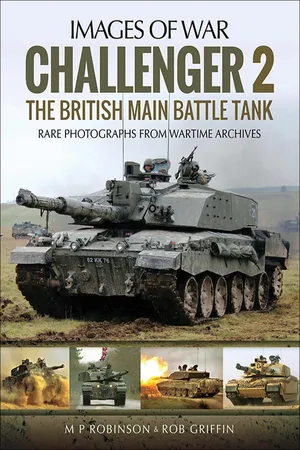
For much of the Cold War, the British Army's main battle tanks (MBT) were first the Centurion and then the Chieftain. The question of the latter's replacement became urgent when in 1980 MBT80 was canceled. While the Royal Ordnance Challenger (originally the Shir 2) was acquired as a stop gap its design and capability limitations quickly became apparent.Vickers then took over the Royal Ordnance tank building facility and against stiff foreign competition developed the Challenger 2.This superbly researched and illustrated book tells the story of the evolution and subsequent successful career of Challenger 2 which has seen distinguished service in war and peace since 1990 and has proved itself one of the worlds most formidable fighting vehicles. The authors do not shy away from technical detail and make comparisons with competitors. The result is an objective and authoritative work which will delight military equipment buffs, modelers and wargamers.
Information
Chapter One
Chieftain, MBT80 and the Shir
There were two schools of thought in British main battle tank design philosophy in the 1970s. One was the continued evolution of the existing Chieftain design; the other was the development of a completely new MBT design. The second of these trends, which encompassed the Future Main Battle Tank (FMBT) and Main Battle Tank 80 (MBT80) programmes, became the single greatest barrier to replacing the Chieftain in a timely manner. Both developmental trends were pursued in the 1970s and resulted in considerable investment from the government and from private companies in the defence sector. Component, armour and weapons development for official and non-official projects resulted in a wide range of technically brilliant solutions but also to a dilution of effort (aggravated by political meddling at high levels). Britain shared many of its innovations with allied powers in good faith but ultimately the continued development of the Chieftain design was the path forced on the army after the two new MBT programmes failed.
The FMBT programme of the early 1970s was premised on co-production with West Germany and was discarded in 1976 because British and West German design priorities and doctrine were incompatible. The other tank producing nations in NATo had their own conscript armies and tank producing industries and no possible partner had much interest in adopting British design practices. The MBT80 project that succeeded the FMBT programme was also deeply tied to the whole notion of production with a partner nation. Discussion of what the MBT80 might have resembled remains conjectural. What is known is that the most advanced technological solutions to the different elements of MBT design would have been included in a vehicle weighing over 65 tons.2
The MBT80 remained a loosely defined paper project throughout its existence, despite Britain having plenty of innovative technology available to create world beating tank designs in the late 1970s. Proposed features for the MBT80 incorporated a number of proven and unproven technical solutions; the more unusual proposals ranged from mounting the main armament in a turret with offset gun trunnions to the possible use of an aluminium hull rear section to minimize weight. It is unlikely that such unconventional features would have been included in a production vehicle but many avenues were expected to be explored and innovative ideas to be tested. A production MBT80 would have carried an advanced 120mm rifled gun developed from the guns tested for the United States Army’s MBT main armament programme. It would have been frontally protected with Chobham armour with detachable Chobham armour side arrays. The engine had not yet been finalized when it was cancelled but might well have been a 16-cylinder version of the Rolls Royce Condor diesel giving it unprecedented power.3
For all of the innovations included on the wish list of technical features for a new MBT, the most important extended to the fire control system, which was expected to include the most advanced panoramic thermal vision systems yet devised by British companies like Barr and Stroud. Despite the extensive paper studies and the two test rigs built to research the design parameter of the MBT80, Britain lacked the funds and the political will to develop a definitive Chieftain replacement.4 There were additional factors that made the MBT80 programme extremely vulnerable to cost overruns and to delays in finalizing the specification. The MBT80 programme became a political morass by the late 1970s given government pressure from the highest levels to find an allied production partner nation to share the development costs. The Americans, West Germans and French had their own programmes and expressed little interest in joining the British despite entreaties at the highest levels. Nothing resulted and by the time it was cancelled a definitive prototype had not even been constructed. Given the economic and political crises that marked the late 1970s it is easy to see that the Chieftain replacement was but one of many defence priorities the government had to review.
The second (and far more practical) trend of tank design being undertaken in the UK in the 1970s was being pursued by Royal ordnance and Vickers for export clients. Vickers marketed their 37 ton Vickers Medium Tank, which was produced under licence in India, to African armies and Kuwait; Royal ordnance marketed the Chieftain and developed that basic project into a much improved design for the Imperial Iranian Army. The ultimate version proposed to the Iranians transformed the basic Chieftain design into the Shir 2 by the late 1970s. The definitive Shir 2 was driven by a 1200 horsepower Rolls-Royce diesel and featured a hydropneumatic suspension. It employed a welded armour steel turret and hull with the turret front and glacis protected with revolutionary Chobham composite armour. The Shir 2’s composite armour layout closely followed that proposed for the experimental FV4211 ‘Aluminium Chieftain’. The design represented great advances in protection and battlefield mobility over the British Army’s own Chieftains but retained the 120mm L11A5 gun and the IFCS fire control system that was standard on the Chieftain Mk.5. Other British firms had perfected advanced night vision equipment, more modern fire control systems and advanced sighting equipment. The British thus had every ingredient for world class battle tank design available from their domestic industries.5
The decision to stop the MBT80 programme and instead to procure a modified Shir 2 was controversial and had political overtones but it was the express wish of the Royal Armoured Corps – the “user” – as promoted vehemently and successfully by the relevant OR Branch in the MOD. The reasons were obvious; it was expected greatly to exceed the original cost estimates and require an unacceptably long time before completing its development phases and entering service. The requirement for a Chieftain replacement was urgent, partly due to NATO’s exaggerated impression of the Soviet T64 and T72’s capabilities. A second factor was the change of regime in Iran and the cancellation of the Iranian Shir orders. The Iranian affair left Royal Ordnance on the precipice of fiscal disaster and the British government with an opportunity to exit the MBT80 programme; the Shir 2 was thus bought practically ‘off the shelf’. While the Shir 2 design was short of the General Staff Requirement intended for the MBT80 its cost was about 40 per cent less per unit and the sound design included a high proportion of tested components. It was expected to be available for issue within 5 years and, with a list of modifications, it met army approval; eventually 400 of these vehicles were ordered to equip nearly half of the MBT regiments in the British Army of the Rhine. With new thermal vision devices and other modifications to make them suitable for British Army service, the Shir 2 design became the British Army’s FV4030/4. Christened ‘Challenger’, the new vehicle was not intended to replace the Chieftain, but rather to supplement the existing MBT fleet.6
In the 1980s, therefore, the Royal Armoured Corps was condemned to operating two types of MBT. The Chieftain was fast nearing the end of its life; even after its upgrade in the early 1980s with Stillbrew armour and the Thermal Observation and Gunnery System (TOGS) introduced with the Challenger it was still basically a 1950s design. Feasibility studies had been conducted since 1969 to up-gun and up-armour the Chieftain. For the most part upgrades and modifications had focused on increasing the Chieftain’s armour protection, its ammunition stowage and its power output. The Chieftain’s notoriously unreliable engine became the focus of most of the available funding for the MBT’s modestly successful improvement in the 1970s. By the 1980s the suggested improvements to the Chieftain offered limited returns as advances in armour, guns and in fire controls could be delivered on a newly built MBT.7

A Chieftain Mk.6 or Mk.9 of the 15th/19th The King’s Royal Hussars at Bovington. This vehicle was built in the late 1960s as a Mk.2 and like most Chieftains, it was upgraded repeatedly. There were nearly 1000 Chieftains in British service in the early 1980s, and the last were withdrawn in 1994-95. The Chieftain was theoretically already past its scheduled replacement date in 1986 when this photo was taken. (Tim Neate)

A Chieftain Mk. 11 of the Royal Scots Dragoon Guards in the 1980s. The Mk. 11 was updated with the TOGS system introduced with the Challenger 1 and it carried Stillbrew appliqué armour. These measures provided a more capable MBT to the armoured regiments equipped with the Chieftain in BAOR but only 200 vehicles were upgraded to Mk. 11. The Chieftain Mk. 11 still suffered from a lower power to weight ratio than many of its contemporaries. (Tim Neate)

The FV4211 Aluminium Chieftain was the vehicle from which the Challenger 1’s armour layout developed. The FV4211 was the first MBT designed to mount Chobham armour. (Keith Paget)

This photo of the glacis arrangement of the FV4211 clearly shows the glacis armour arrangement inherited by the Shir 2, Challenger 1 and Challenger 2. (Keith Paget)

Seen here as a derelict, this is the ATR2 test rig, numbered 99 SP 27, the only surviving prototype vehicle from the MBT80 programme. Two test rigs were built ahead of the proposed construction of MBT80 prototypes. The details of their brief careers as test vehicles are unknown. (Keith Paget)

The ATR2 is a vehicle shrouded in mystery because no documentation has yet emerged to confirm its exact place in the MBT80’s development. We can see a general similarity with the Shir 2 hull layout, but the gun mantlet features a wider trunnion arrangement than a Chieftain turret. (Keith Paget)

A Challenger 1 prototype photographed on a Royal Ordnance display stand in July 1982. (Tim Neate)

Seen here in 1983, a Challenger 1 prototype puts on a display at Bovington. The production Challenger 1 featured a TOGS barbette on the front right of the turret next to the gunner’s primary sight. (Tim Ne...
Table of contents
- Cover
- Dedication
- Title
- Copyright
- Contents
- Acknowledgements
- Preface
- Introduction
- Chapter 1: Chieftain, MBT80 and the Shir
- Chapter 2: Challenger 1
- Chapter 3: The Vickers Mk.7
- Chapter 4: GSR 4026, CAT 87 and the End of the Cold War
- Chapter 5: The 120mm L30A1 gun
- Chapter 6: The New Vickers MBT
- Chapter 7: Options for Change, operation Granby and the Selection of the Vickers Challenger 2
- Chapter 8: Challenger 2 Prototypes
- Chapter 9: The Challenger 2 Described
- Chapter 10: Early Service
- Chapter 11: Saif Sareea II
- Chapter 12: Operation Telic
- Chapter 13: Occupation and Urban Combat in Iraq
- Chapter 14: Challenger 2 Variants
- Chapter 15: The Challenger 2’s career since 2003
- Chapter 16: The Future
- Notes
Trusted by 375,005 students
Access to over 1.5 million titles for a fair monthly price.
Study more efficiently using our study tools.
Frequently asked questions
Yes, you can cancel anytime from the Subscription tab in your account settings on the Perlego website. Your subscription will stay active until the end of your current billing period. Learn how to cancel your subscription
No, books cannot be downloaded as external files, such as PDFs, for use outside of Perlego. However, you can download books within the Perlego app for offline reading on mobile or tablet. Learn how to download books offline
Perlego offers two plans: Essential and Complete
- Essential is ideal for learners and professionals who enjoy exploring a wide range of subjects. Access the Essential Library with 800,000+ trusted titles and best-sellers across business, personal growth, and the humanities. Includes unlimited reading time and Standard Read Aloud voice.
- Complete: Perfect for advanced learners and researchers needing full, unrestricted access. Unlock 1.5M+ books across hundreds of subjects, including academic and specialized titles. The Complete Plan also includes advanced features like Premium Read Aloud and Research Assistant.
We are an online textbook subscription service, where you can get access to an entire online library for less than the price of a single book per month. With over 1.5 million books across 990+ topics, we’ve got you covered! Learn about our mission
Look out for the read-aloud symbol on your next book to see if you can listen to it. The read-aloud tool reads text aloud for you, highlighting the text as it is being read. You can pause it, speed it up and slow it down. Learn more about Read Aloud
Yes! You can use the Perlego app on both iOS and Android devices to read anytime, anywhere — even offline. Perfect for commutes or when you’re on the go.
Please note we cannot support devices running on iOS 13 and Android 7 or earlier. Learn more about using the app
Please note we cannot support devices running on iOS 13 and Android 7 or earlier. Learn more about using the app
Yes, you can access Challenger 2 by Robert Griffin in PDF and/or ePUB format, as well as other popular books in History & 20th Century History. We have over 1.5 million books available in our catalogue for you to explore.