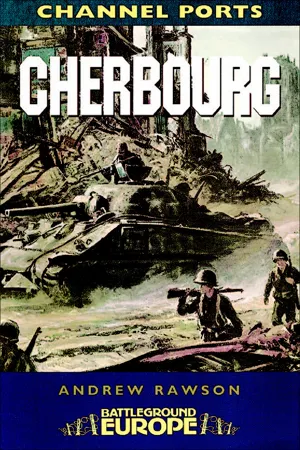
eBook - ePub
Cherbourg
About this book
Following the landings in Normandy, one of the Allies main concerns was how to supply the expanding beachhead. Having cut off the Cotentin peninsula, General Bradley turned his attentions to the port of Cherbourg, the deep-water port nearest to the American landing beaches. However, Hitler had given specific orders that the port must be held until the last man. For over two weeks three divisions battled for the ring of forts surrounding the town and only after heavy casualties was the port taken. It was, however, too late, the Germans had reduced the docks to ruins.This book details this important, yet little known battle, giving a detailed and illustrated account of the events around Cherbourg in June 1944. Visitors to the area will also be able to visit the key sites on a series of tours around the peninsula.
Information
CHAPTER ONE
Establishing the Beachhead
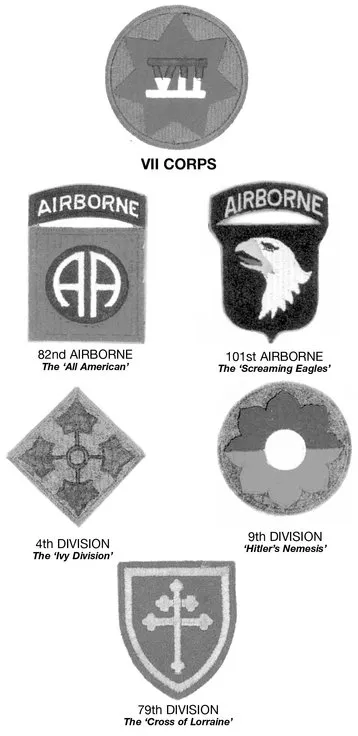
Cherbourg had featured heavily in the Allies planning for the landing on the Normandy coast. Once a secure beachhead had been established General Omar Bradley had to secure the port as soon as possible. The build up of troops needed to push inland would quickly outstrip the capacity of the temporary harbours built on the beaches. Planning had been dominated by the need for adequate port facilities to maintain the flow of men, equipment and supplies from England to the front line. VII Corps Field Order Number 1, issued on 28 May 1944 emphasised the importance of Cherbourg:
VII Corps assaults Utah Beach on D-Day at H-Hour and captures Cherbourg with minimum delay.
Meanwhile, V Corps would land on Omaha Beach, securing the area east of the River Vire, linking up with British troops at Bayeux. As soon as the two American Corps had contacted at the town of Carentan, General ‘Lightning’ Joe Collins, VII Corps commander, could turn his attention to forcing a route across the Cotentin, cutting off Cherbourg from the rest of the German Seventh Army. Originally it had been expected that the port would be captured on D+8, but a reassessment of the German troops in the area made a few days before the landings put the date back to D+15.
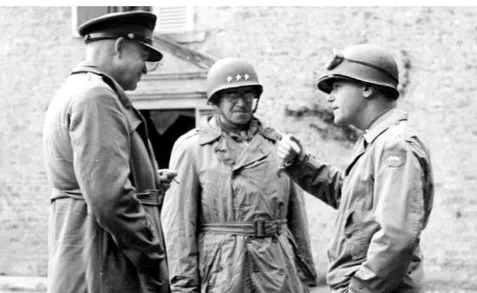
General ‘Lightning’ Joe Collins briefs General Eisenhower and General Bradley, First US Army’s leader.
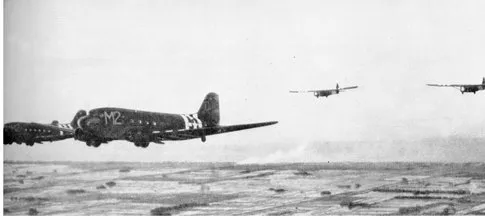
C47- Skytrains (Dakotas) tow Waco gliders over the Cotentin Peninsula.
Following a spell of poor weather at the beginning of June, General Dwight D Eisenhower, Supreme Commander of OPERATION OVERLORD, finally fixed the date for D-Day and during the early hours of 6 June hundreds of bombers, transport planes and gliders flew over the Normandy coast as thousands of men huddled in landing craft and ships headed for the beaches; the Allied assault on Nazi occupied Europe had begun.
The first phase of VII Corps’ plan was to land two airborne divisions on the Cotentin Peninsula to secure the inland areas ahead of the sea borne invasion. The paratroopers and glider troops were expected to capture crossings over the Douve and Merderet Rivers but poor weather conditions caused havoc and hundreds of men landed miles from their intended drop zones.
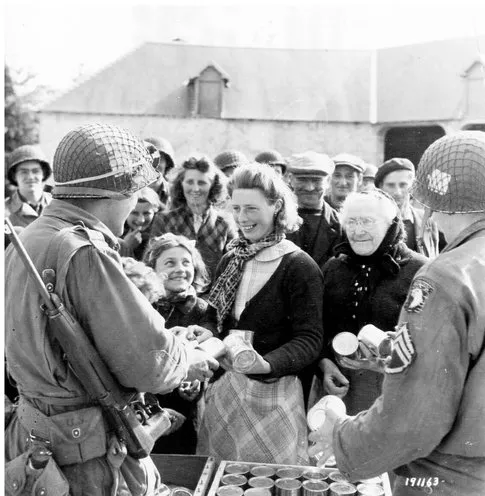
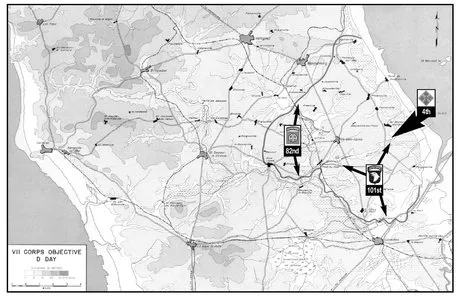
General Matthew Ridgway’s 82nd (All American) Airborne Division was either side of the Merderet River. 505th Regiment landed east of the river and secured Ste Mere Église after heavy fighting. Meanwhile, 507th and 508th Regiments were scattered along the banks of the river, where the Germans had flooded the area, and isolated groups of men spent the day fighting for the crossings over the river. Major-General Maxwell D Taylor’s, 101st (Screaming Eagles) Airborne Division was also spread over a wide area south and east of Ste Mere Église. Despite the confusion, 501st Regiment pushed south towards Carentan, securing crossings along the Douve River as 505th and 507th Regiments cleared the area inland of Utah Beach.
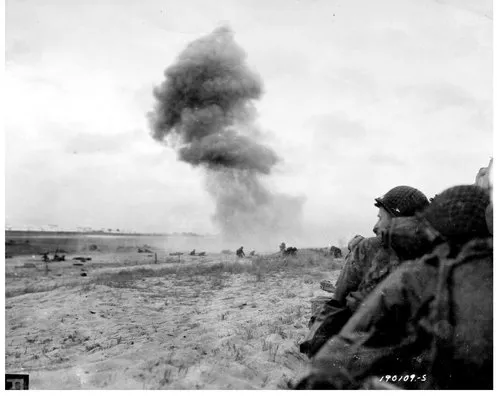
While the two airborne divisions struggled to secure their drop zones, the landing craft carrying the first wave of the 4th Infantry Division were approaching Utah Beach. Three out of the four craft responsible for guiding the landings were either disabled or sunk at an early stage and the remaining vessel struggled to guide the division ashore in the strong offshore currents. The division landed over a mile south of their intended target where the beach defences were weaker than expected and Major-General Raymond O Barton’s men pushed inland quickly having suffered only light casualties. Within a few hours of landing the leading elements of the 4th Infantry Division had met up with paratroopers of the 101st Airborne east of Ste Mere Église. The landings were underway and by nightfall over 20,000 men and 1,700 vehicles had been put ashore on Utah Beach. Hitler’s pledge to stop an Allied invasion at the water’s edge had failed; the Atlantic Wall had been breached.
Troops come ashore on Utah beach under artillery fire. NARA-111-SC-190109-S
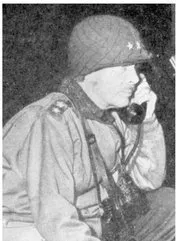
Major-General Raymond Barton. Having secured Utah Beach, 4th Division would play an important role in the attack on Cherbourg.
Troops continued to pour ashore the following day and although German resistance was weaker than anticipated, progress inland was slow. 101st Division reinforced its hold along the River Douve with the help of one of 4th Division’s Regiment’s while the rest of Major-General Barton’s men attempted to clear the coastal fortifications north of Utah Beach. 82nd Division was again unable to secure a passage across the River Mederet and the setback severely limited consolidation of the beachhead’s western tip. General Ridgway’s men eventually captured the La Fière causeway on 9 June and later that night 90th Infantry Division began to relieve the beleaguered paratroopers with orders to push west of the Merderet. 4th Division was also experiencing difficulties securing the area south of Montebourg, and 9th Infantry Division sent one of its Regiments to assist in clearing the batteries along the coast when it came ashore on 10 June. The following day General Barton was able to report that his men had finally secured its D-Day objectives, the high ground between Le Ham and Quineville.
Men of the 101st Airborne Division share their rations with the local population. NARA-111-SC-191163
Once VII Corps had established a solid beachhead, General Collins turned his attention to linking up with V Corps at Carentan. 101st Division’s attack across the River Douve on 10 June encountered fierce resistance and for two days the paratroopers edged forward along ditches and hedgerows. American troops finally entered the ruins on 12 June and despite counterattacks by German armour and panzer grenadiers, 101st Airborne made contact with V Corps’ on 14 June.
4th Division’s landing on Utah Beach and the link up with the 82nd and 101st Airborne Divisions.
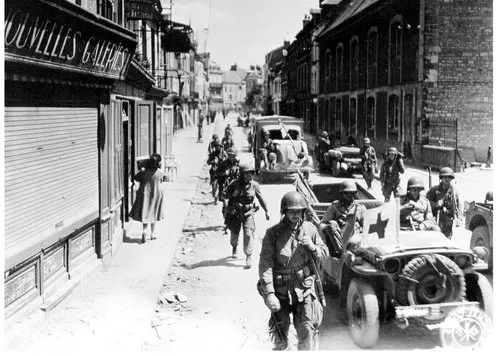
Having liberated Carentan, General Bradley could turn his attention to cutting the Cotentin Peninsula. NARA-111-SC-320862
While progress was being made on VII Corps’ flanks, 90th Division had failed to advance far beyond the Merderet River in the centre. Brigadier-General Jay W Mackelvie’s men struggled to take their objectives and after four days of repeated failures, General Collins replaced him and two of his two regimental commanders. Mackelvie’s replacement, Major-General Eugene M Landrum, realised that his men had to come to terms with the difficulties presented by the Normandy countryside. It was ideal defensive territory covered by a patchwork of small fields, each one bordered by thick hedgerows that severely limited observation and confined vehicles to narrow lanes. Landrum’s comments about fighting in this ‘bocage’ and the merits of the German 88mm anti-tank gun, would apply throughout the battle for Cherbourg and beyond:
‘Coming under hostile fire causes inertia to our troops, do not believe that they are afraid but bewildered, and this can be broken by common sense, applying simple tactics of fire and movement which are applicable in any type of fighting. It is doubtful whether any man is pinned down unless out in the open... [we] mustn’t let ourselves be stopped by fire, we must get something moving right away. Part of the line may have to take it, but we have to get fire on the hostile weapons, the machine guns. It is seldom that any unit of any size is pinned down, so it should be possible always to manoeuvre some of your forces if there is any concealment at all, and there’s plenty of it here... PWs [Prisoners] say they can tell the direction from which we are coming and how we’re going, which indicates we’ve got to control our fire... and they say we bunch up... we should be able to control our men better in this terrain. The danger of the 88 is that it multiplies in quantity as one man tells another about them, and finally our men think there are four times as many as there really are. It is an effective weapon, but it can be beaten, we have plenty of artillery to be used on call.’
9th Division reinforced 90th Division’s line west of the river 15 June and the linking up the La Fière and Carentan crossings ov...
Table of contents
- Title Page
- Copyright Page
- Table of Contents
- ACKNOWLEDGEMENTS
- CHAPTER ONE - Establishing the Beachhead
- CHAPTER TWO - Sealing off the Cotentin Peninsula
- CHAPTER THREE - 19 June – The opening attack
- CHAPTER FOUR - 20 June – The drive north
- CHAPTER FIVE - 21 June – Sealing off the port
- CHAPTER SIX - 22 June – The first assault
- CHAPTER SEVEN - 23 June – Making inroads into the perimeter
- CHAPTER EIGHT - 24 June – The noose tightens
- CHAPTER NINE - 25 June – Overlooking the port
- CHAPTER TEN - 26 & 27 June – Clearing the city
- CHAPTER ELEVEN - The Final Pockets of Resistance
- CHAPTER TWELVE - Touring Cherbourg
- INDEX
Trusted by 375,005 students
Access to over 1.5 million titles for a fair monthly price.
Study more efficiently using our study tools.
Frequently asked questions
Yes, you can cancel anytime from the Subscription tab in your account settings on the Perlego website. Your subscription will stay active until the end of your current billing period. Learn how to cancel your subscription
No, books cannot be downloaded as external files, such as PDFs, for use outside of Perlego. However, you can download books within the Perlego app for offline reading on mobile or tablet. Learn how to download books offline
Perlego offers two plans: Essential and Complete
- Essential is ideal for learners and professionals who enjoy exploring a wide range of subjects. Access the Essential Library with 800,000+ trusted titles and best-sellers across business, personal growth, and the humanities. Includes unlimited reading time and Standard Read Aloud voice.
- Complete: Perfect for advanced learners and researchers needing full, unrestricted access. Unlock 1.5M+ books across hundreds of subjects, including academic and specialized titles. The Complete Plan also includes advanced features like Premium Read Aloud and Research Assistant.
We are an online textbook subscription service, where you can get access to an entire online library for less than the price of a single book per month. With over 1.5 million books across 990+ topics, we’ve got you covered! Learn about our mission
Look out for the read-aloud symbol on your next book to see if you can listen to it. The read-aloud tool reads text aloud for you, highlighting the text as it is being read. You can pause it, speed it up and slow it down. Learn more about Read Aloud
Yes! You can use the Perlego app on both iOS and Android devices to read anytime, anywhere — even offline. Perfect for commutes or when you’re on the go.
Please note we cannot support devices running on iOS 13 and Android 7 or earlier. Learn more about using the app
Please note we cannot support devices running on iOS 13 and Android 7 or earlier. Learn more about using the app
Yes, you can access Cherbourg by Andrew Rawson in PDF and/or ePUB format, as well as other popular books in History & Women in History. We have over 1.5 million books available in our catalogue for you to explore.