A fully illustrated encyclopedia of military trains around the world, from the early 19th century to today, arranged alphabetically from Angola to Vietnam.
European military forces were quick to put railways to use in warfare, whether for deploying soldiers or moving heavy artillery. Soon enough, the train became a potent weapon in its own right—a battleship on rails. Armed and armored, they became the first self-propelled war machines, which by the time of the American Civil War were able to make significant contributions to battlefield success.
Thereafter, almost every belligerent nation with a railway system made some use of armored rolling stock, ranging from low-intensity colonial policing to the massive employment of armored trains during the Russian Civil War. And although they were somewhat eclipsed as frontline weapons by the development of the tank and other AFVs, armored trains were still in use as late as the civil wars of the former republic of Yugoslavia.
This encyclopedic book covers, country by country, the huge range of fighting equipment that rode the rails over nearly two centuries. While it outlines the place of armored trains in the evolution of warfare, it concentrates on details of their design through photographs and meticulous drawings. Published in French in 1989, this highly regarded work has been completely revised and expanded for this English edition. It remains the last word on the subject.
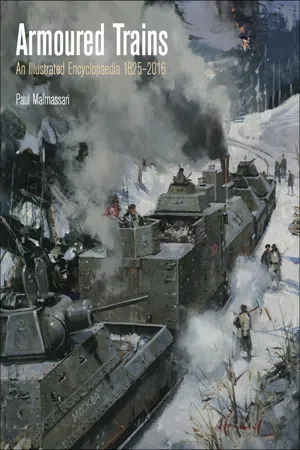
- 528 pages
- English
- ePUB (mobile friendly)
- Available on iOS & Android
eBook - ePub
About this book
Information
APPENDIX 1
ARMOURED TRAINS IN ART AND PROPAGANDA
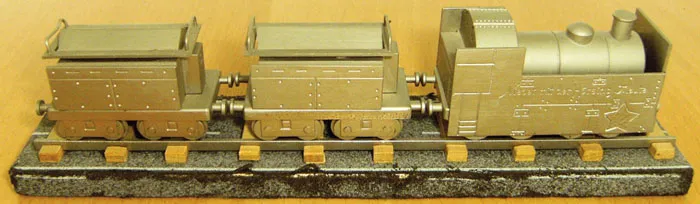
Postcards were an excellent means of spreading a propaganda image, a role taken over today by postage stamps. Much rarer were commemorative objects such as this East German stylised model train of the Leuna Arbeiter uprising of 1919.
(Photo: Paul Malmassari Collection)
AUSTRIA-HUNGARY
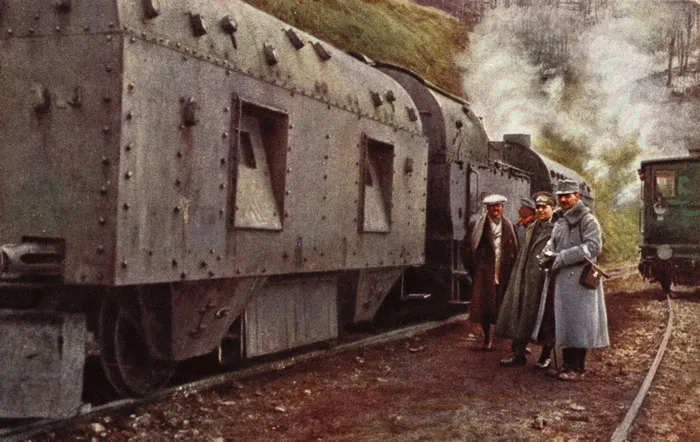
This section presents a series of classic postcards of the Great War period. The Austro-Hungarian armoured trains were more impressive than their German counterparts, and were the subject of a great many reproductions aimed at the general public.
(Postcard: Paul Malmassari Collection)
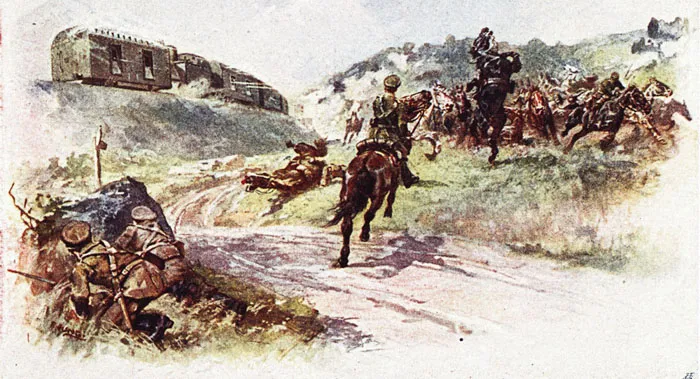
Type A armoured train in combat with Russians.
(Postcard: Paul Malmassari Collection)
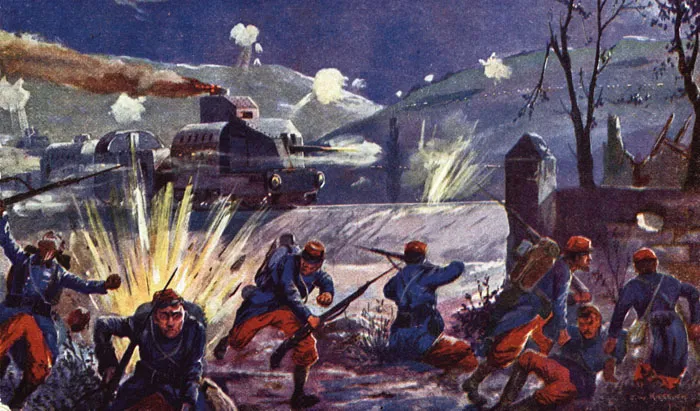
A patriotic German postcard, using the image of an Austro-Hungarian Type B armoured train, which was evidently felt to be more impressive, and more symbolic of armoured trains in general, than their own. In actual fact French soldiers wearing blue and scarlet uniforms, typical of the early months of the war, never came into contact with Austro-Hungarian armoured trains. In addition, the artist has represented the observation cupola as a chimney.
(Postcard: Paul Malmassari Collection)
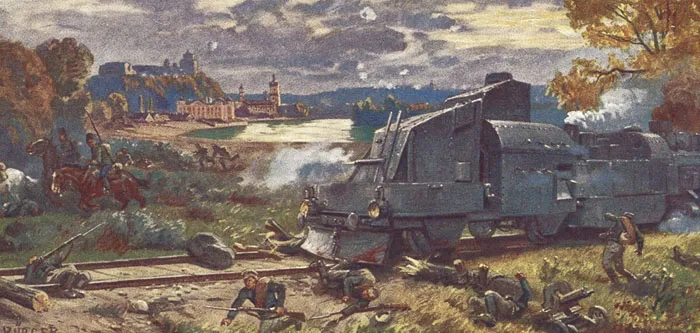
A fine composition showing a Type B PZ brushing aside Russian obstacles during the fight for Wilna. However, when the town did fall, on 19 September 1915, it was captured by German troops.
(Postcard: Paul Malmassari Collection)
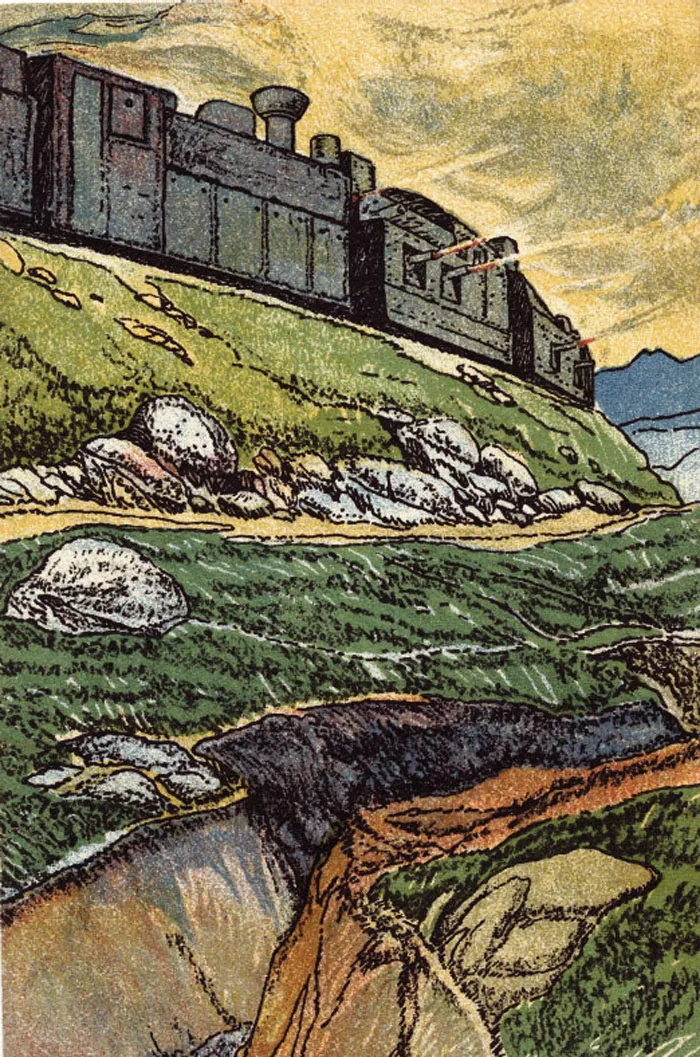
Here PZ I / IX is the subject of a postcard which is strikingly faithful to the actual appearance of the train.
(Postcard: Paul Malmassari Collection)
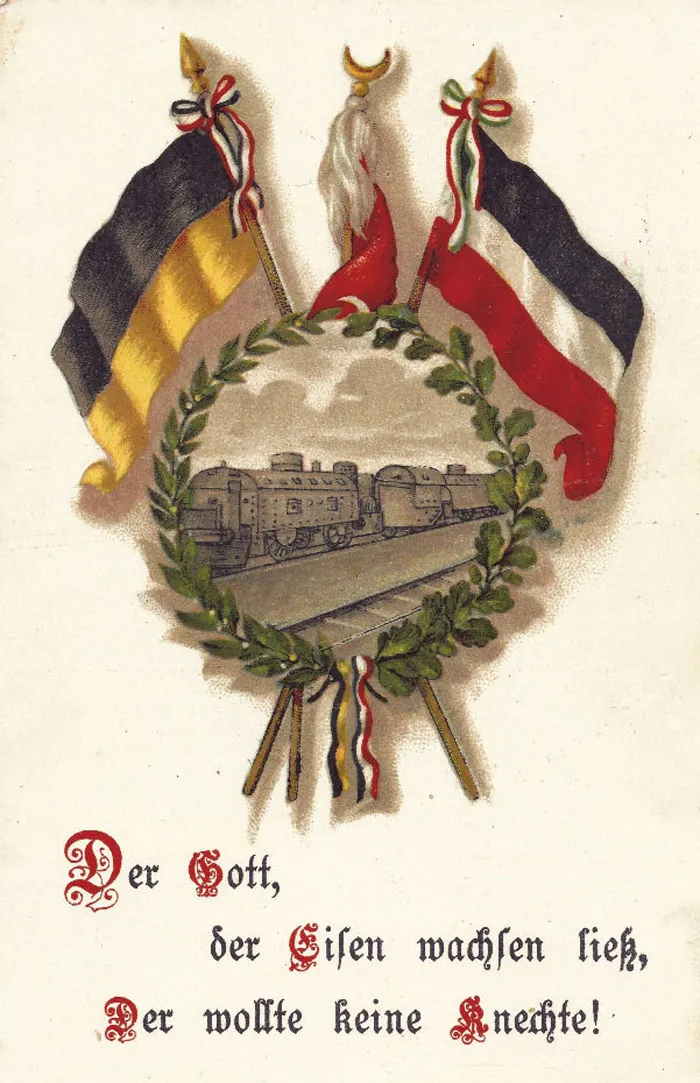
A patriotic postcard, with three national flags behind the cartouche of the armoured train: German on the right, Ottoman in the centre and Austro-Hungarian on the left. The black and gold which were the colours of the House of Habsburg between 1804 and 1866 continued to be used when representing the Emperor.
(Postcard: Paul Malmassari Collection)
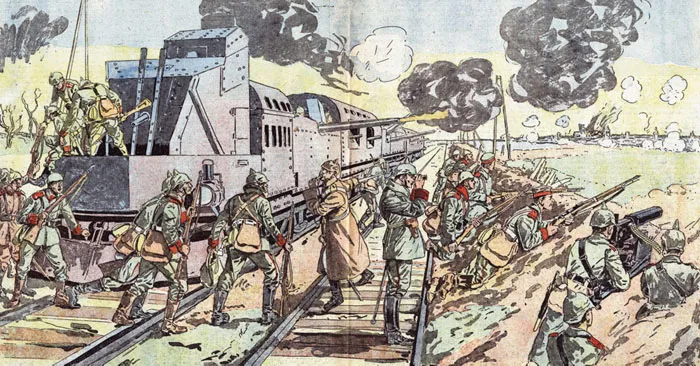
An illustration of a Austro-Hungarian armoured train used by the French popular press to portray the intervention of a German train. In truth the images of the German trains lacked the visual impact necessary for efficient propaganda. The resulting scenario is certainly aesthetic, but it contains numerous inaccuracies, notably the long-barrelled gun in the position where one would find the engine, and the common misconception that the observation cupola was a chimney.
( L’Illustration National No 42: Paul Malmassari Collection)
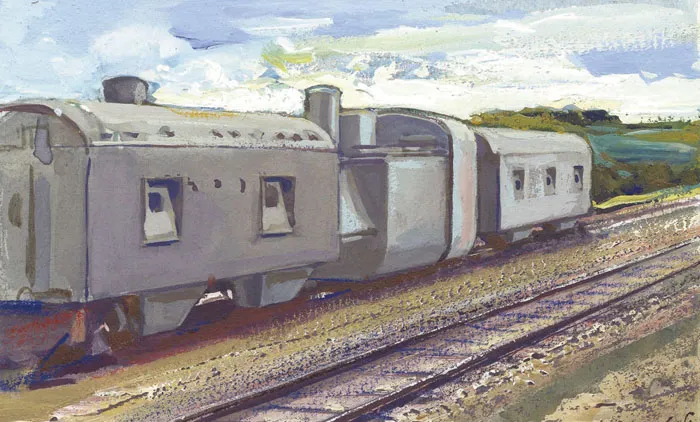
An original watercolour signed Linebauer, which is perhaps unfinished, but which clearly shows one of the early Austro-Hungarian armoured trains. Note the rear armoured wagon depicted as having three lateral machine-gun positions but lacking a cupola.
(Watercolour: Paul Malmassari Collection)
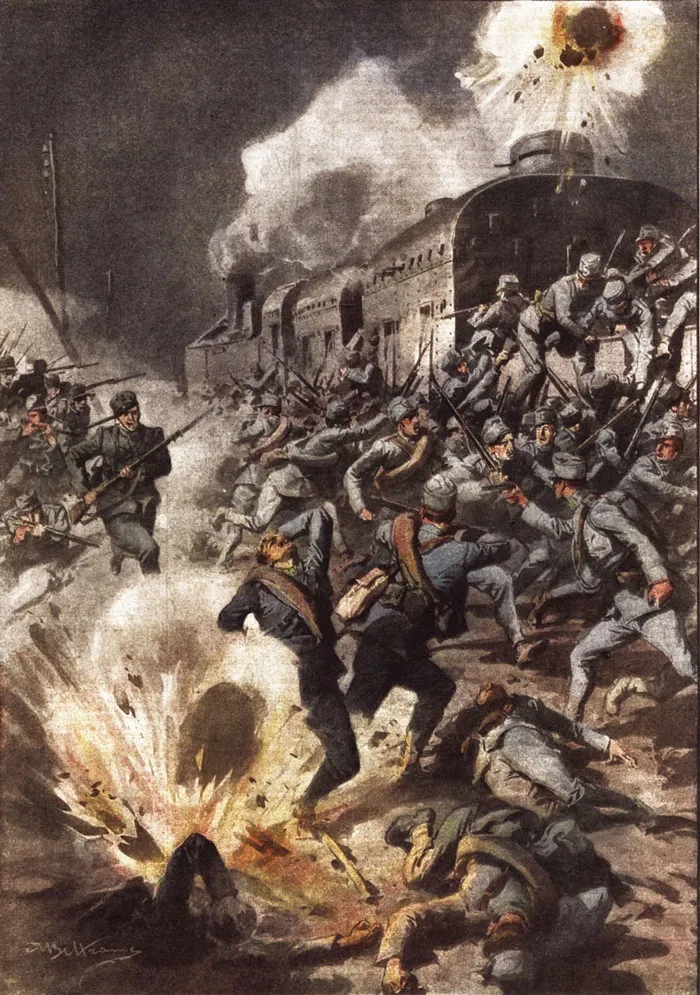
A fine heroic engraving of fighting between Italian soldiers and troops disem-barked from an Austro-Hungarian armoured train. The action took place on the night of 12/13 September 1915, when the Austrians advancing from Gorizia attempted a surprise attack on Zagora. Note that the engine is not the actual type which would be used with these wagons.
(Engraving: La Domenica del Corriere, No 39, XVIIth Year [26th September–30 October 1915]: Paul Malmassari Collection)
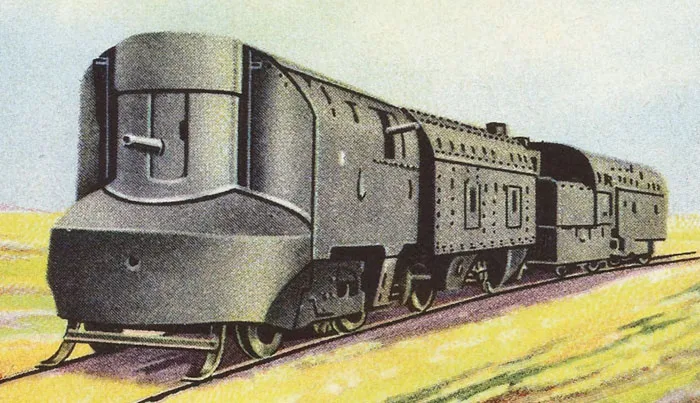
This small collectors’ card (original size 5.8cm x 4.8cm/2¼in x just under 2in) faithfully depicts PZ II, but during its Czech period as Train No 1, with minor differences.
(Card: Bilderdienst Schienen Wunder, Berlin, No 288: Paul Malmassari Collection)
BELGIUM
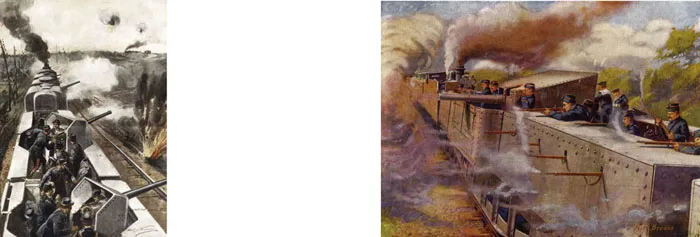
The impressive appearance of the Belgian armoured trains (as with their Austro-Hungarian contemporaries) inspired many artists, and in almost all types of media. The illustration on the right taken from a popular publication details the colour of the Belgian uniforms, with Royal Navy gunners manning the guns. The view on the left is an engraving which appeared in La Domenica del Corriere dated 17 January 1915.
(Both illustrations: Paul Malmassari Collection)
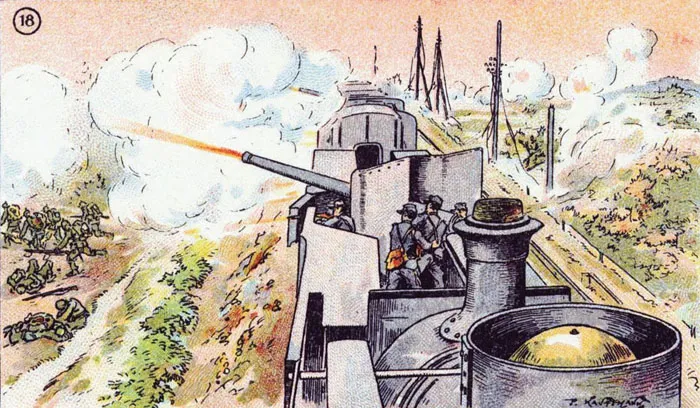
A Heavy Armoured Train on a collectors’ card painted by Nathan. It draws inspiration from an original photo which was widely printed in the contemporary press; this can be seen in the Belgian chapter, page 61.
(Illustration: Paul Malmassari Collection)
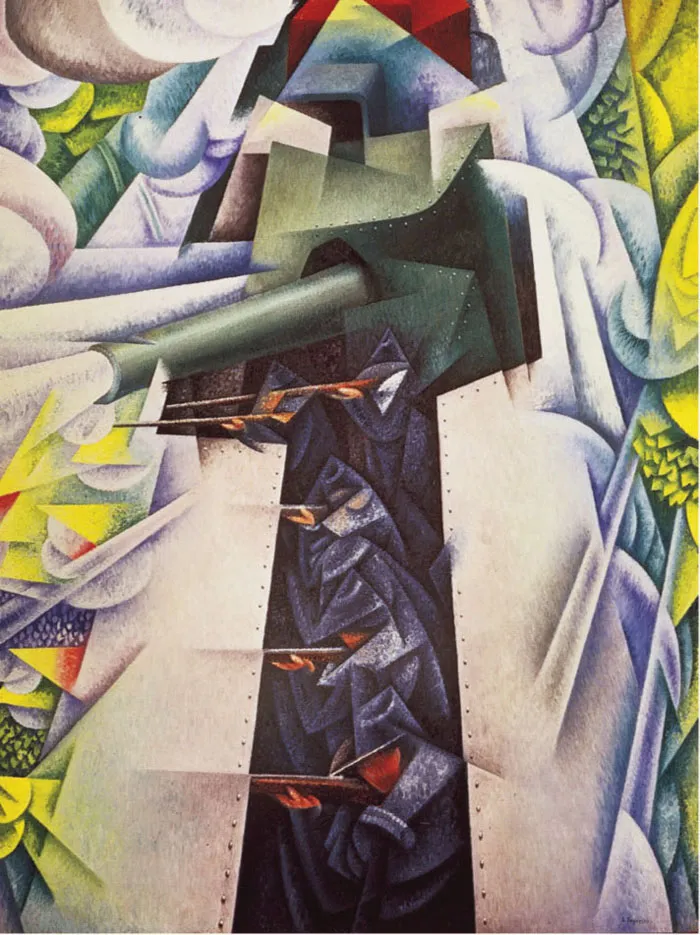
Armoured Train...
Table of contents
- Front Cover
- Half-Title Page
- Title Page
- Copyright Page
- Contents
- Introduction
- Angola
- Argentina
- Armenia
- Austria
- Austria-Hungary
- Belgium
- Bosnia and Herzegovina
- Brazil
- Bulgaria
- Burma-Myanmar
- Cambodia
- Canada
- Chile
- China
- Colombia
- Confederate States of America
- Congo-Léopoldville
- Croatia (Independent State)
- Croatia (Republic)
- Cuba
- Czechoslovakia
- Egypt
- Estonia
- Finland
- France
- Georgia
- Germany
- Great Britain
- Greece
- Guatemala
- Honduras
- Hungary
- India
- Indonesia
- Iraq
- Irish Free State
- Italy
- Japan
- Latvia
- Lithuania
- Malawi
- Malaysia
- Mauritania
- Mexico
- Morocco
- Mozambique
- The Netherlands
- New Zealand
- Nicaragua
- North Korea
- Norway
- Ottoman Empire
- Paraguay
- Peru
- Poland
- Portugal
- Rhodesia & Zimbabwe
- Romania
- Russia, USSR & Russian Federation
- Slovak Republic
- South Africa
- South Korea
- South Sudan
- Spain
- Sweden
- Switzerland
- Thailand
- Tunisia
- Ukraine
- United States of America
- Vietnam
- Yugoslavia
- Appendix 1
- Appendix 2
- Acknowledgements
Trusted by 375,005 students
Access to over 1.5 million titles for a fair monthly price.
Study more efficiently using our study tools.
Frequently asked questions
Yes, you can cancel anytime from the Subscription tab in your account settings on the Perlego website. Your subscription will stay active until the end of your current billing period. Learn how to cancel your subscription
No, books cannot be downloaded as external files, such as PDFs, for use outside of Perlego. However, you can download books within the Perlego app for offline reading on mobile or tablet. Learn how to download books offline
Perlego offers two plans: Essential and Complete
- Essential is ideal for learners and professionals who enjoy exploring a wide range of subjects. Access the Essential Library with 800,000+ trusted titles and best-sellers across business, personal growth, and the humanities. Includes unlimited reading time and Standard Read Aloud voice.
- Complete: Perfect for advanced learners and researchers needing full, unrestricted access. Unlock 1.5M+ books across hundreds of subjects, including academic and specialized titles. The Complete Plan also includes advanced features like Premium Read Aloud and Research Assistant.
We are an online textbook subscription service, where you can get access to an entire online library for less than the price of a single book per month. With over 1.5 million books across 990+ topics, we’ve got you covered! Learn about our mission
Look out for the read-aloud symbol on your next book to see if you can listen to it. The read-aloud tool reads text aloud for you, highlighting the text as it is being read. You can pause it, speed it up and slow it down. Learn more about Read Aloud
Yes! You can use the Perlego app on both iOS and Android devices to read anytime, anywhere — even offline. Perfect for commutes or when you’re on the go.
Please note we cannot support devices running on iOS 13 and Android 7 or earlier. Learn more about using the app
Please note we cannot support devices running on iOS 13 and Android 7 or earlier. Learn more about using the app
Yes, you can access Armoured Trains by Paul Malmassari in PDF and/or ePUB format, as well as other popular books in History & Military & Maritime History. We have over 1.5 million books available in our catalogue for you to explore.