- 152 pages
- English
- ePUB (mobile friendly)
- Available on iOS & Android
eBook - ePub
Ironbridge in the Great War
About this book
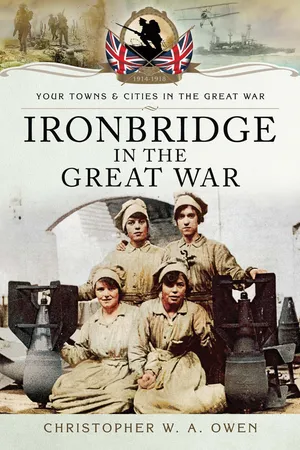
Famed as the birthplace of modern industry and the first cast iron metal single span bridge, Ironbridge is venerated the world over yet its social history is at times unfamiliar.One hundred years ago this sleepy town, set by the river Severn, willingly volunteered its lifeblood to a war that everyone confidently believed would be a short-lived, adventurous romp. Misled by government propaganda, they soon discovered through fighting relative's letters and various official news reports, many of which are unearthed for the first time throughout this book, that it had rapidly degenerated into an endless morass of bloody violence with the probability of their men meeting a painful death on a daily basis thrown in for good measure.The town's wartime heritage is one of enterprise and hard work as the majority of the Great War gun-fodder comprised working-class men drawn from prestigious local companies. Maw & Co, the world-famous ceramic tile maker, raised its own company of enlisted fighting men, in common with other businesses nationwide, that were known as Pals Battalions. As in most instances across the land, it subsequently paid a heavy price for this mass act of patriotism. Ironbridge also became a cradle of the fledgling women's wartime workforce, who helped produce vital heavy munitions components at another famous local company's works.Ironbridge in the Great War is the story of the town's great sacrifice, as evidenced by the numerous and diverse war monuments that populate the town and its surrounding hamlets. This is detailed work that includes fascinating facts about the town, which, despite being constantly under the world spotlight, remained, until now, a part of its hidden wartime social history.
Trusted by 375,005 students
Access to over 1.5 million titles for a fair monthly price.
Study more efficiently using our study tools.
Information
CHAPTER 1
1914: Men of Iron

‘In the beginning God created Iron ore, and Bedlam men smelted it.’
(Local saying)
Introduction to Ironbridge
Ironbridge is some forty miles north-west of Birmingham, three miles from junction 7 which is the western terminus of the M54 motorway.

View of Ironbridge town – present day
This historical town is located in a semi-rural part of Shropshire, one of the largest farming counties in the West Midlands. It nestles in the basin of the great gorge of the Severn river which snakes lazily eastwards across the south edge of the great Shropshire plain. It then carves its way through dense limestone hills at Buildwas to form the natural gorge leading up to the town itself.
The Severn was once the lifeblood of the community being first and foremost a major transport artery serving all the local industrial village communities along its banks. Up to the late nineteenth century shallow draft sail barges called ‘Trows’ carried Ironbridge’s iron products, pottery and ceramic tiles along the Severn to an eagerly waiting world market. Ironbridge became an industrial heartland containing famous factories producing cast-metal products, fine ceramics of bone china, and decorative tiles, all of them world-famous names.
At the time of the Great War, the town was still referred to in written accounts by the old name of Iron-Bridge, not spelled as one word, possibly in deference to its industrial heritage.
The town itself should not be considered as just the core urban layout clustered around the famous bridge that we see today, but as a conglomeration of smaller villages and hamlets contained within a three-mile radius. They all shared both in the industrial prosperity of the area, and the tragedy of the Great War.
Ironbridge became the focus of huge industrial advancement in the eighteenth and nineteenth centuries. It commenced with the construction of the world’s first cast-iron bridge from which the town derives its name.
It was built by the famous ironmasters Abraham Darby III and John Wilkinson (described as ‘iron mad’) in partnership with several Broseley businessmen.
Construction began in 1779 and it was opened to the public in 1781 as a toll road bridge. Tolls for crossing the Iron Bridge were collected up to 1950 since when it has been closed to vehicular traffic. It was scheduled as an Ancient Monument by act of Parliament in 1934. It is now designated a world heritage site currently under the stewardship of English Heritage (conservators charitable trust) in partnership with the local authority, Telford & Wrekin Council. At the time of going to press it is undergoing a two million pound renovation (partly crowd-funded) in order to protect and preserve it for posterity. The town’s glory days are now long gone; Ironbridge town is reduced to the status of a village suburb in the massive urban sprawl designated as Telford New Town.

The Iron Bridge, opened in 1781
The Ironbridge demographic in the Great War
The satellite villages of Ironbridge were still attached for socioeconomic and historical reasons at the turn of the twentieth-century. For the purposes of consideration regarding the Great War, these comprise Coalbrookdale, Coalport, Jackfield, Madeley and of course the main town itself.
Coalbrookdale village
Still busy with industry, Coalbrookdale is located on the same bank of the Severn to Ironbridge in an accompanying gorge running at ninety degrees to the river at the junction of Dale End and the Wharfage near the old Merrythought factory. Its long slow winding road leads us steadily uphill through the village itself past the Ironbridge Iron & Steel Museum Trust complex (originally the Dale Company site) and via Jiggers Bank up to the island on the A4169 bypass. This key village was the base chosen by Abraham Darby III for his main factory. It has abundant water supplies provided by several streams which could be easily damned and harnessed to power machinery.
Originally from a Quaker family, Abraham Darby IV, as part of his conversion to Anglicanism, instigated and paid for the construction of Holy Trinity Church in Coalbrookdale in 1849, with his wife Matilda laying the foundation stone in 1851. Construction was completed in 1854 and it was consecrated by the Bishop of Hereford.

Coalbrookdale village scene – present day

Coalbrookdale Company Works – now housing the Ironbridge Gorge Museum Trust

Coalbrookdale memorial, Paradise, Wellington Road, Ironbridge
The church was to play its part in the Great War as many village men served and a privileged few lie buried in its graveyard. Interior plaques commemorate all of the war dead and their service to the village. The main war memorial attached to the church is located outside the old Institute, at the junction of Wellington Road and Paradise, a few hundred yards down the road towards Ironbridge.
Coalport village
Nowadays, this quiet, extensively wooded hamlet runs parallel to the river on its north-eastern bank, about half a mile from the centre of Ironbridge, along the Lloyds and Coalport High Street, with the majority of the inhabitants’ houses located on either side of the main throughroad. No longer a hub of industry, it is still home to the Coalport China Museum.

Coalport village, present day

Coalport China works museum featuring bottle kiln
Surprisingly, it was destined to rival Ironbridge in fame as a manufacturing town with the arrival of the Shropshire Canal in 1793 instigated by William Reynolds, whose father was the partner of Abraham Darby III the Iron Bridge builder.
Coalport also became the centre of one of the leading porcelain manufacturers of Britain with the classic chinaware of the Coalport China Company fired in their famous and innovative bottle kilns.
The Wedgwood factory, based at Burslem, Stoke-on-Trent, took interest and in 1934 absorbed Coalport China into their own business.
Jackfield village
Located on the south-western bank of the Severn, directly opposite Coalport across the river, Jackfield village centre is now sparse. It comprises cottages dotted along the riverbank road leading to St Mary the Virgin Church containing its memorial plaque to the Great War, and the village hall. A small tin chapel that was there has now been moved to Blists Hill Museum. It is home to the Maw & Co and Craven Dunnill encaustic tile & ceramics factories. Both have long ceased trading in the town at the site of the old factories, which are now preserved as museums, being considered industrial heritage sites of national importance. It is also home to a famous brass band that can trace its history back to the turn of the twentieth century. A First World War memorial footbridge, opened in 1922, links Jackfield to Coalport.

Jackfield village – present day
Madeley village
This satellite to Ironbridge is located on the same side of the river above it on the plain overlooking the gorge with the Severn running through it. It was originally a mining village with several pits owned and run by the Anstice family.
Madeley has been the scene of some tragic coal mining disasters: one in 1864 involving the death of nine local colliers, and another in 1912 in which seven miners died including two children aged 14. The decline in the coal industry in the first half of the twentieth century is reflected in the decline of Madeley’s civic power and influence locally. It has latterly reverted to a district of the greater town of Telford.
St Michael’s Church, in the older part of the original village, was to serve as the graveyard of many of Ironbridge’s Great War dead.
Major Charles Allix Lavington Yate, the area’s only Great War VC winner, lived in Madeley. This hero is commemorated on a plaque in St Michael’s Church, and also on the memorial sepulchre in the main square which is inscribed with the dead of both world wars. There is a separate stone paving memorial plaque for Lavington Yate, which was laid in August 2016 and features in chapter six of this book.

St Michael’s Church, Madeley

Lavington Yate Memorial plaque in St Michael’s Church, Madeley
The Wellington Journal and Shrewsbury News
To give the reader a flavour of the Ironbridge area’s social history in the lead-up and early months of the war we have included some snippets of daily life revealed through the pages of the only newspaper available. Ironbridge’s own newspaper folded in the 1870s and the job of keeping its denizens informed and updated fell to the nearest weekly publication, the Wellington Journal and Shrewsbury News. With offices four miles away in the town centre of Wellington, established in 1854 by Thomas Leake, it took over the rival Shropshire News in 1874, and was to steadfastly report all the war news to the inhabitants for the duration and beyond. It was absorbed by the Shropshire Star Newspaper group and ceased publication in the 1960s.
Ironbridge area news round-up, 1914
Ironbridge town was judicially autonomous. It had its own ‘Petty Sessions’ (minor criminal court), presided over most times by an alderman/magistrate dispensing justice. In 1914 this was Mr A.B. Dyas, who had also served as mayor. There was a similar judicial set-up for the Madeley area. The Journal of 4 July 1914 reported the following from the Ironbridge Petty Sessions:
Iron-Bridge
Assault – Edward Garbett, labourer, Broseley was charged with beating Edith Rogers and also with assaulting her baby, Ada. She lived three doors down from the defendant.
About six in the evening when she was standing near her house door with the baby in her arms, who was six months old, defendant came out of his house and without any provocation struck her once on the breast and twice on the back, with his fist.
He also hit the baby with his open hand in the eye and left a mark. She was unconscious for some moments – Defendant stated that a bother arose over the children and when Mrs Rogers called him names he struck her with open hand on the back and if he struck the child it was an accident. On the first count he was fined 15 shillings, including costs for beating the w...
Table of contents
- Cover
- Dedication
- Title
- Copyright
- Contents
- Acknowledgements
- List of Abbreviations
- Introduction
- Chapter 1 – 1914: Men of Iron
- Chapter 2 – 1915: The Common Clay
- Chapter 3 – 1916: Bedlam – In the thick of it
- Chapter 4 – 1917: From the Gorge into the Abyss
- Chapter 5 – 1918: The Industry of Wholesale Slaughter
- Chapter 6 – 1918/19: Aftermath and the Ironmasters’ Toll
- Appendix
Frequently asked questions
Yes, you can cancel anytime from the Subscription tab in your account settings on the Perlego website. Your subscription will stay active until the end of your current billing period. Learn how to cancel your subscription
No, books cannot be downloaded as external files, such as PDFs, for use outside of Perlego. However, you can download books within the Perlego app for offline reading on mobile or tablet. Learn how to download books offline
We are an online textbook subscription service, where you can get access to an entire online library for less than the price of a single book per month. With over 1.5 million books across 990+ topics, we’ve got you covered! Learn about our mission
Look out for the read-aloud symbol on your next book to see if you can listen to it. The read-aloud tool reads text aloud for you, highlighting the text as it is being read. You can pause it, speed it up and slow it down. Learn more about Read Aloud
Yes! You can use the Perlego app on both iOS and Android devices to read anytime, anywhere — even offline. Perfect for commutes or when you’re on the go.
Please note we cannot support devices running on iOS 13 and Android 7 or earlier. Learn more about using the app
Please note we cannot support devices running on iOS 13 and Android 7 or earlier. Learn more about using the app
Yes, you can access Ironbridge in the Great War by Christopher W. A. Owen in PDF and/or ePUB format, as well as other popular books in History & British History. We have over 1.5 million books available in our catalogue for you to explore.