The "acclaimed naval historian . . . takes the reader through the intricacies of warship design and construction in both French and British navies." —
Historical Novel Society
In the series of wars that raged between France and Britain from the seventeenth to the nineteenth centuries, seapower was of absolute vital importance. Not only was each nation's navy a key to victory, but was a prerequisite for imperial dominance. These ongoing struggles for overseas colonies and commercial dominance required efficient navies which in turn insured the economic strength for the existence of these fleets as instruments of state power.
This book, by the distinguished historian Jonathan Dull, looks inside the workings of both the Royal and the French navies of this tumultuous era, and compares the key elements of the rival fleets. Through this balanced comparison, Dull argues that Great Britain's final triumph in a series of wars with France was primarily the result of superior financial and economic power.
This accessible and highly readable account navigates the intricacies of the British and French wars in a way which will both enlighten the scholar and fascinate the general reader. Naval warfare is brought to life but also explained within the framework of diplomatic and international history.
"A welcome and concise source of information . . . Military historians will find data about the numbers of ships in each navy for each period covered. Diplomatic historians will find brief descriptions of the various heads of state and the ministers whose decisions led to wars, victories, defeats, and economic disasters." —
International Journal of Naval History
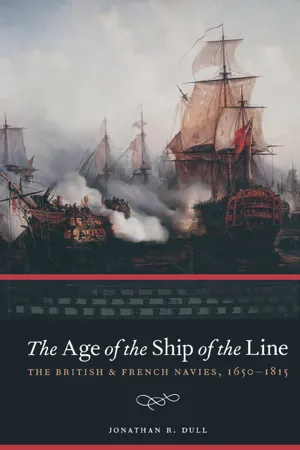
- 264 pages
- English
- ePUB (mobile friendly)
- Available on iOS & Android
eBook - ePub
About this book
Information
Contents

List of Maps and Battle Diagrams
Preface
1. The Ship of the Line Begins Its Reig
2. Louis XIV and His Wars
3. Foolish Wars End an Age of Peace
4. Sea Power and the Outcome of the Seven Years’ War
5. Winners and Losers in the War of American Independence
6. Change and Continuity during the French Revolution
7. The Role of the Navies in the Napoleonic War
8. The Ingredients of Supremacy in the Age of Sail
Notes and Suggested Further Reading
Index
Maps and Battle Diagrams
Maps
1. Europe in 1750
2. The Caribbean
Battle Diagrams
1. Toulon, 22 February 1744
2. Minorca, 20 May 1756
3. The Chesapeake, 5 September 1781
4. The Saintes, 12 April 1782
5. The Glorious First of June, 1 June 1794
6. Aboukir, 1 August 1798
7. Trafalgar, 21 October 1805
Preface
Between 1689 and 1815 the British (or initially the English allied with the Scots) fought seven wars against France. Their navies played an important, sometimes critical, role. The power of the rival navies was based chiefly on their ships of the line, great wooden warships carrying two or three tiers of iron or brass cannon. The age of the ship of the line is largely the story of the navies of Britain and France, the two powers best able to afford the massively expensive fleets of ships of the line. Although Spain and the Netherlands maintained good sized navies throughout the period, by the early eighteenth century they had become subordinate players in the naval rivalry of Britain and France. Other navies, such as those of Russia, Denmark, Sweden, Naples, and Venice, were regional powers, largely restricted to the Baltic or Mediterranean Seas. The goal of this book is to explain the background, course, and results of the seven wars between the British and French, particularly the causes of the final British triumph.
By treating the British and French navies in tandem I hope to give a balanced account of their rivalry; I confess to loving both countries and warmly supporting their friendship. The statesmen of the eighteenth century generally saw war not primarily as a contest of societies but more as a contest of economies, in which victory went to the strongest, not to the “best,” and in which the chief virtue was endurance. I approach these wars in much the same way, using ships of the line as the measure of strength. Thus this book pays as much attention to the number of ships of the line engaged in the various campaigns as to the admirals and statesmen who directed them. In all the Franco-British wars of the period, including the one Britain lost, the War of American Independence, the side that could put the most ships of the line to sea was successful.
I have learned much by conversations with historians more knowledgeable than I am in nautical matters. I am particularly grateful to Daniel Baugh, Richard Harding, John Hattendorf, Roger Knight, Nicholas Rodger, Patrick Villiers, and Clive Wilkinson; the mistakes I have made are totally my responsibility. Some of these conversations took place during either a 2005 trip to Paris or a 2006 trip to Greenwich, England, made possible, respectively, by the Association France-Amériques and the National Maritime Museum. I am extremely grateful to the members of both organizations for their generosity, hospitality, and kindness, particularly to Patricia Cédelle and Janet Norton, who handled the respective arrangements.
In the interest of saving space I will not repeat the acknowledgments to friends and colleagues that I made in my last book, The French Navy and the Seven Years’ War. I am still indebted to all of them for their help or encouragement. I must, however, again thank my sister, Caroline Hamburger, for her hospitality during the times I was in London, and my wife, Susan Kruger, for her constant helpfulness and support. I dedicate this book to my children, Veronica Lamka, Robert Dull, Max Kruger-Dull, and Anna Kruger-Dull, in the hope that someday they will live in a world without war.
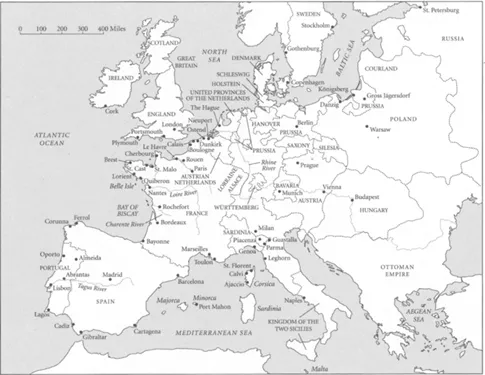
MAP 1. Europe in 1750
From Dull, The French Navy and the Seven Years’ War (Nebraska, 2005).
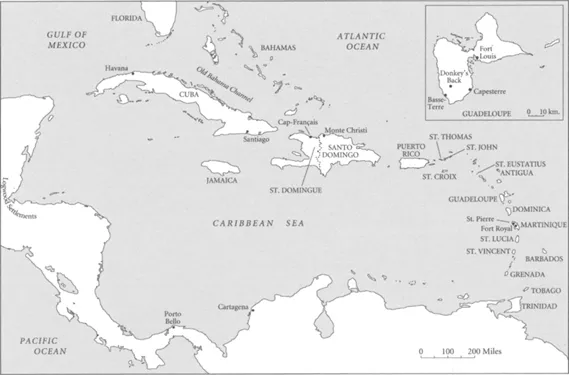
MAP 2. The Caribbean
From Dull, The French Navy and the Seven Years’ War (Nebraska, 2005).
The Age of the Ship of the Line
1. The Ship of the Line Begins Its Reign
I
Between the 1650s and the 1850s, naval warfare was ruled by the ship of the line and the line of battle after which it was named. These huge three-masted wooden ships were some 120 to 210 feet long with a beam (width) of 30 to 60 feet. They carried between 40 and 130 cannon mounted along two, three, or, in the case of the Spanish ship of the line Santísima Trinidad, four decks.1 The ship of the line was the most expensive, technologically advanced, and visually impressive weapon of its day. It also was the measure of national naval power, like the dreadnought of World War I or the aircraft carrier of World War II. The line of battle—a string of warships following each other bow to stern—was the best way to bring its power to bear, as each ship thus could give support to neighboring ships. Only in shallow or poorly charted waters, like the eastern Baltic, was the ship of the line not dominant; there the galley, a shallow-draft oar-powered warship, continued to play a major role throughout the eighteenth century.
The era of the ship of the line began when its two components, the ship of the line and the line of battle, were combined. That time was long in coming. The line of battle is so logical an arrangement that the earliest groups of European ships carrying cannon sometimes made use of it. A Portuguese fleet commanded by Vasco da Gama seems to have employed a line of battle off the coast of India in 1502.2 Its use was intermittent, however, because its main advantage was mutual support in an artillery duel. Some naval battles consisted of such duels; the English, for example, foiled the Spanish Armada of 1588 by the use of cannon. Until the middle of the seventeenth century, however, naval warfare often involved either boarding (ships grappling an opponent and then dispatching a boarding party) or the use of fire ships (setting ships on fire in order to ram them into enemy vessels). The Dutch, who by the 1640s had become the greatest naval power in Europe, were masters of a variety of tactics. In 1639, they used both a line of battle and fire ships against a huge Spanish fleet off the English coast.3
The use of great ships of 50 or more cannon also was long established by 1650. Most major naval powers had one or more of these ships, such as the English Prince Royal of 55 cannon, launched in 1610, and the Sovereign of the Seas, 90 cannon, launched in 1637, or the French Couronne, 68, launched in 1638. These ships, however, were clumsy to sail and expensive to build, man, and maintain. As an admiral’s flagship they could be useful in a battle, but without other ships of similar size they could not alter the disorganized melee of a naval battle based on boarding or the use of fire ships. Fleets during the first half of the seventeenth century were very heterogeneous, moreover, frequently consisting mostly of converted merchant ships.
A turning point came in 1649 when the Parliament of England decided to build a group of very large and heavily armed frigates (fast, medium-sized warships usually carrying 20 or more cannon) that was the predecessor of groups (or “classes”) of ships of the line of a standard size. The thirteen ships of the Speaker class, launched between 1650 and 1654, were of roughly similar size (about 750 tons) and carried 48 to 56 cannon; in tonnage and armament they were similar to a very large galleon, the chief warship of the late sixteenth and early seventeenth centuries and still the mainstay of the Spanish navy, but they were longer, lower, and faster than galleons. No other navy had a group of ships to match them; the Dutch navy, hitherto Europe’s best, continued to rely chiefly on taking merchant ships into naval service.4
The li...
Table of contents
- Cover
- Half Title
- Title Page
- Copyright
- Contents
Trusted by 375,005 students
Access to over 1.5 million titles for a fair monthly price.
Study more efficiently using our study tools.
Frequently asked questions
Yes, you can cancel anytime from the Subscription tab in your account settings on the Perlego website. Your subscription will stay active until the end of your current billing period. Learn how to cancel your subscription
No, books cannot be downloaded as external files, such as PDFs, for use outside of Perlego. However, you can download books within the Perlego app for offline reading on mobile or tablet. Learn how to download books offline
We are an online textbook subscription service, where you can get access to an entire online library for less than the price of a single book per month. With over 1.5 million books across 990+ topics, we’ve got you covered! Learn about our mission
Look out for the read-aloud symbol on your next book to see if you can listen to it. The read-aloud tool reads text aloud for you, highlighting the text as it is being read. You can pause it, speed it up and slow it down. Learn more about Read Aloud
Yes! You can use the Perlego app on both iOS and Android devices to read anytime, anywhere — even offline. Perfect for commutes or when you’re on the go.
Please note we cannot support devices running on iOS 13 and Android 7 or earlier. Learn more about using the app
Please note we cannot support devices running on iOS 13 and Android 7 or earlier. Learn more about using the app
Yes, you can access The Age of the Ship of the Line by Jonathan R. Dull in PDF and/or ePUB format, as well as other popular books in History & British History. We have over 1.5 million books available in our catalogue for you to explore.