From the author of
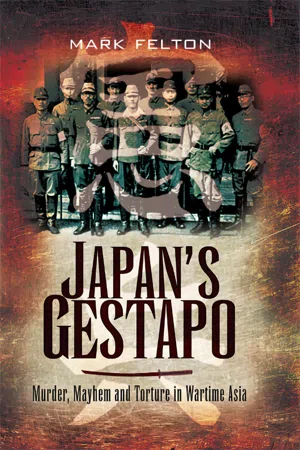
Children of the Camps, a look at the disturbing activities of the Kempeitai, Japan's feared military and secret police.
The book opens by explaining the origins, organization, and roles of the Kempeitai apparatus, which exercised virtually unlimited power throughout the Japanese Empire. Author Mark Felton reveals their criminal and collaborationist networks that extorted huge sums of money from hapless citizens and businesses. They ran the Allied POW gulag system that treated captives with merciless and murderous brutality. Other Kempeitai activities included biological and chemical experiments on live subjects, the Maruta vivisection campaign, and widespread slave labor, including "Comfort Women" drawn from all races. Their record of reprisals against military and civilians was unrelenting. For example, Colonel Doolittle's raid on Tokyo in 1942 resulted in a campaign of revenge not just against captured airmen but thousands of Chinese civilians. Their actions amounted to genocide on a grand scale. Felton backs up his text with firsthand testimonies from survivors who suffered at the hands of this evil organization. He examines how the guilty were brought to justice and the resulting claims for compensation. As a result,
Japan's Gestapo provides comprehensive evidence of the ruthlessness of the Kempeitai against the white and Asian peoples under their control.
- 224 pages
- English
- ePUB (mobile friendly)
- Available on iOS & Android
eBook - ePub
About this book
Information
Chapter One
Big Brother
The Emperor is a Revealed God among men, a Manifest Deity for us.
State Shinto belief, Japan
A man sat in a wooden chair with his head resting on his chest. Blood dripped from his mouth and chin. His hair was long and dirty and hung across his eyes like a veil. He was stripped to the waist, his torso oily with sweat. The man groaned and slowly raised his head to look at his inquisitors. There were two of them. One sat before the man on a chair, wearing an army shirt, breeches and riding boots, his sleeves rolled up, a cigarette in his right hand. The second, dressed similarly to the seated man, stood in the shadows, for the room was small and airless, holding a thick wooden club in his hands. The man tied to the chair moaned again and muttered something in English. The seated inquisitor leaned forward and cocked his ear towards the Englishman’s lips, listening intently. Suddenly he jumped up and yelled, ‘Liar! You lie to me again? You think that we do not already know the truth?’ His accent was heavy, and he turned to his comrade and grunted an order in Japanese. The man with the club stepped forward and with a sharp intake of breath he brought the club down on to the Englishman’s exposed back again and again, the blows raining down with rhythmic regularity, the strokes well-practised many times over in this dark, dank room. The Englishman screamed as the wood bit into his flesh, and he twisted and fought like a trapped animal, but his bindings were strong and held him firmly pinned to the chair which was itself bolted securely into the grimy floor. Twenty blows later it stopped. The Englishman moaned and groaned while his Japanese torturer leaned forward to ask the same questions over and over again, as he had asked for several preceding days to obtain the confession he searched for. When the answers failed to satisfy, the Japanese pushed his lit cigarette into the Englishman’s face, mashing the hot ash into the skin until the pungent smell of burned flesh filled the room. Then the beating began again. This was a vignette of horror repeated tens of thousands of times throughout the Occupied Territories of Asia during the Second World War, committed by an organization so unscrupulous, savage and obedient to Japan’s war aims that torture and abuse were its stock in trade.
The merest mention of the name ‘Kempeitai’ struck fear and terror into the hearts of countless Allied prisoners of war and civilian internees during the Second World War. The name had the same effect upon the millions of subjugated peoples in the former European colonies and states overrun and occupied by the Japanese forces; and the name even began to strike fear into the Japanese themselves, both soldiers and civilians, as the war began to turn against their empire. The men of the Kempeitai bestrode the stage of the Far Eastern war like childhood bogeymen, slavish adherents to Japanese ultra-nationalist militarism and obedient torturers for the Japanese police state they helped to create. Their cruelty was renowned, their tortures rightly feared, and their position of power in the wartime Japanese empire seemingly unassailable.
The Kempeitai has been likened in character to Germany’s dreaded Gestapo, the Geheime Staatspolizei or Secret State Police, and there were some similarities. But the remit of the Kempeitai was much broader in its duties and responsibilities than the Gestapo, having its fingers stuck deep into many more metaphorical pies than Heinrich Himmler’s organ of terror ever managed. To take the analogy further, the Kempeitai featured elements of not only the Gestapo, but Nazi Germany’s other police branches, such as the Sicherheitsdienst (SD), Germany’s primary intelligence service, and the Wehrmacht’s Feldgendarmarie or Military Police. Integrated into the Kempeitai were espionage sections comparable with Germany’s other military intelligence organization, the Wehrmacht’s Abwehr.
The Kempeitai was responsible for running Japan’s prisoner of war and civilian internment camp system, and under its control the camps were as harsh and depraved as Himmler’s concentration camps or Josef Stalin’s Gulag. The Kempeitai was also a tool of propaganda, and contained sections that aped Dr. Josef Goebbels’ ministry in Berlin. Other more sinister secret sections of the Kempeitai conducted biological and chemical warfare experiments at a series of specially constructed facilities throughout Asia that rivalled the amoral human experiments conducted by Dr. Josef Mengele and other SS doctors at Auschwitz. The Kempeitai was also a fighting organization, with its own specially trained commandos very similar to Otto Skorzeny’s famous SS commandos, who successfully rescued the deposed Italian dictator Benito Mussolini in Italy in 1943 and infiltrated Allied lines in Belgium dressed as American military police during the Ardennes Offensive in 1944. It was a Kempeitai commando unit that made the first successful enemy landing in Australia.
The tentacles of Kempeitai power stretched into every unit of the Japanese army, every prison camp, every conquered city, every battlefield and every atrocity committed by the Japanese in the name of their divine Emperor. The cruelty of the Kempeitai was legendary, and its reputation as one of history’s most blood-soaked organizations is richly deserved. Extreme barbarity and sadism was virtually the organization’s creed, and its operators happy proponents of these tenets on innumerable occasions.
The Kempeitai was an old organization, much older than any comparable Nazi or Soviet force. It had been formed in 1881, at a time when Japan was rushing headlong towards modernity and the Westernization of its institutions and economy. Only thirteen years before, in 1868, the ancient Shogunate system of military dictators drawn from the samurai class had been ended by a bloody revolution, and the Emperor Mitsuhito restored to the position of constitutional monarch. The so-called Meiji Restoration, after the emperor’s posthumous name, ushered in a massive and ambitious programme of modernization of all aspects of Japanese society. For over 200 years Japan had been closed to the outside world on the orders of the Shoguns and the nation had been bypassed by the Industrial Revolution, leaving her armed forces obsolete and the nation vulnerable to conquest by any number of European colonial powers vying for control in Asia.
The Japanese had only to glance across the ocean to China to see what potential fate was in store for their own nation if they did not act, and act quickly. The large, hungry and aggressive European dog was pushing at the gates trying to get in, and the Japanese understood that the threat to their culture and their independence was very real. The hungry dog had already begun to devour China in large, meaty chunks. Trade had turned into economic warfare waged by the most ruthless of means. ‘In the eighteenth century British traders brought back [to Britain] porcelain and tea to a homeland besotted with chinoiserie and hooked on the green leaf (the Treasury was soon hooked on tea duties). The acquisition of bases in India opened the way for further British expansion eastwards, having given them access on the subcontinent to the one commodity which above all other found a welcome if illegal market in China: opium.’1 China in the nineteenth century was feudal, corrupt, inefficient, and industrially backward. It was ruled by the same Manchurian dynasty (considered a foreign imposition by most Han Chinese) that had seized power from the Ming emperors in the early seventeenth century. The ruling house was weak and plagued by internal feuds and power struggles and despised by most of those it governed. When a show of unified strength was most needed to counter the threat the barbarians posed to the Celestial Empire the Chinese government was found to be lacking. The Emperor Hsien Feng’s favourite concubine Tzu Hsi had proclaimed herself regent in 1864 when her son, the new emperor, had suddenly died after only three years on the throne. Only four years earlier in November 1860, Czarist Russia had forced the Chinese to cede to them the whole of east coast Manchuria from the Amur River to the Yalu River bordering Korea. Manchuria would later become a focus of Japan’s expansion into Asia, and a favourite playground of the fledgling Kempeitai.
The Empress Dowager, as Tzu Hsi had become known, assumed the powers of regent to her infant nephew Emperor Kuang Hsu with the backing of the Household troops. This wily woman was the effective ruler of China from 1864 until her death in 1908, an Oriental Queen Victoria ruling without parliament or democracy. When Kuang Hsu came of age in 1889 and tried to introduce far-reaching reforms in the Chinese economy and the armed forces, Tsu Hsi had him placed under house arrest and continued her disastrous reign in traditional ignorance of the Foreigner. Her mismanagement would end the Qing Dynasty’s claim on power. China’s armed forces were badly organized, indifferently armed and led and utterly incapable of dealing with the modern industrial-military war machines of Europe, the United States and later Japan. ‘Soldiering was regarded as a despised profession, so it was hardly surprising that the junior commissioned ranks were lazy, incompetent, more interested in their privileges than their duties, and as corrupt as the system that produced them … The men themselves, ill-disciplined and uninterested, simply reflected the manner in which they were led and their conditions of service.’2 Since 1839 China had been prey to the imperial designs primarily of Britain, who had engineered the Opium Wars, forced ‘Unequal Treaties’ upon the Imperial court in Beijing in 1842 and 1860 and gained five treaty ports along the China coast to use as gateways into the huge and untapped Chinese market, including the most significant market place of them all – Shanghai. China had been forced to cede the barren island of Hong Kong to the British in 1842 and made further land concessions by ceding Kowloon in 1860 and leasing the New Territories to Britain for ninety-nine years in 1898.
The Chinese government watched as its economy fell piece by piece into Western hands, and watched as every effort they made to reassert their authority was met by gunboat diplomacy as the Westerners protected their huge trade profits. Except Hong Kong, Weihai and Macau, the treaty ports remained a part of China but they were firmly under Western control, and from these ports missionaries and traders had fanned out into the interior preaching alien religious concepts and interfering with traditional Chinese culture as well as spreading the evils of drug addiction throughout the empire.
The steady expansion of Hong Kong was a further insult to the Qing court in the Forbidden City, and the whites who lived and worked in China were exempt from Chinese laws and punishments through the principle of extraterritoriality. Foreigners could only be punished by their own consuls and courts. The Japanese saw immediately that unless they modernized quickly and developed a modern and strong indigenous economy they would quickly be subordinated to Western trade interests and reduced to virtual vassal status.
The new, democratic Japanese government poured money into the creation of new so-called keiretsu companies such as Mitsui and Mitsubishi to compete with Western companies and prevent them from gaining a toe-hold in Japan. They also reorganized their armed forces into mirror images of their Western counterparts. An Imperial Army and Navy was created using Western military advisors from France, the United States and Britain, and new military ideologies and technologies were speedily absorbed to form efficient and strong divisions and fleets capable of deterring any Western designs on the nation. The Kempeitai was one such organization created at this time, modelled not on an English-style service police but instead copied from a French-style gendarmerie.
Institutionally, the new Kempeitai was part of the Imperial Japanese Army (IJA), functioning as a military police under the auspices of the Minister of War. It also functioned as executive police under the direction of the Interior Minister, and as judicial police under the Justice Minister, so the reach and influence of the Kempeitai was extensive from the very beginnings of its existence. In the early days the primary task of the Kempeitai was tracking down and capturing young peasant men who were intent on avoiding conscription into the IJA. Before 1868 national defence had not existed in Japan, and instead the country had been divided up into feudal fiefs each under the control of a regional warlord known as a daimyo. Each daimyo maintained a personal army of samurai warriors for his protection, and daimyo formed grand alliances from time to time during the interminable civil wars that wracked Japan. The most powerful daimyo became Shogun. After 1600, the Tokugawa clan dominated the shogunate and united the nation, and the post became hereditary until the system was overthrown in 1868 during the Meiji Restoration. However, the old animosities and jealousies had not disappeared with the introduction of a constitutional monarchy and parliamentary system of government, and some samurai had been excluded from the new government and opportunities because of their former loyalties to the Tokugawa family and the shogunate.
The new IJA had faced down several revolts by disenchanted samurai in Japan, the last serious outbreak occurring in 1877 when the Satsuma clan had led an army against the legitimate government. Japan needed to maintain a strong, modern, Western-trained and organized army not only to crush internal rebellion against the new regime’s reforms, but also to act as a block on the Western Powers and their wish to plunder Japan like they were plundering China. Forcing young men to serve in the new army was difficult, as in the past peasants had been prohibited from owning weapons under pain of death from their samurai overlords. No military tradition existed among the rural poor. Parents resisted having their sons taken away from them because their labour was needed on the land, so the Kempeitai’s job was difficult but necessary to the security of the new state.
During the late nineteenth century the Kempeitai remained a small organization numbering less than 400 men. A general affairs branch was in change of Kempeitai policy, personnel management, internal discipline and liaison with the various ministries. An operations branch was charged with distributing Kempeitai military police units to the various parts of the IJA, as well as performing general public security and intelligence-gathering duties. Intelligence gathering and maintaining public security became increasingly important as Japan’s influence in Asia increased in the early twentieth century. The Kempeitai first served overseas when Japan flexed her military muscles in Korea in 1907 following her extraordinary victory over Czarist Russia in the Russo-Japanese War of 1904–5. Japan already had the beginnings of an overseas empire before defeating Russia in 1905. In 1894–5 the new and modern IJA and Imperial Navy had roundly defeated the Chinese during a short war, at the conclusion of which Japan had been awarded a naval base in northern China named Port Arthur (now Lushun), as well as the island of Taiwan and the Pescadores Islands. The world sat up in 1905 and took notice of this small island nation that had already defeated the enfeebled Chinese and had now achieved a stunning victory over modern Russian forces. Japan was the first Asian nation in history to defeat a Western country, and her victory had sent shockwaves through the halls of power in London, Paris, St. Petersburg and Washington DC. In 1910 Japan had formally annexed the Korean peninsula, and the Kempeitai came to prominence in maintaining a brutal Japanese occupation.
Japanese interest in Korea had begun in 1895 during the war with China. The Japanese wanted Korean ports opened to Japanese trade before the United States intervened. To aid this process the Kempeitai assisted in the ruthless and despicable murder of the Korean emperor’s influential wife, Empress Myeongseong (also known as Queen Min), who had sought the assistance of the Russians in preventing the Japanese from occupying Korea after the nation had emerged from Chinese control in 1895. The Japanese identified Empress Myeongseong as an obstacle against further overseas expansion and determined to remove her from power. Rebellions and uprisings were formented by the Japanese in league with collaborationist Korean royals and officials, but this only led Myeongseong to take a yet harsher and more vocal stand against the Japanese.
Miura Goro, Japan’s Minister to Korea and a former IJA lieutenant general, decided to act. He organized a large group of Japanese soldiers into an assassination team led by a Major Niiro, and enacted Operation ‘Fox Hunt’. Early on the morning of 8 October 1895 Niiro and his several dozen assassins broke into the Royal Palace at Kyungbok, killed the Korean household guards and burst into the king’s chambers. King Gojong was thrown to the ground, and when his son tried to intervene he was beaten with a sheathed sword. Other assassins forced their way into Myeongseong’s chambers and shot dead Palace Minister Lee Gyung-sik when he tried to protect the empress. A Russian military adviser working at the palace, Aleksey Seredin-Sabatin witnessed some of the assault. ‘The courtyard where the queen’s wing was located was filled with Japanese, perhaps as many as 20 or 25 men. They were dressed in peculiar gowns and were armed with sabres, some of which were openly visible.’ Seredin-Sabatin recalled that while ‘some Japanese troops were rummaging around in every corner of the palace and in the various annexes, others burst into the queen’s wing and threw themselves upon the women they found there’. Seredin-Sabatin witnessed several assaults on women, recalling: ‘Two Japanese grabbed one of the court ladies, pulled her out of the house, and ran down the stairs dragging her along behind them. Moreover, one of the Japanese repeatedly asked me in English, “Where is the queen? Point the queen out to us!”’3 One of the Japanese assassins, Isujuka Eijoh, later wrote an account of what happened next. When they identified the 43-year-old Empress Myeongseong ‘we stabbed her several times and stripped her stark naked. We examined her genitals …’ and then she was raped. Finally, the assassins ‘poured oil on her body and set her on fire.’4
The Empress was burned alive. Her gruesome death and the preceding rapes were suppressed from the Japanese and Korean public for decades and they did not become widely known until the beginning of the twenty-first century. Many Japanese histories today still deny that the assassins behaved in this manner. Major Niiro and his men successfully escaped from the palace and were spirited out of Korea to Japan. Before he left, Niiro cabled the IJA’s Chief of Staff in Tokyo: ‘Queen dead and King safe.’ There was widespread international outrage at the behaviour of the Japanese in assassinating a crowned monarch, but a ludicrous show trial of General Miura and his men staged at Hiroshima broke down through lack of ‘clear-cut evidence’ and no one was ever punished. Thereafter, Japanese influence over the Korean Court was virtually absolute until the Korean monarchy was abolished when Japan finally annexed the peninsula in 1910.
After 1910 the Kempeitai was charged with the maintenance of public order within Japan under the direction of the Interior Minister, and with the same task in Korea under the War Minister. Intelligence gathering, and specifically the rooting out of potential opponents of the Japanese regime, became an important Kempeitai mission. The Kempeitai organized a secret police unit called the Tokubetsu Koto Kempeitai (Special Higher Law Soldiers), known as the Tokko. There was, confusingly, already a similar civilian organization in Japan also called the Tokko, so by the early twentieth century the Japanese operated two separate secret police forces.
The Kempeitai Tokko was an all-powerful organization dedicated to hunting down anyone deemed a threat to national security, including communists, liberals, foreign spies, and those opposed to Japanese aggression in Asia. The Tokko had the power to arrest anyone it suspected of behaviour contrary to ‘good’ public order, and the Tokko ...
Table of contents
- Cover
- Dedication
- Title
- Copyright
- Contents
- Acknowledgements
- Introduction
- Chapter One Big Brother
- Chapter Two Organ of Terror
- Chapter Three Slaves for the Emperor
- Chapter Four Bridge House
- Chapter Five Resistance is Futile
- Chapter Six Double Tenth
- Chapter Seven Sex Slaves
- Chapter Eight Slaughter of the Innocents
- Chapter Nine Asian Auschwitz
- Chapter Ten The Bomber Boys
- Chapter Eleven Kempeitai Kamikazes
- Chapter Twelve Leave No Survivors
- Chapter Thirteen End Game
- Chapter Fourteen Bearing the Unbearable
- Bibliography
- Index
Trusted by 375,005 students
Access to over 1.5 million titles for a fair monthly price.
Study more efficiently using our study tools.
Frequently asked questions
Yes, you can cancel anytime from the Subscription tab in your account settings on the Perlego website. Your subscription will stay active until the end of your current billing period. Learn how to cancel your subscription
No, books cannot be downloaded as external files, such as PDFs, for use outside of Perlego. However, you can download books within the Perlego app for offline reading on mobile or tablet. Learn how to download books offline
Perlego offers two plans: Essential and Complete
- Essential is ideal for learners and professionals who enjoy exploring a wide range of subjects. Access the Essential Library with 800,000+ trusted titles and best-sellers across business, personal growth, and the humanities. Includes unlimited reading time and Standard Read Aloud voice.
- Complete: Perfect for advanced learners and researchers needing full, unrestricted access. Unlock 1.5M+ books across hundreds of subjects, including academic and specialized titles. The Complete Plan also includes advanced features like Premium Read Aloud and Research Assistant.
We are an online textbook subscription service, where you can get access to an entire online library for less than the price of a single book per month. With over 1.5 million books across 990+ topics, we’ve got you covered! Learn about our mission
Look out for the read-aloud symbol on your next book to see if you can listen to it. The read-aloud tool reads text aloud for you, highlighting the text as it is being read. You can pause it, speed it up and slow it down. Learn more about Read Aloud
Yes! You can use the Perlego app on both iOS and Android devices to read anytime, anywhere — even offline. Perfect for commutes or when you’re on the go.
Please note we cannot support devices running on iOS 13 and Android 7 or earlier. Learn more about using the app
Please note we cannot support devices running on iOS 13 and Android 7 or earlier. Learn more about using the app
Yes, you can access Japan's Gestapo by Mark Felton in PDF and/or ePUB format, as well as other popular books in History & Japanese History. We have over 1.5 million books available in our catalogue for you to explore.