![]()
Contents
INTRODUCTION
ACKNOWLEDGEMENTS
1. The Jacobean and Commonwealth First Rate
2. The Pepysian Age
FIRST RATES IN THE ANGLO-DUTCH WARS
THE NAVY BOARD MODEL
3. The First Rate under the Later Stuarts
THE ROYAL WILLIAM OF 1719
4. The Era of the Establishments
5. Anson’s New Navy
THE CHANGING SHAPE OF THE BOW
6. The French Revolutionary War and the Expansion of the First Rate
THE CHANGING SHAPE OF THE STERN
7. The Caledonia’s Descendants, 1812 to 1840
8. The Transition to Steam
9. Arrangements
FITTINGS
10. Structure
11. First Rate Prizes
INDEX
![]()
Introduction and Acknowledgements
THIS book describes and illustrates the Royal Navy’s largest and most powerful warships from the Prince Royal of 1610 until the final manifestation of the wooden capital ship in the 1850s with the steam-assisted Victoria and Howe.
Under the classification system adopted by the Navy, its greatest ships were categorised as ‘First Rate’, a description which has come down to the modern era as signifying objects of the highest quality. These ships were the largest moving artefacts in the world prior to the modern era, and they served not only as the most imposing weapons systems of their day – the ultimate deterrent against the country’s overseas opponents – but also as potent symbols of the power and prestige of the nation, not just for the monarch and the government, but also for the wider civil populace. The greatest care was lavished upon their building and their fitting out involved enormous expense, but as a focus of national pride, they were held in high esteem by the public. The surrender of the Royal Prince in 1666 was a major blow to English morale, while the losses in the Medway a year later were viewed as nothing less than a national catastrophe.
During the seventeenth century the definition of a First Rate, based first on the size of the complement and then on the number of guns, became more ambiguous, in some cases depending on the number of flagships required. Some of the early ships only received the First Rate accolade for part of their lives, and these have been mentioned only briefly in this book. The Second Rate Saint Michael, for example, was re-classed as a First Rate between 1672 and 1689, but design-wise her study really belongs to a book on the smaller three-deckers, the Second Rates. On the other hand, the Royal James (built in 1658 by the Commonwealth as the Second Rate Richard) was re-classed as a First Rate from 1660 and served as such until her loss in 1667, so full coverage is included in this volume.
During the late eighteenth century, four captured prizes were classed as First Rates by the Royal Navy – the French Ville de Paris in 1782 and Commerce de Marseille in 1793, and the Spanish Salvador del Mundo and San Josef in 1797. Consideration of these four ships is included in the final chapter of this book.
In 1817 all the surviving Second Rate three-deckers – previously counted as 98-gun ships – were re-classed as First Rates (the new Second Rate henceforth comprised the largest two-deckers). Apart from several very elderly ships which by 1817 had mainly been reduced to harbour service (Barfleur of 1768, Glory of 1788, Prince of 1788, and Prince of Wales of 1794), the ships affected by reclassification were the Dreadnought, Neptune and Temeraire, the Ocean, Impregnable, Boyne and Union, and the Trafalgar, Princess Charlotte and Royal Adelaide (the last three were still building).
These small three-deckers were always considered to be the poor relations of the 120-gun ships that formed the core of the First Rates after 1817, so they have not been covered in detail in this book. However, it is worthwhile pointing out that, although weaker than contemporary First Rates, from the Dreadnought onwards all these ships were comparable in size with the pre-war First Rates, such as Britannia (now renamed Saint George), Victory and Royal Sovereign, which trio had been reduced to Second Rates before 1817 but were restored to their former rating in that year.
In the text abbreviations have been kept to a minimum, but in the tables BU stands for ‘broken up’ and RB for ‘rebuild’ or ‘rebuilt’. Dates are given in European format of day.month.year, and are in accordance with the calendar used in Britain at the time – Julian (or Old Style) until September 1752 and Gregorian (or New Style) thereafter; however, the start of the year under Old Style calculation (25 March) has been taken back to 1 January to comply with modern conventions.
Author’s acknowledgements
As always, I am extremely grateful to those who have provided help and information in the compilation of this book. In particular, I would wish to thank Andrew Lambert, Frank Fox, David Hepper, John Houghton and John Tredrea, all of whom kindly read through drafts of the text and made welcome suggestions for improving it or pointed out errors and oversights. Thanks are also due to Rob Gardiner, who as publisher sourced all the illustrations, contributed much of the captions, and was constantly helpful in providing guidance. As always, my long-suffering wife Ann put up with my frequent unavailability as I manipulated the text.
Publisher’s acknowledgements
For help with illustrations, we are indebted in particular to Major Grant Walker of the US Naval Academy Museum in Annapolis, and Arnold and Henry Kriegstein. The vast majority of the images came from the National Maritime Museum at Greenwich (credited NMM plus a reference number), where Douglas McCarthy handled our large and complex orders with unfailing efficiency and courtesy. Of the curatorial staff special thanks go to Jeremy Michell and his staff at the Brass Foundry for help with selecting the draughts, and to Simon Stephens for arranging access to some of the more obscure models in the Kidbrooke store.
![]()
CHAPTER
1
The Jacobean and
Commonwealth First Rate
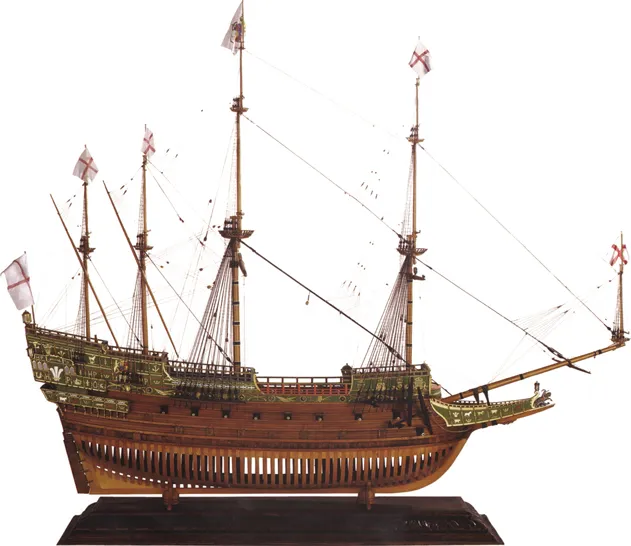
THE Prince Royal was the first three-decked warship to be built for the Navy, although the third tier was for many years to be only lightly armed. A convincing oil painting of the ship at Vlissingen (Flushing) by Hendrik Cornelisz Vroom and dated to 1613 shows that the levels of the gunports were stepped down towards the stern, indicating that initially the three gundecks were not flush from end to end, but incorporated falls in the deck levels designed to cope with the notable ‘sheer’ or rising of decks towards the ship’s ends. This modern model is based on that 1613 painting, with the stepped gunports aft. While there were apparently fewer guns on the upper deck, both the 1613 painting and the model show a continuous row of upper deck gunport wreaths. The ship had been commissioned (on 6 April of that year) under Lord High Admiral Charles Howard to transport James I’s daughter Elizabeth and her new husband, the Elector Palatine Frederick, from Dover to Vlissingen in May.
FROM SHIP ROYAL TO FIRST RATE
A system of grading the fighting ships of the Monarch’s navy into several ranks or ratings appears to date from the start of the Stuart era. Certainly the ships of the Elizabethan navy were perceived to undertake different roles depending on their size and strength, and the Tudors would generally refer to the largest of their galleons as ‘Great Ships’. Yet it was only from James I’s accession that any formal system of classification was established, with the ‘Great Ships’ being clearly separated from the...