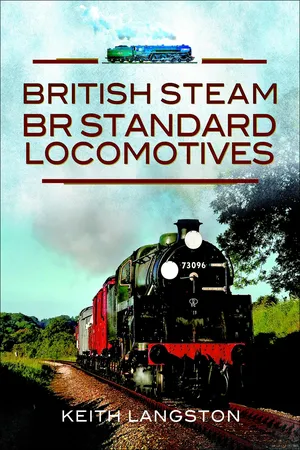
A history of post second world war steam locomotive design and construction in Great Britain, the perfect gift for railroad history buffs.
After WWII the existing railway companies were all put into the control of the newly formed British Transport Commission and that government organization spawned British Railways, which came into being on January 1st 1948. The railway infrastructure had suffered badly during the war years and most of the steam locomotives were "tired" and badly maintained and or life expired. Although the management of British Railways was already planning to replace steam power with diesel and electric engines, they still decided to build more steam locomotives as a stop gap. Some 999 Standard locomotives were built in twelve classes ranging from super powerful express and freight engines to suburban tank locomotives. The locomotives were mainly in good order when the directive came in 1968 to end steam, some trains were only eight years old. There still exists a fleet of forty-six preserved Standards of which 75% are in working order in and around the UKs preserved railways, furthermore three new build standard locomotives are proposed. Steam fans who were around in the 1960s all remember the "Standards."
- 208 pages
- English
- ePUB (mobile friendly)
- Available on iOS & Android
eBook - ePub
British Steam: BR Standard Locomotives
About this book
Chapter 1
7P6F (7MT) 4-6-2 BR STANDARD ‘BRITANNIA’

First of the 999 BR Standard Class locomotives, 4-6-2 No 70000 BRITANNIA is pictured at Neasden (24E) en-route to Marylebone Station London for an official BR inspection and naming ceremony, by the then Minister of Transport Alfred Barnes MP on 30th January 1951.
Having been first out-shopped in un-lined black and without nameplates No 70000 was repainted into BR passenger green with, black and orange lining, a red background to the nameplate and a bright metal finish to the wheel rims, handrails, buffers and drawgear prior to the ceremony.
The ‘Britannia’ livery was eventually changed to BR unlined green without bright metal fittings. For many years the cab roof of BRITANNIA was painted white to commemorate the loco hauling the funeral train of HRH King George VI from Norfolk to London, following his death at Sandringham in February 1952. Colour Rail
BR Standard ‘Britannia Class’ was the first of the 999 ‘Riddles’ Standard type locomotives to enter service. The first of the class 70000 BRITANNIA was rolled out of Crewe Locomotive Works in January 1951. The new class of 55 engines were considered at the time to be a striking design of Mixed Traffic locomotives, intended to have wide route availability. The Britannias were roughly equal in power to the Western Region (ex GWR) Castle class, the London Midland Region (ex LMS) Royal Scot class, the Southern Region (ex SR) West Country class and the Eastern Region (ex LNER) V2 class.
The 4-6-2 locomotives were designed in the Derby drawing office of BR and all were built at Crewe. They were given the number series 70000 to 70054 with 70000 to 70024 entering service in 1951, 70025 to 70044 entering service in 1952/53 and 70045 to 70054 entering service in 1954.
The Britannia boiler was designated BR1 type and its proportions were comparable with those of Gresley’s widely acclaimed V2 boiler, which had proved to be an excellent steam producer. The BR1 was superheated and in keeping with Standard Design Group policy was fitted with a self-cleaning smokebox, rocking grate and self-emptying ashpan. To complete the ‘new’ look Riddles added roller bearings and a tender cab. The new Pacific class was claimed by many observers at the time to have a distinctive ‘LMS look’ to it.
The ‘Britannia’ build specification took into all general aspects the Standard Design Groups criteria and in addition called for a liberal number of wash out plugs and doors, an enhanced design of regulator in the smokebox and improved accessibility of injectors and all pipe work. Importance was also placed on providing the enginemen with a better and more spacious cab/tender layout. In fact Riddles insisted that a wooden mock up of the proposed cab design be exhibited to staff prior to the intended design being signed off.
Britannia Class Facts
BR Pacific ‘Britannia’ Class 7P6F (7MT) 4-6-2
Built: Crewe Works 1951–54, 54 locomotives built.
Loco Weight: 94 tons 0 cwt
Tenders: BR1 49 tons 3 cwt, BR1A 52 tons 10 cwt, BR1D 54 tons 10 cwt
Driving Wheels Diameter: 6 foot 2 inches
Boiler Pressure: 250lb/psi
Cylinders: (2) 20 inch diameter x 28 inch stroke
Valve Gear: (piston valves) Walschaerts
Coal Capacity: BR1 and BR1A 7 tons, BR1D 9 tons
Water Capacity: BR1 4250 gallons, BR1A 5000 gallons, and BR1D 4725 gallons
Tractive Effort: 32,150lb at (85% pressure)
The Riddles Class 7 ‘Pacific’ was intended as a fast mixed traffic locomotive with wide route availability. The small (by express locomotive standards) 6ft 2in diameter driving wheels underlined the designer’s mixed traffic intentions, whilst their low axle loading (a little over 20 tons) satisfied route availability criteria. In addition the wheelbase of 58ft 3in meant that the class could easily be turned on the many 60ft turntables in use around the regions. The locomotives’ length over buffers was specified to be 68ft 9in.
The tractive effort of the ‘Britannia’ class was listed at 32,150lb (at 85% boiler pressure) compared with for example the rebuilt ‘Royal Scot’ class listed at 33,150lb (at 85% boiler pressure). At the time double blastpipes were seen as the norm for large locomotives, therefore observers were surprised by the ‘Standard’ team’s choice of single blastpipe and chimney. Riddles foresaw that the choice of just two 20in x 28in cylinders would appreciably reduce maintenance cost/time, in comparison to multi-cylinder locomotives.
Performance did not suffer either as the class constantly proved capable of maintaining express timings, often with heavily loaded trains. When in the care of a locomotive crew who had taken the time to learn the required technique of handling the two-cylinder ‘Pacific’s’, performances more normally associated with multi-cylinder ‘Class 8’ steam power were regularly recorded.
Locomotives Nos 70000 to 70034 and 70050 to 70054 were fitted with roller bearings and thereafter engines Nos 70035 to 70039 were built with roller bearings fitted only on the leading and trailing coupled axles, in another deviation from original design specification loco Nos 70040 to 70049 were built with plain bearings throughout. Reportedly experience in traffic showed no great advantage with roller bearings when judged by either reliability or cost criteria.
Initial locomotive allocations for operating purposes:
Nos. 70000–70014 Eastern Region
Nos. 70015–70024 Western Region
Nos. 70025–70029 Western Region
Nos. 70030–70044 London Midland Region
Nos. 70045–70049 London Midland Region
Nos. 70050–70054 Scottish Region
Nos. 70015–70024 Western Region
Nos. 70025–70029 Western Region
Nos. 70030–70044 London Midland Region
Nos. 70045–70049 London Midland Region
Nos. 70050–70054 Scottish Region
However, in practice some early a...
Table of contents
- Title Page
- Copyright Page
- Table of Contents
- ROBERT ARTHUR RIDDLES C.B.E.
- BRITISH RAILWAYS STANDARD CLASS LOCOMOTIVES
- Chapter 1 - 7P6F (7MT) 4-6-2 BR STANDARD ‘BRITANNIA’
- Chapter 2 - 8P 4-6-2 BR STANDARD ‘DUKE OF GLOUCESTER’
- Chapter 3 - 6P5F 4-6-2 BR STANDARD ‘CLAN’
- Chapter 4 - BR STANDARD 5 MT 4-6-0 ‘CLASS 5’
- Chapter 4 - BR STANDARD ‘CLASS 4MT’ 4-6-0
- Chapter 5 - BR STANDARD ‘CLASS 4MT’ 2-6-0 (MOGUL)
- Chapter 6 - BR STANDARD ‘CLASS 3MT’ 2-6-0 (MOGUL)
- Chapter 7 - BR STANDARD ‘CLASS 2MT’ 2-6-0 (MOGUL)
- Chapter 8 - BR STANDARD ‘CLASS 4MT’ 2-6-4T ‘CLASS 4 TANK’
- Chapter 9 - BR STANDARD ‘CLASS 3MT’ 2-6-2T ‘CLASS 3 TANK’
- Chapter 10 - BR STANDARD ‘CLASS 2MT’ 2-6-2T ‘CLASS 2 TANK’
- Chapter 11 - BR STANDARD ‘CLASS 9F’ 2-10-0
- Chapter 12 - R A RIDDLES–WAR DEPARTMENT (WD) AUSTERITY LOCOMOTIVES
- KEEPING STEAM MEMORIES ALIVE
Trusted by 375,005 students
Access to over 1.5 million titles for a fair monthly price.
Study more efficiently using our study tools.
Information
Publisher
Wharncliffe BooksYear
2012Print ISBN
9781845631468
Subtopic
Trasporti ferroviarieBook ISBN
9781783408016
Frequently asked questions
Yes, you can cancel anytime from the Subscription tab in your account settings on the Perlego website. Your subscription will stay active until the end of your current billing period. Learn how to cancel your subscription
No, books cannot be downloaded as external files, such as PDFs, for use outside of Perlego. However, you can download books within the Perlego app for offline reading on mobile or tablet. Learn how to download books offline
Perlego offers two plans: Essential and Complete
- Essential is ideal for learners and professionals who enjoy exploring a wide range of subjects. Access the Essential Library with 800,000+ trusted titles and best-sellers across business, personal growth, and the humanities. Includes unlimited reading time and Standard Read Aloud voice.
- Complete: Perfect for advanced learners and researchers needing full, unrestricted access. Unlock 1.5M+ books across hundreds of subjects, including academic and specialized titles. The Complete Plan also includes advanced features like Premium Read Aloud and Research Assistant.
We are an online textbook subscription service, where you can get access to an entire online library for less than the price of a single book per month. With over 1.5 million books across 990+ topics, we’ve got you covered! Learn about our mission
Look out for the read-aloud symbol on your next book to see if you can listen to it. The read-aloud tool reads text aloud for you, highlighting the text as it is being read. You can pause it, speed it up and slow it down. Learn more about Read Aloud
Yes! You can use the Perlego app on both iOS and Android devices to read anytime, anywhere — even offline. Perfect for commutes or when you’re on the go.
Please note we cannot support devices running on iOS 13 and Android 7 or earlier. Learn more about using the app
Please note we cannot support devices running on iOS 13 and Android 7 or earlier. Learn more about using the app
Yes, you can access British Steam: BR Standard Locomotives by Keith Langston in PDF and/or ePUB format, as well as other popular books in Tecnologia e ingegneria & Trasporti ferroviari. We have over 1.5 million books available in our catalogue for you to explore.