eBook - ePub
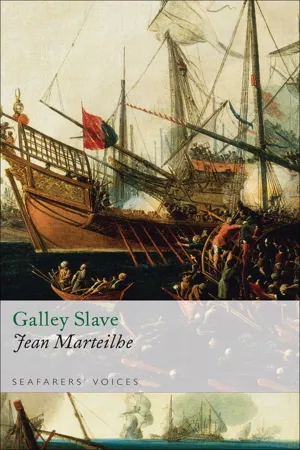
Galley Slave
The Autobiography of a Protestan Condemned to the French Galleys
- 224 pages
- English
- ePUB (mobile friendly)
- Available on iOS & Android
eBook - ePub
About this book
This remarkable memoir tells of the miseries of Jean Marteilhe of Bergerac, a Protestant condemned to the Galleys of France for his Religion, who, after the revocation of the Edict of Nantes in 1685, attempted, like so many French Huguenots, to escape to the more sympathetic Protestant countries bordering France. In 1700, heading through the Ardennes towards Charleroi, he was captured by French Dragoons and thrown into gaol.In 1707 he then found himself, like so many Huguenots, condemned to serve in the French Mediterranean galleys. Little is known of life as a galley slave on these oared vessels. Certainly no accounts have come down to us from ancient Greece or Rome, though a little is known from the time of the Crusades. So Marteilhes racy account represents the only authentic record of the miseries of a galley slave who experienced all the horrors of whips and chains and the dreaded bastinado—foot whipping.For six years he pulled his oar, often seeing friends and co-religionists lashed—sometimes to death—under the whips of the overseers. He himself sustained almost fatal injuries in a bloody engagement with the British off the mouth of the Thames before being released under a general amnesty in 1713.Galley Slave brings vividly to life the sufferings and conditions on the seventeenth- and eighteenth-century galleys and is a unique and unforgettable account.
Information
1. Flight and capture 1700-1701
ALMOST ALL OF MY fellow Huguenots would bear witness to the bloody and cruel persecutions inflicted upon them in every part of France since the year 1684. Many have written about it in a general way, but no one (at least to my knowledge) has particularised the different kinds of hardship and torture to be experienced in the galleys. I shall therefore impart what befell myself in those vessels, from the year 1700 to the year 1713, at which time I was happily delivered by God’s mercy, and by the intercession of Anne of England.
I was born in 1684, at Bergerac, a small town in the province of Perigord. My parents were in trade, but brought up their children as Huguenots in the true reformed religion – Protestantism. I will not weary my reader by relating the events of my childhood; but pass to my flight from my home, and what occasioned it.
During the Nine Years’ War which terminated in the Peace of Ryswick (1697), the Jesuits had not been able to indulge in the pleasure of harassing the Huguenots with the King’s troops, because the latter were needed to guard the kingdom. But no sooner was peace concluded, than these pitiless soldiers made their rage felt throughout France.
In 1699, the Duke de La Force26 requested permission from the court to go to his estates in Perigord, in order, as he expressed it, ‘to convert’ the Huguenots. This permission was granted and La Force immediately set out from Paris, accompanied by four Jesuits, guards and servants. Arrived at his castle, about three miles from Bergerac, La Force began to exercise unheard-of cruelties against Huguenots on his estates. Peasants of every age, and both sexes, were made to suffer, without trial, the most terrible tortures to compel them to renounce their religion, and then, by means as equally diabolical, to take the most fearful oaths to remain attached to the Roman Church. To testify the joy and satisfaction which he felt at his successes, and to terminate his enterprise in a manner he felt worthy of his motives, La Force made a bonfire of a magnificent library of Protestant books which his ancestors (all Protestants themselves) had carefully collected.
At this, I must amuse my reader with a scene which took place at the castle, where La Force was reposing after his fatigues, while receiving the praises of the priests and monks of the neighbourhood. There was an advocate of Bergerac, named Grenier. This man was a wit, but also a little mad. He expressed a wish to join the other flatterers, and was admitted to audience. La Force was sitting in his chair of state, his four Jesuits27 by his side.
Grenier began in these words: ‘Monseigneur, your grandfather was a great warrior, your father a great saint, while you, Monseigneur, are a great huntsman.’ The Duke, who had no great passion for the chase, here interrupted to inquire how Grenier judged that he, the Duke, was a great huntsman.
‘I judge of it,’ replied Grenier, pointing to the Jesuits, ‘by your four bloodhounds.’ Immediately they heard this, the fathers, like good Christians, demanded that Grenier be severely punished. But as it was represented that Grenier was not right in his mind, La Force was content with simply driving the advocate from his presence.
After this, the Duke returned to Paris to render an account of his successes to the court, successes that obtained for him permission to return to Perigord in October 1700, to convert, by any means, the Huguenots in all the royal towns of that province. He eventually came to Bergerac, accompanied by the same four Jesuits, and a regiment of dragoons. The cruelties of these latter made a great many more converts than the exhortations of the Jesuits, as there were no measures these booted and spurred missionaries did not exercise to oblige the citizens to go to Mass.
Twenty-two of these dragoons were quartered with my father, and after having consumed and destroyed everything in the house, my father was cast into prison, while two of my brothers, and my sister, still children, were placed in a convent. I had the good fortune to escape from the house before they entered it, but this left my poor mother in the midst of those twenty-two wretches, who caused her to undergo horrible tortures before dragging her before La Force who, with infamous treatment, presented the form of renunciation for her signature. Though weeping abundantly, she signed. But after writing her name at the bottom, she added: ‘(La) Force made me do it’, alluding to the Duke. They tried to make her efface these words, but as she persisted in refusing, one of the Jesuits did so for her.
Knowing myself in great danger, and just sixteen years of age, I left the town after dark, accompanied by a friend, Daniel Le Gras, a hairdresser. After walking all night through the woods, we found ourselves the next morning at Mussidan, a small town twelve miles from Bergerac. There we resolved, whatever the perils, to try to reach the safety of Holland. We implored divine protection for our journey, and vowed we would remain firm and constant in confessing the Protestant religion, even at the risk of the galleys, or death. After making a firm resolution not to imitate Lot’s wife28 by looking back, we proceeded cheerfully along the high road to Paris, although not too well supplied with money – our whole capital being about ten pistoles.29
After lodging every day at the humblest inns, we eventually reached Paris on 10 November 1699. Here we expected to meet some of our acquaintances, and learn the easiest and least dangerous route to the frontier. A good friend drew us a map as far as Mézières, a garrison town on the River Meuse, at that time the frontier of the Spanish Netherlands, beyond which was the formidable forest of Ardennes, and beyond which lay Charleroi, and freedom. He informed us that the great danger would be entering Mézières – because they were extremely particular at the gate in stopping strangers, and those found without passports were taken at once before the governor, and thence to prison. But on leaving Mézières, he added, no one was ever stopped. And once through Mézières, the forest of Ardennes would favour our journey to Charleroi, twenty-six or so miles away, when we should then be out of the French territories. Our friend added that at Charleroi there was also a Dutch garrison whose commander would protect us from all danger.
We started from Paris for Mézières. Nothing occurred en route, for within the French dominions no one was ever stopped, the government concentrating only on the borders. We arrived then, one afternoon, about four o’clock, at the summit of a little hill, about three-quarters of a mile from Mézières. From here we could see the whole of the town and the gate by which we should have to enter, this latter being approached by a long bridge over the River Meuse. As it was very fine weather, a number of the inhabitants were walking about on the bridge. We thought that by mixing with these citizens, we should be able to enter the town without attracting attention. We emptied our knapsacks of our few shirts and put them all on, putting our knapsacks into our pockets. We then cleaned our shoes, and combed our hair, so as not to look like travellers. We had no swords, for that was then forbidden in France. We descended the hill and walked up and down the bridge with the citizens, until the drum beat for the closing of the gates, at which all the inhabitants hastened to return into the town, and we with them. We were filled with joy when the sentinel ignored us, but the gate leading out of the town, being shut at the same time, meant we must now lodge for the night.
Entering the first inn that presented itself, we were met by the landlord’s wife. We ordered supper; and whilst at table, at about nine o’clock, the landlord arrived back. From our chamber, we heard his wife tell him she had received two young strangers. Her husband immediately asked if we had a ticket of permission from the governor. His wife replied that she had not inquired.
‘Slut!’ said he. ‘Do you wish to ruin us utterly? You know the prohibitions against lodging strangers. They must come with me at once to the governor.’ He then entered our chamber, and asked very civilly if we had spoken to the governor. We told him that we had not thought this necessary when lodging for only one night.
‘It would cost me a thousand crowns,’ said he, ‘if the governor knew that I had lodged you without his permission. But you do have the passport necessary to enter frontier towns?’ We replied that we were well furnished with papers.
‘Hopefully that will be enough. Still, you must come with me to the governor to show your passports.’ We replied that we were very fatigued; but that next morning we would willingly accompany him. He appeared satisfied and left.
We finished our supper, and though our bed was a good one, it did not induce sleep, so troubled were we by the perils that threatened next day. We talked quietly through the night of the answers we should make to the governor, but saw nothing in front of us, but going straight from the governor’s house to prison. We finally decided our only chance was to escape at dawn. As light began to break, we got up and dressed quickly, and crept down to the kitchen, to find this was where the landlord and his wife slept. He immediately awoke, and seeing us about so early, inquired the reason.
We said that having to go to the governor, we wished to breakfast as soon as possible, so on leaving the governor’s we could proceed onwards at once. The landlord approved our scheme, and ordered his servant to fry some sausages, while he, the landlord, made his toilet. This kitchen was on the ground floor, close to the street door which the servant now opened. Making a pretext that we wished to go out for a few moments, and without saying farewell, or paying our reckoning, we found a little boy, of whom we asked the way to the Charleville gate, by which we could leave the town. We were very near it, and as the gate was open we went out without any obstacle.
On reaching Charleville, a small town with neither gate nor garrison, and within gunshot of Mézières, we breakfasted quickly, and then left it to enter the safety of the forest of Ardennes. It had frozen during the night, and the trees appeared terrible, covered with hoar frost and icicles. As we penetrated this vast forest we were confronted with a great number of roads. Not knowing which led to Charleroi, we asked the way of a peasant we met. His answer was that for strangers to go to Charleroi by way of the Ardennes forest was very dangerous, as the further we advanced the more roads we should meet. And as there was neither village nor house in this great wood, we might wander about for twelve or fifteen days. And that if the frost continued we might perish there of cold and hunger, plus the forest was full of ravenous animals. We offered the peasant a gold louis if he would serve as a guide to Charleroi.
‘Not if you were to offer me a hundred,’ he said. ‘I think that you are Huguenots trying to escape from France, and helping you would only put a rope round my own neck.’ Although he would not guide us, he gave us good advice to leave the forest, and detailed various villages through which we should have to pass to Charleroi. ‘A route,’ he ended, ‘longer than that by the Ardennes, but without any danger.’
We thanked this good man and in the evening we arrived at the first village of which he spoke. We slept there, and next morning continued on the next road he suggested. This led us straight to a narrow gorge, called the Guet du Sud, between two mountains, where there was a guardhouse of French soldiers, with a sentinel in front of it, stopping all strangers and asking for passports. Like poor straying sheep, we had walked into the jaws of the wolf. We had been seen, and so had to go forward, but then, by the most favourable chance, rain began to fall so heavily that the sentinel went into the guardhouse for shelter, and we passed by quite innocently. And pursuing our way, arrived at the town of Couve.
At that moment we were safe, had we only known it, as this little town was not on French territory. It belonged to the Prince of Liège,30 and contained a castle garrisoned by Dutch troops, the governor of which granted an escort to all refugees to conduct them to Charleroi. But it was God’s will that we should remain in ignorance, so that our faith should be put to the trial during thirteen years of dungeons and galleys, as will be seen in the course of these memoirs.
We arrived, then, at Couve, wet to the skin. We entered an inn to dry ourselves, and to get something to eat. Having sat down to table, they brought us a pot of beer with two handles, without giving us any glasses. On asking for some, the host said that he perceived we were Frenchmen, for the custom of that country was to drink out of the pot. But this request for glasses, which seemed at the time a mere trifle, was the cause of our ruin, for in the same room with us were two men: one an ordinary citizen, the other a gamekeeper of the Prince of Liège. The latter, noticing the observation of the landlord, began to examine us very carefully, and at last declared he was ready to lay a wager that we did not carry rosaries in our pockets. That is, we were not Catholics.
My companion, at that moment taking a pinch of snuff, gestured to his snuff box, saying that that was his rosary. This reply told the gamekeeper what he wanted to know: that we were Protestants, attempting to escape from France. And as the belongings of those arrested belonged to the informer, and he thought we had money, he conceived the design of following us when we left Couve, in the hope we would pass through Mariembourg, about three miles away, but back in French territory.
On leaving Couve, we should have taken the road to the left, by which we should have avoided touching French territory. But coming towards us along that road we perceived an officer on horseback. And as the least thing increases fear, lest this officer should stop us, we turned and took the fatal road to Mariembourg – a small town with only one gate, so there is no direct passage through it. Still unaware of the treacherous gamekeeper we arrived when it was almost dark, and entered through the gate. There was an inn opposite. We went in, they gave us a room, and we had a good fire made to dry ourselves. After about half an hour a man came in who saluted us very civilly, then asked whence we came, and whither we were going. We told him we had come from Paris, going to Philippeville. At this he said that we must speak to the governor of Mariembourg. We thought to quiet him as we had done our host at Mézières, saying we were weary and would go the next morning, but he replied, now sharply, that we must follow him at once.
We arose without showing any fear, and speaking quietly in local Bergerac patois, I said to Daniel that once outside, in the dark, we would run for it. We followed the fellow whom we took for the landlord, but who was really a sergeant of the town guard, and saw in the courtyard of the inn, a detachment of eight soldiers with fixed bayonets, at their head the treacherous gamekeeper of Couve. We were immedi ately seized, and led before the governor, M Pallier by name, who asked us what countrymen we were, and whither we were going. To the first question we told him the truth. To the second I prevaricated, and using my companion’s trade, I said we were apprentice hairdressers, out to see France. That our design was to go to Philippeville, from thence to Maubeuge, Valenciennes, Cambrai, etc., and so return to our own country. The governor had us examined by his valet, who knew something about a barber’s work. The valet fortunately began with Daniel, who soon convinced them such was our business.
The governor then asked us of what religion we were. We told him plainly that we were Huguenots, for on this question our conscience would not allow us to disguise the truth. The governor then asked us if our design was not, in reality, to leave the kingdom. This we denied. Alas, may God pardon us that we were weak and foolish enough not to tell the whole truth. But such is human nature, which never performs a good work perfectly.
After the examination, which lasted a good hour, the governor ordered a major who was present to conduct us to prison. This he did, using the same escort and accompanied by the gamekeeper. On the way, the major, named M de La Salle, asked me if it were true that we were from Bergerac. I told him it was.
‘I was born about a mile and a half from there,’ said he, and asked my family name, on hearing it, exclaim ing, ‘Why your father is a good friend of mine! Be comforted my children,’ he added, ‘I will get you out of this unhappy affair. You will be free after two or three days.’
We arrived at the prison, and now the gamekeeper asked the major to have us searched, that he might have his reward, believing we had a great deal of money. We said we had only about one pistole. This the major told us to give to him, whereby we would not be searched. He feared lest we had more about us, which would be taken as a sign we wished to escape from the kingdom, it being well known wandering apprentices are not overburdened wit...
Table of contents
- Cover
- Title Page
- Copyright
- Contents
- Editorial note
- Introduction
- Galley Slave
- Foreword: A description of a galley, its crew, and method of fighting
- Chapter 1: Flight and capture 1700-1701
- Chapter 2: The prisons at Tournay and Lille
- Chapter 3: To Dunkirk in the galley chain 1702
- Chapter 4: Incidents at the galleys, Dunkirk 1703-1705
- Chapter 5: We almost perish in a great storm, Dunkirk 1707
- Chapter 6: Our galley destroyed, the crew massacred, Dunkirk 1708
- Chapter 7: At Dunkirk 1709
- Chapter 8: We are removed with great torments from the galleys at Dunkirk to those at Marseilles 1712
- Chapter 9: The last of the chains 1713
- Notes
Trusted by 375,005 students
Access to over 1.5 million titles for a fair monthly price.
Study more efficiently using our study tools.
Frequently asked questions
Yes, you can cancel anytime from the Subscription tab in your account settings on the Perlego website. Your subscription will stay active until the end of your current billing period. Learn how to cancel your subscription
No, books cannot be downloaded as external files, such as PDFs, for use outside of Perlego. However, you can download books within the Perlego app for offline reading on mobile or tablet. Learn how to download books offline
Perlego offers two plans: Essential and Complete
- Essential is ideal for learners and professionals who enjoy exploring a wide range of subjects. Access the Essential Library with 800,000+ trusted titles and best-sellers across business, personal growth, and the humanities. Includes unlimited reading time and Standard Read Aloud voice.
- Complete: Perfect for advanced learners and researchers needing full, unrestricted access. Unlock 1.5M+ books across hundreds of subjects, including academic and specialized titles. The Complete Plan also includes advanced features like Premium Read Aloud and Research Assistant.
We are an online textbook subscription service, where you can get access to an entire online library for less than the price of a single book per month. With over 1.5 million books across 990+ topics, we’ve got you covered! Learn about our mission
Look out for the read-aloud symbol on your next book to see if you can listen to it. The read-aloud tool reads text aloud for you, highlighting the text as it is being read. You can pause it, speed it up and slow it down. Learn more about Read Aloud
Yes! You can use the Perlego app on both iOS and Android devices to read anytime, anywhere — even offline. Perfect for commutes or when you’re on the go.
Please note we cannot support devices running on iOS 13 and Android 7 or earlier. Learn more about using the app
Please note we cannot support devices running on iOS 13 and Android 7 or earlier. Learn more about using the app
Yes, you can access Galley Slave by Jean Marteilhe in PDF and/or ePUB format, as well as other popular books in History & Military & Maritime History. We have over 1.5 million books available in our catalogue for you to explore.