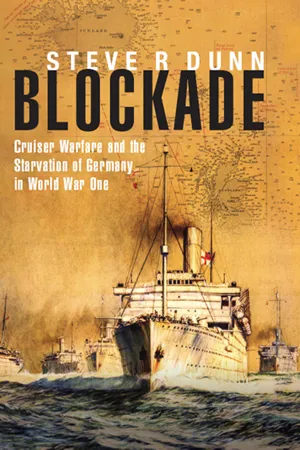
This WWI naval history vividly tells the story of the Royal Navy's Northern Blockade and the battles at sea that brought Germany to its knees.
At the outbreak of World War I, Britain established a naval blockade that greatly diminished Germany's access to trade and vital resources. The Northern Blockade brought the German economy to its knees and greatly diminished home front morale. Patrolling the inhospitable waters between Iceland and Scotland, the 10th Cruiser Squadron played a vital role in winning the war on the Western Front. At the same time, the Royal Navy successfully countered Germany's attacks on British commerce, preventing much suffering in Britain.
Drawing on numerous first-hand accounts, Historian Steve Dunn vividly chronicles this long-running battle at sea. Beginning with the blockade's initial formation, he recounts the changes in strategy on both sides, including the use of converted liners and armed merchant vessels as warships. He also vividly describes the final destruction of German surface vessel commerce warfare, culminating in the hard-fought battle between the raider SMS
Leopard and two British warships.
- 256 pages
- English
- ePUB (mobile friendly)
- Available on iOS & Android
eBook - ePub
About this book
Information
P A R T O N E
The German Auxiliary Cruiser Guerre de Course
Recognising the importance to Britain of imported goods, the Imperial German Navy set a strategic goal to disrupt and destroy British trade. To accomplish such a task, the planners acknowledged that their limited number of appropriate vessels, essentially long-range cruisers, was insufficient. Thus they looked for other solutions. Britain, too, had a strategic imperative to disrupt and deny German trade; but first she had to determine the appropriate tactics.
1
A Change of Strategy, 1914
Given that Britain is an island with a prevailing westerly wind and with its most likely enemies off its eastern coast, separated by the North Sea and the Channel, close blockade of an opponent’s ports to deny him access to the sea and trade was always going to be the navy’s favoured strategy.
In the eighteenth and nineteenth centuries such a strategy proved successful, particularly against France. To take but one example from many, during the Seven Years War of 1754–1763, Louis XV’s plan of invasion was ruined and his fleet destroyed by the close blockade of Admiral Hawke and others. In September 1759, for instance, Hawke himself was deployed off Brest, Duff off Morbihan, Rodney off the Normandy coast and Commodore Boys positioned off Dunkirk, while cruisers watched the Flanders coast and others watched Le Havre. The French fleet was bottled up, its invasion barges eventually destroyed and its ships put to the sword by Hawke at Quiberon Bay. As the historian Frank McLynn put it, ‘the blockade was hurting the French badly as they later admitted. Even at the simplest level their matelots were cooped up in inaction and inertia while constant vigilance kept the Royal Navy at a high pitch of readiness’.
The Royal Navy was an inherently conservative institution whose motto could well have been ‘if it ain’t broke, don’t fix it’, and as it entered the twentieth century the navy saw no need to change a proven strategy. Close blockade and gunnery engagement at short ranges had worked for Nelson and Hawke, so there was no perceived need to change. When First Sea Lord Admiral Sir Arthur ‘Old’ Ard ‘Eart’ Wilson was called to present the navy’s strategy in the event of war to the Committee for Imperial Defence in 1911, his shambolic and muttered testimony implied that they would keep close blockade on the enemy’s coast and engage his ships in the North Sea if they tried to come out. There was no mention of cooperation with the army, or any more ingenious strategy which might reflect the requirements of modern warfare and diplomacy, nor any consideration of the changes which new and different classes of ship might have wrought, an omission which earned him the sack (along with his political boss, First Lord of the Admiralty Reginald McKenna) and propelled the young and mistrusted Winston Churchill into the First Lord’s chair.
In fact, voices had been questioning the accepted wisdom for some years. The deployment of large and costly warships in the North Sea and close to the enemy’s coast had become, in some eyes, a much more perilous strategy, given the invention of the locomotive torpedo (invented by the British engineer Robert Whitehead in 1866 but initially rejected by the Royal Navy), the submarine, the mine and the torpedo gunboat. Now small, low-cost weapons, available to any tin-pot country, could be used to damage or sink expensive capital ships, especially in the confined waters of the coastal littoral or the narrow North Sea. The refusal of many in the Admiralty to recognise this game-changing fact was in part ignorance, part snobbery and part a recognition that all their expensive hardware and accepted strategies would be at naught if submarines and torpedoes ruled the roost.
Submarines were seen as a much reviled and distrusted class of ship. Many sailors thought them a dishonourable and underhand weapon, suitable only for weaker nations and only then for coastal defence. Sir Arthur Wilson, as an example, thought that their crews should be hanged as pirates if captured and while in office as First Sea Lord did much to retard the development of the weapon for the Royal Navy. In 1911 the Inspecting Captain of Submarines (the man in charge of the navy’s submarine development and training) was Captain Sydney Hall. He was a man of firm opinions and at odds with Wilson on tactical matters, particularly the pace of building new submarines and the type of boat which should be built. When it appeared to Wilson that Hall was getting too close to the engineering companies building the navy’s submarines, Wilson took the opportunity to fire him from his post and assigned him to an old and useless third-class cruiser, Diana, based off Crete.
It was the tradition that the departing officer had the right to nominate his own successor, and Hall nominated Captain Frank Brandt, a navy ‘brain’, and at the time in charge of the 8th Submarine Flotilla. Wilson overruled this appointment and appointed the more congenial Roger Keyes instead. But Wilson’s desire to impose his own will on submarine development did not stop there. Brandt, a submarine specialist, never got another decent posting; he was assigned first to an old (1894) and wretched second-class protected cruiser, Eclipse, and in July 1914 to Monmouth – then in the Third Fleet – and took her to die a fiery death at the battle of Coronel on 1 November 1914. The general attitude of most senior officers of the period could be summed up by the comments of Brandt’s admiral at Coronel, Rear Admiral Sir Christopher Cradock, to his friend Roger Keyes, the new Inspecting Captain of Submarines, ‘it would be far more satisfactory to these “playthings” to know whether they were observed or made hits or misses … I am sure you will know what to do’. ‘Playthings’ was the common view.
But one man who clearly saw that submarines had revolutionised naval warfare, and hence the strategy of close blockade, was Jacky Fisher, quondam First Sea Lord, and the man who created the dreadnought. Fisher had driven the introduction of submarines, and when out of office continually badgered First Lord Winston Churchill to increase the numbers being built. More than anyone, Fisher realised that the advent of the torpedo-armed submarine meant that the narrow waters of the North Sea and English Channel became a very high-risk environment for large and expensive capital ships. Rather than risk battleships in such a situation it was better, he argued, to police those waters through ‘flotilla defence’, using large numbers of torpedo boats (surface vessels carrying on-deck torpedoes), submarines and torpedo boat destroyers (more usually abbreviated to ‘destroyers’) to render the waters uninhabitable for enemy battleships, potential invasion fleets and the like. Fisher’s was something of a lone voice in the wilderness for much of the early part of the twentieth century, although he was not without support. Rear Admiral Frederick E E Brock, commanding the Portsmouth Division, Home Fleet, wrote to the then First Lord, McKenna, in March 1910, referring to the recently published Naval Estimates for 1910–1911 and insisting ‘how much I think that the additional men and destroyers provided for are required in addition to the battleships’.
Under pressure from Fisher, Churchill began to consider the possibilities of ‘flotilla defence’, whereby large numbers of light (and cheap) craft would be deployed in the North Sea, with the battlefleet held to the north to intervene when the enemy was ‘fixed’, and the implications of this on a strategy of close blockade. Not the least of the attractions of such a scheme for Churchill was its economy and his need to stabilise the naval cost estimates. With this in mind, in February 1912 he asked his Chief of the Naval Staff, Rear Admiral Ernest Troubridge, to work on a plan for a North Sea deployment that would adopt the idea of using light forces. This plan was ready to issue to the Commander-in-Chief Home Fleet by May, but a last minute intervention by Churchill, demanding that it be tested in manoeuvres, stopped its issue (and infuriated Troubridge).
When tested in the summer, the fleet manoeuvres showed the scheme to be seriously flawed. Troubridge’s war plan was a compromise between close blockade and flotilla defence and as such satisfied no one. He proposed a cordon of three hundred miles from Norway to the Dutch coast – an intermediate blockade, as opposed to the close blockade planned for in 1911 and for many years beforehand. This was shown to be unworkable, for the navy did not have enough cruisers or destroyers to support it. Churchill was forced to make an embarrassing climb-down in front of the Committee for Imperial Defence. He blamed Troubridge and soon got rid of him.
For the public at large, the major concern was not of the intricacies of flotilla defence, but of invasion. It is strange that, in the years leading up to the war, Britain and its politicians were seized by the thought of invasion and much argument was expended concerning the need to retain soldiers at home to deal with this threat, rather than send them to France, and as to where the navy should be stationed to meet it. Books such as Erskine Childers’s The Riddle of the Sands (1903) and The Invasion of 1910 by William Le Queux, serialised by the Daily Mail in 1906, had stoked such fears, as had Guy du Maurier’s play An Englishman’s Home of 1909, which ran uninterrupted for eighteen months. In 1908 the Committee of Imperial Defence had appointed an invasion inquiry before which former Prime Minister A J Balfour, amongst others, testified. The conclusion was that a successful invasion could not be mounted, but the public were not aware of this and the ‘idea of invasion became almost a psychosis’. In reality, the Germans had no such plans and had never had such plans – it was a complete red herring.
But other, more perceptive, voices began to see another threat, that of the danger to our supply chain. In July 1914 Sir Arthur Conan Doyle wrote a short story for The Strand Magazine. It was billed as ‘the amazing story of England’s peril and how our naval supremacy was challenged by a few submarines’. In Conan Doyle’s tale he has an enemy naval officer make this speech:
of course, England will not be caught napping again in such a fashion. Her foolish blindness is partly explained by her delusion that her enemy would not torpedo merchant vessels. Common sense should have told her that the enemy will play the game that suits them best – that they will not inquire what they may do but they will do it first and talk about it afterwards. The opinion of the whole world now is that if a blockade were proclaimed one may do what one can with those who try to break it and that it was as reasonable to prevent food from reaching England in war time as it is for a besieger to prevent the victualling of a beleaguered fortress.
Reviewing the story, the Daily Telegraph asked retired Admiral Lord Charles Beresford for an opinion. He ventured, ‘we have done something to meet the dangers to our food supplies by arming some of our merchantmen’, which was technically true, as plans existed for that to happen in time of war. The writer Arnold White (author of The Navy and its Story) added that Sir Arthur has ‘placed his finger on the neuralgic nerve of the British Empire – ie the precarious arrival of our food supplies’.
The recognition that food and raw material supply was critical to any war effort was not uniquely Conan Doyle’s. It had been articulated as early as the sixteenth century by Sir Walter Raleigh who wrote, ‘there are two ways in which England may be afflicted. The one is by invasion … the other by impeachment of our trades’. As then, as now.
With regard to the fragile nature of the supply chain to the British Isles, it is worth noting that this issue had been addressed by Parliament at least five times during the Dutch and Napoleonic wars of the seventeenth, eighteenth and nineteenth centuries. The Compulsory Convoy Act of 1798, for example, compelled all British merchant ships to and from British ports in time of war to sail in convoy, protected by Royal Navy ships, and in return for the payment of a fee for the protection provided. This act was not repealed until 1872, pressure from the shipowners being the driving force. This repeal was in fact a major change in war strategy for the Royal Navy, although this was little recognised at the time. The navy’s role was now defined by phrases such as ‘securing the sea communications’, ‘protecting the ocean highways’ and ‘preserving the sea routes’: all phrases which hid the fact that merchant ships would no longer receive direct protection. This would be a significant problem when war came.
* * *
Rear Admiral Troubridge was exited from his post at the end of 1912 and new war plans were issued to the Commander-in-Chief Home Fleet, Admiral George Callaghan, for 1913. These plans enjoined him to base himself on the Firth of Forth and ‘sweep and patrol’ the southern half of the North Sea with his fleet, without specifying the extent of such sweeps or their frequency, but ordering him not to pass beyond a point roughly halfway across. Callaghan was informed that ‘the general idea of these plans is to exercise economic pressure upon Germany by cutting off German shipping from Oceanic trade’. The penny had dropped, although not with everyone. Rear Admiral David Beatty, for one, wrote to Churchill, whilst still serving as his naval secretary, to complain about both the vagueness and the lack of offensive spirit in the new orders. Churchill proved to be a waverer, advocating in 1913 a madcap scheme for close blockade of the Heligoland Bight and the capture of the island of Borkum. Callaghan was dismissive: ‘this policy of close blockade was considered a few years ago and abandoned as impractical. As it appears to be still more impractical now it is useless to consider it’, he wrote. Churchill continued to press for his plan as late as June 1914, however, ignoring the inconvenient realities.
Thus it came about that, under a possibly reluctant Churchill, and successive First Sea Lords (he got through four), the navy developed a plan which took account of the changed realities of naval warfare. Out went the concept of close blockade and engagement of the enemy’s battlefleet close to their shores. In came the idea of distant blockade and the slow strangulation of an opponent’s power to resist. As war against Germany was declared, the British Grand Fleet sped to its haven of distant Scapa Flow in the Orkney Isles; the Channel Fleet of old and expendable battleships assembled at Sheerness to escort the BEF to France and defend against the much-feared invasion; and smaller ships assembled at Dover, Harwich and in the Orkney and Shetland Islands to create the northern and southern limits of a distant blockade, closing the North Sea entrances and exits to Germany and its allies.
2
Cruiser Warfare
The interdiction of an enemy’s trade on the high seas had always been a major facet of naval warfare. Whether it be Drake and Raleigh, licensed privateers plundering Spanish ships for the Virgin Queen in the sixteenth century, or Joseph Barss in the Liverpool Packet capturing fifty American vessels in the war of 1812, the disruption of an opponent’s trade was seen as a legitimate (and profitable) activity.
For most of the nineteenth century the British considered that their most likely opponent at sea would be the French, and vice versa. However, the French also observed that they were deficient in heavy ships (battleships) and unlikely to make up the deficit for reasons of cost and resources.
Out of this strategic conundrum was developed a new concept known as the Jeune École (Young School). Its adherents advocated a two-pronged strategy: first, the use of small, powerfully equipped units to combat a larger battleship fleet, and secondly, commerce raiders capable of ending the trade of the rival nation. Without overtly saying so, the plan was clearly aimed at Britain, the largest navy in the world at the time and heavily reliant on trade for economic prosperity and survival.
The French developed and commissioned a new class of vessel specifically designed as raiding ships for this role, such as Dupuy de Lôme. Laid down in 1888, but with typical French lassitude not commissioned until 1895 – by which time h...
Table of contents
- Cover
- Title Page
- Copyright
- Contents
- Dedication
- List of Illustrations
- Dramatis Personae
- Prologue: 16 March 1917
- Introduction: The Navy at War
- Part One: The German auxiliary Cruiser Guerre de Course
- Part Two: Blockade
- Part Three: A Desperate Battle
- Part Four: Endings
- Appendices
- Select Bibliography
Trusted by 375,005 students
Access to over 1.5 million titles for a fair monthly price.
Study more efficiently using our study tools.
Frequently asked questions
Yes, you can cancel anytime from the Subscription tab in your account settings on the Perlego website. Your subscription will stay active until the end of your current billing period. Learn how to cancel your subscription
No, books cannot be downloaded as external files, such as PDFs, for use outside of Perlego. However, you can download books within the Perlego app for offline reading on mobile or tablet. Learn how to download books offline
Perlego offers two plans: Essential and Complete
- Essential is ideal for learners and professionals who enjoy exploring a wide range of subjects. Access the Essential Library with 800,000+ trusted titles and best-sellers across business, personal growth, and the humanities. Includes unlimited reading time and Standard Read Aloud voice.
- Complete: Perfect for advanced learners and researchers needing full, unrestricted access. Unlock 1.5M+ books across hundreds of subjects, including academic and specialized titles. The Complete Plan also includes advanced features like Premium Read Aloud and Research Assistant.
We are an online textbook subscription service, where you can get access to an entire online library for less than the price of a single book per month. With over 1.5 million books across 990+ topics, we’ve got you covered! Learn about our mission
Look out for the read-aloud symbol on your next book to see if you can listen to it. The read-aloud tool reads text aloud for you, highlighting the text as it is being read. You can pause it, speed it up and slow it down. Learn more about Read Aloud
Yes! You can use the Perlego app on both iOS and Android devices to read anytime, anywhere — even offline. Perfect for commutes or when you’re on the go.
Please note we cannot support devices running on iOS 13 and Android 7 or earlier. Learn more about using the app
Please note we cannot support devices running on iOS 13 and Android 7 or earlier. Learn more about using the app
Yes, you can access Blockade by Steve R Dunn in PDF and/or ePUB format, as well as other popular books in History & Military & Maritime History. We have over 1.5 million books available in our catalogue for you to explore.