"This magnificent book reinforces Norman Friedman's unparalleled reputation as a peerless author of maritime topics."—
Australian Naval Institute
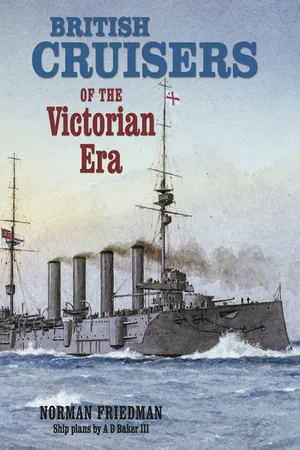
Gradually evolving from the masted steam frigates of the mid-nineteenth century, the first modern cruiser is not easy to define—but for the sake of this book, historian Norman Friedman takes as a starting point Iris and Mercury of 1875. They were the Royal Navy's first steel-built warships; were designed primarily to be steamed rather than sailed; and formed the basis of a line of succeeding cruiser classes.
The story progresses with the last armored cruisers, which were succeeded by the first battlecruisers (originally called armored cruisers), and with the last Third Class Cruisers (Topaze class), all conceived before 1906. While dovetailing precisely with the author's previous book on British cruisers, this one also includes the wartime experience of the earlier ships.
The two central themes are cruisers for the fleet and cruisers for overseas operations, including (but not limited to) trade protection. The distant-waters aspect covers the belted cruisers, which were nearly capital ships, intended to deal with foreign second-class battleships in the Far East. The main enemies contemplated during this period were France and Russia, and the book includes British assessments of their strength and intentions, with judgments as to how accurate those assessments were. Deeply researched, original in its analysis, and full of striking insights, this is another major contribution by Norman Friedman to the history of British warships.
- 350 pages
- English
- ePUB (mobile friendly)
- Available on iOS & Android
eBook - ePub
British Cruisers of the Victorian Era
About this book
Information
Topic
StoriaSubtopic
Storia militare e marittimaTable of contents
- Front Cover
- Title Page
- Copyright Page
- Contents
- Acknowledgements
- Illustrator’s Notes
- INTRODUCTION
- 1. STEAM, SAIL AND WOODEN HULLS
- 2. IRON HULLS
- 3. THE FIRST ARMOURED CRUISERS
- 4. FAST STEEL CRUISERS
- 5. THE TORPEDO AND SMALL CRUISERS
- 6. BIG CRUISERS TO PROTECT COMMERCE
- 7. THE FAST WING OF THE BATTLE FLEET
- Appendix: Vickers Designs
- 8. EPILOGUE: FISHER’S REVOLUTION
- Bibliography
- Notes
- Data List (specifications)
- List of Ships
- Abbreviations
Trusted by 375,005 students
Access to over 1.5 million titles for a fair monthly price.
Study more efficiently using our study tools.
Frequently asked questions
Yes, you can cancel anytime from the Subscription tab in your account settings on the Perlego website. Your subscription will stay active until the end of your current billing period. Learn how to cancel your subscription
No, books cannot be downloaded as external files, such as PDFs, for use outside of Perlego. However, you can download books within the Perlego app for offline reading on mobile or tablet. Learn how to download books offline
Perlego offers two plans: Essential and Complete
- Essential is ideal for learners and professionals who enjoy exploring a wide range of subjects. Access the Essential Library with 800,000+ trusted titles and best-sellers across business, personal growth, and the humanities. Includes unlimited reading time and Standard Read Aloud voice.
- Complete: Perfect for advanced learners and researchers needing full, unrestricted access. Unlock 1.5M+ books across hundreds of subjects, including academic and specialized titles. The Complete Plan also includes advanced features like Premium Read Aloud and Research Assistant.
We are an online textbook subscription service, where you can get access to an entire online library for less than the price of a single book per month. With over 1.5 million books across 990+ topics, we’ve got you covered! Learn about our mission
Look out for the read-aloud symbol on your next book to see if you can listen to it. The read-aloud tool reads text aloud for you, highlighting the text as it is being read. You can pause it, speed it up and slow it down. Learn more about Read Aloud
Yes! You can use the Perlego app on both iOS and Android devices to read anytime, anywhere — even offline. Perfect for commutes or when you’re on the go.
Please note we cannot support devices running on iOS 13 and Android 7 or earlier. Learn more about using the app
Please note we cannot support devices running on iOS 13 and Android 7 or earlier. Learn more about using the app
Yes, you can access British Cruisers of the Victorian Era by Norman Friedman in PDF and/or ePUB format, as well as other popular books in Storia & Storia militare e marittima. We have over 1.5 million books available in our catalogue for you to explore.