eBook - ePub
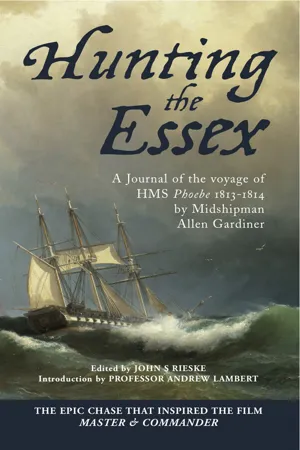
Hunting the Essex
A Journal of the Voyage of HMS Phoebe, 1813–1814
- 152 pages
- English
- ePUB (mobile friendly)
- Available on iOS & Android
eBook - ePub
Hunting the Essex
A Journal of the Voyage of HMS Phoebe, 1813–1814
About this book
In February 1813 the British frigate Phoebe set out on a secret mission that would involve sailing halfway around the world to attack American settlements in the Pacific Northwest. The United States, frustrated at the treatment of its shipping by the combatants in the Napoleonic Wars, had finally opened hostilities against the British in the previous June. From the American perspective the War of 1812 began with disasters in its invasion of Canada, but against all expectations the infant US Navy had scored significant victories at sea. The most strategically significant of these was the campaign by the frigate USS Essex, which had almost annihilated the lucrative British whaling trade in the south Pacific. Therefore, Phoebe was diverted to hunt down and destroy this highly successful commerce-raider. After an epic search, Phoebe tracked her prey to neutral Valparaiso where the American frigate was blockaded and,in a very bloody battle, eventually captured. The American captain, David Porter, published a self-serving account of his actions which ever since has mired the battle in controversy, so this British naval eyewitness account is an important counter-balance. It is one of the lesser-known campaigns of a war which is currently celebrating its bicentenary, but its inherent drama inspired the plot of Patrick O'Brian's novel The Far Side of the World, although in its movie adaptation Master & Commander the American frigate is transformed into a French privateer.
Information
A JOURNAL
of the
PROCEEDINGS
of
H. M. S. PHOEBE
during
A VOYAGE
to the
SOUTH SEAS
Commencing
MARCH 25 1813
By
ALLEN FRANCIS GARDINER
Prosperous zephyrs constant blow
Heaven protects where e’re we go
O! guide our little bark, & bless
Each undertaking, with success,
Be ours to lead the way to fame
Emulate each glorious name
The principal object of this voyage of which I intend to give a short account, is to take possession of an American Settlement on the North West Coast of America, and to intercept the trade which is carried on between that place and China.
It had long been considered as worthy of the attention of government, and upon the breaking out of the present war with the United States, was much urged by the directors of the North West Company, however on account of various delays, no necessary measures were taken till February 1813 when it was determined that the Phoebe should be dispatched on this service, together with the Isaac Todd ship of eighteen guns, which was fitted out as a letter of marque.1 Besides her own, she was ordered to take several months provisions for us, which with the quantity of water, and articles for traffic [ie trade] she had on board, not only lumbered her very much, but entirely spoilt her sailing. Two of the directors of the N.W. Company, with several artificers, and mechanics, were sent on board her; and everything being ready we sailed from Spithead on the 25th of March.
As our orders were secret, the general object of the expedition was all we knew, the intermediate places of rendezvous, and our subsequent operations were all matters of conjecture. This is one of the greatest inconveniences of a sailor’s life, but secrecy is a policy in war without which, even the best concerted plans must fail of success. The winds being light we moved but slowly down channel which, as may well be supposed, gave time for many of those painful reflections which though pride often conceals, nature cannot suppress.
Fortune seemed to smile upon us even at this early period of our voyage, for scarcely had we lost sight of old England’s shores, than we discovered two ships to leeward in chase of third, and making all sail after them, soon came up with, and even in time to share for the capture of La Meglionesse, French Corvette of 20 guns, and 140 men.2 She had only been two days from Brest, and had made no captures. The other two ships were the Unicorn and Stag, which had been in chace of her nearly the whole morning.
Our first orders were now opened by which we were directed to steer for the Island of Teneriffe, there to complete our water, and from thence to proceed to Rio Janeiro, where we should open our final orders. Soon after we got out of the channel we encountered a strong gale from the NE which did not however last long, but decreased into a steady breeze from that quarter, and notwithstanding the bad sailing of the Isaac Todd we made Teneriffe on the morning of the 11th. The height and ruggedness of this island whose cloud capt mountains are perpetually covered with snow had a very remarkable appearance on our nearer approach and many of the latter from their abruptness and wild irregularity bore evident marks of having been of volcanic production. Had this island been as well known to the Ancients as the neighbouring coast, Atlas no doubt would have long since been eased of his ponderous burden.3
We anchored in Santa Cruz bay in the Evening, where we found the Doris, Salcette, and Porcupine with all the East India fleet.4 This harbour or rather roadstead is very insecure, being completely open and unsheltered to the Southward and is seldom free from a heavy swell which occasions a great surf on the beach.
As all the best births which are nearly opposite the town about ¾ of a mile from the shore, were occupied, we were obliged to anchor farther out, where we had 50 fathoms, and moored with the kedge to the Southward.
The town is situated nearly at the head of the bay, on a gentle ascent at the foot of a high mountain. The country around and many of the hills are well cultivated and produce corn, grapes, and figs, but a great deal is necessarily left barren on account of the ruggedness of the rocks and the difficulty of access. The town from its romantic situation has a pretty appearance from the bay, but the houses are low, ill built, and irregular, few of them exceeding two stories. In this small town there are three churches, which are very conspicuous, two of them in particular being considerably higher than any of the other buildings, and when entering the bay, had the appearance of ships at anchor. In one of these are still preserved, as trophy’s of war, two English Jacks, which were taken when the fort was attacked by Lord Nelson, and a cross is erected on the place where he attempted to land.5
Our meeting with the India fleet made our stay here very pleasant. The number of passengers they had on board, and particularly those of the female sex, did not a little enliven the scene; and add to our amusement.
But yet amidst all this happiness and similarity of feeling which seemed to reign in every breast, there was one among us, who looked upon these things in a far different light and whose story I think cannot fail to draw a tear of sympathy. This was a native of Santa Cruz, who had been nineteen years in our service, but had never since his first entry, had an opportunity of visiting his native place, or even of hearing of any of his friends. Immediately on our arrival here, he asked permission to go on shore, stating the circumstances, which was readily granted. But only conceive the agitation of a mind employed in such a distressing research, uncertain what misery another hour might disclose. He returned on board the same evening, but what was the result? His parents who were both living when he left the Island had long since paid the debt of nature, all his friends had left the place, nor could he hear any account of the remainder of his unfortunate family. This though a sad, is not a solitary instance of the complicated misfortunes which often attend the sailor on his return to his native country, but from their long absences and the few opportunities which they have even when on shore of visiting their friends, they are often led to anticipate these trying events.
* “Then happy those—since each must drain
“His share of pleasure share of pain—
“Then happy those beloved of heav’n
“To whom the mingled cup is given
“Whose lenient sorrows find relief
“Whose joys are chastened by their grief.”
“His share of pleasure share of pain—
“Then happy those beloved of heav’n
“To whom the mingled cup is given
“Whose lenient sorrows find relief
“Whose joys are chastened by their grief.”
We were much disappointed at not being able to see the Peak before we sailed from Santa Cruz bay which is on the N.E. end of this island; it cannot be seen on account of the surrounding high land, and when we sailed, which was on the evening of the 15th, the darkness of the night concealed it from our view. The East India Convoy sailed the same morning but two of them (Ocean and De Vaynes)6 not being quite ready we took them under our convoy, expecting to join the fleet at the Cape de Verd Islands from which we intended to take a fresh departure.
We fell in with the N.E. trades two days before we arrived in Santa Cruz, but on account of the frequent calms and light winds which we now experienced, together with the bad sailing of the convoy did not make the Cape de Verds till the morning of the 26th.
At day light we saw St Antonio which is the westernmost of the group, but as the weather was very hazy the high, and apparently barren, summit of this island was all that we could at that time distinguish, rising as it were majestically above those mists which entirely concealed its base. This is frequently the case in these climates, occasioned by the great exhalations which the powerful, and almost perpendicular, rays of the sun, always produce.
Imagining that the India Fleet were astern, and supposing that they would touch here, we lay too till the morning in expectation of seeing them, that we might resign our charge, but being disappointed we again continued our course to the Southward, passed the small island of Brava, and the next night saw the volcano on Fogo. The sky was particularly clear and the moon had just then risen, so that although at a great distance it could be seen very distinctly. The next day we passed within a few miles of this Atlantic Lemnos, whose wild, and mountainous, appearance agreed in every respect with the picture which imagination had drawn the night before. We now bade adieu to the old world and were looking forward with pleasure to the time of our arrival in Rio Janeiro which was to be the next place of rendezvous.
Nothing particular occurred till the 5th of May, when being within 5º of the line, an interesting, though trivial circumstance gave rise to many pleasing reflections, which although equally transient with their pinioned excitor, I should be sorry to pass over in silence. They were occasioned by the unexpected appearance of a solitary swallow, who followed us for some time and by its slow and mournful movements seemed to solicit our protection. After flying several times round the ship as though unwilling to approach, without some assurance on our part, it at length alighted, and hopping about from one rope to the other, seemed to share in the general amusement.
But sailors who on many occasions display a generous feeling, perhaps peculiar to themselves, yet seldom evince it by those soothing methods which alone can afford relief to the distressed objects of their benevolence. Under such mistaken notions of kindness they were determined to catch this little wanderer following it from one place to another till at last weary of such inhospitable treatment though perhaps not less weary of its long journey it left us as quickly as Noah’s dove when she found no rest for her foot. It is to be hoped that it found an ark in some of our convoy but I fear not.
I have only hinted as to the pleasing reflections which this little incident occasioned, but as I can only judge of those which passed in my own breast I shall be silent. Suffice it to say that such are accidental and unexpected visit from a bird of its domestic nature and so common in England could not fail to present to a sea-green imagination, many of those rural and social scenes, kind friends, and affectionate relations whose influence on the mind only increases as distance separates.
From this time we were almost continually becalmed for nearly a fortnight, when being in about 3º north, the long wished for breeze at length sprung up from the Southward, and brought us into the S.E. trades. We crossed the line early on the morning of the 15th, in Longitude 22º, and went through the usual ceremonies of ducking, and shaving.7 As these seas are now so much frequented, one would suppose that this custom would be abolished, but it is still entered into with great spirit, indeed the forfeits, which are always paid in liquor by those officers who have never crossed before, are great inducements to the continuance of this tribute as it is called to Neptune, but which is generally consecrated to Bacchus.
The Ocean, and De Vaynes, parted company on the 28th, and although we took the Isaac Todd in tow a few days after we crossed the line, we did not make Cape Frio till the 9th of June. On the 11th we anchored in Rio Janeiro, after a tedious passage of eleven weeks and one day.
The bold and mountainous appearance of the land about the entrance of the harbour is very remarkable, forming many high, and singular peaks, but particularly that called the Sugar loaf, which rises almost perpendicularly, and forms the Southern entrance.
This harbour which is very capacious, and able to contain the largest fleet, is interspersed with several small islands, nor have the advantageous situations of those near its mouth been overlooked by the Portuguese, as they are well fortified, and are a great addition to the strength of the place.
The city of St Sebastian which is on the Southern shore, is situated in a valley close to the sea, and from the number of churches, and public buildings which it contains, has a very pretty appearance from the bay. Although nature has drawn her outline here, with her roughest pencil, yet she has clothed it, with such exquisite colours, that its wildness only increases its beauty. The valleys are covered with verdure, and the rough summits of the highest mountains are generally softened with the most luxurious foliage.
* “The negligence of Nature wide and wild,
“When undisguis’d by mimic art, she spreads
“Unbounded beauty to the roving eye.”
“When undisguis’d by mimic art, she spreads
“Unbounded beauty to the roving eye.”
I was however much disappointed when I went on shore, for all which from the ship had the appearance of beauty and grandeur seemed to vanish when I entered the narrow, and dirty streets of this city. Indeed I think there is no place where the very great inferiority of the works of man when compared with those of nature, is more remarkably displayed; but as Cowper justly observes,
“God made the Country, man the Town”.9
There are however some streets which are broad, and tolerably well built, but there is in general such an intermixture of fine houses, and miserable looking shops, that the latter destroy the effect of the former. The churches are their greatest pride, and these are indeed very neat, and richly ornamented.
Bahia, or as it is now generally called St Salvador, was formerly the capital, and is still the see of the principal bishop of the Brazils, but the opulence and the convenient situation of this place has given it the preference, and the court has been held here for some time.
The Palace is situated on the South side of a large square facing the sea in one part of which is the Princes Chapel, and in the front a fountain dedicated to Phoebe. The water is conveyed into the town from a great distance, by means of an aqueduct, which is composed of a double row of arches one above the other; it is very conspicuous on entering the bay which no doubt must be a great disadvantage to a garrisoned town. The vain affectation of pomp and grandeur which is everywhere observable among the nobility and gentry of this place, is quite ridiculous, and it is not uncommon to see them driving about in their carriages attended by two or more servants whose hats and coats are embroidered with lace, but without either shoes, or stockings. But notwithstanding all their pretensions to affluence, and state, they entirely exist on the exertions of those poor wretches whom they force from their country to supply the want of industry, and the calls of avarice. Men, women, and children, are here bought, and sold, in the market, with as much unconcern as a horse, or a sheep would be in Europe. The indolence of the inhabitants is alone sufficient to render them despicable, in the esti...
Table of contents
- Cover
- Title Page
- Copyright
- Contents
- Editor’s Preface
- A Note on Transcription
- Introduction
- List of Illustrations
- A Journal of the Proceedings of H.M.S. Phoebe during a voyage to the South Seas commencing March 25 1813
- Appendix: Related Documents
- Notes
- Bibliography
Trusted by 375,005 students
Access to over 1.5 million titles for a fair monthly price.
Study more efficiently using our study tools.
Frequently asked questions
Yes, you can cancel anytime from the Subscription tab in your account settings on the Perlego website. Your subscription will stay active until the end of your current billing period. Learn how to cancel your subscription
No, books cannot be downloaded as external files, such as PDFs, for use outside of Perlego. However, you can download books within the Perlego app for offline reading on mobile or tablet. Learn how to download books offline
Perlego offers two plans: Essential and Complete
- Essential is ideal for learners and professionals who enjoy exploring a wide range of subjects. Access the Essential Library with 800,000+ trusted titles and best-sellers across business, personal growth, and the humanities. Includes unlimited reading time and Standard Read Aloud voice.
- Complete: Perfect for advanced learners and researchers needing full, unrestricted access. Unlock 1.5M+ books across hundreds of subjects, including academic and specialized titles. The Complete Plan also includes advanced features like Premium Read Aloud and Research Assistant.
We are an online textbook subscription service, where you can get access to an entire online library for less than the price of a single book per month. With over 1.5 million books across 990+ topics, we’ve got you covered! Learn about our mission
Look out for the read-aloud symbol on your next book to see if you can listen to it. The read-aloud tool reads text aloud for you, highlighting the text as it is being read. You can pause it, speed it up and slow it down. Learn more about Read Aloud
Yes! You can use the Perlego app on both iOS and Android devices to read anytime, anywhere — even offline. Perfect for commutes or when you’re on the go.
Please note we cannot support devices running on iOS 13 and Android 7 or earlier. Learn more about using the app
Please note we cannot support devices running on iOS 13 and Android 7 or earlier. Learn more about using the app
Yes, you can access Hunting the Essex by Midshipman Allen Gardiner, John S Rieske in PDF and/or ePUB format, as well as other popular books in History & British History. We have over 1.5 million books available in our catalogue for you to explore.