eBook - ePub
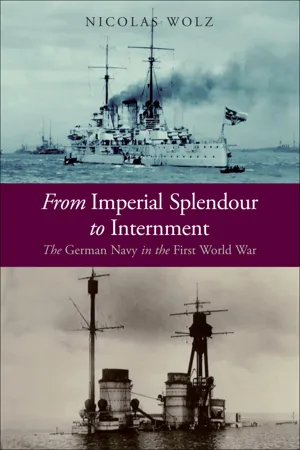
From Imperial Splendour to Internment
The German Navy in the First World War
- 320 pages
- English
- ePUB (mobile friendly)
- Available on iOS & Android
eBook - ePub
About this book
This important new work describes how the Imperial German Navy, which had expanded to become one of the great maritime forces in the world, second only to the Royal Navy, proved, with the exception of its submarines, to be largely ineffective throughout the years of conflict.The impact of this impotence had a far-reaching effect upon the service. Germany, indeed most of Europe, was in the grips of a spirit of militant nationalistic fervour, and the inactivity of the great Imperial Navy caused deep frustration, particularly among the naval officers. Not only were they unable to see themselves as heroes, they were also ridiculed on the home front and felt profoundly humiliated. With the exception of the one sea battle at Jutland, their ships saw little or no action at sea and morale slowly collapsed to a point where, at the end of the war, the crews were in a state of mutiny. The seemingly ludicrous order that forced the fleet to go to sea against the British in 1918 was driven by a sense of humiliation, but coming at the war's end it triggered a revolution because the German sailors wanted no part in such madness. The internment at Scapa Flow was the ultimate shaming. This is a fascinating and perceptive analysis of a whole era, and it contributes substantially to our understanding of the war and its consequences consequences, sadly, that helped pave the way for the Third Reich.
Information
1
‘We desperately need a strong Fleet!’
The German Dream of Naval Power
ON THE EARLY MORNING OF 23 June 1914 the silhouettes of four mighty warships appeared through the swathes of grey mist drifting over Kieler Förde. At the stern of each of the steel giants fluttered a great white ensign, the naval flag of Great Britain. Under the curious gaze of numerous onlookers, the four ships – King George V, Ajax, Audacious and Centurion – entered Kiel harbour one after another. They made up the 2nd Battleship Squadron under the command of Vice Admiral Sir George Warrender. The three light cruisers, Southampton, Birmingham and Nottingham, commanded by Commodore William E Goodenough, formed their escort. Kiel awaited these representatives of the world’s greatest naval power, for this was Kiel Week, and the visit by the British squadron would lend the festivities a special glamour.
The German hosts were eager to make the stay of the British officers and men as pleasant as possible. They organised balls, parties and sports events: the married British officers were invited into the homes of married German officers. Vice Admiral Warrender frequented the highest circles. He met not only Prince Heinrich of Prussia, the Kaiser’s younger brother, and since 1909 Inspector-General of the Navy, but also the Commander-in-Chief of the German Fleet Admiral Friedrich von Ingenohl; the Secretary of State at the Reich Navy Office and Constructor-General of the Fleet Grossadmiral Alfred von Tirpitz, and finally, aboard the Imperial Yacht Hohenzollern, Kaiser Wilhelm II himself. In conversations, speeches and toasts, the good comradeship and community feeling existing between the British and German navies was referred to repeatedly.
On 28 June, when news came of the assassination of the heir to the Austrian throne at Sarajevo, a dark shadow was cast over Kiel Week, but the mood amongst the seafarers remained friendly. Two days later the British squadron weighed anchor and headed for home. On the German ships the flag signal ‘Glückliche Reise’ was hoisted. The British replied by radio: ‘Friends in the past and friends for ever!’1. Five weeks later the First World War began. The most astonishing thing about the Kiel reunion was not the fact that the men of two different countries swore eternal friendship with each other, but that within a blink of the eye they were transformed into deadly enemies.
In October 1914 a 76-year-old man in South Germany asked the authorities if it was true, as he had been told, that a great war had broken out. He lived the life of a recluse in the depths of the forest, without post or newspapers, and had first learned of the upheaval in Europe when a tourist happened to mention it.2 And if one imagines that this man went to Kiel Week, it would have been almost incredible to him that the Kaiser Reich of 1914 had a navy to keep pace with that of the British. For while Great Britain had the greatest and strongest navy in the world, which had ruled the waves unchallenged since Nelson’s legendary victory at Trafalgar more than a century before, Germany had hardly ever given a thought to its naval forces for decades. An exception was the Reichsflotte, brought to life by the Frankfurt National Assembly in the year of the 1848 revolution. When the revolution collapsed, the fate of this ‘fleet’ was sealed, and the ships, which had been conceived as a symbol of German unity, met a sad end under the auctioneer’s hammer.
The Germans had good reasons for their backwardness in naval affairs. The German Reich founded in 1871 was, like Prussia before it, a classical continental power with thousands of miles of frontier which needed to be protected against France in the west and Russia in the east. In contrast, the coastline was comparatively short and easy to defend, even without a strong navy. Thus for many years almost the entire military budget went to the army, for it was the army which, in three wars (against Denmark, Austria–Hungary and France), had battled for the unity of the Reich. In none of these wars had the navy particularly made its mark, and the contribution of those sailors who had taken part in the land campaign against France was not even recognised as war service. Nothing illustrates better the insignificance of the naval forces than the fact that until 1888, supreme command of the Kaiserliche Marine, as it had been called officially since 1871, lay in the hands of army officers, namely Generals Albrecht von Stosch and Leo von Caprivi.
All the same, a small fleet did exist, brought from Prussia into the Reich. Prince Adalbert, a nephew of the Prussian King Friedrich Wilhelm III, had built it up. It was principally his responsibility to protect the coast and maritime trade. More extensive ideas, such as a challenge to the maritime hegemony of Great Britain, did not interest him. On the contrary – he consciously sought inspiration and practical support from the sea power he admired. For several decades the British helped in naval development. British firms not only supplied ships, machinery and guns to Germany, but also charts and nautical instruments. ‘We were, so to speak, like a creeper around the British navy,’ Admiral Tirpitz wrote later about this era. ‘We preferred to get things from Britain. If a piece of machinery worked reliably and without breakdowns, if a cable or a chain didn’t break, then it was definitely not a domestic piece but made in British workshops, a rope with the famous red thread of the British Navy.’3
Up until 1865 the Royal Navy trained whole series of German officers, many of whom later had influential positions in the Imperial Navy. Finally, the British also provided the small German fleet, which had no overseas bases of its own, with logistical support, and so enabled German warships to operate beyond the North Sea and Baltic for the first time. In a nutshell, Britain was and remained ‘for half a century the master smoothing the way for his German apprentice on the seas with willing help’.4
The British could allow themselves this generosity because German ships were for a long time of a size the British need not bother about from a strategic viewpoint, scarcely more than the harmless playthings of a rich land fascinated by technology. At that time the real danger to the Royal Navy came from Russia and France, both of which countries had been modernising their fleets since the 1880s. It was with these two nations in mind that the ‘two-power standard’ was laid down in the Naval Defence Act 1889. This stipulated that the Royal Navy always had to be as strong as the next two most powerful navies together: Britain was prepared to make a major effort to maintain the disparity. Only in this way, it was believed, could Britain remain independent of treaty partners, keep open its foreign policy options and preserve a balance of forces in Europe. This was the famous policy of ‘splendid isolation’, soon to come to an end.
Two men played a decisive role in this: Kaiser Wilhelm II and Konteradmiral Alfred Tirpitz, nominated by him as State Secretary of the Reich Naval Office. Wilhelm II had acceded to the throne in 1888 at the age of twenty-nine on the sudden death of his father, Kaiser Friedrich III. His aim was to found a new era and elevate Germany to be a world power. In his opinion, and also in the view of many of his contemporaries, the Reich had been held in check, and under the leadership of Otto von Bismarck had pursued a policy with a continental orientation. Meanwhile, other great powers had carved up the world between themselves, acquiring one colony after another. This must come to an end if Germany was to preserve its status alongside other great powers. In October 1897 Bernhard von Bülow, appointed Secretary of State for the Foreign Office, formulated the new ‘world policy’: ‘We do not want to put anybody in the shadows, but we also want our place in the sun.’5
It was not that such a change of direction in German foreign policy was aimed primarily at Great Britain, the leading world colonial power, and it was not so much ‘that from now on Germany tried to force its way, impetuous and demanding, into the ranks of the imperialist States’, or the bustling rhetoric of German politicians which turned the Reich into Britain’s bitter rival in the years to come.6 Much more threatening from the British point of view was the military means by which the Kaiser was planning the rise of Germany to a world power: the building of a powerful battle fleet. That, and nothing else, was the ‘passbook into the great game’.7
The naval enthusiast monarch, who as a boy had stood at the side of his grandmother Queen Victoria in raptures at the annual naval reviews and as Kaiser had a special liking for his admiral’s uniform, had thought at first that he should have a fleet of fast cruisers. In comparison to conventional battleships they had weaker armour and guns of smaller calibre, but by virtue of their speed and great range could be deployed anywhere in the world and show the German flag even in the most remote corners of Africa and Asia.
The man whom Wilhelm II had chosen to build this fleet for him had other plans, however. Konteradmiral Tirpitz was forty-eight years of age in June 1897 when he was called to head the Reich Navy Office. He had spent thirty-two of those years in the navy, finally as commander of the Imperial Cruiser Division in East Asia. In the course of this long career, the man with the rounded head and shaggy grey beard had developed his own concept of German naval power, and also quite flagrantly the authority to carry it through. He succeeded in convincing the Kaiser that the new German fleet should not consist of cruisers, but heavy, powerful, seagoing battleships or ‘ships of the line’ as the Germans called them, with thick armour and large-calibre guns – exactly as the American naval theoretician, Alfred Thayer Mahan, had postulated in his exceedingly influential book, The Influence of Sea Power upon History. Soon after, Wilhelm II became Tirpitz’s convert and proclaimed publicly, ‘We desperately need a strong German fleet!’8
The lesser range and speed of these ships was not important because, in Tirpitz’s view, for Germany ‘the most dangerous enemy at sea is Britain. She is also the rival against whom we must have most urgently a certain measure of naval power as a political power factor … our fleet must accordingly be so equipped as to be able to perform at its best between Heligoland and the Thames.’ He came to the conclusion that: ‘The military situation against Britain demands as many battleships as possible.’9 According to his train of thought, if Germany had a fleet with which it could threaten Britain militarily, then it should also be possible to impress her politically with German claims to be a world power. Only a fleet deserving of respect could put Germany, the land power, into a position of being enough of a threat to the naval power Great Britain to persuade the British to come to an arrangement and grant political concessions. Rapprochement through deterrence – that was the basic concept which has gone down in history as the ‘Tirpitz Plan’.
The Tirpitz Plan, however, contrary to all appearances, did not have a continuing offensive military intention of aiming to undermine British naval supremacy and with it the British position in the European equilibrium, even if this has always been assumed. In 1894 Tirpitz himself saw strategic offensive as being the ‘natural intended purpose of a fleet’.10 Constructing a powerful fleet was intended much more as a political lever. The ‘strengthening of our political power and significance as seen by Britain’ was, as Tirpitz explained in 1897, ‘the basic purpose of the fleet-building plan.’11 What the military objectives of the fleet might be remained relatively uncertain: in general, its role would be simply to protect the German coast against a British attack.
How large would the German fleet need to be for its very existence to be seen by the British as threatening? To answer this question Tirpitz developed his famed ‘risk theory’, which stated that the fleet must be at least strong enough so that by attacking it the ‘most powerful naval opponent [by this he meant Britain] would risk placing her own power base in question.’12 In order to complete this prediction, by Tirpitz’s reckoning the German fleet would have to be not less in size than two-thirds that of the Royal Navy.
His plan envisaged turning out over a period of twenty years an average of three capital ships (ie battleships or armoured cruisers) each year, thus sixty capital ships and the requirement in smaller units (small cruisers, torpedo boats, later U-boats). That was the figure which Tirpitz assumed – he could not know – the British would not be able to exceed by more than half as much again. After twenty years in service, moreover, every ship would be replaced automatically by a new construction, so that the fleet would, in practice, be indefinitely self-renewing. His contemporaries called this Äternat, a term probably derived from the English word ‘eternise’.
Proposing such a system was one thing. To make it reality was something else. The Tirpitz Plan, as its creators were aware, would be enormously expensive, and without the consent of the Reichstag, which in the German system of parliamentary monarchy controlled the domestic budget, not a single ship would ever be launched. The conservative Prussian farmers saw their traditional position of precedence threatened by the ‘ghastly fleet’.13 Worse, the priority of the SPD (Sozialdemokratische Partei Deutschlands) deputies, with barely a third of the seats at the end of the nineteenth century, was social reform. How could they be persuaded to vote initially for a ‘powerful seagoing fleet’, especially since it was Tirpitz’s aim in the long term to deprive parliament of its jurisdiction in the allocation of naval funds?14 Tirpitz resolved the problem by not going all the way at once. Instead, he proceeded in several stages, intentionally making it more difficult for parliamentarians to see what he was up to. The first naval bill, which Tirpitz presented to the Re...
Table of contents
- Front Cover
- Title Page
- Copyright Page
- Contents
- Foreword
- Maps
- Prologue
- 1 ‘We desperately need a strong fleet!’: The German Dream of Naval Power
- 2 ‘And if they don’t come, then we shall fetch them’: The War Begins
- 3 ‘But the flag still flew’: Fighting and Dying in the Name of Honour
- 4 ‘I feel guilty that our people are having it so good’: Life on Board and Ashore
- 5 ‘I wish I were a soldier’: Self-doubt and Mental Crises
- 6 ‘The day has come! The enemy is in sight!’: The Battle of Jutland
- 7 ‘And as if the world were full of the devil’: The U-boat War
- 8 ‘These people should simply be put up against a wall and shot’: Unrest in the Fleet, 1917
- 9 ‘Better to go down with honour!’: The Plan for the Last Foray
- 10 ‘We are destroyed for all time’: Armistice and Internment
- 11 ‘A painful and grandiose piece of theatre’: The Scuttling of the Fleet at Scapa Flow
- Notes
- Bibliography
Trusted by 375,005 students
Access to over 1.5 million titles for a fair monthly price.
Study more efficiently using our study tools.
Frequently asked questions
Yes, you can cancel anytime from the Subscription tab in your account settings on the Perlego website. Your subscription will stay active until the end of your current billing period. Learn how to cancel your subscription
No, books cannot be downloaded as external files, such as PDFs, for use outside of Perlego. However, you can download books within the Perlego app for offline reading on mobile or tablet. Learn how to download books offline
Perlego offers two plans: Essential and Complete
- Essential is ideal for learners and professionals who enjoy exploring a wide range of subjects. Access the Essential Library with 800,000+ trusted titles and best-sellers across business, personal growth, and the humanities. Includes unlimited reading time and Standard Read Aloud voice.
- Complete: Perfect for advanced learners and researchers needing full, unrestricted access. Unlock 1.5M+ books across hundreds of subjects, including academic and specialized titles. The Complete Plan also includes advanced features like Premium Read Aloud and Research Assistant.
We are an online textbook subscription service, where you can get access to an entire online library for less than the price of a single book per month. With over 1.5 million books across 990+ topics, we’ve got you covered! Learn about our mission
Look out for the read-aloud symbol on your next book to see if you can listen to it. The read-aloud tool reads text aloud for you, highlighting the text as it is being read. You can pause it, speed it up and slow it down. Learn more about Read Aloud
Yes! You can use the Perlego app on both iOS and Android devices to read anytime, anywhere — even offline. Perfect for commutes or when you’re on the go.
Please note we cannot support devices running on iOS 13 and Android 7 or earlier. Learn more about using the app
Please note we cannot support devices running on iOS 13 and Android 7 or earlier. Learn more about using the app
Yes, you can access From Imperial Splendour to Internment by Nicolas Wolz in PDF and/or ePUB format, as well as other popular books in History & Military & Maritime History. We have over 1.5 million books available in our catalogue for you to explore.