The 1st volume in this comprehensive reference series details the design and employment of British warships in the 17th and early 18th centuries.
During the seventeenth century, Britain transformed from a minor state into a global economic power with the largest navy in the world. The character of this navy was forged by a bloody civil war, three fiercely disputed conflicts with the Dutch, and the first of many wars with the French. In the process, British naval ships evolved from the galleons that had defeated the Spanish Armada to prestige vessels like HMS
Sovereign of the Seas, and the lightly built frigates of the Commonwealth era.
This detailed and authoritative reference volume outlines the history of every ship built, purchased or captured that saw naval service during this era. Like its companion volumes, the book is organized by Rate, classification and class. The technical and building data of each ship is followed by a concise summary of its career. With its unique depth of information, this is a work of the utmost importance to every naval historian and general reader interested in the navy of the sailing era.
eBook - ePub
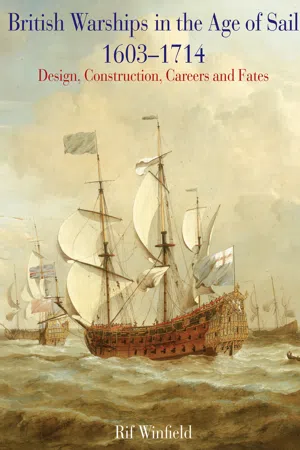
British Warships in the Age of Sail, 1603–1714
Design, Construction, Careers and Fates
- 384 pages
- English
- ePUB (mobile friendly)
- Available on iOS & Android
eBook - ePub
About this book
Information
1 First Rates – ‘Ships Royal’
Asystem of grading the fighting ships of the King’s Navy into four categories or ranks was introduced early in King James I’s reign. It was originally based on the number of men carried per gun, but soon this was altered to the total number of men in the ship’s established complement. Ships with 400 men or more were categorised as ‘Royal Ships’, but from the introduction of the rating system, the old ‘Ships Royal’ of the Tudor and early Stuart navy officially became classed as First Rank (later in Charles I’s reign the word ‘Rate’ was substituted).
All First – and Second – Rates were built in the Royal Dockyards. These prestige ships were designed and commissioned for fair-weather operations, and were usually paid off at the end of summer to avoid the storms of autumn and winter. Nevertheless they were structurally solid and capable of taking (as well as dealing out) immense punishment in battle.
Because they were so expensive to run, few First Rates were built (although eight were built in the decade following the Second Dutch War), in spite of royal patronage for these potent symbols of naval power.
(A) Vessels in service or rebuilding at 24 March 1603
The six largest vessels in the Queen’s navy at the time of Elizabeth’s death in 1603 comprised two distinct groups. Five of these six ships were survivors of the English squadrons that fought against the Spanish Armada in 1588 (although all these had subsequently undergone a rebuilding); the exception was the newer Merhonour. The largest trio were three galleons each with an ‘established’ seagoing complement of 500 men (comprising 340 mariners, 40 gunners and 120 soldiers). These comprised the Elizabeth Jonas (sometimes just called the Elizabeth), the Triumph and the White Bear (often simply called the Bear); these three had all been built originally during the first few years of Elizabeth’s reign; and then were all rebuilt during the late 1590s.
The smaller three ships each had an ‘established’ seagoing complement of 400 (comprising 268 mariners, 32 gunners and 100 soldiers). They comprised the Merhonour (sometimes called the Mere Honour or simply the Honour), the Ark Royal and the elderly Victory. Two other ships of similar size still actually in existence were the former prizes Saint Matthew (ex-Spanish San Mateo) and Saint Andrew (ex-Spanish San Andrea), of 500 and 400 men respectively, and each with 50 guns. These were galleons of the ‘Apostle’ class captured at Cadiz in June 1596 and added to the navy. However, they were only commissioned for one voyage – for the expedition to the Azores in 1597, and both were given away in 1604 to Sir John Leigh as being no longer serviceable.
REBUILT GROUP (1595–99). These galleons when originally built were among the earliest true galleons in the Navy Royal, but with high structures. The origins of the first date back to 1557, when the keel was laid of a new ‘great ship’ of 800 tons as a replacement for the Henry Grace a Dieu (burnt in 1553); first tentatively called the Peter, and later the Edward, she was officially named Elizabeth Jonas at her launch in 1559, almost a year after the new queen’s accession. A second 800-ton ship, the Victory, was purchased in 1560 and a 1,000-ton ship, the Triumph, was begun in 1561 and launched in October 1562. In 1563, a fourth ‘great ship’ of 900 tons was started, probably using material from the old Great Bark; this became the White Bear in 1564. Of the four, the Victory had been rebuilt in 1586 to incorporate the principles of Hawkyns’s ‘race-built’ galleons, and appears in the second group below. The remaining trio were rebuilt in the late 1590s to incorporate the same principles.
Elizabeth [Jonas] Woolwich Dyd. [M/Shipwright Peter Pett]
Dimensions & tons: 100ft 0in keel x 38ft 0in x 18ft oin. 684/855 tons.
Men (1603): 500. Guns: 55 (3 cannon, 2 demi-cannon, 18 culverins, 13 demi-culverins, 19 sakers) + 3 smaller.
L: 3.7.1559. RB: 1597–98.
Repaired at Woolwich 1585–86. Commissioned 1588 under Sir Robert Southwell; in actions against the Spanish Armada. Rebuilt 1597–98 at Woolwich (warrant to repair her issued 27.9.1597). In 1599 under Lord Thomas Howard, as Admiral, for the mobilisation of that year. Sold 1618.
Triumph Woolwich Dyd. [M/Shipwright probably Matthew Baker]
Dimensions & tons: 100ft 0in keel x 40ft 0in x 19ft oin. 760/955 tons.
Men (1603): 500. Guns: 55 (4 cannon, 3 demi-cannon, 19 culverins, 16 demi-culverins, 13 sakers) + 4 smaller.
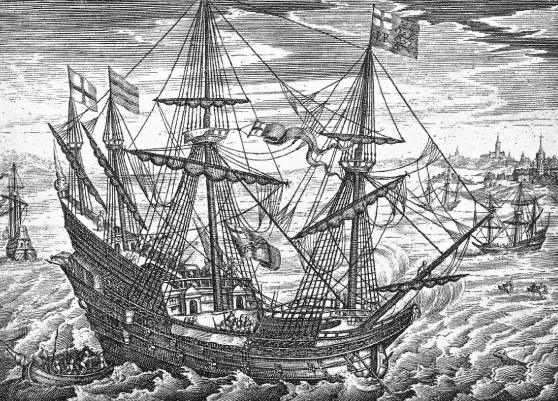
This Dutch engraving by Claes Visscher purports to show the White Bear, one of a series depicting ships that fought the Armada in 1588. It was produced well after the event and much doubt has been cast on details of the ship, but in general terms it gives an impression of the largest warships of the period.
L: 10.1562. RB: 1595–96.
Repaired at Woolwich 1585–86. Commissioned 1588 under Lord Hugh Seymour until 2.1588, then under Sir Martin Frobisher; in actions against the Spanish Armada. Rebuilt 1595–96 at Woolwich (warrant to repair her issued 5.8.1595). In 1599 under Sir Fulke Greville, for the mobilisation of that year. Sold 1618.
[White] Bear Woolwich Dyd. [M/Shipwright probably Matthew Baker]
Dimensions & tons: 110ft 0in keel x 37ft 0in x 18ft oin. 732/915 tons.
Men (1603): 500. Guns: 57 (2 cannon, 6 demi-cannon, 21 culverins, 16 demi-culverins, 12 sakers), nil smaller.
L: 1564. RB 1598–99.
Repaired at Woolwich 1585–86. Commissioned 1588 under Lord Howard of Effingham until 2.1588, then under Lord Edward Sheffield; in actions against the Spanish Armada. Rebuilt 1598–99. Noted as unserviceable in 1627, and sold at Rochester 12.6.1629.
SMALLER GROUP (1586–90). These galleons were earlier constructed or converted to the ‘race-built’ format. The oldest, the Victory, had been one of the ‘great ships’ built in the 1550s, allegedly as a large merchantman called the Great Christopher, but was rebuilt in 1586. The Ark Royal was begun as a private ship (the Ark Ralegh) for Sir Walter Ralegh, but her construction was taken over while on the stocks and she was completed for the Queen. A further ‘great ship’ was begun soon after the Armada; her name was sometimes listed as Mary Honora (and this was usually corrupted in seamen’s talk to ‘Mary Nora’); unlike earlier capital ships, which had all been four-masted – except the ‘Middling’ Dreadnought and Swiftsure – the Merhonour (as her name is usually recorded) and the smaller pair of Great Ships of 1590 (see Chapter 2) dispensed with the bonaventure mizzen mast, although the Merhonour was one of the longest ships in the navy.
Victory (former Great Christopher)
Dimensions & tons: 95ft 0in keel x 35ft 0in x 17ft oin. 565/707 tons.
Men (1603): 400. Guns: 34 (4 cannon, 6 demi-cannon, 14 culverins, 8 demi-culverins, 2 sakers) + 10 smaller.
Purchased 14.3.1560 from Anthony Hickman & Edward Castlyn, and renamed 11.1560. Rebuilt 1586.
Commissioned 1588 under Sir John Hawkyns, as Rear-Adm., in actions against the Spanish Armada. Ordered 4.1600 ‘to lie between the forts of Gravesend and Tilbury’ to serve as a guard ship. Removed from Chatham to Woolwich 1606 to rebuild, but eventually BU 1608 (replaced by Prince Royal).
Ark Royal Deptford Dyd. [M/Shipwright Richard Chapman]
Dimensions & tons: 100ft 0in keel x 37ft 0in x 15ft oin. 555/694 tons.
Men (1603): 400. Guns: 38 (4 cannon, 4 demi-cannon, 12 culverins, 12 demi-culverins, 6 sakers) + 6 smaller.
Purchased and L: 1587.
Commissioned 1588 under Lord (Charles) Howard of Effingham, as Lord High Admiral, in actions against the Spanish Armada. In 1596 under Amyas Preston, as flagship of the Lord High Admiral, for expedition to Cadiz. In 1599 under Sir Walter Ralegh, for the mobilisation of that year. Docked 9.10.1606 at Woolwich to rebuild 1607–08.
Merhonour Woolwich Dyd. [M/Shipwright Matthew Baker]
Dimensions & tons: 110ft 0in keel x 37ft 0in x 17ft oin. 692/865 tons.
Men (1603): 400. Guns: 39 (4 demi-cannon, 15 culverins, 16 demi-culverins, 4 sakers) + 2 smaller.
L: 1590.
Commissioned 1596 under Lord Thomas Howard, for expedition to Cadiz. In 1597 under Sir Robert Mansell, as flagship of Robert Devereux (the Earl of Essex), Adm., for expedition to the Azores. In 1599 under Sir Henry Palmer, for the mobilisation of that year. In 1603 under Sir William Monson, in the Channel. Docked 10.1.1612 at Woolwich to rebuild 1612–15.
(B) Vessels acquired from 24 March 1603
Following their recent reconstructions, little was done to the three larger vessels during the early years of James I’s reign. Of the three existing ‘smaller’ ships, the Ark Royal was rebuilt between 1607 and 1608, the Victory was broken up in 1608 (her material was probably incorporated in the construction of the Prince Royal – theoretically a new ship) and the Merhonour was rebuilt between 1612 and 1615. Notably all the First Rates were built at Woolwich until 1660.
ANNE ROYAL. Repairs to the Ark Royal were approved in August 1606, and she was taken to pieces and rebuilt in 1607–08, being nominally of 800 tons, and renamed Anne Royal at her re-launch in honour of James’s queen.
Anne Royal Woolwich Dyd. [M/Shipwright Phineas Pett]
Dimensions & tons: 107ft 0in keel x 37ft 10in x 15ft 4in. 621/828 tons.
Men: 400. Guns (1624): 40 (2 cannon-periers, 5 demi-cannon, 12 culverins, 13 demi-culverins, 8 sakers) + 4 smaller (port-pieces).
Ord (warrant issued): 15.4.1607. L (RB): 29.6.1608.
Commissioned 1625 under Capt. Sir Thomas Love, as flagship of Adm. Sir Edward Cecil (subsequently created Viscount Wimbledon), for assault on Cadiz. In 1636 under Sir John Pennington, Vice-Adm. of the Ship Money Fleet. Bilged on her own anchor and sunk off Tibury Hope in the Thames 9.4.1636; raised and her remains were broken up at Blackwall.
PRINCE ROYAL. In 1606 it was decided to repair the Victory, and the work entrusted to Phineas Pett in 1607. However in 1608 Pett recommended to James I that a completely new ship should be built as a replacement. In November Pett showed a model of the proposed ship to the King, who was ‘exceedingly delighted’ and gave personal approval to build what was the largest prestige vessel yet built for war. She was originally intended to retain the name Victory, but this was changed at her launch to Prince Royal.
The first ‘three-decker’ to be built for the English navy, she carried two complete batteries of guns (there were eight pairs of gunports on the LD and nine pairs on the second or MD). Initially completed with the LD and UD stepped down towards both bow and stern (these two decks both became flush decks, eliminating the stepped-down sections, in the 1621 refit). The partially armed third deck above certainly had spaces for a complete battery, with eight pairs of ports (one under the forecastle, three in the waist and four under the half-deck), but seems to have carried fewer guns on this deck, above which a grating was superimposed to protect gun crews from falling projectiles or parts of spars; a tenth pair of ports was added when the step-down was eliminated.
While unquestionably she was built as a full three-decker in structural terms, she is in her initial guise perhaps better perceived as a two-and-a-half-decker, with the se...
Table of contents
- Cover
- Title Page
- Copyright
- Contents
- Series Foreword by Andrew Lambert
- Preface
- Acknowledgements
- Sources and Data
- Bibliography
- Introduction
- Chronology
- Fleet Actions
- Glossary and Abbreviations
- Preamble
- Chapter 1 First Rates – ‘Ships Royal’
- Chapter 2 Second Rates – the ‘Great Ships’
- Chapter 3 The Third Rates – ‘Middling Ships’
- Chapter 4 The Fourth Rates – ‘Small Ships’
- Chapter 5 The Fifth Rates
- Chapter 6 The Sixth Rates
- Chapter 7 Unrated Vessels
- Chapter 8 Hired Vessels
- Appendices
- D – Dockyard Launchings 1603–1714
Trusted by 375,005 students
Access to over 1.5 million titles for a fair monthly price.
Study more efficiently using our study tools.
Frequently asked questions
Yes, you can cancel anytime from the Subscription tab in your account settings on the Perlego website. Your subscription will stay active until the end of your current billing period. Learn how to cancel your subscription
No, books cannot be downloaded as external files, such as PDFs, for use outside of Perlego. However, you can download books within the Perlego app for offline reading on mobile or tablet. Learn how to download books offline
Perlego offers two plans: Essential and Complete
- Essential is ideal for learners and professionals who enjoy exploring a wide range of subjects. Access the Essential Library with 800,000+ trusted titles and best-sellers across business, personal growth, and the humanities. Includes unlimited reading time and Standard Read Aloud voice.
- Complete: Perfect for advanced learners and researchers needing full, unrestricted access. Unlock 1.5M+ books across hundreds of subjects, including academic and specialized titles. The Complete Plan also includes advanced features like Premium Read Aloud and Research Assistant.
We are an online textbook subscription service, where you can get access to an entire online library for less than the price of a single book per month. With over 1.5 million books across 990+ topics, we’ve got you covered! Learn about our mission
Look out for the read-aloud symbol on your next book to see if you can listen to it. The read-aloud tool reads text aloud for you, highlighting the text as it is being read. You can pause it, speed it up and slow it down. Learn more about Read Aloud
Yes! You can use the Perlego app on both iOS and Android devices to read anytime, anywhere — even offline. Perfect for commutes or when you’re on the go.
Please note we cannot support devices running on iOS 13 and Android 7 or earlier. Learn more about using the app
Please note we cannot support devices running on iOS 13 and Android 7 or earlier. Learn more about using the app
Yes, you can access British Warships in the Age of Sail, 1603–1714 by Rif Winfield in PDF and/or ePUB format, as well as other popular books in History & Military & Maritime History. We have over 1.5 million books available in our catalogue for you to explore.