Fletcher Class Destroyers
eBook - ePub

Fletcher Class Destroyers

  1. 64 pages
  2. English
  3. ePUB (mobile friendly)
  4. Available on iOS & Android
eBook - ePub

Fletcher Class Destroyers

About this book

An informative reference for modelers with a brief history of the U.S. Navy ship, its design aspects, and a survey of model kits and reference materials.

The ShipCraft series provides in-depth information about building and modifying model kits of famous warship types. Lavishly illustrated, each book takes the modeler through a brief history of the subject class, highlighting differences between sister ships and changes in their appearance over their careers. This includes paint schemes and camouflage, featuring color profiles and highly-detailed line drawings and scale plans. The modeling section reviews the strengths and weaknesses of available kits, lists commercial accessory sets for super-detailing of the ships, and provides hints on modifying and improving the basic kit. This is followed by an extensive photographic survey of selected high-quality models in a variety of scales, and the book concludes with a section on research references—books, monographs, scale plans and relevant websites.
The subject of this volume is the Fletcher class, often considered the most successful of all American destroyers. Built to the first design that was freed from treaty restrictions, they came into service near the beginning of the Pacific War and fought with distinction through all the most ferocious of the campaigns against Japan.
They were constructed in large numbers, with several variations, and their popularity is reflected by the wide range of available kits.

Frequently asked questions

Yes, you can cancel anytime from the Subscription tab in your account settings on the Perlego website. Your subscription will stay active until the end of your current billing period. Learn how to cancel your subscription.
No, books cannot be downloaded as external files, such as PDFs, for use outside of Perlego. However, you can download books within the Perlego app for offline reading on mobile or tablet. Learn more here.
Perlego offers two plans: Essential and Complete
  • Essential is ideal for learners and professionals who enjoy exploring a wide range of subjects. Access the Essential Library with 800,000+ trusted titles and best-sellers across business, personal growth, and the humanities. Includes unlimited reading time and Standard Read Aloud voice.
  • Complete: Perfect for advanced learners and researchers needing full, unrestricted access. Unlock 1.4M+ books across hundreds of subjects, including academic and specialized titles. The Complete Plan also includes advanced features like Premium Read Aloud and Research Assistant.
Both plans are available with monthly, semester, or annual billing cycles.
We are an online textbook subscription service, where you can get access to an entire online library for less than the price of a single book per month. With over 1 million books across 1000+ topics, we’ve got you covered! Learn more here.
Look out for the read-aloud symbol on your next book to see if you can listen to it. The read-aloud tool reads text aloud for you, highlighting the text as it is being read. You can pause it, speed it up and slow it down. Learn more here.
Yes! You can use the Perlego app on both iOS or Android devices to read anytime, anywhere — even offline. Perfect for commutes or when you’re on the go.
Please note we cannot support devices running on iOS 13 and Android 7 or earlier. Learn more about using the app.
Yes, you can access Fletcher Class Destroyers by Lester Abbey in PDF and/or ePUB format. We have over one million books available in our catalogue for you to explore.

Information

Modelmakers’ Showcase
Halford 1943 scratch-built by Joseph Neumeyer, 1/96 scale
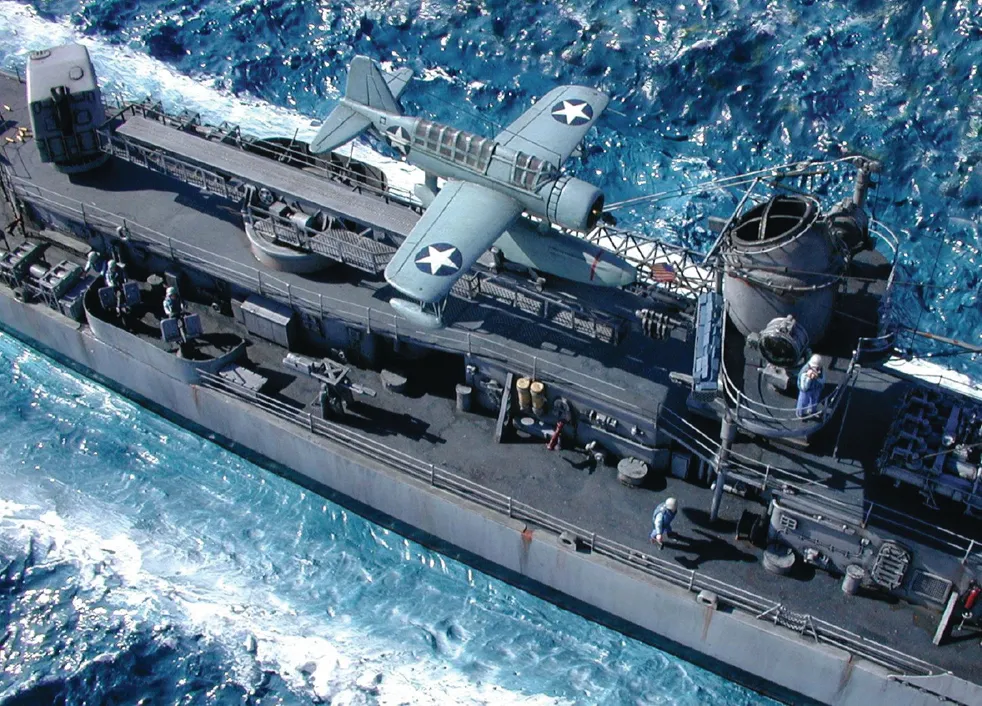
This exciting 1/96 scale model was constructed by Joseph Neumeyer of Dynamic Dioramas. It shows one of the three Fletcher Class DDs that were modified to have a catapult on the aft deckhouse. Joseph made this model as a commission for a client who wanted it as a display for his shop in Montrose, California. Joseph has been interested in modelling – especially dioramas – since he was a youngster in Hancock Park.
This one is of the Halford when she had a catapult fitted. Six Fletcher class destroyers were selected for an experimental conversion (DDs 476-481), but only three – Pringle, Stevens and Halford were actually completed as such. In any event, the experiment did not work out and all three destroyers were re-converted to the normal mid-war Fletcher configuration and served honourably for the rest of the war.
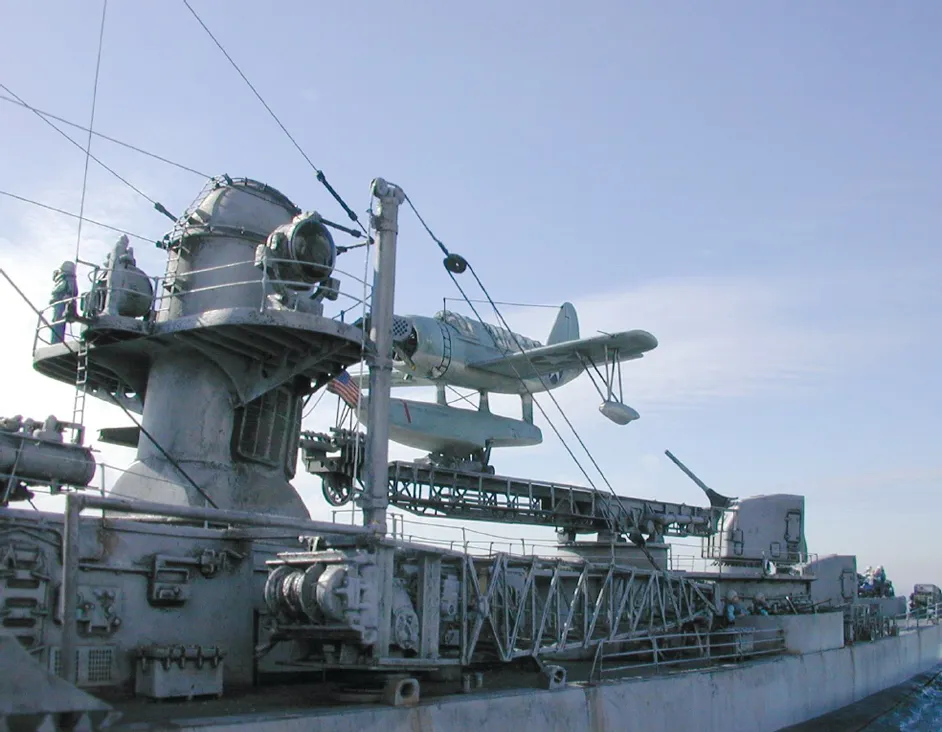
Although there is plentiful data on Fletcher class destroyers, specialised information on the three catapult destroyers is an exception. The client provided ships’ logs, while Floating Drydock provided plans and pictures. The crane on the starboard side was the hard part – there was only a plan view and a few pictures. By educated guesses and studying other similar cranes of the USN, Joseph was able to construct an accurate replica. This was borne out by a letter that the owner of the model received from a crewmember of the Halford. In this letter the sailor states how moved he was to see such a lovingly made replica of his own ship, and remarked on the accuracy of the aircraft-handling crane as it was his job to operate that crane.
The hull of this ship was a standard fibreglass Fletcher hull from Scale Shipyard of Long Beach, California. They also supplied the deck guns and other standard fittings, such as cable reels and torpedo tubes. These basic details were considerably enhanced by scratch-building extra features. For instance, the torpedo tubes had various rods, cylinders, training wheels, and other detail added to the basic forms supplied by the manufacturer.
A number of parts were derived from other kits and modified to suit. This method of modelmaking is a technique known as ā€˜kit-bashing’. Often the actual model part would bear no relationship to what it was used on the Halford model but it had a similar shape or complexity to what was needed. The idea was to accurately ā€˜indicate’ rather than exactly ā€˜reproduce’ the form being modelled.
For those who wish to see this model, it is on display at Collector’s World, located at 2249 Honolulu Avenue, Montrose, California 91020.
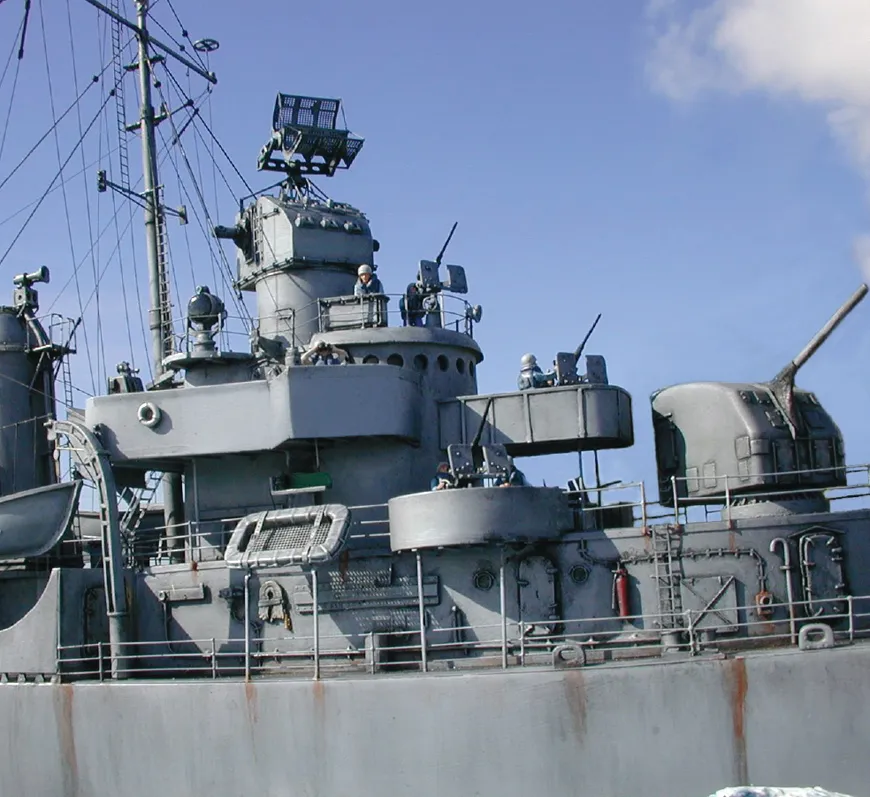
A dramatic picture of Joseph Neumeyer’s model of the Halford. Note how the drama and excitement is increased by having all of the guns and radar trained at the same target above.
This shows the positioning and type of catapult used on the Halford. The catapult was made from a photoetch set as a cut down cruiser-type catapult.
This picture shows how Joseph scratch-built or kit-bashed lots of small items to give the necessary realism. An example would be the siren atop the fore stack.
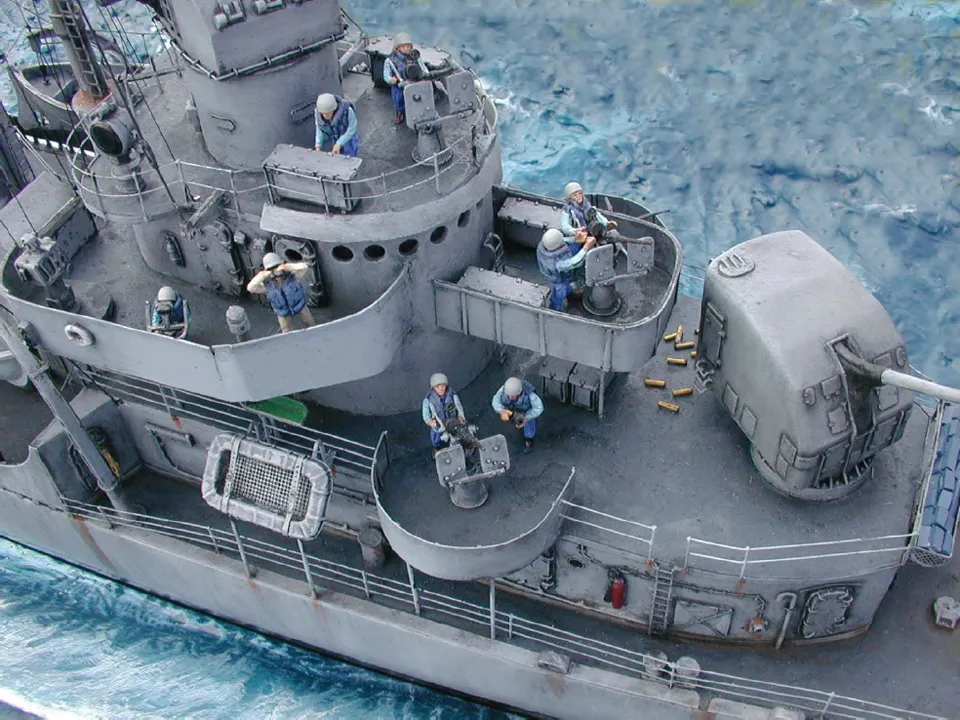
A view of the bridge and the activity around it. The scene is brought to life by the addition of figures in action poses and details such as empty shell cases scattered behind the gunhouse.
This is a view of the specialised crane installed to retrieve the aircraft out of the water. In the absence of close-up photos this can ...
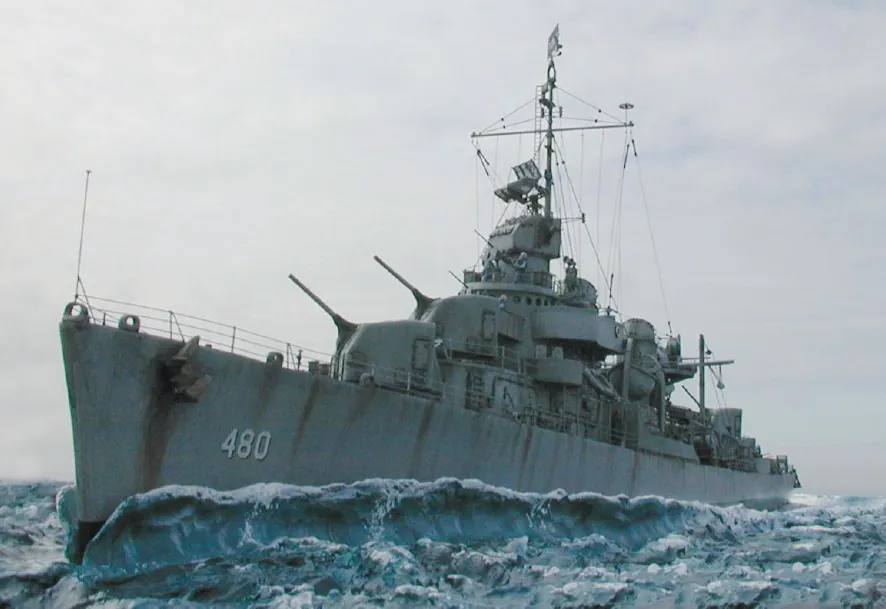
Table of contents

  1. Cover
  2. Title Page
  3. Copyright
  4. Contents
  5. Design
  6. Careers
  7. Model Products
  8. Modelmakers’ Showcase
  9. Appearance
  10. Selected References