- 202 pages
- English
- ePUB (mobile friendly)
- Available on iOS & Android
eBook - ePub
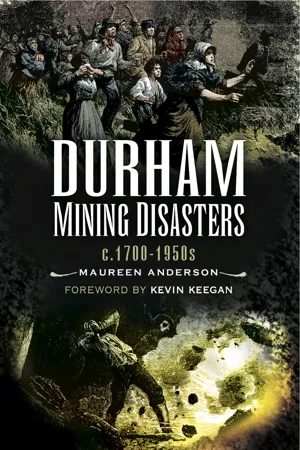
Durham Mining Disasters, c. 1700–1950s
About this book
It is now over half a century since the last coalmining disaster to affect the lives and families of people living and working on what became known as the Great Northern Coalfield. This was the first area of Britain where mining developed on a large scale but at tremendous human cost. Mining was always a dangerous occupation, especially during the nineteenth century and in the years before nationalization in 1947. Safety was often secondary to profit. It was the disasters emanating from explosions of gas that caused the greatest loss of life, decimating local communities. In tight-knit mining settlements virtually every household might be affected by injury or loss of life, leaving widows and children with little or no means of support. At Haswell in 1844 95 men and boys perished; 164 died at Seaham in 1880 and 168 at West Stanley in 1909. This volume provides us with an account of these and all the other pit disasters in County Durham from the 1700s to the 1950s
Information
Part One
The Early Years
1705–1805
With very few within the working classes literate, superstition often took the place of logic and this was certainly so with the early North East miners. Some thought that explosions and accidents were the work of ‘Auld Nick’ (the Devil) that lived in the lowest regions of the pits and these verses from the Collier’s Rant, with its origins lost in the mists of time, describes these beliefs:
As me an’ me marra were gannin’ te’ wark,
We met wi’ the De’il it was i’ the dark,
Aw up wi’ me pick it being i’ the neet,
Aw chopped off his horns, likewise his club-feet.
Foller the horses, Johnny me laddie,
Foller them through me canny lad, oh!
Foller the horses, Johnny me laddie,
Oh lad lye away me canny lad oh!
As me an’ me marra were puttin’ the tram,
The light it went oot, an’ me marra went wrang,
Ye wad ha’e laughed had ye seen the gam,
The Dei’l tyeuk me marra an’ aw gat the tram.
Foller the horses, Johnny me laddie,
Foller them through me canny lad, oh!
Foller the horses, Johnny me laddie,
Oh lad lye away me canny lad oh!
Although there are few in-depth details of the mining accidents that took place in the eighteenth and early nineteenth centuries most of the reports that have survived of those with multiple fatalities are described as being due to an explosion. There is a mention of an explosion at Stony Flatt, Gateshead stating only that there were over thirty killed on 3 October 1705. An entry in the burial register of St Mary’s Church lists twenty-two names, including Joseph Jackson, the coal-owner, and his daughter, Abigail.
The earliest pit disaster in the North East recorded with more than perfunctory detail was the report of one that took place at Fatfield, in the parish of Chester-le-Street, in 1708. From the circumstances related it is obvious that at this time the pits of Fatfield were still dependant on natural ventilation to provide any circulation of air. The names of those that lost their lives have not been found and there is no information on when the pit was first established or who the owners were at that time. The disaster was described in the Annals of Coal Mining and the Coal Trade:
18 August: at three o’clock in the morning; the sudden eruption of violent fire discharging itself at the mouths of three pits, with as great a noise as the firing of cannon, or the loudest claps of thunder, and sixty-nine persons were instantly destroyed. Three of them, two men and a woman, were blown quite up from the bottom of the shaft, 342 feet deep, into the air, and carried to a considerable distance from the mouth of the pit. The engine used for drawing up the coals, which was of great weight, was removed and cast aside by the force of the blast; and singularly the fish in a rivulet flowing within about twenty yards from one of the pits were found dead in large numbers, floating on the surface of the water.
The narrator goes on to explain the effects of stith, or chokedamp, and sulphur, or firedamp, and then proceeds to say:
To prevent both these inconveniences, as the only remedy known here, the viewer of the works takes the best care he can to preserve a free current of air through all the works, and as the air goes down one pit it should ascend another. But it happened in this colliery, there was a pit which stood in an eddy, where the air had not always a free passage, and which in hot and sultry weather was very much subject to sulphur; and it being then the middle of August, and some danger apprehended from the closeness and heat of the season, the men were with the greatest care and caution withdrawn from their work in that pit and turned into another; but an overman, some days after this change, and upon some notion of his own, being induced, as is supposed, by a fresh, cool, frosty breeze of wind, which blew that unlucky morning, and which always clears the works of all sulphur, had gone too near this pit, and had met the sulphur just as it was purging and dispersing itself, upon which the sulphur immediately took fire by his candle, which proved the destruction of himself and so many men, and caused the greatest fire ever known in these parts.

A heart rending sketch of families and neighbours rushing to the pit mouth after hearing an explosion. Author’s collection
Three further disasters at Fatfield in the eighteenth century were recorded but all with very little detail. The parish register of Holy Trinity Church at Washington records a number of pitmen from Lonnen Pit, Fatfield, buried on 17 and 19 June 1736 but the entry merely states ‘Lost in Ye Pitt’ with no mention of the cause of death. One tells us only that there was an explosion in 1763 when fifteen people were killed; the other is from Local Records:
1767 (27 March) A terrible accident happened at a colliery near Fatfield, in the county of Durham. The colliery was 80 fathoms deep, and on the morning of the above day, when all the hands were at work, it went off with a tremendous explosion, by which 39 persons lost their lives. The bodies were found in a most mangled condition. In the Newcastle Journal of this time are the following remarks on coal mine explosions: ‘As so many deplorable accidents have lately happened in collieries, it certainly claims the attention of coal owners to make a provision for the distressed widows and fatherless children occasioned by these mines, as these catastrophes from foul air become more common than ever; yet, as we have been requested to take no particular notice of these things, which, in fact, could have very little good tendency, we drop the further mentioning of it; but before we dismiss the subject, as a laudable example for their imitation, we recommend the provision made in the Trinity House for distressed seamen, seamen’s widows, &c, which, in every respect, is praiseworthy and confers honour on that brotherhood.’ It was from such injunctions laid upon the newspaper editors that these occurrences, for a great number of years, were kept as much as possible from the public.

Young boys employed in weighing the coal. www.cmhrc.co.uk
Within the incomplete list of the names that have been found of those that lost their lives at Fatfield were two females. It is rather curious to note that there were no females recorded in any ensuing mining disaster in the County of Durham. Perhaps they were lucky enough to escape death but it seems more likely that only males were employed to work underground after that year. If the latter was the case then it would be to the credit of the coal owners except for the fact that very young boys were not exempt from the pits. The last recorded explosions at Fatfield with multiple fatalities were at Hall Pit on 28 September 1813 when thirty-two men and boys died. Of these nineteen were under the age of sixteen, with two just seven. At the Juliet Pit on 3 July 1925 eleven men and boys and the same number of horses were ‘blown into eternity’.
Lumley appears to have been a dangerous pit but again there is little detail yet found. In 1727 there was an accident which claimed the lives of sixty; an explosion in 1797 killed thirty-one and in 1799 thirty-nine, whose bodies reportedly were never recovered. On 10 June 1757 fifteen men and a boy were suffocated by a gust of foul air which took fire in a pit near Ravensworth. Two explosions at North Biddick, also known as Butney Pit, in Washington, were recorded in Local Rec...
Table of contents
- Front Cover
- Other books in the series:
- Title Page
- Copyright Page
- Contents
- Foreword by Kevin Keegan
- Introduction
- Acknowledgements
- Part One: The Early Years, 1705–1805
- Part Two: Children, Candles and Catastrophes, 1812–1850
- Part Three: Fires, Fumes and Fatalities, 1851–1897
- Part Four: The Final Years and Blood Still Stains the Coal, 1906–1951
- Glossary
- Bibliography
Trusted by 375,005 students
Access to over 1.5 million titles for a fair monthly price.
Study more efficiently using our study tools.
Frequently asked questions
Yes, you can cancel anytime from the Subscription tab in your account settings on the Perlego website. Your subscription will stay active until the end of your current billing period. Learn how to cancel your subscription
No, books cannot be downloaded as external files, such as PDFs, for use outside of Perlego. However, you can download books within the Perlego app for offline reading on mobile or tablet. Learn how to download books offline
Perlego offers two plans: Essential and Complete
- Essential is ideal for learners and professionals who enjoy exploring a wide range of subjects. Access the Essential Library with 800,000+ trusted titles and best-sellers across business, personal growth, and the humanities. Includes unlimited reading time and Standard Read Aloud voice.
- Complete: Perfect for advanced learners and researchers needing full, unrestricted access. Unlock 1.5M+ books across hundreds of subjects, including academic and specialized titles. The Complete Plan also includes advanced features like Premium Read Aloud and Research Assistant.
We are an online textbook subscription service, where you can get access to an entire online library for less than the price of a single book per month. With over 1.5 million books across 990+ topics, we’ve got you covered! Learn about our mission
Look out for the read-aloud symbol on your next book to see if you can listen to it. The read-aloud tool reads text aloud for you, highlighting the text as it is being read. You can pause it, speed it up and slow it down. Learn more about Read Aloud
Yes! You can use the Perlego app on both iOS and Android devices to read anytime, anywhere — even offline. Perfect for commutes or when you’re on the go.
Please note we cannot support devices running on iOS 13 and Android 7 or earlier. Learn more about using the app
Please note we cannot support devices running on iOS 13 and Android 7 or earlier. Learn more about using the app
Yes, you can access Durham Mining Disasters, c. 1700–1950s by Maureen Anderson in PDF and/or ePUB format, as well as other popular books in History & British History. We have over 1.5 million books available in our catalogue for you to explore.