"A first-rate visual guide to the most famous preserved warship on the planet. The imagery has the 'wow' factor . . . a brilliant showcase."—
Warships International Fleet Review
HMS
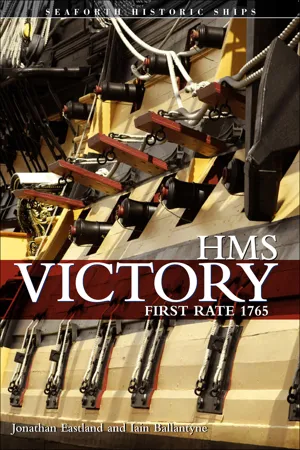
Victory is probably the best-known historic ship in the world. A symbol of the Royal Navy's achievements during the great age of sail, she is based in Portsmouth and seen by tens of thousands of visitors each year.
In this new series written by experts and containing more than 200 specially commissioned photographs, each title will take the reader on a superbly illustrated tour of the ship, from bow to stern and deck by deck. Significant parts of the vessel for example, the capstan, steering gear, armament, brody stove, cockpit, stern cabins are given detailed coverage both in words and pictures, so that the reader has at hand the most complete visual record and explanation of the ship that exists.
In addition, the importance of the ship, both in her own time and now as a museum vessel, is explained, while her design and build, her fighting career and her life prior to restoration and exhibition are all described.
No other books offer such superb visual impact and detailed information as the Seaforth Historic Ship Series—a truly groundbreaking concept bringing the ships of our past vividly to life.
Nominated for the 2011 Mountbatten Awards
"In a precise and careful treatment, they cover the evolution of naval architecture, maritime warfare, and British strategy that led to the construction of the 100-gun ship-of-the-line . . . A valuable book for students of the age of fighting sail."—New York Military Affairs Symposium
- 128 pages
- English
- ePUB (mobile friendly)
- Available on iOS & Android
eBook - ePub
About this book
Information
Chapter One
THE MIRACULOUS VICTORY
As the 199th anniversary of the Battle of Trafalgar dawned, Mother Nature let Britain know her fury was still full and awesome.
The most powerful storm for decades battered the south of England, sleeting rain streaking through the rigging of Horatio Nelson’s immortal flagship, HMS Victory, at Portsmouth. Under scudding, leaden clouds, a sodden crowd of sailors and marines in dress uniform assembled in a square on Victory’s quarterdeck; a Royal Marines band played and the passing of Britain’s greatest naval hero was honoured once more, with the laying of a simple laurel wreath on the spot where he fell, victim of an enemy musket ball in 1805.
In the 1840s, a young Queen Victoria, spontaneously visiting the Victory en route from Osborne House on the Isle of Wight to London to perform an official engagement, was visibly moved on being shown the place where Nelson had taken his last breath. She was ‘much affected by the reflections which such a scene awakened’. 1
The ceremony that takes place on Victory each year on the anniversary of the Battle of Trafalgar, is no less poignant for the passing of time. In 2004, 160 miles to the west of Portsmouth, the same south-westerly storm battered Plymouth more brutally, rocking the modern warships of Britain’s twenty-first century high-tech fleet at their moorings, the sea slapping noisily against the thin stressed steel of their grey-painted hulls. In Plymouth Sound an angry froth hurled spray and stones over rocks at the foot of the Hoe, where, prior to the building of the breakwater by French prisoners of war, some taken at Trafalgar, many a ship had come to grief. Rigging slammed with metallic despair against the masts of yachts moored along the Cattedown, a sheltered dagger of water thrusting up towards the River Plym.
Anniversary storm - a south-westerly gale screeches through the rigging of Nelson’s flagship HMS Victory on 21 October 2004, as dawn breaks over Portsmouth on the 199th anniversary of the Battle of Trafalgar. Jonathan Eastland/Ajax

Some 416 years earlier, in the same place, the first British warship to be named Victory upon which, like Nelson’s flagship, the fate of England also rested, found herself trapped by a lack of wind. Her sailors, embarked in Victory’s boats carrying her heavy anchors as far ahead as cable lengths permitted, were being urged to row with all their might. As the anchors were let go, capstans in the Tudor warship groaned to the sweat and grunts of her crew. This process – ‘warping out’ in the face of adverse winds and tides – was a common but no less exhausting practice in the days of sail.
It was a race against time, for a massive Spanish invasion fleet loomed over the horizon. That afternoon, 19 July 1588, a pinnace called the Golden Hinde had brought news that, after many months of fearful anticipation, the Armada was off the Lizard.
The Golden Hinde’s breathless captain, Thomas Fleming, had hurried up the sloping streets of the crowded Barbican clustered around Sutton Harbour, to reach the wide open common of the Hoe, where, if popular legend is to be believed, the English fleet’s commanders were holding a council of war over a game of bowls.2
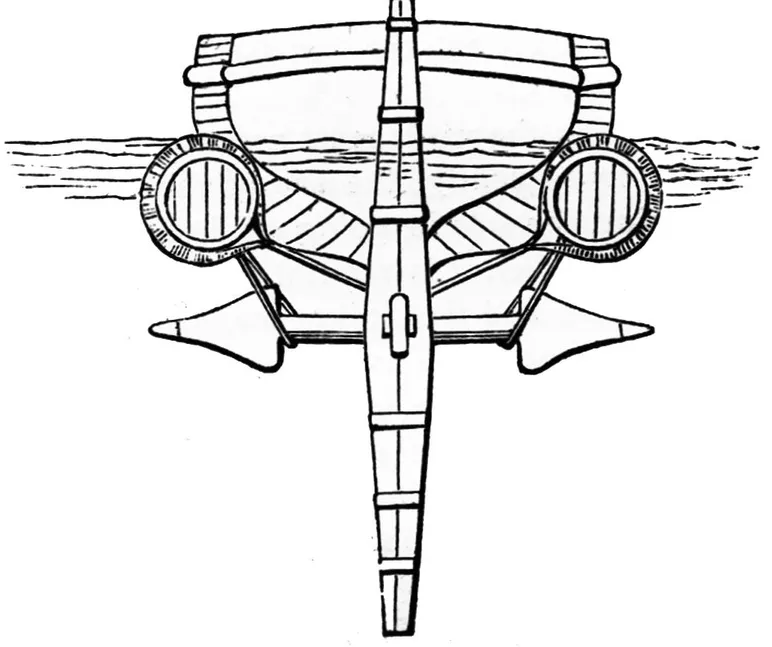
A ship’s anchor was carried under a roe-ing (rowing) launch when warping out of harbour during the days of fighting sail. Ajax Vintage Picture Library
After hearing the news, the commander of the around 100 English naval vessels assembled at Plymouth, Lord Charles Howard of Effingham, studied the faces of his senior captains, foremost among them being Vice Admiral Sir Francis Drake, who smiled and took his time to aim at the jack. Having delivered his shot, Drake observed that it was better to wait for the tide to turn and for the ships to finish embarking all they would need by way of powder and shot for the fight ahead.
Effingham told Drake’s cousin, John Hawkins, Treasurer of the Navy, that the latter’s flagship, the Victory, should stay close to him during the battle. The Lord High Admiral would likely need to avail himself of Hawkins’ considerable experience.
Now, with the Armada almost in sight of Plymouth, and warning beacons burning on headlands all along the south-west peninsula, Victory’s sailors were being urged to row ever harder as their boats carried heavy anchors out ahead of the ship while rough methods were being used to inspire those on the capstans.
The bo’sun’s whistle was kept going, and belaying pins came in handy for the stimulation of skulkers.3
They must get out before Spanish men-of-war trapped them like rats in a barrel, taking revenge for a similar stroke by an English naval force, at Cadiz in April 1587. Luckily, in July 1588 off Plymouth, the Spanish commander would not prove to be as daring as the men who led the English fleet.
As the Victory finally cleared the Sound, on her quarterdeck John Hawkins in all likelihood gave thanks to God. As the famous seadog paced up and down he made a robustly inspiring sight:
...a burly, grizzled elder in greasy, sea-stained garments...The upper half of his sharp, dogged visage seems of brick-red leather, the lower of badger’s fur...4
The fifty-five year old Hawkins was a devoutly religious man but, as a hot headed twenty year old, the first Victory’s most famous flag officer had beaten someone to death in a street brawl, surviving the resulting legal action and going on to terrorize the high seas as one of the most notable pirates of his time. Hawkins was a tough, ruthless man of modest education but he was fiercely clever. He was born in 1533, into a family of rogue traders in bustling Plymouth, which was Elizabethan England’s most enterprising, and cutthroat, port. John Hawkins was by the age of thirty-five renowned as England’s first slave trader. Slaving is a most heinous crime by today’s standards, but an acceptable avenue of commerce in the sixteenth century. Not even Englishmen were safe from such depredations, however, as the Barbary corsairs of North Africa often cruised the Channel to snatch women and children from their beds during forays ashore.5 The slave trade remains a stain upon humanity and, in some dark corners of the globe, still persists.
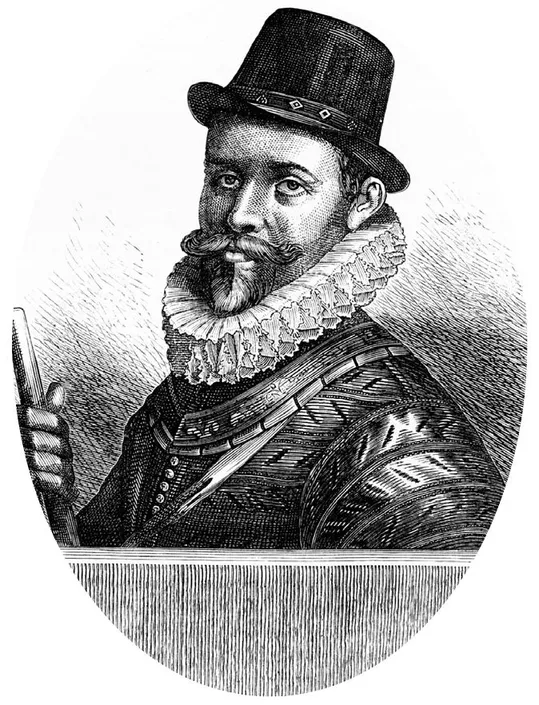
Sir John Hawkins, who sailed in the first Victory and was an advocate of race built ships; his designs made some of the English fleet more nimble than the Spanish which were unwieldy and difficult to manoeuvre. Ajax Vintage Picture Library
Such was Plymouth’s reputation as a nest of pirates that any merchant ships sailing close by, kept what guns they had fully manned and ready to fire. The freebooters that habitually lurked in the Devon town’s tightly packed harbour not only included Drake but also Martin Frobisher, who, like the other two swashbucklers, would find glory during the pursuit of the Armada. They hoped that rich prizes would make them wealthy beyond their wildest dreams. Drake was already a rich man, having the previous year brought home a superb prize, the carrack San Felipe. Her abundant cargo of silks, spices, jewels, coin and gold plate would be worth £12,000,000 in today’s money.
Not everything ran smoothly for Hawkins; a disastrous expedition in the late 1560s, when he was cornered by a superior Spanish naval force and defeated at Juan de Ulloa in the Gulf of Mexico, had left the crews of several of his privateering vessels scattered across the Spanish Main, either in prison or on the run, with a good proportion of them subsequently deported in irons to Spain itself.
To obtain the influence needed to spring them from various dungeons, Hawkins became involved in efforts to replace Protestant Queen Elizabeth with the Catholic Queen Mary. However, he was a double agent, gathering information to betray the various plots against the English throne, and while such intrigues did result in the release of a number of his men, a good many were also sentenced to years as galley slaves or condemned to death. Hawkins was appointed Treasurer to the Navy in 1577, succeeding his father-in-law Benjamin Gonson, and he proceeded to transform the Queen’s ships into the ...
Table of contents
- Title Page
- Copyright Page
- Table of Contents
- HMS VICTORY Battle Honours
- Foreword
- Acknowledgements
- Nautical Terms
- Introduction - Britain Needs to Understand the Worth of its Navy
- Chapter One - THE MIRACULOUS VICTORY
- Chapter Two - THE FURY OF THE WINDS AND WAVES
- Chapter Three - A CANNON-BALL MAY KNOCK OFF HIS HEAD
- Chapter Four - A GLORIOUS DEATH IS TO BE ENVIED
- Chapter Five - I WILL GO THROUGH THEM
- Chapter Six - WOE BE TO THE FRENCHMAN SHE GETS ALONGSIDE OF!
- Chapter Seven - I HAVE THEIR HEARTS NOW
- Chapter Eight - ENGAGE THE ENEMY MORE CLOSELY
- Chapter Nine - STUPID WITH GRIEF
- Chapter Ten - EVERY COCK CROWS UPON HIS OWN DUNGHILL
- Chapter Eleven - I CHASED THE BATTLE AND THE BREEZE
- Chapter Twelve - THE IMMORTAL SHIP
- Epilogue - THE NAVY AND THE NATION
- Appendix 1
- Appendix 2 - HMS Victory Flag Officers 1778-2005
- Appendix 3 - HMS Victory Chronological Build & Repair History
- Appendix 4 - Guns and their disposition in HMS Victory at the time of Trafalgar
- BIBLIOGRAPHY
- SOURCES
- INDEX
Trusted by 375,005 students
Access to over 1.5 million titles for a fair monthly price.
Study more efficiently using our study tools.
Frequently asked questions
Yes, you can cancel anytime from the Subscription tab in your account settings on the Perlego website. Your subscription will stay active until the end of your current billing period. Learn how to cancel your subscription
No, books cannot be downloaded as external files, such as PDFs, for use outside of Perlego. However, you can download books within the Perlego app for offline reading on mobile or tablet. Learn how to download books offline
Perlego offers two plans: Essential and Complete
- Essential is ideal for learners and professionals who enjoy exploring a wide range of subjects. Access the Essential Library with 800,000+ trusted titles and best-sellers across business, personal growth, and the humanities. Includes unlimited reading time and Standard Read Aloud voice.
- Complete: Perfect for advanced learners and researchers needing full, unrestricted access. Unlock 1.5M+ books across hundreds of subjects, including academic and specialized titles. The Complete Plan also includes advanced features like Premium Read Aloud and Research Assistant.
We are an online textbook subscription service, where you can get access to an entire online library for less than the price of a single book per month. With over 1.5 million books across 990+ topics, we’ve got you covered! Learn about our mission
Look out for the read-aloud symbol on your next book to see if you can listen to it. The read-aloud tool reads text aloud for you, highlighting the text as it is being read. You can pause it, speed it up and slow it down. Learn more about Read Aloud
Yes! You can use the Perlego app on both iOS and Android devices to read anytime, anywhere — even offline. Perfect for commutes or when you’re on the go.
Please note we cannot support devices running on iOS 13 and Android 7 or earlier. Learn more about using the app
Please note we cannot support devices running on iOS 13 and Android 7 or earlier. Learn more about using the app
Yes, you can access HMS Victory by Jonathan Eastland,Iain Ballantyne in PDF and/or ePUB format, as well as other popular books in History & Early Modern History. We have over 1.5 million books available in our catalogue for you to explore.