This WW2 military history "combin[es] a look at the background to the battle . . . and the ground level memories of the participants with great skill." (
History of War.org)
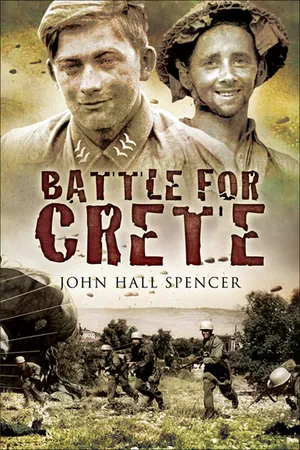
After two years' extensive research, John Hall Spencer has written a thorough account of the political and military background to the German invasion of Crete and the bitter fighting that followed the first airborne assault on an island in history.
Battle for Crete tells of confused negotiations between the British and Greek governments; the misunderstandings between Winston Churchill's War Cabinet and commanders in the field; the near capture of the King of Greece; the lack of preparation by the defenders and the suppression of a critical post-battle report by General Wavell.
There are vivid eyewitness accounts of the fighting both during the invasion and the subsequent campaign and ultimate retreat and evacuation. The Royal Navy and Royal Air Force's contribution is well documented, as are the roles of the German air force, in this "close run" campaign fought with aggression by both sides.
- 320 pages
- English
- ePUB (mobile friendly)
- Available on iOS & Android
eBook - ePub
Battle for Crete
About this book
Information
Print ISBN
9781844157709
Subtopic
Military & Maritime HistoryPart One
ADVENT
‘War is a science so obscure and imperfect that custom and prejudice confirmed by ignorance are its sole foundation and support.’
Marshal Saxe : Reveries on the Art of War
Chapter One
The Royal Navy was there. Within a week of the Italian attack on Greece they had broken up an attempt to seize Crete, and their torpedoes – delivered by Fleet Air Arm Swordfish – had sent two cruisers and three of Italy’s six battleships to the bottom at Taranto. And Mussolini’s troops fighting in Albania were faring badly. It was November 1940.
The Italian attack had been a rash and independent undertaking. Since the security leak from Rome of the impending German attack on the Low Countries earlier in the year (Hitler suspected King Victor Emmanuel but in fact it was Mussolini himself who instructed his Foreign Minister, Count Ciano, to warn the Dutch and Belgian Ambassadors that their frontiers were about to be crossed by German armour) Hitler had kept his own counsel.
Mussolini was jealous. In his weakness he could only complain to Ciano: ‘It is humiliating to remain with our hands folded, while others write history.’1
He resented the German triumphs brought off without the aid of his advice, without a token Italian contribution, without even his foreknowledge. Ciano said: ‘Mussolini resented the fact that Hitler did all the talking. . . . He had to keep quiet most of the time which, as dictator, or rather the dean of dictators, he was not in the habit of doing.’
‘Hitler always faces me with a fait accompli,’ Mussolini complained to Ciano after his Brenner Pass meeting with Hitler on October 4. ‘This time I am going to pay him back in his own coin. He will find out from the papers that I have occupied Greece. In this way equilibrium will be re-established.’
He fixed the attack for October 28, and then wrote to Hitler on the 22nd, back-dating the letter to the 19th; referring in general terms to his ambitions in Greece, but without fixing dates which would have courted a restraining injunction, he sent the letter to Berlin to await Hitler’s return from France.
Hitler was told the contents of the letter by telephone from Berlin two days later. He asked for an immediate conference. Mussolini suggested the 28th, at Florence. As Hitler stepped from his train, Mussolini greeted him with an attempt at Napoleonic élan. It did not quite come off. ‘Führer,’ he said, ‘we are on the march!’
The Italian attack on Greece was seen in Berlin as a ‘regrettable blunder’. It had been made with three divisions only, ‘entirely inadequate forces’. At a conference on November 4 Colonel-General Alfred Jodl, Chief of Operations Staff of O.K.W. (the High Command of the German armed forces), said to the Naval Chief of Staff, Vice-Admiral Otto Schniewind: ‘On no occasion was authorisation for such an independent action given by the Führer to the Duce.’
Winston Churchill, his mind nursed on the solemn periods of British history, saw at once the opportunity not simply of avoiding defeat at home at a time when Britain and the Commonwealth stood alone against Germany and her satellites in Europe but, like Pitt before him, of winning victory in the Mediterranean.
On November 20 Hitler wrote to Mussolini: ‘When I asked you to receive me in Florence, I set out with the hope of outlining my news to you before the beginning of the threatened conflict with Greece, of which I had only the vaguest information. Above all I wanted to persuade you to delay this action a little, until a more favourable time, at any rate until after the American Presidential Election. . . . The situation, as it has now developed, will entail psychological and military consequences of the utmost gravity.’
Franco, for one, had drawn his own conclusions from the Italian failure; Hitler continued that it had ‘accentuated the tendency of certain nations to avoid becoming entangled with us and to await the outcome of events’. Bulgaria and Yugoslavia had declined to join the Tripartite Alliance, and whilst Hungary and Romania were about to join it there had been ‘a decided strengthening of the position of those . . . who assert that in this war the last word has not yet been spoken’. As to the military consequences, ‘these, Duce, are extremely serious. Britain will have at her disposal a number of air bases within range of Ploesti. . . . I am determined, Duce, to react with decisive forces against any British attempt to establish a substantial air base in Thrace’.
The Duce was humbled.
‘Führer,’ he replied, ‘I am sorry that my letter of October 19 did not reach you in time for you to give me your advice on the projected expedition against Greece, advice to which I should have strictly conformed, as on other occasions.’
Irrepressible self-esteem then reasserted itself as did a familiar reluctance to take orders: ‘The Spanish trump can now be played. I am inclined to meet Franco myself and exert the necessary pressure to bring him into the war.’ Having repeated Hitler’s main proposals as his own, he ended: ‘Those are the broad lines of the plan to which I am willing to give my consent,’ and, with caution reasserting itself, ‘I will give it also to all measures which you regard as necessary to restore the situation.’
German War Directive No. 20 launching the move against Greece – Operation Marita – was issued on 13 December 1940. Its declared purpose was ‘to foil British attempts to create air bases under the protection of a Balkan front . . . for this would be dangerous above all to Italy as well as to the Romanian oil-fields’.
An unstated and marginal purpose was to end the fiasco which Mussolini had already made of his attack on Greece. Mussolini was, however, given no hint of the strategy to which Hitler’s proposals were leading. For him, as for the British, it appeared that two German pincer thrusts would develop southwards to the Mediterranean, converging at Suez and driving beyond to the oil-fields of the Persian Gulf: one through Bulgaria to Greece, the Ægean, Crete, and on; the other into Africa by Sicily. (A further War Directive dated 11 January 1941, issued after the loss of Bardia, ordered the establishment of the German Air Force on Sicily and the dispatch of German troops to Tripolitania – the beginning of the Afrika Korps.)
In his letter of November 20 Hitler had, however, given Mussolini a hint: ‘We should make every possible effort,’ he wrote, ‘to turn Russia away from the Balkans and to direct her towards the Orient.’
On November 12 Ribbentrop, the ex-champagne salesman, had had his first meeting in Berlin with his opposite number, the Russian Foreign Minister, Molotov.
‘England is beaten,’ said the German; ‘it is only a question of time before she finally admits defeat.’
‘Join hands with us of the Tripartite Pact,’ he said in effect, ‘and you will share in the dismembered spoils of the British Empire.’
Molotov remained sceptical. A remark he later attributed to himself was: ‘If England is in fact defeated and powerless, why have we been conducting this discussion in your air-raid shelter?’2
Hitler had received the Soviet Government’s formal reply a fortnight later. Stalin declared that he was prepared to accept the draft of the Four-Power Pact outlined by Ribbentrop on conditions; these included: ‘that the area south of Batum and Baku in the general direction of the Persian Gulf is recognised as the centre of the aspirations of the Soviet Union’; ‘the establishment of a base for land and naval forces of the U.S.S.R. within range of the Bosphorus and the Dardanelles by means of a long-term lease’; and ‘the withdrawal of German troops from Finland’.
Thus Stalin’s price for giving Germany freedom of action against Britain was to exact terms which would safeguard him against subsequent German attack by northern or southern outflanking movements and to gain for himself and to deny to Hitler the oil-fields of Iraq and Iran.
This was hard, shrewd, cynical bargaining. ‘Stalin is nothing but a cold-blooded blackmailer,’ Hitler complained to Admiral Raeder.3 And his reply went to German Commanders-in-Chief in the Directive of December 18: ‘The German armed forces must be prepared even before the end of the war against England, to overthrow Soviet Russia in a rapid campaign (Operation Barbarossa).’
All was to be ready by 15 May 1941.
He now turned his mind to the problem of securing his southern flank preparatory to launching Barbarossa.
Meanwhile, the British Inter-Services Mission to Greece, led by Major-General M. Gambier-Parry until he was succeeded later in November by Major-General T. Heywood, were getting an ambiguous response from the Greeks.
The Germans had been at pains to assure them that the fight was one which concerned only Italian and Greek. The German Ambassador remained in Athens, as did the German Military Attaché and his staff. They now watched sardonically the arrival of senior British officers under assumed names, in plain clothes4 and whose reception at cheap hotels in the suburbs had all the heavy-handed quality of third-rate melodrama.
This German attitude of benevolent neutrality fitted Greek prejudice and preconception. In common with many nations of the Near East, the Greek tends to admire the German. It is a sentiment found as far down into Asia as Afghanistan. In part, no doubt, it is the admiration of the chronically disorganised for discipline; but also it is the traditional feeling that Germany is the buffer between the sea-power of Britain and the land-power of Russia. For the Greeks, there was even the vain, naive hope that Germany would rescue them from Italy.
General Metaxas, the Greek dictator, had been told by the German Minister that Germany would not regard the presence of a small British air detachment as a casus belli; no airfield facilities should be given in northern Greece, however: Hitler’s expressed fear to Mussolini of a raid on the oil-fields at Ploesti was genuine.
Air Commodore J. D’Albiac, who had arrived in Athens on November 6 to take command of the five R.A.F. squadrons of Blenheims, Gladiators and Wellingtons allocated, was told that no air bases could be made available to him in the requested area of Salonica. The Greeks did, however, come out strongly in favour of a naval base on Crete at Suda.
Suda should now become, said the Prime Minister, ‘a second Scapa’. But the navy, in the person of Admiral Cunningham, wondered whether Navarino in the south-west comer of the Peloponnese would not have been the better choice.
Army Headquarters in Cairo displayed little interest in Greece or Albania at this time : the immediate task, so well begun, was to throw the Italians out of Africa. This reflected the views of others in high places – Admiral Sir Tom Phillips, Vice-Chief of the Naval Staff for one. He was arguing in London: ‘For God’s sake don’t let’s go fighting in Macedonia. We must not commit ourselves to fighting on land in Europe at present – and so we mustn’t go to Greece.’
On October 9 the Cabinet had decided that Mr Anthony Eden should go to the Middle East. A few days later he inspected the Polish Brigade and other units at Alexandria. After the parade he had sent for Colonel N. Sim, commanding 2nd Battalion the York and Lancaster Regiment, and apologised because he had to send the battalion to Malta where things were none too good.
However, on October 21 the Chiefs of Staff Committee had considered a suggestion from the Joint Planning Staff that growing strength in the Middle East, coupled with Marshal Graziani’s reluctance to move over to the offensive in Africa, might make it possible ‘to earmark and prepare a small force and move it to reinforce Crete in the event of Greece becoming involved in war’.
And on October 28, as the delivery of the Italian ultimatum, its rejection and the Italian invasion of Greece followed each other in quick succession, Admiral Cunningham sent for Colonel Sim. On board H.M.S. Queen Elizabeth he told him that he was now to embark his battalion in H.M.S. Ajax. Details would be arranged with the Captain. The battalion had been detailed to go to Crete: the Mediterranean Fleet was going to use the anchorage at Suda Bay by permission of the Greek Government.
The move was, he added, to be left highly secret; and, as the battalion was anyway preparing for embarkation overseas, Colonel Sim did not think it necessary to inform any of his men. Two nights later the battalion embarked at Alexandria and, after dark, they sailed north without escort.
It was proposed that the build-up of the garrison on the island would be completed with a second phase when another battalion of infantry – the 2nd Black Watch – and light and heavy anti-aircraft batteries would follow. These additional units were now given their warning orders.
These were the first dispositions made – infantry and artillery in brigade strength to Suda Bay and a few R.A.F. bombers to airfields in the neighbourhood of Athens.
The variously interested factions now began to lobby. Pro-Greek British service elements in Athens were all for giving every possible aid and for throwing the Italians out of Albania. The Naval Attaché, Rear-Admiral C. Turle, managed to reach the Prime Minister back in London during December.
He arrived, his diary records, at the darkened Cabinet offices in Parliament Square one night shortly before 10 p.m. Brendan Bracken was waiting in the sitting-room; Turle found him an interesting talker ‘though rather overpowering’.
Turle continues: ‘After a short wait I am taken along to the Cabinet offices and then to the Prime Minister’s private room.
‘A dinner party has just broken up – Winston Churchill being in front, smoking an outsize cigar and dressed in his air-raid or romper overalls of R.A.F. blue cloth, with a broad belt and soft brown leather zip slippers. Four or five others, including Kingsley-Wood,5 are just getting up from table.’
Turle now shifts the tense as the diary account continues: ‘Before the party broke up there was some general talk about Greece. W.C. impressed me at once by his clear grasp of all essentials – I found it almost impossible not to be dominated by him. He especially stood out alone and unapproachable, with his quick rolling phrases; the words he uses again and again crack into one’s brain with their entire suitability to the occasion and with their exact nicety.’
Turle endeavoured to stick to three main points:
- To get Italy out of Albania before Germany came to her rescue.
- Air support, and only air support, was vitally needed.
- Neither the Air Ministry nor any high R.A.F. officer realised the urgency; in fact they believed that time was on the British side and reiterated D’Albiac’s view that strong air forces must be built up in Greece by the spring.
The Prime Minister with Sir Archibald Sinclair, Secretary of State for Air, and Marshal of the Royal Air Force Sir Charles Portal, Chief of Air Staff, discussed the points in detail.
‘W.C. is a fascinating companion. . . . He paddles up and down the room (like a waterhen), puffing at another cigar and with his hands deep thrust through his belt.
‘One incident interested me vastly – and it shows the value of the red herring. Portal was, I felt sure, being rather cornered about one special type of night fighter which should fire aft instead of forward. W.C.’s questions were coming down hard and fast on Portal who deliberately changed the subject and talked of two bonfires started in outlying fields which had been very successful near Bristol, one bonfire indeed having attracted sixty-nine bombs to its innocent vicinity.’
This piece of intelligence apparently intrigued the Prime Minister; bonfires held the conversation for five minutes; and there were no more awkward questions.
When Turle left at 11.15 he had the Prime Minister’s assurance that all possible air assistance would be sent at once: he understood fifteen squadrons in a few weeks for sure, and perhaps up to twenty-two squadrons.
Turle’s intention, expressed when he had said good-bye in Athens to Harold Caccia, First Secretary at Athens, of retiring if he failed to secure a full measure of help for Greece, and of lobbying, briefing the parliamentary obstructionists, and ‘however unimportant a mouse I might be, of raising all the hell I could’, appeared in the event to be unnecessary.
He flew from Stradeshall to Malta, and thence to Egypt, and then again by Wellington two nights later to Tatoi Airfield, Athens, to arrive back on Christmas Eve.
In a New Year telegram to the Director of Naval Intelligence, Turle pointed out how dangerously stretched were the Greek forces and, in his view, that they would not be able to stand up to a slight reverse. They were sustained only by their contempt for the Italians and their conviction of the divine assistance of the Virgin Mary. The Minister, Sir Michael Palairet, did not like the ...
Table of contents
- Title Page
- Copyright Page
- Table of Contents
- Foreword
- Author’s Note
- Part One - ADVENT
- Part Two - ONSLAUGHT
- Part Three - END
- Index
Trusted by 375,005 students
Access to over 1.5 million titles for a fair monthly price.
Study more efficiently using our study tools.
Frequently asked questions
Yes, you can cancel anytime from the Subscription tab in your account settings on the Perlego website. Your subscription will stay active until the end of your current billing period. Learn how to cancel your subscription
No, books cannot be downloaded as external files, such as PDFs, for use outside of Perlego. However, you can download books within the Perlego app for offline reading on mobile or tablet. Learn how to download books offline
Perlego offers two plans: Essential and Complete
- Essential is ideal for learners and professionals who enjoy exploring a wide range of subjects. Access the Essential Library with 800,000+ trusted titles and best-sellers across business, personal growth, and the humanities. Includes unlimited reading time and Standard Read Aloud voice.
- Complete: Perfect for advanced learners and researchers needing full, unrestricted access. Unlock 1.5M+ books across hundreds of subjects, including academic and specialized titles. The Complete Plan also includes advanced features like Premium Read Aloud and Research Assistant.
We are an online textbook subscription service, where you can get access to an entire online library for less than the price of a single book per month. With over 1.5 million books across 990+ topics, we’ve got you covered! Learn about our mission
Look out for the read-aloud symbol on your next book to see if you can listen to it. The read-aloud tool reads text aloud for you, highlighting the text as it is being read. You can pause it, speed it up and slow it down. Learn more about Read Aloud
Yes! You can use the Perlego app on both iOS and Android devices to read anytime, anywhere — even offline. Perfect for commutes or when you’re on the go.
Please note we cannot support devices running on iOS 13 and Android 7 or earlier. Learn more about using the app
Please note we cannot support devices running on iOS 13 and Android 7 or earlier. Learn more about using the app
Yes, you can access Battle for Crete by John Hall Spencer in PDF and/or ePUB format. We have over 1.5 million books available in our catalogue for you to explore.