- 208 pages
- English
- ePUB (mobile friendly)
- Available on iOS & Android
eBook - ePub
About this book
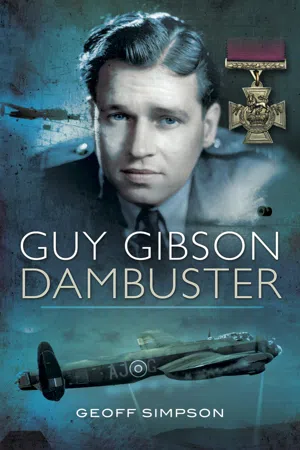
A new assessment of the life of one of the most famous and controversial airmen of the Second World War, this book covers Guy Gibson's sometimes troubled upbringing and the impact on him of his time at St Edward's School, Oxford. In particular, the story of his career in the RAF is relayed, including his stunning leadership achievement in creating No 617 Squadron and leading its attack on the dams of western Germany. The much-discussed circumstances of his unnecessary death and the theories, which have grown up around it are examined, as well as his legacy—he remains a great British hero almost 70 years after his death in a world utterly different to the one he knew.
Information
Chapter 1
Early Life
The words, ‘By Tre, Pol and Pen shall ye know all Cornishmen’ or their variations, stretch back hundreds of years. Guy Penrose Gibson was born far from the county in the extreme west of England, but his middle name told the world of his Cornish ancestry. The Penrose estate stands near the village of Porthleven, home to Gibson’s maternal grandparents.
When Elsie Balme produced a book called Seagull Morning about a thirties and forties childhood spent in Porthleven she wrote of,
‘that strange grey, sprawling, rather ugly, yet infinitely appealing village of Porthleven, with its rumbustious community life; its unabashed scandalmongering; its infinite capacity for interfering in people’s private affairs; and its uncanny ability to draw back to itself those who belong to it, so that if you have lived there, then you will never be completely alive again anywhere else, because some part of you will live there for ever.’
She also lamented many of the changes that had occurred by the time her book appeared in 1990.
The house that Captain Edward Carter Strike, a master mariner, and his wife Emily lived in immediately before the First World War still stands. It offered them, and offers its present occupants, a spectacular view across the town and harbour of Porthleven, from a vantage point up on Breage Cliffs.
There is a suggestion in the family that Captain Strike, having been born the son of a fisherman and risen in life, later wanted to keep his distance from the men who still sailed from the harbour. From his house Captain Strike could see them, but was well removed from their presence. The Strikes were a prosperous family and so they could afford to place themselves in such a desirable position.
The name Strike is one that stands out and it occurs with some frequency in West Cornwall, but one authority at least does not regard ‘Strike’ as having a particularly Cornish origin. It is said to be an early English occupation surname, given to someone whose work involved the measuring of quantities of corn. Such a person used a flat stick, known as a strike (from an old English derivation), to level the crop in its container.
One of the daughters of Captain and Mrs Strike was Leonora Mary, ‘Nora’, who finished her education in Belgium in 1913 and came back to Porthleven. She was attractive, outgoing and not short of male admirers. Before the end of the year she had married Alexander James Gibson, aged thirty-six, who at first did not commend himself to Nora’s parents.
Alexander had been born in Russia while his father was working there. Known as ‘AJ’ in his family, he lived in India and was rising in the Indian Forest Service.
In those days, there were often rules, or at least guidelines, on when it was suitable for people in particular occupations to marry. Alexander came home on leave and stayed in Porthleven. Some accounts suggest that he was actively looking for a wife. If so, Nora, nineteen at the time, was a suitable candidate and the situation developed quickly. The wedding took place on 2 December 1913 and Alexander, after a honeymoon in Europe, took his bride back to his base in Lahore, capital of the Punjab.
The marriage was troubled from the start, but continued in India at Lahore and at a bungalow at Simla in the hills, which the family used during the hottest of the Indian weather. The bungalow was called ‘Talland’, a reminder of Cornwall. Talland Bay lies between Looe and Polperro in the south east of the county, with two beaches, one sandy, and rock pools. Today the South West Coast Path passes by.
In the early twenty-first century Simla is known as Shimla and, placed in the Himalayan foothills, is a major tourist attraction. Many visitors arrive on the 2ft 6in gauge railway, opened in 1903, which takes them up into the hills from Kalka. The journey is ninety-six kilometres long and offers spectacular views. When the Gibson family spent part of the year in Simla, it was the summer capital of British India, a status it had enjoyed since 1864.
In June 1915 the eldest child of the Gibsons was born, a boy christened Alexander Edward Charles, who would become known to his immediate family as ‘Alick’. Alexander was a name that ran in the Gibson family.
Two more children followed, the first being Joan Lemon in 1916. The family account is that ‘Lemon’ was the name of a family friend and the naming of Joan a tribute to that friend. Joan would later change her middle name to the more feminine sounding Lemona.
Then on 12 August 1918, another Gibson son was born to Nora in Simla. It was on 11 September, exactly two months before the armistice and the end of the First World War fighting, that he was christened Guy Penrose Gibson by the Reverend H.J. Wheeler, the minister at Christ Church in Simla. The name ‘Guy’ was a tribute to another friend.
Wheeler officiated at an imposing church which had been consecrated in 1857, the first church in Simla and claimed to be only the second in northern India. Built of stone and brick in lime mortar, it still stands and has a chancel window designed by Lockwood Kipling, father of Rudyard. The memorials include one to Lieutenant General Sir Gerald de Courcy Morton, credited with playing a leading role in the development of the dumdum bullet.
Early life in India was very comfortable for the children with plenty of servants at hand. Attention and affection, though, often came from these servants rather than from the mother and father of the three Gibson youngsters. Meanwhile the marriage of Nora and AJ continued to be rocky.
In 1922 Nora took the children to Porthleven and a first meeting with their maternal family. In addition it was a first glimpse of the Cornish town for Guy in particular and of the harbour and seascapes that he grew to love. Then there was a return to India. AJ became chief conservator of forests and the amount of travelling he did increased.
Two years after the first visit to England, Nora and the children came back to Cornwall. The marriage to an older man, who, it is suggested, was regularly unfaithful and less interested than his wife in socialising had in reality come to an end.
So Nora, Alick, Joan and Guy came again to Cornwall. Nora moved the children around between hotels and rooms. Not starved of male company just because her husband was in India, she started an affair, which seems to have been obvious in its debauchery to the children.
Joan and Guy escaped at times to the home of their grandparents in Porthleven, where they received affection not always granted them at their various homes. Their grandmother proved to be a rather more competent mother than their actual mother. Other relatives rallied round and this produced a circle of childhood acquaintances.
Trish Knight-Webb, a cousin of Guy’s, wrote in 2012:
‘My own memories of Guy are very sketchy so these are mostly from my sisters who were contemporaries of his.
‘Guy spent many of his holidays with my family in their rectory because my uncle and aunt were mostly absent. There was the incident of the chickens which took place, I think, when my father was a curate possibly in Castle Cary, Somerset. Guy claimed that he had persuaded some chickens to walk in a straight line.
‘On another occasion Guy stood on a chair and waved a knife about chanting “here comes the chopper”. This definitely took place when the two sisters had rented adjacent cottages in Penzance when home on leave. I know my sister Bunty was very scared!
‘We all spent our holidays down in Porthleven, either with or near our grandparents so there were many family picnics with cousins all of whom were gathered there. Those in the forces who were on leave foregathered including my brother, Keith who also went into the RAF. He was killed in a fighter plane in 1942.’
Trish’s brother, Keith Lloyd Davies, was around a year older than Guy. He was lost on 27 November 1941, flying a Hurricane of No 607 (County of Durham) Squadron. His aircraft was hit by flak off Boulogne and went into the sea. The body of Keith Davies was not recovered by either side and his name is recorded on panel 30 of the Runnymede memorial.
Two other pilots from No 607 Squadron were lost at much the same time, though their aircraft were engaged by German fighters, as well as by anti-aircraft fire. They were Sergeant R. Weir and Sergeant W.E. Hovey.
Now Guy Gibson’s love affair with Cornwall and the sea took off. He would spend long periods talking to the fishermen at the harbour. Equally he was content to spend time on the harbour wall watching the sea, which could be spectacularly rough, and the arrivals and departures of craft in the harbour.
In later life he was guarded about the impact on him of his dysfunctional childhood, but his time at the harbour certainly provided happiness and escapism. The plaque in commemoration of Guy Gibson that has been placed on the clock tower building in Porthleven is very appropriate in its location.
Alick Gibson was sent to Folkestone, Kent to become a boarder at the now long gone St George’s Preparatory School and, aged eight, Guy followed him. Around this time their mother and sister were living in a flat in Kensington. Joan was not sent to school.
AJ had bought a house at Saundersfoot in southwest Wales, in part to further a romantic attachment, but also, he claimed, to provide a base for his family.
The school in Folkestone was situated at 23/25 Earls Avenue, on the corner of Westbourne Gardens in the town. The Headmaster was the Reverend C.A. Darby, who had founded the establishment as Earl’s Avenue School.
A fellow pupil, though he was older than Guy, was David Tomlinson, who would achieve fame as an actor – for example, as Pilot Officer ‘Prune’ Parsons in The Way to the Stars and as George Banks in Mary Poppins after an early spell in repertory in Folkestone. Tomlinson served in the Grenadier Guards and in the RAF during the war, partly as an instructor in Canada, reaching the rank of flight lieutenant. In 1956 he survived a crash in a Tiger Moth and a subsequent prosecution for reckless flying.
Another local clergyman, the Reverend W.H. Elliott, who was vicar of Holy Trinity Church, Folkestone, from 1918 to 1929, wrote an account of his life in which he noted that Guy attended children’s services at Holy Trinity. Mr Elliott said that during the Second World War he read an article by Guy Gibson in which it was gratifying to find that the services were referred to and that Gibson said he owed much to Mr Elliott’s teaching.
Folkestone is, of course, the seaside too. It was and is a much larger and more formal place than Porthleven. The ships that came in and out of the harbour were often much bigger. Perhaps Guy continued his love affair with the sea while he was at St George’s, but it has to be assumed that maritime Kent did not come to have the same influence on him as nautical Cornwall.
AJ retired from his last Indian post as conservator of forests in Bihar and Orissa, close to Nepal. He undertook consultancy work in Australia, then came back to the UK, took a new job and had quarters in London. He had little contact with his children.
Alick went on from Folkestone to St Edward’s School, Oxford and Guy followed him in September 1932, when he had just passed his fourteenth birthday. Thirteen was the typical age at which boys started at English public schools. Guy happened to be born in August, a month which the educational system finds a little difficult to accommodate.
St Edward’s School, Oxford
St Edward’s, ‘Teddies’ to those connected with it, has very strong military and Royal Air Force links. The school claims that more of its old boys served their country in The Great War than, pro rata, any other British independent school.
It is an interesting thought, though it can be no more than coincidence, that amongst the St Edward’s men who served in the Second World War were three of the most famous, charismatic and controversial RAF pilots of the day – Guy Gibson, Douglas ‘Tin Legs’ Bader and Adrian Warburton, particularly associated with service in Malta. Another old boy was Sergeant Arthur Banks, awarded a posthumous George Cross in 1945. Banks was shot down over northern Italy in August 1944 while flying a Mustang of No 112 Squadron on an armed reconnaissance mission. In trying to regain Allied lines he linked up with partisans and operated with them against the enemy until December 1944, when he was captured, tortured, by both Germans and Italians and eventually murdered.
St Edward’s was founded in 1863, one of a number of educational creations of Reverend Thomas Chamberlain, Senior Student (Fellow) of Christ Church, Oxford and vicar of St Thomas’s Church. Chamberlain was a leading figure in the Oxford Movement which argued against what it saw as the increasing secularisation of the Church of England and harked back to historic Catholic doctrines. The regime at the school was harsh and continued to be harsh at the time that the Gibson brothers were there, though whether it was any more so than the generality of English public schools at the time is debatable. Over the years further members of the extended family followed Alick and Guy to ‘Teddies’.
One great advantage that the school offered parents of the time was that it was considerably cheaper than more prominent establishments. In 2012 the school, now a considerably friendlier place at which to be educated than in the 1930s, had about 660 pupils, about one third of whom were girls, the first having enrolled in 1982.
At such schools brothers tended to go where their elder siblings have gone. Alick was in Cowell’s House and so Guy went there too, finding himself across the road from the main school in a separate building, formerly a large residence for an affluent member of the Oxford community. Cowell’s was named in honour of Wilfred Cowell who remains, and is likely to remain, the school’s longest serving teacher. Mr Cowell arrived in 1880 and served until 1937.
There was a great advantage to this allocation. It brought Guy under the auspices of the Cowell’s housemaster, A.F. (‘Freddie’) Yorke, who combined distinction as a schoolmaster with being a civilised man. Mr Yorke became, both in practical terms and to some extent legally, a father figure for both boys, somebody who would influence their thinking in their later lives.
One of Freddie Yorke’s former charges recalls today, ‘a superb housemaster who was respected by all those who knew him. A good looking man, he was a bachelor who ran his house quietly but very competently, preferring others to recognise the errors of their ways rather than ramming it down their throats. If a problem was reported to him he would take the approach that he had been aware all the time and was just “wondering when you were going to come and tell me about it”!
‘He understood his boys and earned their respect by being scrupulously fair and absolutely ordinary. Never heavy handed, though corporal punishment was always at his disposal, he preferred a more logical approach – if the junior dayroom made too much noise he confiscated their only radio. He was a background man who preferred a small circle of friends from within the common room and remained especially close to the Reverend Ken Menzies, another softly spoken and shy member of staff.’
As well as being housemaster of Cowell’s Freddie Yorke was second master to the warden (headmaster) for some years and the senior science and chemistry teacher at the school. When he retired he followed Menzies to Eastbourne but their friendship was swiftly ended when Menzies died soon afterwards. At this time the boys of Cowell’s presented Yorke with a huge television set with which he was absolutely thrilled.
As with many schools there was an initiation ceremony to endure. At St Edward’s, Alick and Guy were called upon to stand on a table and sing a song, recite poetry and probably do other tasks demanded by older boys. The proceedings finished with the newcomer’s shorts descending.
Being small didn’t help, as well as not being more than average at games. So one way and another Guy got off to a poor start socially. On the credit side, it is usually a help to have an older relative as a pupil in such circumstances.
Parents weren’t of much assistance in this case. AJ rarely appeared and when Nora did it usually didn’t take much perception to realise that she had refreshed herself very well on the way.
Overall, Guy’s school life did improve with the guidance of Mr Yorke. He played hockey and rugby and represented his house at cricket. Eventually he became a house prefect, though he failed to rise to the top of the school’s prefectorial system.
Guy was interested in photography and how things worked and his fascination with flying was developing. It might have been supposed that the Royal Navy would attract him more than the RAF, but that was not the case. A master kept an elderly aircraft near the school and trips were possible. That may have been a factor in Guy’s burgeoning interest.
He served in the Officer Training Corps (OTC) and managed to become a lance corporal. In every aspect of school life he did enough and achieved a bit, but the glittering prizes eluded him. Academically he did not easily obtain the passes that would help him towards his future career.
Flying has glamour today. In the 1930s it was even more glamorous. Records were being set, new routes opened. New types of aircraft were in the news. The men and women who achieved these things had a celebrity and media exposure which has now moved elsewhere. Then as now in the aviation world, the pilots were naturally the elite and many boys and some girls aspired to form the next flying generation.
Flying was expensive too and so the goal for many was ...
Table of contents
- Title Page
- Copyright Page
- Table of Contents
- GUY GIBSON – DAM BUSTER
- Introduction
- Foreword
- Acknowledgements
- Abbreviations
- Chapter 1 - Early Life
- Chapter 2 - Towards a Career
- Chapter 3 - Flying the Hampden
- Chapter 4 - Phoney War
- Chapter 5 - Destroying the Barges
- Chapter 6 - Into the Night
- Chapter 7 - Closer to London
- Chapter 8 - Back to Bombers
- Chapter 9 - Gus Walker at Syerston
- Chapter 10 - Why the Dams?
- Chapter 11 - Preparing the Way
- Chapter 12 - To the Dams
- Chapter 13 - Two Very Different Debates
- Chapter 14 - Anti-Climax
- Chapter 15 - The Final Flight
- Chapter 16 - The Film
- Chapter 17 - Mrs Gibson
- Appendix 1 - Birth Of A Legend
- Appendix 2 - Guy Gibson the Man
- Appendix 3 - Harris and Gibson
- Appendix 4 - Gibson’s Dog
- Appendix 5 - Notes on Some People in the Gibson Story
- Appendix 6 - The Squadrons and the Airfields
- Appendix 7 - The Crews and the Decorations
- Appendix 8 - Some Memorials
- Appendix 9 - Citations for Guy Gibson’s Decorations
- Bibliography
- Index
Trusted by 375,005 students
Access to over 1.5 million titles for a fair monthly price.
Study more efficiently using our study tools.
Frequently asked questions
Yes, you can cancel anytime from the Subscription tab in your account settings on the Perlego website. Your subscription will stay active until the end of your current billing period. Learn how to cancel your subscription
No, books cannot be downloaded as external files, such as PDFs, for use outside of Perlego. However, you can download books within the Perlego app for offline reading on mobile or tablet. Learn how to download books offline
Perlego offers two plans: Essential and Complete
- Essential is ideal for learners and professionals who enjoy exploring a wide range of subjects. Access the Essential Library with 800,000+ trusted titles and best-sellers across business, personal growth, and the humanities. Includes unlimited reading time and Standard Read Aloud voice.
- Complete: Perfect for advanced learners and researchers needing full, unrestricted access. Unlock 1.5M+ books across hundreds of subjects, including academic and specialized titles. The Complete Plan also includes advanced features like Premium Read Aloud and Research Assistant.
We are an online textbook subscription service, where you can get access to an entire online library for less than the price of a single book per month. With over 1.5 million books across 990+ topics, we’ve got you covered! Learn about our mission
Look out for the read-aloud symbol on your next book to see if you can listen to it. The read-aloud tool reads text aloud for you, highlighting the text as it is being read. You can pause it, speed it up and slow it down. Learn more about Read Aloud
Yes! You can use the Perlego app on both iOS and Android devices to read anytime, anywhere — even offline. Perfect for commutes or when you’re on the go.
Please note we cannot support devices running on iOS 13 and Android 7 or earlier. Learn more about using the app
Please note we cannot support devices running on iOS 13 and Android 7 or earlier. Learn more about using the app
Yes, you can access Guy Gibson by Geoff Simpson in PDF and/or ePUB format, as well as other popular books in History & Military Biographies. We have over 1.5 million books available in our catalogue for you to explore.