- 288 pages
- English
- ePUB (mobile friendly)
- Available on iOS & Android
eBook - ePub
About this book
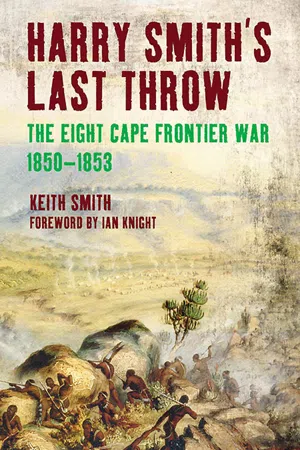
"The War of Mlanjeni was the longest conflict in South African history until the second Anglo-Boer War. The loss of life was substantially heavier than that of the Zulu War of 1879 and the political after-effects of it were significantly greater than those that followed the Zulu War. The Zulu War has been the subject of numerous accounts but the silence surrounding the Eighth Frontier War is deafening. Harry Smith's Last Throw fills this gap: a moving history, vividly drawn out using eye-witness accounts. The narrative is not limited to the British perspective. Xhosa accounts have been translated (many for the first time) to avoid an Anglo-centric bias. For both sides by the 8th War there was a great deal of blood to avenge and brutal killings were perpetrated by many combatants. The author provides a colorful backdrop, explaining how the Dutch East India Company came to the Cape to establish a provision station for ships on the way to its East Indies empire. Dutch Burghers settled there but the Company had no interest in Africa itself. In order to be viable farms had to be large and this created a class of independent-minded who looked increasingly to the interior of Africa, pushing the Colonys borders. The wars with the Xhosa were the result of the eventual expansion of these boundaries into Xhosa territory."
Information
Chapter 1
Setting the Scene
The Indigenous People
It would be a grave error to imagine that the land at the southern tip of the African continent was empty of people when the Dutch arrived in 1652 to establish a settlement there. There were, in fact, two numerous peoples already in occupation, as they had been for thousands of years.
The nomadic San, or Bushmen, were perhaps the oldest inhabitants of South Africa and were widely distributed. They were a small race physically and depended upon hunting and gathering for subsistence. The men hunted game using spears and poisoned arrows while the women foraged through the bush searching for wild fruits, berries, tubers and other edible plants.1
The Khoikhoi, known to the new settlers as ‘Hottentots’, were very distant descendants of the San and their language included the same ‘clicks’ found in their ancestors’ tongue. They were, however, a little more sophisticated, being herdsmen of cattle and goats, which they considered represented their individual wealth. The men hunted and the women engaged in agriculture but the people remained quite primitive. While not a nomadic people, they did move with the seasons to take their cattle to better grazing, a process known as transhumance.2
A third people, who lived far to the east of the Cape, were the amaXhosa,3 a part of the numerous Nguni, a Bantu sub-group which had gradually moved south from the sub-Sahara.4 The central part of the country was high plateau, arid and sparsely grassed, thus requiring the Nguni to follow a broad coastal path.
The Nguni shared a common language, including the clicks of the San and Khoikhoi, but as separate clans were established, so the language of each took on variants. Even so, the many different Nguni people such as Zulu, Mbo, Mpondo, Thembu and Xhosa, could still understand each other’s speech without much difficulty.
The Xhosa were the most numerous people to be found on the periphery of the nascent Cape colony. Like many other Nguni, the constituent clans were often named after a male ancestor in the remote past, a name known as a patronymic.
They were culturally little different from the Khoikhoi, their lives also being dominated by cattle, their external form of wealth, and the land on which the cattle grazed. Ownership of the land did not rest with individuals but was controlled by the chiefs, who made it available to their people. In short, it was a feudal society. The men did little work, the tending of the herds being the responsibility of youths and boys, while the women cared for their families and tended the gardens in which they grew Indian corn (maize or mealies) and other vegetables. Their diet also included honey, wild figs and berries. Compared with the Khoikhoi, however, their skills in animal husbandry and simple agriculture were more highly developed, and they were also able to fashion iron tools and weapons.
There were two essential features which governed relationships in Nguni, and therefore Xhosa, society. The most important was that of exogamy: marriage was not permitted between members of the same extended family, thus ensuring that the blood line remained open. Xhosa chiefs, for example, frequently took Thembu wives. (The Thembu were also a Nguni people who lived on the northern periphery of the Xhosa, especially the Gcaleka. Their life-style and weapons were much the same as the Xhosa.)
The second significant feature was that inheritance of the chieftainship was not based upon simple primogeniture, that is, inheritance by the firstborn male, but by a more complicated method through the ‘chief son’.
According to Xhosa custom, the chief ’s first wife was known as the founder of the ‘Right Hand House’ because of the position of her hut in the umuzi (homestead) relative to that of the chief. However, the chief was succeeded, not by the first wife’s son but by the oldest son of the ‘Great Wife’ whom he often married later in life, thus creating the ‘Left Hand’ or ‘Great House’.5 This son was normally named as the chief ’s successor before his father’s death. This means of succession was perhaps the single most frequent cause of disharmony in families and clans, frequently leading to conflict.6 It is a discord that we shall see often as our story unfolds.
The Cape Settlement
On 7 April 1652 the Dutch East India Company (Vereenigde Oostindische Compagnie, or VOC) founded a settlement at the Cape of Good Hope, under the leadership of Jan van Riebeeck, on the small plain on the shore of Table Bay, in the shadow of the rugged mountains almost encircling it. Its purpose was to enable ships en route to or from the Company’s colonies in what is now Indonesia, to re-provision with fresh water, meat and vegetables. Repairs could also be made to vessels if required. The men who served under van Riebeeck were employees of the Company and were not therefore free to do as they chose.7
The Khoikhoi were obstructive to the settlers and initially refused to trade with them. In time, however, they were seduced by the trade goods that the white newcomers had to offer and, over the first century of white occupation, lost touch with their heritage, being reduced to the status of workers for the colonists.
Unlike the San, the Khoikhoi were eventually prepared to intermix with other races, including white men, and between these two and the (often Asiatic) slaves who escaped from the colony, founded what can only be called a coloured mixed race. Some of these people drifted off to the north, where they established themselves as a people known as Bastaards, or Griqua.
The early settlement at the Cape consisted of two simple elements: a mud-brick fortress near the shore of Table Bay and a large rectangular garden nearby for the growing of food. (Remarkably, much of this garden remains: it is at the centre of Cape Town, and is still known as the Company Garden.) Grazing land was also appropriated for the few cattle which were brought in, and the inhabitants lived in hovels that were quickly thrown up. The old fort was eventually replaced by a larger one, built of stone, in 1679.
The early years of the settlement were miserable indeed and the inhabitants were frequently close to starvation. They were timid and suspicious, making them slow to establish trade relations with the indigenous population; those San remaining in the area were quick to move away from the white men.
In 1656 van Riebeeck decided that instead of binding the settlers to the Company, some should be allowed to take up their own land to develop private farms. The spirit of free enterprise quickly took root. The Khoikhoi were subsequently even more severely affected by this extension of European grazing land – land which they themselves had used since time immemorial.8
During the following ninety years, the settlement expanded to become a substantial colony, expanding progressively as far as the high plateau to the north and taking over a considerable amount of land to the east, though never seeming to have enough of that precious commodity. This was not as surprising as might be thought: each ‘Boer’, or farmer, demanded one or more farms of at least six thousand acres, plus farms of the same size for each of their sons, in order to compensate for the frequently poor quality grazing. This occupation of land was always, of course, at the expense of the aboriginal owners. Over time the troublesome San had been hunted down or driven to the mountainous or arid fringes of the expanding colony and the Khoikhoi had become totally subservient to their new masters.
The administration of the Cape had, during this period of rapid expansion, recognised that it must exercise some control over the burgeoning colony and in 1743 had set the eastern boundary at the Brak River. The Boers, however, anxious both to escape the control of the Company and to appropriate new lands, had progressed still further east. In 1770 the border was moved to the Gamtoos River and only five years later it was placed on a line from the Upper Great Fish River through the Bushmans River to the sea – but still the Boer farmers outran it.
Between 1775 and the end of the century, the Dutch fought two wars in defence of their new frontier: the first was in 1781 and the second was in the years 1789 – 93. Both of them were against the new obstacle to their expansion – the Xhosa. Both wars had their origins in the scarcity of two resources: land and cattle. The Xhosa had always enjoyed a tradition of cattle theft among themselves and, in meeting with white settler-farmers who also raised cattle, their theft extended to the animals of the Boers. It was also very unsettling for a Boer farmer to awake one morning and find his farm overrun by Xhosa, busily building their imizi, or homesteads, on what they had thought to be their land.
By the eighteenth century the Xhosa had roughly divided into four great families, all descended from a remote common ancestor, Tshawe. These families were the Tshawe themselves, the Ntinde, Mdange and Gwali. Much of Xhosa history prior to the incumbency of chief Tshiwo, a great-great-great-grandson of Tshawe, is shrouded in myth and the early genealogies remain uncertain.
When Tshiwo died in the early eighteenth century, he was survived by his brother Mdange and a son of the right hand house, Gwali. Tshiwo had taken a great wife but she had not yet borne him a son, so Gwali became the new paramount chief. But at the time of Tshiwo’s death, his great wife was carrying his child and Mdange hid her, and subsequently her newborn son Phalo as well. Years later, Mdange revealed the existence of the boy and claimed the paramountcy for him. Gwali refused to accept him and in the battle which followed Gwali was defeated and fled south-west across the Kei River, accompanied by Ntinde and his people.
Meanwhile, Phalo took up his role as the new paramount chief of the Tshawe. Mdange eventually followed Gwali across the Kei, leaving Phalo to his own devices. In coming years Phalo had a number of sons, the two most significant of whom were Rharhabe, son of the right hand house, and Gcaleka, of the left hand house and thus the heir to the paramountcy, each of whom were to found their own chiefdoms.
Tensions between Rharhabe and Gcaleka developed because the latter was declared to be a diviner. Rharhabe claimed that this would bring dissension to the clan because diviners were usually common people who dared not ‘smell out’ a chief. Gcaleka, on the other hand, being a chief himself, might have no such qualms. The situation eventually moved to war and in the subsequent battle Rharhabe was defeated and made a prisoner. On his release he too moved into a region that was later called the Ciskei.9 Here, Rharhabe tried to gather together those people who had previously crossed the Kei River. Only the Dange and Gqunukhwebe resisted him. (The Gqunukhwebe was a clan that was originally Khoikhoi but which had, through the services their chief had rendered to Tshiwo, been admitted to the Xhosa.)
In 1775 Phalo, a weak ruler anyway, died and Gcaleka became the paramount chief. He did not survive long either, dying in 1778. Rharhabe chose this moment to attempt to seize the paramountcy for himself, but Gcaleka’s heir Khawuta drove Rharhabe away. In his frustration, Rharhabe hurled himself on the Dange and drove them west across the Great Fish River.
In 1782, Rharhabe was involved in a dispute with the Thembu and died during an invasion of their territory, together with his heir Mlawu. He was survived by his eleven-year-old son Ngqika, whose uncle, Ndlambe, took on the role of regent. Thus we find the paramount chief of the Xhosa, Gcaleka, on the east bank of the Kei River while the Rharhabe, under Ngqika, with the lesser clans, were in the Ciskei to the west.
Ndlambe was the second son of the house of Rharhabe. He was a clever and ambitious man who immediately took up his father’s mantle and challenged the remaining people who had obstructed Rharhabe in his quest to bring all the Ciskei Xhosa under his influence. Ndlambe first brought Langa of the Mbalu under his power, then both of them attacked the Gqunukhwebe, who also then moved still further west across the Fish River in June 1779.
The Xhosa continued their migration west across the Fish River and Boer complaints of theft and conflict continued to assail the administration at the Cape. Finally, in December 1780, instructions were issued to the field cornet at the frontier, now designated ‘Commandant of the Eastern Country’, to negotiate with the Xhosa, setting the Fish River as the boundary between the two races. However, these negotiations were often with minor chiefs and any agreement thus reached would not bind any other chief, nor eliminate further conflict.
* * *
The next major event was the decision by the British to take over the Cape. This step was taken to forestall, they thought, a French bid for the colony. On 11 June 1795, a British fleet sailed into False Bay and landed troops. The small Dutch garrison capitulated only after three months of negotiations and threats and, assuming the title ‘Commandant of the Town and Settlement of the Cape of Good Hope’, Major-General James Henry Craig took command of the administration.10
In 1799, the British fought the brief Third Frontier War (and their first) against the Xhosa, although, not knowing how to contain the enemy, the acting governor, Major-General Francis Dundas, used one of the remaining Dutch administrators to negotiate a peace.11
Far away in Europe, events were taking place that would have a dramatic effect in South Africa. A peace was declared between the French and British, together with their allies, and on 25 March 1802 the Treaty of Amiens was signed. One of its provisions was that the Cape Colony should be returned to its original founders, and the new Dutch administration arrived at the Cape on 23 December 1802.12
A British Colony
This situation did not prevail for long. In July 1805, intelligence reached London that the French again planned to seize the Cape. The Admiralty was also greatly concerned that the Americans too were casting covetous eyes in that direction. In response to these stimuli, a fleet of no fewer than sixty-one ships was prepared in secret and on 31 August it departed with an army of seven thousand troops under the command of General Sir David Baird. By 3 January 1806 it was standing off the South African coast. By the end of February Britain was again master of the Cape, this time permanently.
Between 1806 and 1847 Britain fought three more frontier wars against the Xhosa and, as each was won, so more Xhosa land to the north and east was swallowed up. The Fourth War was fought in 1811 – 12, the Fifth in 1818 – 19 and the Sixth in 1834 – 6.13
During those wars the Xhosa quickly learned that their spears would not win them any battles against firearms, and they abandoned their traditional fighting methods in favour of hit-and-run, or guerrilla, tactics. Their ability to remain almost invisible in heavy bush was soon found to give them a considerable advantage, since the more heavily burdened white soldiers found it difficult to move and fight in such an environment and the invisibility of their foes generated considerable fear.

Around the same time as the second British seizure of the colony, a major change was also taking place in the fo...
Table of contents
- Title Page
- Copyright Page
- Table of Contents
- Genealogical Tables
- Abbreviations
- Foreword - ‘The Land is Dead’
- Acknowledgements
- Introduction
- Chapter 1 - Setting the Scene
- Chapter 2 - I Will Be Governor
- Chapter 3 - War’s Grim Visage
- Chapter 4 - Desertions and Incursions
- Chapter 5 - The Colony Fights Back
- Chapter 6 - The End of the Beginning
- Chapter 7 - The New Battleground
- Chapter 8 - October on the Kroome Heights
- Chapter 9 - The Writing on the Wall
- Chapter 10 - Harry Smith Learns his Fate
- Chapter 11 - Changes
- Chapter 12 - The Peace
- Epilogue
- Notes
- A Note on Sources
- Bibliography
- Index
Trusted by 375,005 students
Access to over 1.5 million titles for a fair monthly price.
Study more efficiently using our study tools.
Frequently asked questions
Yes, you can cancel anytime from the Subscription tab in your account settings on the Perlego website. Your subscription will stay active until the end of your current billing period. Learn how to cancel your subscription
No, books cannot be downloaded as external files, such as PDFs, for use outside of Perlego. However, you can download books within the Perlego app for offline reading on mobile or tablet. Learn how to download books offline
Perlego offers two plans: Essential and Complete
- Essential is ideal for learners and professionals who enjoy exploring a wide range of subjects. Access the Essential Library with 800,000+ trusted titles and best-sellers across business, personal growth, and the humanities. Includes unlimited reading time and Standard Read Aloud voice.
- Complete: Perfect for advanced learners and researchers needing full, unrestricted access. Unlock 1.5M+ books across hundreds of subjects, including academic and specialized titles. The Complete Plan also includes advanced features like Premium Read Aloud and Research Assistant.
We are an online textbook subscription service, where you can get access to an entire online library for less than the price of a single book per month. With over 1.5 million books across 990+ topics, we’ve got you covered! Learn about our mission
Look out for the read-aloud symbol on your next book to see if you can listen to it. The read-aloud tool reads text aloud for you, highlighting the text as it is being read. You can pause it, speed it up and slow it down. Learn more about Read Aloud
Yes! You can use the Perlego app on both iOS and Android devices to read anytime, anywhere — even offline. Perfect for commutes or when you’re on the go.
Please note we cannot support devices running on iOS 13 and Android 7 or earlier. Learn more about using the app
Please note we cannot support devices running on iOS 13 and Android 7 or earlier. Learn more about using the app
Yes, you can access Harry Smith's Last Throw by Keith Smith in PDF and/or ePUB format, as well as other popular books in History & 19th Century History. We have over 1.5 million books available in our catalogue for you to explore.