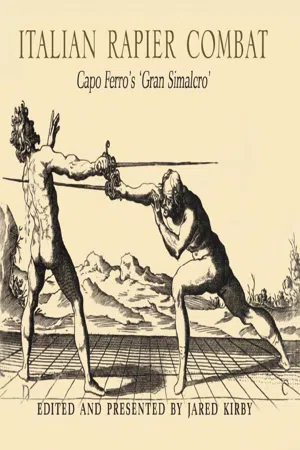
The classic treatise on the art of fencing by the seventeenth-century master, in a fresh translation featuring more than forty beautiful illustrations.
The Italian fencer Ridolfo Capo Ferro was a legend in his own lifetime. His grace and style were emulated throughout a Europe, and his detailed instruction offers a window into his mastery of swordsmanship. This new translation is faithful to the original text while making it accessible to modern readers. It also includes a new introduction and a revised glossary with many newly translated technical terms.
Capo Ferro begins by examining the rapier in detail—its component parts and their suitability—before discussing their actual use. He details the timing and distance needed to control one's adversary, the importance of quick footwork, and defensive tactics such as guards and parries. He also covers using the rapier with auxiliary weapons such as the dagger, cloak, and shield.
Presented by fencing master Jared Kirby,
Italian Rapier Combat is both a vital historical record and an essential guide for any student of fencing.
- 148 pages
- English
- ePUB (mobile friendly)
- Available on iOS & Android
eBook - ePub
About this book
Information
Print ISBN
9781848326453
Subtopic
European Renaissance HistoryCONTENTS
Acknowledgements
Introduction
Glossary
The Grand Simulacrum of the Art and Use of Fencing
Dedication; To the Most Serene Lord Don Francesco Maria Feltrio della Rovere, Sixth Duke of Urbino
General Table of the Art of Fencing
To the Gracious Readers
On Fencing
The Grand Simulacrum of the Use of Fencing
Some Remembrances or True Advices of Fencing
Declarations of Some Fencing Terms that Appertain to the Use
The Plates
Some Terms of the Cut
Secure Method of Defending Yourself from All Kinds of Blows with a Parry of Riverso and Always Striking by Imbroccata
Original Imprimatur
ACKNOWLEDGEMENTS
I would like to dedicate this work to the patrons that made this translation possible.
Without their generous donations and patience this translation could not have come to fruition:
Without their generous donations and patience this translation could not have come to fruition:
William Wilson, The Stoccata School of Defence, Michael Anderson, Tim Ruzicki,
Craig Johnson, Antone Blair, Chris Lyon, Steaphen Fick, Dave Storrs, Fred Kutz,
William S. Ernoehazy, Jr., Kevin P. Menard, Martin Reznick, Art of Combat, John Lennox,
Mtre Alexander Deme, Jason Porter, The School of European Swordmanship, Andrew Feest and
Duncan Fatz — Sussex Rapier School, The School Of The Sword on behalf of Caroline Stewart, Jason
Haggerty, Russell Figgis and Paul Chant.
Craig Johnson, Antone Blair, Chris Lyon, Steaphen Fick, Dave Storrs, Fred Kutz,
William S. Ernoehazy, Jr., Kevin P. Menard, Martin Reznick, Art of Combat, John Lennox,
Mtre Alexander Deme, Jason Porter, The School of European Swordmanship, Andrew Feest and
Duncan Fatz — Sussex Rapier School, The School Of The Sword on behalf of Caroline Stewart, Jason
Haggerty, Russell Figgis and Paul Chant.
I also want to extend a special thank you to Maitre Gérard Six for his generous donation of the
images that are used in this book as well as for his diligent work in the field of fencing.
images that are used in this book as well as for his diligent work in the field of fencing.
Lastly, for their support, time, and effort, I would like to thank the following people:
Ramón Martinez, Jeannette Acosta-Martinez, Martin Resnick, Andrea Lupo ‘Sinclair’, Carol
Crittenden, Val Eads, Ken Mondschein, Greg Mele, Mark Rector, Richard Cohen, Donald J.
LaRocca, Lionel Leventhal, Seth Cunniff, Edgar de la Vega, Jherek Swanger, Aaron and Kathleen
Gormanshaw, Lenard Voelker, Michael Su, Dave Storrs, Suzanne Kirby, Patri Pugliese, The New
Dawn Duellists Society, Swordplay Symposium International.
Crittenden, Val Eads, Ken Mondschein, Greg Mele, Mark Rector, Richard Cohen, Donald J.
LaRocca, Lionel Leventhal, Seth Cunniff, Edgar de la Vega, Jherek Swanger, Aaron and Kathleen
Gormanshaw, Lenard Voelker, Michael Su, Dave Storrs, Suzanne Kirby, Patri Pugliese, The New
Dawn Duellists Society, Swordplay Symposium International.
INTRODUCTION
Ridolfo Capo Ferro’s Gran Simulacro dell’arte e dell’uso della Scherma has been hailed as the pinnacle of all the Italian works on fencing. Many people consider it the most comprehensive, complete and carefully written work ever published on Italian rapier. In his book, Capo Ferro solidifies the foundation of the principles of this art and science. These fundamental principles of fencing had been in use for hundreds of years, but Capo Ferro presented them in a clear, succinct manner which became the framework for many authors to follow.
The focus of the first half of this treatise is on the art and use of the rapier. Capo Ferro defines his terms, presents the principles in an organized manner and discourses in detail about the theory of fencing. There is a presumption in Capo Ferro’s work that the reader has a certain amount of knowledge of fencing theory and a comprehension of the use of the rapier. This was written in a time when men lived and died by the sword, so the knowledge of weapons was of paramount importance. The second half of the book focuses on the practical applications of this basic theory, using 43 illustrations to demonstrate the various techniques and movements, didactically showing the martial use of the rapier, rapier and dagger, rapier and shield, and rapier and cloak.
This monumental work was reproduced many times throughout the seventeenth century. In 1629, an edition was produced which removed the backgrounds from the 1610 illustrations and added intricate artwork depicting Old Testament Bible stories. Nothing is altered from the original illustrations except the background, so instead of fighting in front of rolling hills and castles, the swordsmen are fighting in front of Noah’s Ark and Adam and Eve. In this translation I have chosen to use primarily the plates from 1610 while incorporating several plates from the 1629 edition to familiarize the reader with both. I have also included five pages of the original, together with their translation.
I first became interested in translating Capo Ferro’s opus eight years ago. I had heard many times that Capo Ferro was the greatest fencing master of all time. Considering the high regard in which such notable authors as Egerton Castle and Arthur Wise hold this master, I found it difficult to understand that in four hundred years no one had ever translated his treatise into English. So I began looking for a translator who would take on the project. As new books came out, such as Sydney Anglo’s The Martial Arts of Renaissance Europe (Yale, 2000), Capo Ferro continued to be praised by modern authors. This reinforced the importance of this translation.
I met with many potential translators over the years, but after the initial meeting when they looked at the material, none of them would accept the job. There were two major reasons that translators refused to work on this project. The first reason involved the nature of the highly stylized Renaissance language. It is much like asking someone to translate Shakespearean English into modern Italian. Many of the words that Capo Ferro uses have slightly different meanings now, some words are no longer in use, and others are spelled differently in modern Italian. Therefore, the only way to find the definition is through the use of a sixteenth century dictionary. There are abbreviations that have not been used in centuries. The sentence structure in the sixteenth century would make a modern language professor scream because the grammar has changed so drastically. It is not uncommon to find one sentence that is half a page long, as the use of punctuation was very different. For example, commas are used to break up points, where we use a period today, but a period is only used to end a complete thought, where we start a new paragraph.
The second difficulty arose from the highly technical nature of this work. Without a firm foundation and understanding of the art and science of fencing it is very difficult to comprehend what Capo Ferro is explaining and thereby translate his true intention and meaning. After five years of searching for someone in the United States, I finally decided to employ a professional translator in Italy who was familiar with text like this. Thus the Capo Ferro Translation Project was born. I set up a fund to help raise money in order to pay this professional translator. Many scholars and practitioners of the sword generously donated to support this effort and several organizations lent their help, such as the New Dawn Duellists Society and Swordplay Symposium International.
The translator worked on this project for two years and I finally received the completed manuscript with much excitement. To my surprise and dismay, it was riddled with errors. There were words mistranslated, entire sentences missing, and very little of the material made sense. It was a glaring reminder that regardless of how well someone understands the language and is familiar with historical fencing, a full unde...
Table of contents
- Cover
- Half Title Page
- Title Page
- Copyright Page
- Contents
Trusted by 375,005 students
Access to over 1.5 million titles for a fair monthly price.
Study more efficiently using our study tools.
Frequently asked questions
Yes, you can cancel anytime from the Subscription tab in your account settings on the Perlego website. Your subscription will stay active until the end of your current billing period. Learn how to cancel your subscription
No, books cannot be downloaded as external files, such as PDFs, for use outside of Perlego. However, you can download books within the Perlego app for offline reading on mobile or tablet. Learn how to download books offline
Perlego offers two plans: Essential and Complete
- Essential is ideal for learners and professionals who enjoy exploring a wide range of subjects. Access the Essential Library with 800,000+ trusted titles and best-sellers across business, personal growth, and the humanities. Includes unlimited reading time and Standard Read Aloud voice.
- Complete: Perfect for advanced learners and researchers needing full, unrestricted access. Unlock 1.5M+ books across hundreds of subjects, including academic and specialized titles. The Complete Plan also includes advanced features like Premium Read Aloud and Research Assistant.
We are an online textbook subscription service, where you can get access to an entire online library for less than the price of a single book per month. With over 1.5 million books across 990+ topics, we’ve got you covered! Learn about our mission
Look out for the read-aloud symbol on your next book to see if you can listen to it. The read-aloud tool reads text aloud for you, highlighting the text as it is being read. You can pause it, speed it up and slow it down. Learn more about Read Aloud
Yes! You can use the Perlego app on both iOS and Android devices to read anytime, anywhere — even offline. Perfect for commutes or when you’re on the go.
Please note we cannot support devices running on iOS 13 and Android 7 or earlier. Learn more about using the app
Please note we cannot support devices running on iOS 13 and Android 7 or earlier. Learn more about using the app
Yes, you can access Italian Rapier Combat by Jared Kirby in PDF and/or ePUB format. We have over 1.5 million books available in our catalogue for you to explore.