The social and political aspects of ancient kingship are examined in this historical study of the Hellenistic period.
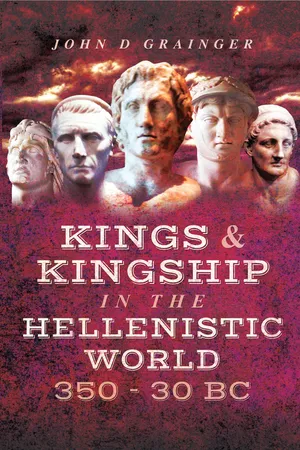
For the crucial centuries between Alexander the Great and the Roman conquest of Macedon, the Mediterranean world was overwhelmingly ruled by kings. This fascinating history examines the work, experience, and preoccupations of these monarchs. Rather than presenting a chronological narrative, John Grainger takes a thematic approach, highlighting the common features as well as the differences across the various dynasties.
How did one become king? How was a smooth succession secured—and what happened when it was not? What were the duties of a king, and what were the rewards and pitfalls of rule? These are just a few of the topics examined in this original and fascinating book.
- 272 pages
- English
- ePUB (mobile friendly)
- Available on iOS & Android
eBook - ePub
Kings & Kingship in the Hellenistic World, 350–30 BC
About this book
Information
Chapter 1
Becoming a King
The true progenitor of Hellenistic kingship, despite the varied models available from Sicily to Persepolis, was Philip II of Macedon (359–336). He was a usurper, and his successor, Alexander the Great, seized the throne of Macedon in a coup d’état in which the rightful king, Amyntas, who had been displaced by Philip but left alive, was murdered, as were a whole series of other likely competitors then and in the following years. When Alexander died in 323 his halfwit half-brother Philip III Arrhidaios and his unborn son (who became Alexander IV when born) were made kings by acclamation of the army in spite of the recommendations of the senior commanders. Both of these kings were murdered, as was Alexander’s sister Kleopatra who, by marrying, might have awarded the kingship to a husband, and so was his illegitimate son Herakles. Their deaths all-but extinguished the dynasty. Some time after the secret murder of Alexander IV in about 310 BC, the man who claimed to be his political heir, Antigonos Monophthalamos, proclaimed himself, and his son Demetrios Poliorketes at the same time, as the successors to Philip and Alexander. Antigonos was, however, neither king in Macedon nor did he have control over several other regions which Alexander had ruled.
In quick succession those who did control the areas free of Antigonos’ rule, Ptolemy in Egypt, Seleukos in the east, Kassandros in Macedon and Lysimachos in Thrace, also proclaimed themselves kings, and they were soon joined by the new tyrant Agathokles as king in Sicily. Each of these men based his authority on control of an army. Suddenly, within about a year, the Hellenistic world went from having no visible king (though documents were dated by the years of Alexander IV until 306, as though he was still alive) to having no less than seven kings – plus three more who had survived from the pre-Philip times.
The pattern was thus set for the next two centuries: kings were made by self-proclamation, by coups d’état, by usurpation, or by hereditary right, and to maintain their claims they needed clear military support. In that sense they were ‘military monarchies’, though they soon shed that image, if not the reality. One of the aims of these kings was to cultivate their legitimacy as royal rulers, which required presenting themselves as kings by right, rather than to obviously relying on force. Therefore, by a variety of means it became expected that the eldest son of a king had the greatest right to succeed him, though it was also necessary that he be nominated by his predecessor – unless, like Philip and Alexander and the new kings, he could carry out a coup. Inheritance from father to son in such a way was normal in Greek society, and these jumped-up kings therefore simply went along the groove of the society in which they had grown up. This did not mean, however, that the sons had necessarily to wait until their fathers died to inherit the kingship. One of the reasons for the disintegration of the Hellenistic world of the kings, and its conquest by Republican Rome was that usurpation became steadily more common, even acceptable, as a means of becoming king. The royal families thus undermined their own system.
For a time, nevertheless, heredity and direct inheritance worked best. The early greater dynasties established the pattern of the eldest surviving sons succeeding their fathers, and in three cases this system lasted for a century and more, but their histories also demonstrate the difficulties involved. The most stable dynasty for some time was that founded by Ptolemy son of Lagos, called Soter (‘saviour’), in which son succeeded father from 306 BC to 145 BC, a line of six kings. In only one case did the eldest son not succeed, when the son of Ptolemy II (Ptolemy ‘Epigonos’, ‘the Son’) was murdered while acting for his father as viceroy in Ephesos; but, not to worry, Ptolemy II had a spare son who became Ptolemy III.1 However, on a more detailed view this dynasty was less stable than it seemed. The first succession, from Ptolemy I to Ptolemy II, was disputed, and only secured by a series of murders; the fifth king was murdered; the sixth disputed the kingship for almost half a century with his brother. Direct hereditary succession was not necessarily therefore a guarantee of peace and dynastic tranquillity. There was a dispute, that is, more or less every time a king died.
The least successful of the early dynasties in establishing hereditary succession – apart from the Argaiad dynasty of Philip and Alexander – was that of Antipater, who had been regent for Alexander the Great and his successors while Alexander was away conquering in the east. Antipater never made himself king (he died in 319 loyal to Philip III and Alexander IV), but his son Kassandros did take the royal title (and was the instrument of the death of Alexander IV).2 He could claim a certain hereditary right in that he had married one of Philip II’s daughters, Thessalonike – who was thus the aunt of the murdered child. Their son succeeded as Philip IV when Kassandros died, but he died soon after his father, apparently from illness; the next two sons, Antipater and Alexander V, succeeded jointly, but quarrelled, one killed the other (and his mother), and the survivor was killed by a rival.3 The dynasty thus failed within three years of Kassandros’ death. (Thessalonike had been murdered by her son even before this final debacle.) And yet Antipater’s progeny was widely spread through the other dynasties by the marriages of his many daughters, who married contemporary kings – Demetrios, Lysimachos, and Ptolemy among them – so that Antipater’s succession, while it failed in the direct male line, lived on through the other dynasties.
Kassandros’ dynasty, however, failed as kings of Macedon, and two other kings of those who also proclaimed themselves in 306–305 failed to establish any sort of a dynasty. Agathokles of Sicily had, like the others, forced himself to territorial rule first, then proclaimed himself king. He had a turbulent time facing rebellions and invasions, but generally succeeded in holding on. He was brought into the society of Hellenistic kings by marriage with Theoxene, one of Ptolemy I’s daughters. But he had older children, and reserved the succession to them. Or so he intended, and he sent Theoxene and her children back to her father to clear the way. But in a lurid episode of violence and betrayal his son and grandson both died as he himself was dying. The intended dynasty thus lasted only one lifetime, though the monarchy he established was soon revived by one of his commanders, Hiero.4
The other failed dynast was Lysimachos, who began his royal career as ruler of Thrace, for which he had had to fight hard and long, and he acquired perhaps the most potentially powerful of the successor kingdoms, Asia Minor, to add to his territories in Thrace, when he and his allies defeated Antigonos Monophthalomos, and to these territories he later added Macedon. This great realm, stretching from the Pindus Mountains to the Taurus, gave him access to a greater armed power, military and naval, and to greater economic power, than any of the other kings, and he had long shown that he was expansionist-minded.5 He was, therefore, an obvious threat to the other kings. Yet simply by quarrelling with his eldest son, the very capable Agathokles, and then ordering his execution, Lysimachos forfeited whatever acceptability he had gained among his subjects. (He was not particularly wellliked, being harsh and unforgiving, but was latterly accepted in part because Agathokles was popular and expected to succeed – which may well be one of the reasons why Lysimachos came to dislike him so much that he had him executed.) His unpopularity therefore made him vulnerable, and when his kingdom was invaded by Seleukos, he received less than full support from his family and his subjects, and none from the international enemies he had made; he died in the final battle.6 Like both Agathokles and Antipater, he lived on through the marriages of his daughters, for a time.
Lysimachos’ nemesis was Seleukos, who succeeded in founding a dynasty which, while not so successful in contriving a direct hereditary succession as was that of Ptolemy, was certainly successful in keeping the kingship within the family for more than a couple of centuries. There were several near disasters in the process, however, and the dynasty more than once was on the verge of destruction or extinction. The second king, Antiochos I, felt compelled to execute his own eldest son, Seleukos, presumably for displaying a too-obvious ambition and eagerness to succeed his father.7 The death of Antiochos II (who became king because Seleukos the prince was dead) led to a disputed succession between his two wives and three of his sons, and twenty years of civil war.8 Twenty years later the dynasty was reduced to a single unmarried male representative, Antiochos III, who faced two rebels, both seeking to remove him, an intriguing minister who may have had greater ambitions, and a war with the current Ptolemy.9 Forty years later again the interference of Rome interrupted the direct succession. Demetrios, the eldest son of Seleukos IV, was held hostage in Italy, which let his uncle Antiochos IV seize the throne, who then murdered his nephew Antiochos, who was technically king, but under age.10 After that the condition of the dynasty only deteriorated to a long series of murders and usurpations. The dynasty was obviously vulnerable, and during the next century the members of the family disputed the succession in every generation.
Even more hair-raising was the zigzag progress – if progress is a suitable term in the context – of the dynasty founded by the first man to make himself a Hellenistic king, Antigonos I. He had made his eldest son Demetrios king along with him, but the two of them tended to operate separately. Antigonos after all was 76 years old when he made himself king in 306, and so he left active campaigning to Demetrios.11 But Antigonos’ ambition never waned, and he was finally brought down, still actively fighting, in battle at Ipsos at the age of over 80, by a coalition of his enemies, who had finally combined with the intention of doing just that. Demetrios survived and escaped from the final battlefield, then roamed the seas with his fleet for several years before seizing Macedon (he was the one who killed off the last of Antipater’s grandsons). But he was as arrogant and ambitious as his father, and when the Macedonians finally realised his ambition they threw him out. He campaigned into Asia Minor, but was shepherded out by Lysimachos’ son Agathokles (whose success only fuelled his father’s antagonism). Demetrios was finally captured by Seleukos, kept in gilded confinement, and died of drink; he had made as comprehensive a set of enemies as his father.12
Between the death of Antigonos I in 301 and that of Lysimachos in 281, seven kings died, only three of them by ‘natural causes’, and three potential dynasties were extinguished. This was followed by the invasion of Macedon and Greece by the Galatians, in the course of which members of the Ptolemaic, Antpatrid, and Lysimachid families all died. It was, that is to say, a dangerous profession, being king.
The death of Demetrios might have been the end of this brief dynasty, but Demetrios had an able son, Antigonos II Gonatas, much less mercurial, more cautious, and eventually more successful. He inherited his father’s fleet and his ambition to rule in Macedon. This took some doing, but in the end, by taking advantage of the kingdom’s destruction by the invasion of the Galatian barbarians, Antigonos succeeded in making himself king. (His most masterly ploy was to recruit an army of Galatians, and use it to drive out the other Galatian invaders; this is the sort of achievement, cunning and anti-barbarian, that appealed to the Hellenistic public.) He was the true founder, or refounder, of the dynasty, which lasted another century in Macedon until the final king, Perseus, was destroyed by Rome – a result which the locals no doubt considered to be another barbarian invasion.
These dynasties therefore exhibit in their beginnings the characteristic methods of becoming king, methods which became normal, if that is the right word, for the next two centuries and more. The requirements were ambition, control of an army, above all one of Macedonian soldiers, victory, and dominance of an extensive territory. These became the necessary basic requirements for later kings, though a king who inherited a throne was under less pressure to exhibit ability and ambition than a man who set out to found his own dynasty anew.
Once in control of the kingdom a king was thereafter preoccupied with two things, first holding onto the territory he had gained and increasing it if possible, and second, retaining his royal position and passing it on to his son. Kings faced competition from opponents, notably in the two-centurylong rivalry between the Ptolemies and Seleukids for control of Palestine and Phoenicia (Koile Syria), but there was also the problem of maintaining control of relatively distant parts of the kingdoms, some of which were very large. This latter issue particularly affected the Seleukid kingdom, which sprawled from the Gallipoli Peninsula to the Hindu Kush when its founder died. Over the next two centuries sections of the kingdom broke away and were formed into independent kingdoms – notably in Baktria in the Far East, in southern Iran, and in Asia Minor – and in each of these regions the new kings had to exhibit the requirements of the founders of the original dynasties, usually by defeating an attempt by the parent kingdom to recover control. Egypt suffered similar secessions, notably when Cyrenaica broke away (more than once), but also in a huge rebellion by native Egyptians during which the rebels founded a new pharaonic regime in the south of the country which lasted for two decades.
All of the original founders of the greater dynasties had been military commanders, learning their military trade as participants in the wars of Philip II and Alexander the Great. Their original power rested unequivocally on command of their soldiers. This became the crucial element in the exercise of royal authority, and every new king, however he achieved that position, was required to demonstrate military success, if not necessarily military prowess (on which see Chapter 9). But there was a difference between the upstart kings and the kings by inheritance. The upstarts had to begin by demonstrating their military ability, while for those who inherited the reverse was the case: they started as kings and then showed military capability.
It was even necessary to achieve successes against the same enemies as their rivals and competitors. So Antigonos II defeated the Galatian invaders of Macedon in the early 270s, and Antiochos I defeated the Galatian invaders of Asia Minor later in that decade; therefore it followed that their competitor Ptolemy II was under the necessity of achieving a Galatian victory as well, which he did when a regiment of Galatian mercenaries he had recruited went on strike, and he used the rest of his army to besiege and destroy them, thereupon proclaiming himself the victor in a Galatian war.13 His contemporaries and rivals no doubt regarded this achievement with sardonic amusement, but it also suggests a powerful awareness of the uses of political propaganda for the royal reputation.
These new kingdoms were not always successful – the rebel Egyptian kingdom was extinguished after only twenty years, and that of Antiochos III’s cousin Akhaios in Asia Minor after less than ten – but their founder kings used the same self-proclamation methods as the original founders of the greater dynasties.
The process of forming a new kingdom out of a fragment of another largely depended on securing the support, paradoxically, of an existing king. The early kings were so overwhelmingly powerful that an ambitious would-be king had to tread very lightly and carefully, a mouse among the clumping feet of the great elephants. It could take a generation or more to go from the original founder of the dynasty who proclaimed himself king to achieve recognised royal status, the intervening period being occupied with supporting the greater dynasty, as an ally or a client, or simply keeping quiet in the hopes that one of the kings would not turn on the aspirant. Two detaching fragments of the Seleukid kingdom may be taken as examples. In Asia Minor a man called Philetairos, probably originally a Paphlagonian, but from his name a Greek-speaker, and who certainly acted as a Greek throughout his life, had been appointed by Lysimachos as custodian of a royal treasure held in the fort at Pergamon. When Seleukos attacked Lysimachos in 282, Philetairos chose to support Seleukos. It is presumed that this decision was based on Philetairos’ calculation of political advantage to himself, but it may also be that he did not like Lysimachos or his policies, even though he had been trusted by the king. Philetairos was able to demonstrate his loyalty towards the Seleukid family only a year later. Seleukos had been murdered as he visited an isolated altar on the Gallipoli Peninsula, and his body left lying where it fell; Philetaros recovered the body, cremated it ceremonially, and handed the ashes over to Seleukos’ son and successor, Antiochos I, when he arrived in Asia Minor, perhaps a year later.14
Philetairos’ custodianship of Lysimachos’ former treasure appears to have continued under his conqueror, and by putting Antiochos under an obligation Philetairos was safe in his local eyrie until he or Antiochos died. He developed and fortified the castle of Pergamon, presumably using part of the treasure entrusted to him, and the castle became the basis of a new city; the treasure does not ever seem to have been claimed by either Seleukos or Antiochos. Philetairos had no children of his own – and was later rumoured to be a eunuch – but he had nephews and it was one of these who succeeded him in control of Pergamon when Philetairos died. This was Eumenes I, and for the representative of the family which originated with a man who was probably no more than a glorified clerk, it was necessary for Eumenes to demonstrate military ability if he was to retain any real authority. He did so by defeating a force supposedly commanded by Antiochos I, in about 263.15 This was ignored by Antiochos, and it was scarcely serious enough to do more than cement Eumenes’ local authority in Pergamon and its surrounding countryside, but that is what it did. (It seems unlikely that Antiochos was the victim, and we probably have here another example of royal propaganda manipulating the truth; it may be significant that despite such a victory, Eumenes never claimed the royal title.) Eumenes was successful enough to be able to hand on his power in his small principality to his son Attalos in 241, and Attalos lost no time in describing himself as a king. He succeeded at a time when the Seleukid family was involved in a civil war, and he gained a useful military reputation by defeating an army of Galatians, who terrified the cities of Asia Minor unless they were restrained by just such a defeat as Attalos administered. This victory further entrenched his and his family’s local power, and he was able to extend his grip from Pergamon towards the sea, where he developed the small port of Elaia into a naval base.16
It may be, in fact, that Antiochos ignored his defeat by Eumenes because he scored his victory over one of Antiochos’ generals. This sort of thing had been something of a local specialty. In 281,...
Table of contents
- Cover
- Title
- Copyright
- Contents
- Introduction
- 1. Becoming a King
- 2. Kings and the Gods
- 3. Kings and Kings
- 4. Kings, Wives, and Children
- 5. Kings and Palaces
- 6. Kings and Governing
- 7. Kings and People
- 8. Kings and Cities
- 9. Kings and War
- 10. Kings and Death
- 11. Kings and Intellectuals
- 12. Usurpations, Legitimacy, and Extinctions
- 13. Kings and Rome
- Appendix I: Dynasties
- Appendix II: Suppression of Monarchies
- Notes
- Bibliography
Trusted by 375,005 students
Access to over 1.5 million titles for a fair monthly price.
Study more efficiently using our study tools.
Frequently asked questions
Yes, you can cancel anytime from the Subscription tab in your account settings on the Perlego website. Your subscription will stay active until the end of your current billing period. Learn how to cancel your subscription
No, books cannot be downloaded as external files, such as PDFs, for use outside of Perlego. However, you can download books within the Perlego app for offline reading on mobile or tablet. Learn how to download books offline
Perlego offers two plans: Essential and Complete
- Essential is ideal for learners and professionals who enjoy exploring a wide range of subjects. Access the Essential Library with 800,000+ trusted titles and best-sellers across business, personal growth, and the humanities. Includes unlimited reading time and Standard Read Aloud voice.
- Complete: Perfect for advanced learners and researchers needing full, unrestricted access. Unlock 1.5M+ books across hundreds of subjects, including academic and specialized titles. The Complete Plan also includes advanced features like Premium Read Aloud and Research Assistant.
We are an online textbook subscription service, where you can get access to an entire online library for less than the price of a single book per month. With over 1.5 million books across 990+ topics, we’ve got you covered! Learn about our mission
Look out for the read-aloud symbol on your next book to see if you can listen to it. The read-aloud tool reads text aloud for you, highlighting the text as it is being read. You can pause it, speed it up and slow it down. Learn more about Read Aloud
Yes! You can use the Perlego app on both iOS and Android devices to read anytime, anywhere — even offline. Perfect for commutes or when you’re on the go.
Please note we cannot support devices running on iOS 13 and Android 7 or earlier. Learn more about using the app
Please note we cannot support devices running on iOS 13 and Android 7 or earlier. Learn more about using the app
Yes, you can access Kings & Kingship in the Hellenistic World, 350–30 BC by John D. Grainger in PDF and/or ePUB format, as well as other popular books in History & European History. We have over 1.5 million books available in our catalogue for you to explore.