The story of a Middle Eastern pilot's life—from his childhood in Tel Aviv during WWII to his early career in the Israeli Air Force to the Lebanon War.
General Amos Amir's autobiography tells the story of the man, the warrior and the commander and the story of the struggling, newly-born, Israeli Air Force. From the Six Day War of 1967 and onward, the IAF turned to be an extremely important component of the overall Israeli defense power. The years from the Sinai War in 1956, through the Six-Day-War, the Yom Kippur War in 1973 and the Lebanon War in 1982, were the years of Amir's flying, fighting and commanding career.
Amir tells his own story in talented, vivid and fluent language. He succeeds in pulling the reader into his narrow cockpit from the early stages of his flying school to later air combats and reconnaissance missions. Tense dogfights, long-range reconnaissance missions and memorable aerial episodes, including piloting a Phantom jet from the deck of the American carrier
Kitty Hawk, are vividly described. The book reveals previously untold stories about the traumatic Yom Kippur War of 1973 and the early stages of the war in Lebanon in the 1982.
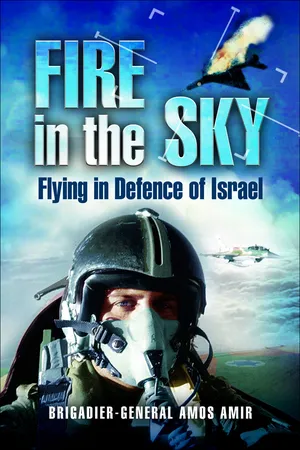
- 224 pages
- English
- ePUB (mobile friendly)
- Available on iOS & Android
eBook - ePub
About this book
Information
CHAPTER ONE
Tel Aviv Skies, 1943
I was riding atop my father Aryeh’s shoulders, and both of us were gazing west out to sea from the promenade beside Tel Aviv’s shore. I was a child of eight, of rotund though not corpulent build, with golden curls and blue-green eyes. I was well-tempered and quick on the uptake, making friends easily wherever I went. Furthermore, I was my parents’ pride and joy.
It was during the Second World War: at the time of the clashes between the Allies and the Germans in the North African desert, and the Italian air strikes on Tel Aviv. Air-raid sirens would occasionally shatter the stillness during the nights.The lights of the city and the houses were darkened. Car headlights were painted black, leaving only a narrow strip of illumination for the purpose of orientation and identification. The civilian guard supervisors paced down the city streets, blowing their insistent whistles and shouting loudly, ‘Turn off the light! Up there on the second floor, turn off the light!’, to the delight of all the neighbourhood children.
I have fond memories of the nights during that period. When my parents grew tired of trudging back and forth to the narrow and cluttered basement that served as our shelter, the whole family set up camp together in the hall, underneath the massive dining table that stood in the middle of the room. There, between Mother and Father, curled up in a thick blanket, I felt as secure as I could possibly be.
Every week, early on Saturday evening, Father would sit down at the big black desk in his room, in shorts and a vest to analyse the war’s progress. He would spread out large maps of Europe and North Africa, marking the movements of the various forces with big arrows.
‘This is as far as Marshal Zhukov’s forces have got. And this is the line that General Teherniakovski has retreated to. This is where we can expect the stupendous clash to take place between Rommel’s German armour and British Field Marshal Montgomery’s divisions. And here, in Brittany, is where the Second Front will open, most likely’, he would mutter, partly to himself and partly perhaps to me, with immense gravity, as if the outcome of the battles depended on him.
I would usually climb atop a stool to see my father’s maps and hear his explanations, which were like the word of God to me. Nachum Gutman, the eminent painter and a family friend of ours, was a frequent visitor to the house. I loved Nachum dearly: he was an ingenuous, warm and wonderful man, who was like an uncle and a grown-up companion to me. With a beret perpetually perched upon his head, Nachum would lay down his paintbrush in his house next door to ours, come inside and sit down beside my father, and try – usually in frustration – to make some sense of the strategic situation in the world.
‘Aryeh, Aryeh. Tell me, what is going to be?’ he would ask, like someone lost in the wilderness.
‘Amos, in these matters I trust your father implicitly,’ he would turn and confide in little me, when he grew tired of Father’s explanations.
From the radio came the voice of Efraim Goldstein (who would one day change his name to Di-Zahav) singing the Mavdil, the Hebrew prayer which marks the end of the Sabbath, and concluding with a warbling rendition of Shavua Tov (‘Good Week’). After Nachum had gone home, during dinner we would listen to Voice of Jerusalem radio, to the political review of commentator Moshe Medzini, of whom my father was always bitingly critical, but to whom he never stopped listening. My mother Anda and I were his dutiful, and certainly sympathetic, audience.
My father and I had a custom of going to visit Grandmother Matilda every Friday afternoon. We would troop down Rashi Street and pass by the Orion theatre. From there, opposite the bustling Atara café, we would continue down Allenby Street from the corner of Geula Street to the promenade beside the beach.
On our way we would sometimes stop in Mugrabi Square, at the foot of the clock, and Father, feeling gracious, would buy me a hot dog with mustard from the burly gentleman who was always there. He stood upright behind the shiny copper tub, drawing out a bun from the bin on the right, picking out a hot dog with the copper tongs from the bin in the middle, and spreading golden mustard from the bin on the left on top of it. The burly gentleman spoke feeble Hebrew with a pronounced German accent. He always wore a long white cloak and a white cook’s hat. It was said by those in the know around town that the gentleman had been a great opera singer in Austria, before immigrating to Israel and occupying his central position in Mugrabi Square. Often in my bed at night, before falling asleep, I would try to imagine the ‘hot dog gentleman’ singing on the opera stage. Time and again, the image always made me laugh.
In the reddening western sky the sound of aircraft engines was suddenly heard. Two clumps of dark spots were seen in the sky, flying from south to north along the shoreline. My eyes were glued to the spots, which slowly approached the promenade and resolved themselves into two formations of six aircraft each, fighter planes following in each other’s tracks, each sextet perfectly arranged in phased order to the right and backwards.
‘Hurricanes,’ hissed my father Aryeh, who was, as far as I was concerned, the leading authority in matters military, and a corporal (no less!) in His British Majesty’s Army here at home. We both followed the aircraft, which were advancing northwards. Suddenly – just as I had once seen in the Carmel newsreels in the movie theatre – the leading aircraft raised its nose, picked up a little altitude, and began turning and diving to the left and downwards, in the direction of the setting sun. One after another, each at the same speed, the other aircraft followed the leader: first one sextet, and then the other immediately afterwards. To me, at that time and in that place, those twelve aircraft, disappearing to the south between the red sky and blue sea, were a rare and magical sight. I tried to think about the small men inside those big machines, their enormous engines thundering so loudly, but in my mind I was unable to make the connection between such puny people and such huge machines.
This marvellous spectacle remained engraved in my memory for years.
CHAPTER TWO
Fire – Cairo-West Skies, 5 June 1967
At 4 am the telephone rang in our home in the pilots’ neighbourhood. I picked up the receiver even before the first ring had died.
‘Flight briefing at five o’clock,’ said the voice on the other end of the line.
‘Affirmative, roger,’ I confirmed the notification in a clear voice, as if it were taken for granted. There was no need for additional explanations. The order had been given, and the nerve-racking wait was finally over. We were going to attack Egypt in order to remove the suffocating noose it had placed around our country’s neck. There were no doubts or vacillations. Everything was crystal-clear.
For the past three weeks we in the Mirage squadron had been ‘scraping the rust,’ so to speak. The pilots had been assiduously reviewing their targets; practising the prospective attack formations time after time in training flights; and going over the possible scenarios and responses, mishaps and emergency routines, procedures for rescue and being captured by the enemy; and every other vital detail – going over them almost ad nauseam.
Before leaving the house, I caught sight of the date in the calendar: 5 June 1967. I bent over and kissed Rachel, who drowsily bid me, ‘Good luck!’, in an understanding and courageous manner. I passed my fingertips over the cheeks of our two boys, and stepped out into the chill of the night.
Yes, I could feel the fear: a compressed, hidden, camouflaged fear, stuck somewhere between my gut and my entrails; fear at the threat of the unknown; fear of setting out and not coming back.
We take our places in the briefing room, the senior squadron leaders – myself among them – in front, and the rest of the pilots behind us. Lapidot, the squadron commander, conducts the briefing in a confident tone of voice. On the blackboard, written clearly in white chalk, are the formation rosters, targets, timetables and codes, with the title in prominent letters above them: Operation Moked (Focus). This is war.
‘5 June 1967, one day before the great defeat of Egypt and its satellites. My hand is trembling! Let someone else write!’ wrote Lieutenant Yair Neuman, who was sitting in one of the back rows of the room during the briefing for Operation Moked, the objective of which was to destroy the Egyptian air force in its own airfields. The next day, 6 June, Yair Neuman would be killed during a sortie over Egypt. The handwritten note, which was meant to be the beginning of a war diary, was found in his clothes after he fell.
With a single, swift motion I shut the canopy of my Mirage’s cockpit, glancing at the mechanic, who clambered down and took the ladder aside. Twirling my finger, I signalled my intention to start the engine. The mechanic gave me the thumbs-up, and I pressed the ignition switch. A loud outrush of compressed air was heard, and the powerful jet engine immediately began to turn. At just the right moment came the dull sound of the internal combustion catching fire. The shrill of the jet rapidly grew louder as the engine went into action independently. The ground crew armourer swiftly slipped under the plane’s belly, drew out the security pins from the bombs and cannon, and held them up at a distance for me to see and confirm.
With a last glance at the mechanic standing at the exit, his arm raised to indicate that I had the green light for departure, I began rolling up the rampway out of the hangar. Once again I locked eyes momentarily with the mechanic, who deviated from his routine, impassive procedure and gave me a special ‘Good luck!’ sign, both his arms upraised with fists clenched.
In the unusual silence over the headphones – not a word was spoken and there was none of the electronic noise of communications equipment and radar – the aircraft, which were heavier than usual because of their full fuel tanks and the complement of arms on their wings, were taxiing along all the approaches to the runway. I slipped into my assigned parking spot and saw my numbers two, three and four fall into place next to me. Although we hadn’t been practising in specific designated formations, I was personally very well acquainted with Maoz, Yitzhak and Yochai and had utter confidence in them.
My initial feelings of fear and concern in the face of the unknown gave way to an absolute concentration on the flawless performance which would be required of me. There was room no more for feelings, only for astute or practised action, dedicated in its entirety to the accomplishment of the mission.
I gazed at the formations of aircraft whose take-off times came before mine. One after another they opened up their engines and began their take-off runs. From each engine in turn came the thud of the afterburner kicking in, and an orange flame burst from the gigantic exhaust pipe for the wink of an eye and disappeared. One after another their images grew hazy in the distance, and – quite out of the ordinary – they were not seen to climb after gathering speed but, staying at a low altitude, vanished on their way westward out to sea.
A glance at the clock showed that it was three minutes to take-off: an Aldis lamp, operated by a special supervisory unit in order to avoid using radio, sent a beam of green light in my direction. I pushed the throttle forward, and in response the aircraft began to move onto the runway. Looking right, I saw the faces of Maoz, Yochai and Yitzhak turned towards me, ready and waiting. It was time for take-off. The clock’s second-hand touched twelve. I took my foot off the brake, gave the engine full throttle, and with another twist of my fingers to the left to turn on the afterburner, the aircraft shot forward with that familiar burst of power.
At high cruising speed, the aircraft gathered into a widely dispersed arrowhead formation, with about 300 metres (328 yards) between each one. They flew at very low altitude; the waves passed by underneath in close aspect and vanished to the rear. Number three wagged his wings slightly to draw my attention to a formation of Vautours from Ramat-David Airbase, which were also almost lapping the water and flying from right to left on a course that was converging with ours. Without climbing, the two formations literally passed through each other, not a word being uttered. Only the wagging of the two leaders’ wings indicated that everything was under control. The formation of Vautours passed and disappeared to the left into the morning mist over the sea. This silent encounter left us with a sublime feeling of enormous unity in the overall effort.
It was 7.48: exactly three minutes past ‘h-hour’. Over the earphones we began to hear the voices of pilots from formations that were in the thick of the fight. The clear sounds of battle: the war had begun. I turned the nose of the plane in a south-westerly direction and waited to come up over land. We were flying at a faster speed now, and all at once the blue background of the sea turned into a pattern of grey-green-brown chequered squares from horizon to horizon, the flat expanses of the Nile delta in northern Egypt. Ahead, three peculiar installations that looked like gigantic houses rapidly drew nearer – a bewildering and completely unexpected sight. Another twenty seconds of swift progress and the peculiar apparitions became recognisable. My formation flew over the Suez Canal and the ‘gigantic houses’ turned out to be the superstructures, tall and visible from afar, of the cargo-ships sailing through the canal.
A quick glance at the stopwatch in front of my eyes told me that the sight-seeing tour of the Middle East was over. ‘Red, pull!’ I announced over the radio, and pulled up the plane’s nose at a steep angle. All at once the horizon around me receded, and an incredible sight came into view: in the middle of the farflung, dusty-yellow desert landscape emerged a huge airfield, with black smoke casting a dark shadow over the entire area. My eyes picked out the pattern of runways that I had memorised visually through countless practice runs in the past. With a quick look I ascertained that the planes of the formation were with me and that the sky was clear of enemy aircraft. With a practised hand I rolled the aircraft downwards toward the centre of the runways, to make my bombing run. From the corner of my eye, on my left, I discerned the flashes of flak, apparently from ground anti-aircraft guns, and put any thought of them out of my mind.
Everything that went before and everything that came after was dwarfed at this critical moment, in view of the supreme need to hit the target accurately with the two bombs. In my diving run to the target I flew through a cloud of smoke that momentarily darkened the cockpit. In the light on the other side the ‘peeper,’ the centrepoint of the gunsight, was close to the centre of the runway. I glanced at the altimeter, stabilised the ‘peeper’ over the target, and squeezed the bomb release switch, putting all my heart and soul into it. The escape manoeuvre to the left at high speed dragged heavily on all my limbs with a G-force five times their natural weight. Behind me, in perfect order, I saw my numbers two, three and four diving after me, and their bombs striking and blasting the centre of the runway.
These are the tensest moments of the mission. Soaring away from the airfield to turn and approach again for the next run, the leader must ensure that the entire formation stays together, and that no MiG has managed to slip in among them and latch on to somebody’s tail; and he has to glance over the cockpit instruments for any sign of malfunction. Most of all, he must carefully reconnoitre the airfield area and pick out targets, aircraft, which must be destroyed in the next run. It takes only a few words for the information concerning the identified targets to be disseminated among the formation members. As planned, the rest of the formation climbed to a higher altitude and returned in a relatively steep run to fire their cannon at the planes parked in the slipways, while I straightened out my aircraft to make a low, horizontal run along one of the runways.
An additional two bombs had been hung from the wingtips: these were special munitions, the latest development from the Rafael Armament Development Authority, designed to crack runways from a low altitude. The bomb release was squeezed again, and on the way out – while gathering the formation together for departure – I took advantage of the low overpass above the centre of the airfield to spot several gigantic Egyptian Tu-16 bombers, the bane of Israel until not long ago, parked intact in lots that hadn’t been dealt with yet. After a split-second’s indecision, I ordered the formation to assemble for a third run, noting the location of the targets I’d discovered. The dilemma, swiftly resolved, pitted the risk of being hit by enemy fire during this extra interval and the limited fuel supply ...
Table of contents
- Title Page
- Copyright Page
- On the author and the book: - “Fire in the Sky”
- Table of Contents
- Preface
- CHAPTER ONE - Tel Aviv Skies, 1943
- CHAPTER TWO - Fire – Cairo-West Skies, 5 June 1967
- CHAPTER THREE - Tel Aviv, 1947
- CHAPTER FOUR - Fire – Ras Sudar Skies, 7 June 1967
- CHAPTER FIVE - Growing Up, 1948
- CHAPTER SIX - Fire – Wadi Al-Hafir Skies, 8 June 1967
- CHAPTER SEVEN - Mount Tabor, 1952
- CHAPTER EIGHT - Fire – Aswan Skies, 14 August 1968
- CHAPTER NINE - Mount Tabor, 1953
- CHAPTER TEN - Fire – ‘Texas’ Skies, 24 June 1969
- CHAPTER ELEVEN - Flight Training Academy, 1956
- CHAPTER TWELVE - Fire – Cairo Skies, 17 June 1969
- CHAPTER THIRTEEN - Flight Training Academy, 1957
- CHAPTER FOURTEEN - Fire – Northern Sinai Coast, 8 November 1969
- CHAPTER 15 - Hazor, 1958
- CHAPTER SIXTEEN - Fire – Golan Heights Skies, 2 April 1970
- CHAPTER SEVENTEEN - Nitsana, 1959
- CHAPTER EIGHTEEN - Fire – Port Said Skies, 25 April 1970
- CHAPTER NINETEEN - Hazor, 1962
- CHAPTER TWENTY - Mirages – The Beginning, 1962
- CHAPTER TWENTY-ONE - Love of Rachel, 1963
- CHAPTER TWENTY-TWO - Fire – Hazor Skies, 11 November 1963
- CHAPTER TWENTY-THREE - Hatserim, 1966
- CHAPTER TWENTY-FOUR - Fire – Mount Hermon Skies, 12 May 1970
- CHAPTER TWENTY-FIVE - Tel Nof Airbase, July 1968
- CHAPTER TWENTY-SIX - Fire – Iraqi Skies, May 1970
- CHAPTER TWENTY-SEVEN - Tel Nof Airbase, June 1970
- CHAPTER TWENTY-EIGHT - Fire – ‘Texas’ Skies, 30 July 1970
- CHAPTER TWENTY-NINE - Tel Nof Airbase, August 1970
- CHAPTER THIRTY - Yom Kippur Day, Tel Aviv, 1973
- CHAPTER THIRTY-ONE - California, 1975
- CHAPTER THIRTY-TWO - Tel Nof Airbase, 1977 – 1978
- CHAPTER THIRTY-THREE - Lebanon, June 1982
- CHAPTER THIRTY-FOUR - Hakirya (Defence Ministry Compound), 1982
- Postscript: A Storm Subsides
- Index
Trusted by 375,005 students
Access to over 1.5 million titles for a fair monthly price.
Study more efficiently using our study tools.
Frequently asked questions
Yes, you can cancel anytime from the Subscription tab in your account settings on the Perlego website. Your subscription will stay active until the end of your current billing period. Learn how to cancel your subscription
No, books cannot be downloaded as external files, such as PDFs, for use outside of Perlego. However, you can download books within the Perlego app for offline reading on mobile or tablet. Learn how to download books offline
We are an online textbook subscription service, where you can get access to an entire online library for less than the price of a single book per month. With over 1.5 million books across 990+ topics, we’ve got you covered! Learn about our mission
Look out for the read-aloud symbol on your next book to see if you can listen to it. The read-aloud tool reads text aloud for you, highlighting the text as it is being read. You can pause it, speed it up and slow it down. Learn more about Read Aloud
Yes! You can use the Perlego app on both iOS and Android devices to read anytime, anywhere — even offline. Perfect for commutes or when you’re on the go.
Please note we cannot support devices running on iOS 13 and Android 7 or earlier. Learn more about using the app
Please note we cannot support devices running on iOS 13 and Android 7 or earlier. Learn more about using the app
Yes, you can access Fire in the Sky by Amos Amir in PDF and/or ePUB format, as well as other popular books in History & Military Biographies. We have over 1.5 million books available in our catalogue for you to explore.