- 224 pages
- English
- ePUB (mobile friendly)
- Available on iOS & Android
eBook - ePub
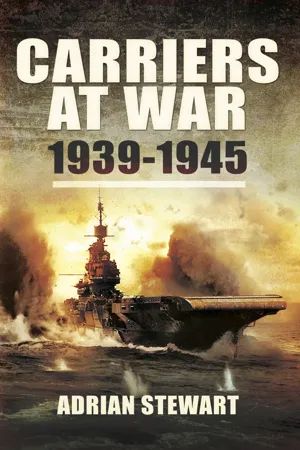
Carriers at War, 1939–1945
About this book
The author begins this fascinating book by tracing aircraft carrier development between the Wars. Eschewed by the Germans and Italians and with Britain squandering her early lead, the Americans and Japanese became front-runners.The Royal Navy learnt the hard way in the early stages of WW2 with the loss of HMS Courageous and Glorious but, following successes at Taranto and Matapan, the value of carriers was no longer in doubt. The sinking of Bismarck and the cataclysmic Pearl Harbor attack signaled the end of the Battleship era. Stung by such spectacular losses the US Navy threw its weight behind the carrier concept and the naval war in the Pacific (Guadalcanal, East Solomon Islands, Santa Cruz, Midmay and Leyte Gulf) revolved round carrier-borne aircraft.Meanwhile the carrier became pivotal in protecting vital convoys in the Atlantic, Arctic and Mediterranean. The author backs his arguments with copious examples of naval and air action.
Information
Chapter 1
The Coming of the Carrier
The date was 12 November 1921. Three years and one day had passed since the end of the war that, it had been promised, would end all wars. This assurance would soon become a hideous mockery; but now, as representatives of the victors assembled in Washington, it was still believed that permanent peace was possible, and one major way to attain it would be to limit the armaments of the great powers. The Washington Conference was concerned with naval limitations and when it concluded on 6 February 1922, with the signing of a number of treaties, it appeared to have achieved its aim and ended a ruinously expensive and potentially dangerous arms race.
First in importance of the agreements reached was the provision that in future the capital ships of the great powers would be maintained in the proportions: Britain: 5; United States: 5; Japan: 3; Italy: 1.75; France: 1.75. By ‘capital ships’, there seems little doubt that most of those present meant battleships and battle-cruisers. These were strictly limited by the ratio agreed and Britain, America and Japan all scrapped large numbers of them that were either already in service or in the course of construction; moreover the standard displacement of future vessels was limited to 35,000 tons and their main armament to guns of 16-inch calibre. In addition, though, probably to the surprise of the more conservative delegates, other detailed regulations were laid down regarding a type of capital ship that as yet scarcely existed: the aircraft carrier.
Of the three countries concerned with the future of the carrier – for the French showed little interest and the Italians even less – it was Britain that had hitherto led the way in its development. Admittedly the first take-off from a temporary wooden platform erected on a warship and the first landing by an aircraft fitted with hooks to catch arrester wires stretched across a similar platform had been made in the United States – at the astonishingly early dates of 14 November 1910 and 18 January 1911 respectively. Yet in both cases the vessels were at anchor and the pilot, Eugene Ely, was a civilian in the service of the pioneer aircraft designer Glenn Curtiss; he was killed nine months later, performing aerobatics at a State Fair. Thereafter, the Royal Navy had taken centre stage, inspired first by a growing tension between Britain and Germany and later by the outbreak of the First World War. Lieutenant Charles Samson of the Naval Wing of the Royal Flying Corps – soon to become the Royal Naval Air Service – had taken off from the heavy cruiser Hibernia when she was underway on 2 May 1912, while Squadron Commander Dunning had made the first deck-landing on 2 August 1917, only to be killed five days later when attempting to repeat this achievement.
The vessel on which Dunning had landed was HMS Furious, one of three warships of 22,500 tons intended to deliver shore bombardments and so fitted with a single heavy gun fore and aft but completely unarmoured and thus able to reach an impressive speed of 31 knots. In early 1917, her forward turret was replaced by a hangar, the roof of which was constructed as a deck, 228 feet long by 50 feet wide, to which the five Sopwith Pups that she carried could be hoisted through a hatchway and from which they could take off. It was always anticipated that they would be unable to land on it but would have to ‘ditch’ or make for the nearest airfield, and after Dunning’s tragic death all attempts at landing were expressly forbidden.
Soon afterwards, Furious was withdrawn for a further conversion, receiving a new hangar with a deck above it in place of her after turret. This deck, 285 feet long by 70 feet wide, was fitted with arrester wires so that aircraft could land on it. Furious thus had two flight decks separated by her main superstructure, past which her aircraft had to be moved laboriously over gangways on each side. Worse still, the superstructure caused such turbulence that of the first thirteen Pups that tried to land on her, all but three were wrecked or went over the side. Once again, all deck landings were forbidden.
Though Furious had undoubtedly foreshadowed the emergence of the true aircraft carrier, this lack of a continuous flight deck, the essential requirement for naval aviation, must invalidate claims that she was herself the earliest of the type. In August 1916, however, the Admiralty had purchased the Conte Rosso, a liner in the course of being built for the Italians, and in September 1918, she joined the Fleet as HMS Argus of 14,000 tons displacement and with a single flush flight deck, 567 feet long, from stem to stern. Gone was her superstructure; her bridge replaced by a small chart-house that could be raised or lowered hydraulically as required; her funnel replaced by ducts running under the flight deck to discharge the gases over the stern. Her odd, ungainly appearance earned her the nickname of ‘The Flat Iron’, but it entitled her to be recognized as the first of that new class of capital ship that would play such a potent part in the Second World War.
By the time the delegates assembled at the Washington Conference, the Royal Navy possessed not only Argus but also Eagle, originally laid down as a Chilean battleship, the Almirante Cochrane, and converted to become the first large fleet carrier – 22,600 tons – and the first to have its bridge, funnel and mast offset on the starboard side of the flight deck to form a streamlined superstructure that would become known as the ‘island’. Moreover, they would soon be joined by light carrier Hermes, the first vessel to be designed and built as a carrier, and Furious, now finally given a continuous flight deck. Both Hermes and Furious were also given starboard ‘islands’.
By contrast, in no other country was a carrier yet in service and only two were even nearing completion. Of these, the American Langley, undergoing conversion from a collier, small with a short flight deck, and painfully slow, was perhaps best summarized by being exempted from the provisions of the Washington Treaty on the ground that she was ‘experimental’.1 And the Japanese Hosho, originally laid down as a tanker, was much the smallest carrier to appear in the years before the Second World War, though a speed of 25 knots did enable her, like Argus and unlike Langley, to take an active part in that conflict.
This situation, so advantageous to Britain, was ended by the Washington Conference. Total aircraft carrier tonnages were fixed, in accordance with the 5:5:3 ratio, at 185,000 for Britain and America and 81,000 for Japan. It was originally intended that individual vessels should not exceed 27,000 tons, but the Americans wished to convert battle-cruisers Lexington and Saratoga, already under construction, so it was agreed that any of the great powers might have two carriers of 33,000 tons each. America accordingly proceeded with the conversion of her two battle-cruisers, and Japan similarly changed two uncompleted capital ships, battle-cruiser Akagi and battleship Kaga, into carriers. Britain, however, converted only the much smaller Courageous and Glorious, sister-ships of Furious. It may be added that both America and, still more blatantly, Japan in fact exceeded both the total and the individual tonnages allowed by the Washington Treaty, while Britain observed them.
Worse still, 1922 as well as seeing the beginning of the end of Britain’s supremacy in naval aviation, also marked the start of political developments that would make naval supremacy of crucial importance. In October of that year, Benito Mussolini organized the Fascist ‘March on Rome’ that would lead to his becoming Prime Minister and the subsequent creation of a totalitarian state with himself as dictator. In the First World War, Italy had been Britain’s ally. She would not be so in a later, larger conflict.
Nor for that matter would Japan – a rupture brought about by this same Washington Conference. The imposition of the 5:5:3 ratio was itself resented by many in Japan but, as her more far-sighted statesmen realized, it in fact gave her a clear local superiority in the North Pacific, strengthened by guarantees from Britain and America that no bases would be constructed nearer to Japan than Singapore and Hawaii; this grievance therefore would probably not have mattered too much had it not been for another decision made at the Conference. As Sir Winston Churchill explains in The Second World War: ‘The United States made it clear to Britain that the continuance of her alliance with Japan’ – which had begun in 1902 – ‘to which the Japanese had punctiliously conformed, would constitute a barrier in Anglo-American relations. Accordingly this alliance was brought to an end.’
It was a fatal error. The Japanese had regarded the alliance with pride as a symbol of their nation’s acceptance by the countries of Europe. Its termination, declares Professor Richard Storry in A History of Modern Japan, ‘inflicted a wound received in sorrow and remembered in wrath’. Later events, notably the American prohibition against immigration by Japanese nationals in 1924, and the erection of crippling tariff barriers following the world depression of 1929, increased Japan’s festering anger, gravely weakened the authority of her moderate and pro-Western civilian ministers, and put political control into the hands of the more extreme factions of the Japanese Army.
In 1931, without the authority, approval or even knowledge of their government in Tokyo, these Japanese militants staged an incident that led to the conquest of the whole of Manchuria, re-named Manchukuo, and began that series of aggressions that would culminate at Pearl Harbour. On 29 December 1934, Japan also ended the pious hopes raised by the Washington Conference, by giving the necessary two years notice that she would no longer be bound by the naval limitation treaties. All the powers promptly began further construction – and not least that power which the participants at the Conference had once joined together to defeat.
Germany had sent no delegates to Washington because the 1919 Treaty of Versailles had already limited her navy to six capital ships of no more than 10,000 tons with guns no larger than 11-inch. In reality, the first three of these, the famous ‘pocket battleships’, exceeded the treaty restrictions, and the next two, Scharnhorst and Gneisenau, ordered after Adolf Hitler had become Chancellor in 1933, openly disregarded them, turning out to be battle-cruisers of over 31,000 tons. Not that this concerned Hitler, who on 16 March 1935 publicly repudiated the terms of the Versailles Treaty.
Against this background, British development of a naval air arm after 1922 fell short in both quantity and quality. Prior to the termination of the Washington Treaty limitations, only one new 23,000-ton carrier had been ordered. It was launched on 13 April 1937, joined the Fleet in the following year, and was given the inspired name of Ark Royal once carried by the flagship of Charles, Lord Howard of Effingham at the time of the defeat of the Spanish Armada. When the Second World War began on 3 September 1939, six new fleet carriers were under construction, but the only modern one in service was Ark Royal, supported by the elderly Eagle, Hermes, Furious, Courageous and Glorious, with the veteran Argus in reserve.
Furthermore, apart from Ark Royal, which could house sixty, the number of aircraft on British carriers was much restricted by their small hangar-space. Thus while Japan’s little Hosho could carry twenty-one aeroplanes, the larger Hermes could take only fifteen and the much larger Eagle eighteen. Even Ark Royal, though built as a carrier, could operate no more aircraft than the conversions Akagi and Kaga, and only about two-thirds of those on Lexington and Saratoga.
The greatest weakness of Britain’s naval air arm in 1939, however, was the singularly poor quality of most of its machines. The disappearance of the Royal Naval Air Service into a newly-formed Royal Air Force controlling all aspects of aerial warfare on 1 April 1918, had at first made little difference to anything more important than the uniforms worn and the ranks held by its personnel. It was a very different story when hostilities ended. Since the war had supposedly ended all wars, there seemed no need for large fighting services and all were drastically reduced, especially the young Royal Air Force. Its Fleet Air Arm was almost wholly neglected as it was strongly held in many quarters that carriers would be too vulnerable to have much practical effect, and all naval air needs would be supplied and dominated by shore-based aircraft.
This attitude led to a lack of interest in the provision of aircraft intended specifically for use on carriers, as was the standard practice in America and Japan. Instead, the Fleet Air Arm was compelled, on the grounds of expense, to make do with adaptations of machines designed to operate on land, lacking the performance and the reliability needed for service at sea. When the Admiralty resumed control of a revived Naval Air Service2 in 1937, there was no time to correct the position before war broke out.
In 1939, the Royal Navy’s carriers were equipped with three main types of aircraft, only one of which was a monoplane. This was the Blackburn Skua, originally intended as a two-seater fighter, armed with four 0.303-inch Browning machine guns in its wings and a Lewis machine gun in its rear cockpit.
Unfortunately, with a speed of 225 mph and a poor rate of climb, it was not really suitable in this role, and its subsequent development called the Roc, which had four machine guns in a power-operated turret was still less suitable, being slower both in level flight and when climbing. The Skua did, however, have a secondary role as a dive-bomber and on 10 April 1940, during the Norwegian campaign, Skuas from Hatston in the Orkney Islands attacked the German light cruiser Königsberg at Bergen, scored three hits with their 500 lb bombs, and sank her in only a few minutes.
It is perhaps a sufficient verdict on the Skua and Roc as fighters that the biplane Sea Gladiator also carried four machine guns, was some 20 mph faster and had a better rate of climb. The most famous of the original British carrier-aircraft, though, was the three-seater Swordfish dual-purpose reconnaissance/torpedo-plane, designed and built as a private venture by Fairey Aviation Company in 1936. Desperately old-fashioned – a biplane with a fixed undercarriage, its cockpits open to the elements and extremely slow – the ‘Stringbag’, as it was affectionately known, was also very reliable, easy to fly and to land on a carrier’s deck and capable of carrying bombs, rockets, depth charges and mines as well as a torpedo. It was to prove one of the great successes of the war in Europe.
Fortunately also, if Britain had not handled her naval air arm well, her enemies in Europe had scarcely considered the matter at all. Italy, which entered the war at midnight on 10 June 1940, had made no plans whatever to add aircraft carriers to her Fleet; Germany had given them a very low priority. Work had commenced on two, named Graf Zeppelin after the airship designer and manufacturer, and Peter Strasser after the head of the German Naval Airship Division in the First World War, but it was significant that the latter should be cancelled in 1940, so that the shipyard could concentrate on more ‘urgent’ work.
Graf Zeppelin was launched on 8 December 1938, but she endured many delays resulting from German inexperience in carrier design and the conflicting interests of Grand Admiral Erich Raeder, Hitler’s naval chief, and Reichsmarschall Hermann Göring whose insistence was that ‘anything that flies belongs to me’. A number of Messerschmitt Bf3 109s, modified for use on carriers and with folded wings, and a few modified Junkers Ju 87 Stuka dive-bombers were converted to serve on Graf Zeppelin but the vessel herself was never completed and, again in 1940, work on her was suspended by the orders of Raeder. Though Hitler – and for that matter Mussolini – later realized the advantages that carriers would have given them, they were not granted enough time to rectify their errors.
Inexperience was also sadly evident in Britain’s early use of her carriers. A number of duties for their aircraft had been envisaged, all of them, it is worth noting, subsidiary to the needs...
Table of contents
- Dedication
- Title Page
- Copyright Page
- Table of Contents
- Acknowledgements
- Chapter 1 - The Coming of the Carrier
- Chapter 2 - The Carrier proves its Worth
- Chapter 3 - End of an Era
- Chapter 4 - The Fights of the Phantoms
- Chapter 5 - To the Aid of Malta
- Chapter 6 - The Fiercest Campaign
- Chapter 7 - Convoy Cover
- Chapter 8 - Support and Protect
- Chapter 9 - The Biggest Battle
- Chapter 10 - Maximum Range
- Bibliography
- Index
Trusted by 375,005 students
Access to over 1.5 million titles for a fair monthly price.
Study more efficiently using our study tools.
Frequently asked questions
Yes, you can cancel anytime from the Subscription tab in your account settings on the Perlego website. Your subscription will stay active until the end of your current billing period. Learn how to cancel your subscription
No, books cannot be downloaded as external files, such as PDFs, for use outside of Perlego. However, you can download books within the Perlego app for offline reading on mobile or tablet. Learn how to download books offline
Perlego offers two plans: Essential and Complete
- Essential is ideal for learners and professionals who enjoy exploring a wide range of subjects. Access the Essential Library with 800,000+ trusted titles and best-sellers across business, personal growth, and the humanities. Includes unlimited reading time and Standard Read Aloud voice.
- Complete: Perfect for advanced learners and researchers needing full, unrestricted access. Unlock 1.5M+ books across hundreds of subjects, including academic and specialized titles. The Complete Plan also includes advanced features like Premium Read Aloud and Research Assistant.
We are an online textbook subscription service, where you can get access to an entire online library for less than the price of a single book per month. With over 1.5 million books across 990+ topics, we’ve got you covered! Learn about our mission
Look out for the read-aloud symbol on your next book to see if you can listen to it. The read-aloud tool reads text aloud for you, highlighting the text as it is being read. You can pause it, speed it up and slow it down. Learn more about Read Aloud
Yes! You can use the Perlego app on both iOS and Android devices to read anytime, anywhere — even offline. Perfect for commutes or when you’re on the go.
Please note we cannot support devices running on iOS 13 and Android 7 or earlier. Learn more about using the app
Please note we cannot support devices running on iOS 13 and Android 7 or earlier. Learn more about using the app
Yes, you can access Carriers at War, 1939–1945 by Adrian Stewart in PDF and/or ePUB format, as well as other popular books in History & Military & Maritime History. We have over 1.5 million books available in our catalogue for you to explore.