- 352 pages
- English
- ePUB (mobile friendly)
- Available on iOS & Android
eBook - ePub
About this book
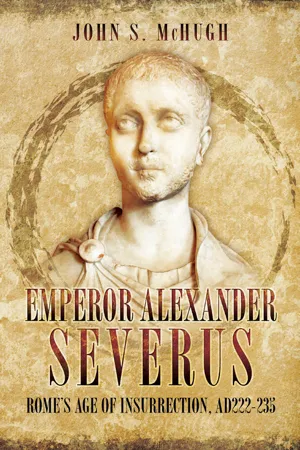
Alexander Severus' is full of controversy and contradictions. He came to the throne through the brutal murder of his cousin, Elagabalus, and was ultimately assassinated himself. The years between were filled with regular uprisings and rebellions, court intrigue (the Praetorian Guard slew their commander at the Emperor's feet) and foreign invasion. Yet the ancient sources generally present his reign as a golden age of just government, prosperity and religious tolerance Not yet fourteen when he became emperor, Alexander was dominated by his mother, Julia Mammaea and advisors like the historian, Cassius Dio. In the military field, he successfully checked the aggressive Sassanid Persians but some sources see his Persian campaign as a costly failure marked by mutiny and reverses that weakened the army. When Germanic and Sarmatian tribes crossed the Rhine and Danube frontiers in 234, Alexander took the field against them but when he attempted to negotiate to buy time, his soldiers perceived him as weak, assassinated him and replaced him with the soldier Maximinus Thrax. John McHugh reassesses this fascinating emperor in detail.
Information
Chapter 1
Murderers and Usurpers AD 192–211
‘… the lot of all Emperors is necessarily wretched, since only their assassination can convince the public that conspiracies against their lives are real’1
These prophetic words were uttered by the Emperor Domitian, murdered in AD 96 by his own friends, his amici, and imperial freedman in a palace conspiracy that probably included his wife and Praetorian Prefects. As the desperate emperor was stabbed repeatedly by his assailants, he attempted to reach the dagger that he kept under his pillow, but he found that its blade had been removed by his closest advisor. His successor, M. Cocceius Nerva, one of his closest amici, was named emperor on the same day, suggesting, at the very least, prior knowledge of the plot.2
This reign heralded the ‘Antonine Age’ of stability, peace and prosperity that ended with the Marcomannic Wars from AD 166, the outbreak of the ‘Antonine Plague’ and the murder of Commodus in AD 192. Nerva and his successors, Trajan, Hadrian, Antoninus Pius, Lucius Verus and Marcus Aurelius, all died of natural causes. Commodus, however, was the victim of another well-planned palace plot involving his closest amici, including the Praetorian Prefect tasked with ensuring his personal safety, his consort Marcia and his cubicularius, the freedman responsible for the imperial bedchamber. The Antonine emperors had faced plots, barbarian incursions and military revolts, but, apart from Commodus, had survived and prospered. Yet from AD 192 until the reign of Diocletian in AD 284, there were thirty-one emperors, of whom only three – Septimius Severus, Claudius Gothicus and possibly Carus – did not die violently. In this age of insurrection, placing power into the hands of a capable commander or politician provided them with the opportunity for revolt or murder. Yet at the same time the empire faced invasions along its considerable borders. An emperor could only be in one place at once. In this period of nearly 100 years, twelve emperors were murdered either by their own troops or the Praetorian Guard, whilst six were assassinated in what can loosely be termed ‘palace conspiracies’, three executed by successful usurpers, two killed in battle with rivals, another two either killed or captured by external enemies, one committed suicide, and of the three who died ‘naturally’, one died of the plague. One wonders why the imperial throne appeared so attractive.
One of the main problems for all these emperors is commented on only in passing by the historian Cassius Dio. When summing up the murder of Commodus, the senatorial historian laments that, ‘with him the line of the genuine Aurelii ceased to rule’.3
The Antonine emperors had adopted their successors, and so in Roman eyes were legitimate members of the imperial family and clearly designated successors. This was not a deliberate policy, simply a failure until the reign of Marcus Aurelius to produce male offspring who survived to adulthood. Commodus was the son of Marcus Aurelius and, as such, his nobility, ancestry and right to rule were never questioned, even by the senatorial elite who despised him. These views are represented by the contemporary historian Herodian, who composed a fictive speech for Commodus after the death of his father that was delivered before the assembled legions on the Danube:
‘Fate has given the empire to me as his successor, not as an adopted heir like my predecessors … but as the only one of your emperors to be born in the palace. No commoner’s swaddling clothes for me; the imperial purple lay waiting for me the moment I was born. On that day I was both man and emperor.’4
Commodus took immense pride in his ancestry and nobility, his coins promote the legend nobilitas, milestones were erected carrying the superlative nobilissimus (most noble) and inscriptions carried the grand title nobilissimus omnium princeps, the most noble emperor.5 The senatorial aristocracy prided themselves on their own lineage; some families like the Acilii Glabriones and Aviolae traced their ancestry back to the Roman Republic, whilst others like the Claudii Pompeiani, the Bruttii and Claudii Severii could point to connections with the imperial family of the Antonines. Pertinax, Commodus’ successor and a leader of the successful conspiracy against him, was a man of senatorial status but not noble birth,6 and anticipating the problems this may cause, he first offered the throne to Acilius Glabrio, ‘the most nobly born’, who turned it down, settling instead on being the hand behind the throne and sitting alongside the new emperor in the Senate.7 These aristocrats are described in the senatorial sources as being ‘the best men’, and their pride can be seen in their attitude to the new emperor, who would send treats from the imperial table to the homes of senators, yet ‘for this the wealthy and vain glorious made great sport of him’.8 The elite senatorial families had to rely on the emperor for offices of state, influence, power, honours, favours, gifts and other forms of beneficia, and yet would resent dealing with a man who was not their social equal. However, once the last of the Antonine emperors was dead, there were many who felt they had the ancestry and nobility to become emperor. Pertinax’s reign lasted three months before members of the Praetorian Guard, many angered by the murder of Commodus, burst into the palace and stabbed him to death. With no legitimate successor to turn to, they simply put the empire up for sale, which had the added benefit of lining their own pockets.
Two members of the senatorial aristocracy took part in what must be one of the most unusual auctions in history. Pertinax’s father-in-law, the Urban Prefect Claudius Sulpicianus, stood on the walls of the Praetorian camp in a bidding war against Didius Julianus, who was not allowed in but had to stand below next to the gates of the fort. Julianus was reputed to be the wealthiest man in Rome and seen as easily capable of making good the monetary promises he made. To the winner, the empire and allegiance of the Praetorian Guard; the loser could expect a summary execution. The bids rose and rose until Sulpicianus promised the enormous figure of 20,000 sesterces per man, which appeared to carry the day. In desperation, Julianus raised his bid massively, to 25,000. The Praetorians may also have feared that Sulpicianus would avenge his murdered son-in-law, and Julianus wrote on placards that he would avenge the murder of Commodus. This swayed the contest in Julianus’ favour and the gates were opened to him. He was declared emperor and acclaimed the new ‘Commodus’. The guard then placed the image of the last Antonine on their standards.9 The soldiers’ choice of epithet reflected their loyalty to the extinguished imperial family. The power of the Praetorians and the weakness of Julianus’ position is reflected in the appointment of their two Prefects, who were the choice of the soldiers themselves and had openly supported Sulpicianus.10
These claimants should have read their history. Tacitus, describing the consequences of the death of Nero and the march of Vespasian on Rome in AD 68–69, commented: ‘A well-hidden secret of the principate had been revealed: it was possible, it seemed, for an emperor to be chosen from outside Rome.’11
A number of senatorial commanders were now declared emperor by their troops. These acclamations had no doubt been carefully planned by each, two of whom had been amici of Commodus. Pescinnius Niger, the governor of Syria, had the support of all the legions in the eastern provinces, but he was the first of his family to enter the Senate and was granted a suffect consulship for his military campaign with Clodius Albinus in Dacia in the reign of Commodus. Then he had, along with Septimius Severus, helped to crush the brigand Maternus in the Deserters War before his appointment to Syria. His career is described by Herodian as a ‘distinguished record’. Decimus Clodius Albinus, another senator with an exemplary military record, had been an amicus of Commodus. He held the governorship of Britain with its three legions. According to the suspect life in the Historia Augusta, he came from a noble family, which can be confirmed by Herodian, who refers to him as ‘ a patrician-born member of the Senate’.12 However, the first to declare himself emperor was Septimius Severus, who had in all probability been made governor of Upper Pannonia on the recommendation of Commodus’ Praetorian Prefect and Pertinax’s fellow conspirator, Laetus. Septimius Severus did not have any distinguished record of military service, having only held a legionary command in Syria. The appointment to Upper Pannonia, with its three legions, usually went to men who had previously held a post-consular provincial governorship and, due to its proximity to Italy, to senators of proven loyalty. Septimius Severus’ brother, Geta, was appointed at the same time to Lower Moesia on the Danube, with its two legions. Laetus and Pertinax’s conspiracy against Commodus was built on firm foundations. The murder of Pertinax and the execution of Laetus by Didius Julianus freed Septimius Severus of his bonds of loyalty to his fellow conspirators and patrons. Additionally, he could now portray himself as the avenger of Pertinax.
Only twelve days after the murder of Pertinax, Septimius Severus assembled the XIV Gemina and probably representatives of the other legions that supported him at his headquarters at Carnuntum. In this time he had assured himself of the support not only of the three legions in his province, but those of his brother in Lower Moesia, as well as the governors and legionary commanders, legates, in Lower Pannonia. Once assured of support in the two Pannonias, he sent reliable representatives to Upper Moesia and Dacia, as well as Noricum and Raetia, carrying letters armed with ‘extravagant promises to raise their hopes’. He easily won their commitment of support. He also ensured that his two sons, Geta and Bassianus, the latter known to history as Caracalla, were safely spirited out of Rome and the clutches of Didius Julianus. Considering the distances involved and the delicate negotiations that this political manoeuvring must have entailed, it is evident that Septimius Severus was preparing the ground for his revolt long before the murder of Pertinax. He would have won over governors and legates with promises of future offices. The governor of the neighbouring province of Lower Pannonia, C. Valerius Pudens, would become governor of Lower Germany and then Britannia.13 He would have reminded the legionaries of the I Adiutrix that Pertinax had been their commander twenty years previously; some of those listening would have remembered him as the successful general of the Marcomannic Wars. These legions acclaimed their commander ‘Imperator Caesar L. Septimius Severus Pertinax Augustus’.
The initial stages of a military revolt are described in much more detail in Herodian’s account of Niger’s preparations:
‘As a first measure he summoned the legionary commanders and military tribunes and more distinguished soldiers in small groups to his private residence, where he discussed the subject with them and tried to win them over by telling them the news he was receiving from Rome. In so doing he intended the news to come to the ears of the soldiers and the rest of the inhabitants of the eastern provinces, once the rumour was current. In this way Niger hoped that no one would have any difficulty in supporting him, if they heard that he for his part was not making any insidious bid for power, but going to assist the Romans in response to their call. And indeed everyone did become excited. Straight away they began to press Niger with requests to be allowed to take a personal part in the campaign.’14
It would have taken at least twelve days for the news of Pertinax’s murder to reach Antioch, and there is evidence of Niger making preparations before this.15 Those first conversations would have been extremely dangerous and probably initially involved testing the loyalty of his guests to Didius Julianus. Events in Rome had taken a turn for the worse for the winner of the imperial auction. The treasury was empty and his own personal wealth could not cover the financial donative he had promised to the Praetorians, who now openly insulted him and refused to guard him. Their loyalty to the new regime was further sapped by constant training in preparation for the war against the seasoned soldiers from Pannonia. Didius Julianus attempted to portray himself as the avenger of Commodus, just as his opponents set themselves up as the avengers of Pertinax, by having the conspirators Marcia and Eclectus, Commodus’ cubicularius, executed. This was not enough, and his support melted away despite his attempt to win over the nobles with lavish banquets ‘playing court to the Senate as well as to all men of any influence’. Frequent games were organized to win over the people.16 Coinage was the main vehicle of propaganda, especially the silver denarius, as it was used to pay the troops. Julianus’ coinage proclaims concordia militum, the harmony of the soldiers.17 Nothing could be further from the truth. The populace of Rome both feared and hated the Praetorian Guard for its arrogance and use of violence to impose its control over the streets of the capital: ‘and great also was the fear inspired by the rest of the population by the armed troops, because the later hated them.’18 Now the open contempt of the Praetorians and Niger’s own agents meant that the games and shows Didius Julianus organized to win support became a hostile furnace of contempt as the mob, over 200,000 strong in the Circus Maximus, shouted insults at him as he sat in the imperial box. The crowd made jokes at his ‘sensuality’, it denounced him for sullying the dignity of the empire by buying the imperial throne, and called upon Niger as ‘protector of the empire’ and ‘champion of the sacred office of emperor’. The mob cried out for Niger to march on Rome and oust their present ruler, chanting his name, and acclaimed him with the titles normally awarded to emperors.19
The Circus Maximus and Colosseum were regularly used to organize public demonstrations, as the numbers involved gave the mob a certain level of security from arrest or execution. Emperors used these public occasions to win popular approval and also as an open audience to hear popular complaints. The emperor, on entering the imperial box, would be greeted with a rhythmic form of chanting, in the same manner he would be greeted as he entered the Senate. This would need some form of organization. We can imagine that as Didius Julianus entered the arena, he was greeted not by the acclamation of his own name but that of Niger’s. This must have been organized by Niger’s freedmen, slaves and clients at the connivance of the main circus factions, the blues and the greens. Demands could be communicated to the assembled crowds by writing on large tablets, which were then paraded around the arena, or at a prearranged signal Niger’s clients, spread around the stadium, could start a chant, which would then be taken up by those around. Dio describes fingers being raised up as such a signal. The emperor had tried to placate opposition by promising a distribution of money, or congiaria, but this only incensed the mob further, so he ordered the guards to kill those nearest to them. Rioting broke out and the streets of Rome ran with blood as the populace and the Praetorians fought, ‘but though many were wounded and killed in many parts of the city, they continued to resist’. The mob had managed to seize weapons, probably from the gladiatorial schools and perhaps from the vigiles, the urban militia charged with policing the capital and dealing with its regular fires. The stadium of the Circus was used as a temporary fortress, and Niger’s supporters were besieged there by Didius Julianus’ troops. The besieged called upon the Praetorians to join them and support Niger, ...
Table of contents
- Cover
- Title
- Copyright
- Contents
- List of Illustrations
- List of Maps
- Maps
- Family Tree
- Chapter 1 Murderers and Usurpers AD 192–211
- Chapter 2 Conspiracy AD 211–217
- Chapter 3 Revolt AD 217–218
- Chapter 4 A Palace Coup AD 218–222
- Chapter 5 Regency AD 222–223
- Chapter 6 Restoring the ‘Golden Age’ AD 224–228
- Chapter 7 The Empire of Alexander Severus AD 222–235
- Chapter 8 War in the East AD 228–233
- Chapter 9 War in the West AD 234–235
- Epilogue
- End Notes
- Bibliography
- Bibliography of Pictures
- Bibliography of Maps
- Key Events
- Plate section
Trusted by 375,005 students
Access to over 1.5 million titles for a fair monthly price.
Study more efficiently using our study tools.
Frequently asked questions
Yes, you can cancel anytime from the Subscription tab in your account settings on the Perlego website. Your subscription will stay active until the end of your current billing period. Learn how to cancel your subscription
No, books cannot be downloaded as external files, such as PDFs, for use outside of Perlego. However, you can download books within the Perlego app for offline reading on mobile or tablet. Learn how to download books offline
Perlego offers two plans: Essential and Complete
- Essential is ideal for learners and professionals who enjoy exploring a wide range of subjects. Access the Essential Library with 800,000+ trusted titles and best-sellers across business, personal growth, and the humanities. Includes unlimited reading time and Standard Read Aloud voice.
- Complete: Perfect for advanced learners and researchers needing full, unrestricted access. Unlock 1.5M+ books across hundreds of subjects, including academic and specialized titles. The Complete Plan also includes advanced features like Premium Read Aloud and Research Assistant.
We are an online textbook subscription service, where you can get access to an entire online library for less than the price of a single book per month. With over 1.5 million books across 990+ topics, we’ve got you covered! Learn about our mission
Look out for the read-aloud symbol on your next book to see if you can listen to it. The read-aloud tool reads text aloud for you, highlighting the text as it is being read. You can pause it, speed it up and slow it down. Learn more about Read Aloud
Yes! You can use the Perlego app on both iOS and Android devices to read anytime, anywhere — even offline. Perfect for commutes or when you’re on the go.
Please note we cannot support devices running on iOS 13 and Android 7 or earlier. Learn more about using the app
Please note we cannot support devices running on iOS 13 and Android 7 or earlier. Learn more about using the app
Yes, you can access Emperor Alexander Severus by John S. McHugh in PDF and/or ePUB format, as well as other popular books in History & Military & Maritime History. We have over 1.5 million books available in our catalogue for you to explore.