The military expert and author of
Philip II of Macedonia presents 9 profiles of exemplary leadership from the ancient world.
Of all the military commanders throughout history, only a few are remembered as great leaders of men in battle. Is there a combination of personal attributes and historical circumstances that produces great commanders? Professor Richard A. Gabriel analyses the biographies of ten great generals, all of whom lived between 1481 BC and AD 632, in order to identify the characteristics of intellect, psychology, personality, and experience that allowed them to tread the path to greatness.
Some of the names included in Gabriel's selection, such as Moses and Muhammad, will surprise many readers—as will the historical figures Gabriel chooses to omit, including Alexander the Great and Atilla the Hun. But Gabriel is not merely interested in famous military exploits. A retired soldier and professor at the Canadian Defence College, he distils the timeless essence of military leadership through the examples of Julius Caesar, Philip II of Macedonia, Thutmose III of Egypt, and others
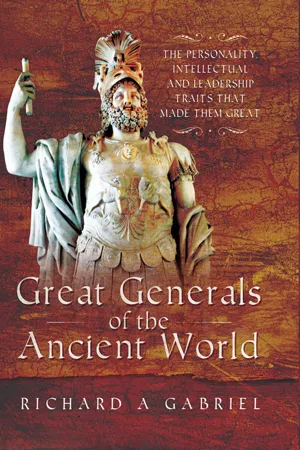
eBook - ePub
Great Generals of the Ancient World
The Personality, Intellectual and Leadership Traits That Made Them Great
- 336 pages
- English
- ePUB (mobile friendly)
- Available on iOS & Android
eBook - ePub
Great Generals of the Ancient World
The Personality, Intellectual and Leadership Traits That Made Them Great
About this book
Information
CHAPTER ONE
WHAT MAKES GREAT GENERALS GREAT?
Great generals cannot be judged to be so apart from the military context in which they fought, the nature of the armies they commanded and the political and social conditions that marked the societies in which they lived. Too often, generals are thought of as great field commanders even when their conduct of war was so restricted by these factors as to make their contribution to victory or defeat nearly irrelevant. Claims about a commander’s genius for war must take into account the level of sophistication of warfare at the time in which he fought. In this regard, the scope, complexity, range, size and lethality of the armies of the late Bronze and Iron ages (2500 BC–AD 600), the period in which the great commanders examined herein fought, was not exceeded in the West until at least the Napoleonic era and, in many respects, not even until the First World War.
What makes a military leader great? Of the thousands of officers who served in history’s armies, why is it that only a few are remembered as remarkable leaders of men in battle? What confluence of personal and circumstantial influences conspire to produce great military leaders? This book examines the role of human will and intellect as evident in the lives of ten selected military commanders of the ancient world whose achievements crucially shaped their respective societies, and in doing so set in motion ideas, beliefs and practices that shaped the larger direction of these societies and, sometimes, even civilization itself. Underlying this effort is the conviction that by understanding the role of the vital human qualities of intellect and will that made these captains great, we can draw lessons that aid us in rediscovering the central place of these human qualities in the management of our own civilization and even, perhaps, our own lives. For it is surely true that the human drama is never really about things, no matter how wondrous or even magical they may appear at the moment. It is, instead, always about ourselves.
But why study the great commanders of antiquity? Because the world of antiquity is not as distant from us as we might believe. Those who lived then were like us in most things that matter to human experience. Moreover, ancient societies often confronted technological challenges equal in difficulty to those we face today. The introduction and management of new technologies in the ancient world was just as difficult and disruptive as in modern times. Thutmose III of Egypt, for example, reformed an Egyptian military system that had remained unchanged for 2,000 years, and then used it to force a country that had been largely sealed from the outside world for those two millennia to embark upon the road to empire. The new Egyptian military order he created lasted for more than half a millennium. The challenges faced by the great commanders of antiquity were often no less daunting than those faced by military leaders today. It is worthwhile to enquire into the personalities, traits and habits of these commanders to see what made them great, and to ask what we might learn from them.
Two sets of factors seem relevant to the success of great commanders. The first are traits of personality and character that permit the development of an intellect that comprehends its environment and can cope with it without paralyzing apprehension. The great commander understands his world even as he sees beyond it, bringing to it a vision of change and objectives toward which he wishes to advance. The second set of factors are the historical circumstances that form the political and social environment in which the commander must act. Great commanders can only emerge when challenging times provide opportunities for their abilities to manifest themselves. Grave social and military crises create opportunities for commanders to rise who, in normal times, would probably have lived quite ordinary lives. The circumstances of history create the stage upon which the commander possessed of the right personality and character is allowed to perform.
With three exceptions, the great commanders examined here all experienced war at an early age. Thutmose III was the commander of the Egyptian army at 16, and a year later led his first military expedition into Nubia. Two years later, he commanded an expeditionary force to recapture Gaza. He was not yet 22 when he fought his famous Battle of Megiddo. Cornelius Scipio was a cavalry troop commander at the Battle of the Ticinus River at age 17. A year later, he fought at the Trebia River, and a year after that at Cannae. He assumed command of the Roman armies in Spain at 26. Hannibal accompanied his father to Spain at the age of 9, and was raised in a military camp while his father conquered Spain. He was 26 when he assumed command of the Carthaginian armies in Spain. Philip of Macedonia took part in the cavalry battles that characterized the Macedonian tribal wars when he was 16, and was a military governor at 18. Marcus Agrippa enlisted in Caesar’s mercenary army at 14, and fought in many of Caesar’s battles, including Munda. As part of Sargon the Great’s military training as a young warrior, he was placed in a walled courtyard armed with a bow and spear. A lion was let loose and Sargon had to kill it or be killed! Alexander led his first expedition against the tribes in Thrace at 16. Only Moses, Julius Caesar and Muhammad never experienced war until they assumed command of their respective armies.
The great commanders of the ancient world were all educated people, formally trained by the educational establishments of their respective times. Sargon II was perhaps the best educated, the modern equivalent of a classics scholar; fluent in ancient languages, a military historian and trained in the school of pragmatic politics at a special college whose purpose was to educate and prepare the leaders of the Assyrian state. Thutmose III was educated as a priest of Amun, and Scipio and Caesar received classical educations at the hands of private Greek tutors. Hannibal was educated in the manner of any Hellenic noble of the day, and spoke Punic, Latin and Greek. Philip II of Macedon was formally educated while a hostage at Thebes, and could speak several languages; he surrounded himself with artists and philosophers. It was Philip who recruited Aristotle, his boyhood friend, to instruct his son, Alexander, for three years at the academy at Missa. Moses may well have been educated, if not at the court of Pharaoh as the Bible tells us, then certainly at one of the many Egyptian scriptoria. We know nothing of Muhammad’s formal education, but his experience as a caravaneer and businessman suggest at least literacy and some level of formal education. He seems to have been particularly well-informed about the theological and social history of Arabia.
Rigorous intellectual training provides the commander with the confidence to trust his intellect to explain the world in which he lives by demonstrating that the mind can make reasonable sense of one’s environment and even, to some lesser extent, the future. Educated people think in terms of cause and effect, of one thing leading to another, of chains of action, where one might bring about ends with some degree of certainty by setting in motion events yet far removed from those ends. Soldiers educated in this manner are far less likely to accept the world as it is, and far less likely to permit cultural and theological explanations to guide their actions. Formally educated leaders are far more likely to see themselves as controlling their own fate, as being able to change the course of events rather than having to acquiesce in them. Without this perspective, it is difficult to see how one could become a great commander.
All the great commanders possessed a remarkable confidence in their own ability and will, traits only partly, if at all, acquired through formal education. Educated leaders possess the potential for greatness precisely because they can understand their environment and discern how to control it, a habit of mind developed through study and thought. Uneducated leaders often fail because they are prisoners of their environment insofar as important aspects of it escape their purview. While such leaders might master their world for a while, eventually they will be overwhelmed by it. Hitler, Stalin, Lenin and Mao, to mention some of the great disrupters of the past century, fell victim to precisely this shortcoming. If the great commanders of the past excelled at anything, it was their ability not to become victims of unanticipated change.
To adjust to changing circumstances requires a mind receptive to new ideas and open to new possibilities. Thutmose III’s adoption of new military technologies, Philip’s development and use of new tactical cavalry doctrines, Scipio’s redesign and tactical employment of the infantry cohort and Sargon’s new doctrine of pre-emptive war are all examples of leaders willing to entertain and apply new possibilities, as are Agrippa’s design of new ships and naval tactics, Moses’ creation of the new Israelite army at Sinai and Muhammad’s invention and execution of the theory and practice of insurgency. The purpose of new ideas is to control events so as to bring about desired outcomes. This often requires that new ideas be placed in service of already extant goals, although new ideas can themselves become vehicles for determining new goals. Thus, Thutmose III’s adoption of the chariot and composite bow for the Egyptian army made sense only because he had already set the objective of driving the Asiatics from the Palestine land bridge. Moses’ redesign of the Israelite army made sense only in relation to his strategic objective of conquering Canaan.
An open and receptive intellect permits a commander to challenge existing assumptions about his world and generate new paradigms that structure novel thinking as a means of adjusting one’s intellectual processes to a new environment. This is an intellectual achievement of the first order, and characterizes the thinking of history’s great commanders. Caesar was able to see a new future for Rome only after he had conceived of the Roman world in a completely new way; that is, as the creator of a new, peaceful, just and prosperous empire based on the integration of conquered peoples into a new social order. Hannibal, too, saw his military campaign against Rome as the vehicle for creating a new world order in which states of relatively equal military and economic power coexisted in peace and harmony. Scipio reached for the same vision after Carthage’s defeat, yet his failure set Rome on the road to empire. Philip’s ability to dream of a unified Greece under the benign tutelage of Macedonia sought to create a world that no Greek had ever before conceived of as possible.
Thutmose brought about a fundamental shift in the paradigm of Egyptian thinking when he forced Egypt to turn away from 2,000 years of isolation and brave the new world beyond the Nile. Sargon of Assyria changed the impetus of 200 years of previous wars of conquest, redirecting Assyria’s energies to consolidating the empire and focusing on its domestic requirements. Moses and Muhammad radically changed the world with their new ideas. In the sense that the great commanders changed the fundamental paradigms of their age, they created new futures for their civilizations. Some of these futures, like those of Rome and Egypt, lasted for hundreds of years after the men who had brought them into being had turned to dust. Others, like Judaism and Islam, are still very much with us.
All of the great captains possessed imagination as a regular habit of mind. Imagination resides in the consciousness between sensory experience and intellect. It is not primarily the ability to conceive of the fantastic. More pragmatically, imagination is the ability to envision alternative sets of circumstances that might realistically be brought into being by human will and action. Imagination, thus, is the ability to foresee what may be foreseen under the reasonable conditions of knowledge that one possesses. It is closely connected to extrapolation, and is a highly pragmatic intellectual skill.
All the great commanders were highly imaginative in this pragmatic sense. Philip of Macedon, for example, completely reinvented the Macedonian army in order to deal with a set of circumstances – the conquest of Greece and eventually of Persia – that did not yet exist, but which Philip could imagine to exist. In the process, he gave Greece a completely new type of army, one that the Greeks themselves could never have conceived without him. Thutmose fashioned new military and diplomatic instruments to deal with the new world confronting Egypt because he could imagine how that new world would be and connect that vision to the means necessary to control it. The great commanders often succeeded because they possessed the ability to imagine the world not as it was, but as it would be if circumstances permitted.
These traits – (1) conceptual thinking from cause to effect, (2) receptivity to new ideas, (3) thinking beyond existing paradigms and (4) practical imagination – are all intellectual achievements that transcend technology, formulaic reasoning and cultural influence. Together, they constitute what might be called imaginative reasoning, where all relevant aspects of problem-solving, human and technological, come together to make mental sense of the world outside the mind. The human individual, not formulas, culture or technologies, remains at the centre of the process, for only humans can conceive of possible worlds. To substitute formulas or technologies for imaginative thought as guides to action, especially on the battlefield or in the world of power politics, is to court disaster. Thus, the Roman armies that fought Hannibal, for example, were defeated repeatedly because their commanders employed them again and again precisely as they were designed to be used. The trouble was that Hannibal fought in a manner completely different from what the Roman armies had been designed for. Roman commanders continued to employ the same military system in defeat after defeat, precisely because they could not sufficiently integrate all the new elements in their drastically changed environment to formulate a successful response to the changes. The Egyptian army, too, met its death in the wars against the Hyksos for the same reasons, by employing an existing successful military system in radically changed circumstances. This same lack of integrated thinking characterized the American military effort in Vietnam. Unable to grasp the changed circumstances under which the old tactical and strategic formulas had to operate, American commanders continued to do what was most familiar to them, with disastrous results.
While certain traits of intellect are important to understanding the success of history’s great commanders, intellect, per se, is not sufficient for greatness. Whatever else the great captains of antiquity were, they were first men of action and will. It is one thing to conceive of great things, quite another to attempt them. And to attempt great things requires personality traits more related to character and will than to intellect. All the great commanders were leaders possessed of strong self-confidence and will. The ability to trust one’s thoughts, experiences and judgment is central to the strength of personality required to give sound thinking the force of action.
Tradition and religion determined a great deal of human behaviour in ancient civilizations. The ‘drag’ of cultural inertia made innovation difficult. New ideas and actions required not only clear thinking, but a great deal of self-confidence and will to make them happen. The roots of a commander’s self-confidence, then, do not lie in formal education but, more likely, in the strength of personality shaped by experience and practice. It is an old soldier’s maxim that one can train a frightened soldier to be less frightened, but one cannot make him brave.
The roots of a leader’s self-confidence are difficult to determine. With the exception of Moses, Muhammad and Caesar, none of whom seem to lack the self-confidence so necessary to success, all the great commanders received military training and experienced war at an early age, an experience that may have taught them self-reliance, the ability to endure difficult circumstances and how to cope with uncertainty. The major goal of military training, at least at the basic level, is not so much to inculcate military skills, most of which are easily learned. Rather its point is to shape the psychology of the soldier so that he comes to trust his own abilities in an uncertain environment. Myra McPherson’s study of Americans during the Vietnam war, Long Time Passing: Vietnam and the Haunted Generation, suggests that Vietnam veterans manifested higher levels of self-confidence in their lives than non-veterans. Self-confidence is a necessary requisite for the strength of will and intellect needed to make a commander great.
All the great captains were risk-takers. It is the riskiness of the professional gambler, not the enthusiastic amateur, which the great commander must possess, for he knows that the mere knowledge of circumstances is insufficient to master them. The battlefield is among the most uncertain places in human experience, a world that can never be completely known or turned completely to one’s will. There is always uncertainty, always the unknown, to be confronted. The great commander confronts uncertainty with the willingness to take risks, to reduce the threat of the unknown by plunging into it and making it known. Hannibal and Scipio were experts at taking risks. Hannibal’s movement over the Alps marked his propensity to take risks on a grand scale. At Trasimene, he relied upon the fog to hide his troops when a sudden wind would have revealed them to the Roman enemy. At Cannae, Hannibal exposed his centre to draw the Romans into a trap. Had his cavalry not returned in time, he would have faced disaster. Scipio’s swift march against New Carthage depended entirely upon guessing correctly that the enemy could not react in time to meet him. Scipio’s campaign in Africa, undertaken below strength and without adequate supplies, remains a classic study in military risk-taking, as does Thutmose III’s willingness to risk his army by moving down a narrow mountain trail to achieve tactical surprise at Megiddo. Without the ability, as Rudyard Kipling put it, ‘to make a heap of one’s winnings and risk it all on one turn of pitch and toss’, the great captain cannot master the uncertainties of the battlefield or those of his larger world that threaten to frustrate his will. There is always danger in taking risks. But for the great commander, the greater danger lies in doing nothing.
Beyond their intellectual and character traits, all the great leaders possessed some element of physical presence that made others love, respect or fear them. Scipio manifested an air of quiet calm and dignity that gave his soldiers confidence. Hannibal’s physique and demeanour was that of the combat-hardened soldier, fearless and competent in the face of danger. Philip of Macedon, his large head atop a body crippled and scarred from battle wounds, seemed every bit the rough warrior chief, even as he was among the most sophisticated military thinkers of his time. Thutmose was tall and robustly built, with a large hawk-beaked nose and thought by his troops to be a god. Muhammad, too, was said to be physically imposing, as were Agrippa and Caesar. Moses enhanced his mysterious sense of command presence by always wearing the mask of a Midianite priest. Only Alexander, 5ft 2in tall, of blonde hair and fair skin, and cursed with a high voice, seems to have lacked a manly warrior-like presence.
The physical presence of these commanders was further enhanced by their willingness to suffer the hardships and dangers of battle. Sargon died leading an attack in battle, Caesar personally led the attack at Alesia – distinguishing himself by his red cloak – Thutmose personally led the attack at Megiddo, Hannibal always fought in the middle of the line, and Philip was wounded five times, Alexander seven and Muhammad twice. There is a mysticism in the attraction of ordinary people for brave men that is not completely explainable in rational terms. Whatever personal charisma was required to convince troops to follow them into the crucible of combat, to persuade them to risk their lives, and to risk the horror of blindness, paralysis and loss of limb from wounds, the great commanders possessed it. It remains a maxim of military life that a combat leader cannot manage soldiers to their deaths. Soldiers must be led. They follow their commanders for the most basic of reasons, because they love, trust and admire him for who he is and what he does.
Great captains can arise only when there are great challenges to be dealt with, or when social turmoil and revolution loosen the constraints that restrain the exercise of social power in normal times. Without great challenges, leadership is confined to a narrower scope of events and concerns. Then, mere competence passes for leadership. In these circumstances, great commanders remain only potentially so, carrying out their duties, their abilities permitted by circumstance to rise only to the level of competence permitted by the environment, but never to greatness. It was, of course, always so. The analysis of great commanders ought not to obscure the fact that in the ancient world great captains were rare.
The secular, democratic, technologically advanced, free economy, post-industrial societies that characterize the modern West necessarily restrict opportunities for military greatness because of the inherent structural limitations placed on power of all types. There are strong institutional barriers to the emergence of great commanders. The fundamental premise of democracy requires the limited exercise of all power. Unlike antiquity, modern generals rarely become political leaders, and political leaders never take the field as military commanders. One of the fundamental characteristics of the great commanders of the past, the fusion of military and political power, is institutionally absent in the modern Western world.
The advent of high-tech warfare has further reduced the degree of greatness associated with military achievement. Wars are now thought of as being fought by rival ‘technological systems’ in which military commanders are interchangeable. Wars are fought and won through planning combat...
Table of contents
- Cover
- Dedication
- Title
- Coptright
- CONTENTS
- 1. What Makes Great Generals Great?
- 2. Thutmose III of Egypt
- 3. Moses
- 4. Sargon II the Great of Assyria
- 5. Philip II of Macedon
- 6. Scipio Africanus
- 7. Hannibal Barca
- 8. Julius Caesar
- 9. Marcus Agrippa
- 10. Muhammad
- 11. Why Not Alexander?
- Selected Bibliography
Trusted by 375,005 students
Access to over 1.5 million titles for a fair monthly price.
Study more efficiently using our study tools.
Frequently asked questions
Yes, you can cancel anytime from the Subscription tab in your account settings on the Perlego website. Your subscription will stay active until the end of your current billing period. Learn how to cancel your subscription
No, books cannot be downloaded as external files, such as PDFs, for use outside of Perlego. However, you can download books within the Perlego app for offline reading on mobile or tablet. Learn how to download books offline
Perlego offers two plans: Essential and Complete
- Essential is ideal for learners and professionals who enjoy exploring a wide range of subjects. Access the Essential Library with 800,000+ trusted titles and best-sellers across business, personal growth, and the humanities. Includes unlimited reading time and Standard Read Aloud voice.
- Complete: Perfect for advanced learners and researchers needing full, unrestricted access. Unlock 1.5M+ books across hundreds of subjects, including academic and specialized titles. The Complete Plan also includes advanced features like Premium Read Aloud and Research Assistant.
We are an online textbook subscription service, where you can get access to an entire online library for less than the price of a single book per month. With over 1.5 million books across 990+ topics, we’ve got you covered! Learn about our mission
Look out for the read-aloud symbol on your next book to see if you can listen to it. The read-aloud tool reads text aloud for you, highlighting the text as it is being read. You can pause it, speed it up and slow it down. Learn more about Read Aloud
Yes! You can use the Perlego app on both iOS and Android devices to read anytime, anywhere — even offline. Perfect for commutes or when you’re on the go.
Please note we cannot support devices running on iOS 13 and Android 7 or earlier. Learn more about using the app
Please note we cannot support devices running on iOS 13 and Android 7 or earlier. Learn more about using the app
Yes, you can access Great Generals of the Ancient World by Richard A. Gabriel in PDF and/or ePUB format, as well as other popular books in History & Historical Biographies. We have over 1.5 million books available in our catalogue for you to explore.