eBook - ePub
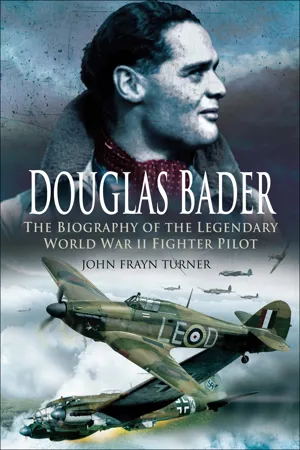
Douglas Bader
The Biography of the Legendary World War II Fighter Pilot
- 256 pages
- English
- ePUB (mobile friendly)
- Available on iOS & Android
eBook - ePub
About this book
Douglas Bader was a legend in his lifetime and remains one today 100 years after his birth. A charismatic leader and fearless pilot he refused to let his severe disability (loss of both legs in a flying accident) ground him. He fought the authorities as ruthless as he did the enemy and not only managed to return to the front line but became a top scoring ace. His innovative tactics (The Big Wing) ensured his promotion and he led a key group of squadrons during the dark days of the Battle of Britain.His luck ran out when he was shot down and captured; he only escaped his burning fighter by cutting away one of his artificial legs. As a POW he was a thorn in the Germans side and he was sent to Colditz Castle. As this perceptive book reveals Bader, the hero, was at times a difficult overbearing man, no doubt in part due to the pain he suffered. But his strengths far outweighed his weaknesses and his place in the annuals of British history is secure.This is a timely republication of an important biography.
Information
CHAPTER 12
In March 1941 Douglas Bader was posted to Tangmere, Sussex, as Wing Leader of what soon became known as the Tangmere Wing. He was the RAF’s very first Wing Leader and the three squadrons he commanded were 616,610 and 145. Many of his lasting friendships dated from that spring and summer. The flavour of these days can be conveyed by the impressions of some of those friends – and then the sorties themselves. But first, the friends.
Johnnie Johnson:
We went on to a Wing of three squadrons which was about right. The great thing was that previously we had been fighting a defensive battle. Then we began to reach out and take on the Luftwaffe over the Pas de Calais. There Douglas’s greatest qualities came to the fore: leadership, the ability to inspire, and his great desire to get out and at them. It was quite extraordinary. Something I had never known before or have never known since. The qualities of moral courage, the ability to command, and the fact that he spoke the same language as these chaps. I was still a pilot officer. Douglas was a wing commander. I think I had reached the elevated rank of flying officer by August. We were all rather like his pupils. Like master and apprentice. He always went to great lengths to have a post-mortem afterwards and explain things to us. Everyone loved him.
Tactically, because the enemy abreast formation was better than the astern pattern, Fighter Command lagged behind the German Fighter Arm. It was not until this spring that Douglas Bader copied the Schwarme, which he called the “Finger Four” because the relative positions of the fighters are similar to a plan view of one’s outstretched fingertips. Bader’s pilots were immediately impressed with their finger fours, for, unlike the line-astem pattern, all pilots were always covered, and all stood an equal chance of survival. Soon all fighter squadrons followed Bader’s lead. It had taken a long time to relearn the doctrine of Oswald Boelcke.’
Laddie Lucas takes up this theme, as an observer rather than a participant in 1941.
‘As I see it, every pilot in the RAF owed something to what went on in World War 1. These tactics were used again, by ourselves and by the Germans. But the actual line-abreast flying, the basic concept of a pair of aircraft, or four aeroplanes in the form of a finger four formation – these were fundamental tactics whether used in World War 1, by the Spaniards, or the Germans, or whoever else. The fact of it was that Douglas modernised it, brought it up-to-date, made it fresh and practical for flying in the 1940s. And don’t forget, this was in direct conflict with a lot of the flying thinking that was being done in 11 Group, which was all line-astem.
It was quite all right to climb a squadron or a Wing up in line-astem to battle height, but then so often they stayed together like that and never came into line-abreast. Terrible for the junior pilots at ass-end Charlie. Douglas started with the basic two aeroplanes then the finger four, then the fours in touch with one squadron, two squadrons, three. This was the basis, with two pilots looking inwards, so that the whole sky was covered right through 180 degrees. This was really fundamental to all his flying, both defensively and offensively, in the sweeps over the north of France from Tang-mere. Douglas never claimed to have pioneered the technique.’
Some people have criticised these tactics as being old hat, but nothing could be further from the truth. Hugh Dundas takes it one stage further:
‘Douglas was very much a pioneer in getting away from that line-astem formation. In fact he and I conducted an experiment together, following a long conversation in the mess. We tried a bit of finger four and adopted it. I certainly never flew anything else for the rest of the war. We were flying over France all the time now, instead of over England. We were doing sweep after sweep after sweep, all day, every day. We always flew in fours. I flew as the other leader, next to him. We did over sixty sweeps together that summer. He liked to have the same chaps with him. He was a hell of a help to me. I had a very nasty bit of being shot down in 1940.1 was shot down and couldn’t get out of the aeroplane. The hood stuck. The aeroplane stopped flying. I got out very low indeed at about three or four hundred feet. I was only on the end of a parachute for three or four seconds. That shook me considerably. I think if I hadn’t come up against someone like Douglas, I might have found it very difficult to get going again. He was a great leader. He liked his wide circle of friends. We used to go to his house and we spent most of that spring and summer together, one way and another.’
Douglas and Thelma now lived near Bognor, in a modem house with a big window. Bay House was five or six miles from Tangmere and its doors remained always open to anyone at the station. Thelma’s sister Jill lived with them at that time. Once or twice a week, Johnnie Johnson would drive over to Bay House, to find the hard core of the Tangmere Wing grouped about its leader. Stan Turner was invariably there. He had been with Douglas in 242, of course. Douglas sipped his lemonade, analysed their recent flights, and discoursed on the importance of straight shooting. Meanwhile the sorties were stepped up. It became a strange contrast between high summer, high clouds, the scent of clover, and even an odd game of golf at Goodwood – and then the sudden sweeps over France. The electric trains purred on: Chichester, Bamham, Ford, and so to Brighton. Thelma and Jill looked after Bay House and were always cheerful. And the Tangmere Wing flew on. As ‘Cocky’ Dundas said, sweep after sweep after sweep. The years of 1940 and 1941 called for greatness. Douglas supplied it.
If flying seems to dominate Douglas’s life in this era, it is because it did just that. Flying was his life. And all that went with it. Nothing can completely recapture the flavour or strain of sixty, seventy Spitfire sorties in two or three months. So here are just ten typical combat reports from 21 June to 23 July told in Douglas’s own words:-
‘21 June 1941
I was leading Tangmere Wing which was milling around in and off the coast around Desvres. Saw the bombers and escort go out near Boulogne, followed by AA bursts. We stayed around above and behind the bombers and escort when I notice two Messerschmitt 109s in line-astem about to turn in behind my section of four. I told them to break left and twisted round quickly (metal ailerons) and fired a very close deflection burst at the first Messerschmitt 109E at about fifty yards’ range, about half to one second. My bullets appeared to hit him as his glass hood dispersed in pieces and the aeroplane pulled up vertically, stalled and spun right-handed. I foolishly followed him down with my eyes and nearly collided with a cannon Spitfire of another squadron in the Wing and then reformed by section. I claim this as destroyed (a) because I know it was and (b) because F/O Marples 616 Squadron saw a Messerschmitt 109 spinning down at the time and place and S/Ldr Turner of 145 Squadron saw a pilot bale out of a Messerschmitt 109 at the time and place, as also did one of his pilots, (c) F/O Machatek of 145 Squadron saw a Messerschmitt 109 dive into the sea right alongside another Messerschmitt 109 which had been shot down by one of 145 Squadron, same time and place, and (d) no-one else claims the second 109 which I am sure was mine.
25 June 1941 (am)
I was the Tangmere Wing Leader flying with 616 Squadron and taking off from Westhampnett at 1158. Joined up with 145 and 610 Squadrons and proceeded up over Dungeness at 20,500 feet. Then flew on to a point opposite Gravelines and turned straight towards the coast, flying south. Noticed a number of Messerschmitt 109s from time to time above and what looked like a combat in the Gris-Nez/Boulogne area at 25,000 feet. When 145 Squadron informed me that they had found bombers and were escorting bombers back over Gravelines, I gave the order for the Wing to withdraw. As we crossed coast at Gravelines at about 18,000 feet my section ran into four to six Messerschmitt 109Fs milling around over Gravel-ines/Dunkirk area about 500 feet below. We flew into them and I gave one a short deflection shot and my No 2 (Sgt West) followed in with another burst of two seconds. Sgt West broke to port and lost sight of enemy aircraft but I broke to starboard and saw it half roll and dive down and followed it down – giving it half second burst – seeing pilot baling out about five miles off Gravelines in sea. Then vectored 280 degrees from this point, crossed over South Foreland and returned to Westhampnett at 1335. This Messerschmitt 109 was not visibly damaged although bullets were seen to strike: i.e. no smoke etc.
25 June 1941 (pm)
As Tangmere Wing Leader and flying with 616 Squadron, we took off from Westhampnett at 1549 and joined up with 610 and 145 Squadrons. Climbed up to 21,000 feet and crossed French coast at Hardelot (?). Joined up with bombers underneath and then flew east with them for a few minutes when numerous enemy aircraft were seen behind, below and to the north of us. Eventually was compelled to engage them and disregard the bombers, since they were all round us and we were flying down-sun. With the leading section I engaged eight to nine Messerschmitt 109Fs which were climbing east to west, i.e. towards Boulogne. We were then at 20,000 feet and the enemy aircraft between 16,000 and 17,000 feet. We dived on to them and F/O Dundas and his No 2 attacked two who turned north and climbed. I attacked four Messerschmitt 109Fs, with my No 2, who were climbing in a slightly left-hand turn. I gave a short burst at one at close range from inside the turn and saw white, black and orange-coloured smoke envelop the aircraft, which went down in an increasingly steep dive which finished up past the vertical. I did not follow the aircraft down and claim it as destroyed. I straightened up from turn just as some more Messerschmitt 109s (which were milling about some Spitfires) turned towards me. I gave a short head-on burst on one of them, who I don’t think had seen me, but saw no apparent result of my fire. I then joined up with S/Ldr Holden of 610 Squadron with my No 2 and gave a short burst at another aircraft but saw no result. Landed Westhampnett at 1722.
2 July 1941
I was leading 616 Squadron’s first section. Sighted approximately fifteen Messerschmitt 109Fs a few miles south-west of Lille so turned south and attacked them. They were in a sort of four formation climbing eastwards. They made no attempt to do anything but climb in formation so I turned the Squadron behind them and about 2,000 feet above and attacked from behind. I attacked a Messerschmitt 109F from quarter astern to astern and saw his hood come off – probably he jettisoned it – and the pilot started to climb out. Did not see him actually bale out as I nearly collided with another Messerschmitt 109 that was passing on my right in the middle of a half roll. Half-rolled with him and dived down on his tail firing at him with the result that glycol and oil came out of his machine. I left him at about 12,000 feet, as he appeared determined to continue diving, and pulled up again to 18,000 feet. My ASI showed rather more than 400 mph when I pulled out. Found the fight had taken me west a bit so picked up two (610 Squadron) Spitfires and flew out at Boulogne round Gris-Nez and up to Gravelines where we crossed the coast again and found a Messerschmitt 109E at 8,000 feet at which I fired from about 300 yards. No damage but this one is claimed as ‘Frightened’! The first Messerschmitt 109 is claimed as destroyed since, although I did not actually see the pilot leave the aircraft, I saw him preparing to do so, and several pilots in 616 saw two parachutes going down, one of which was shot down by P/O Heppell. The second Messerschmitt 109 was seen by P/O Heppell and is claimed as damaged.
4 July 1941
Intercepted one Messerschmitt 109E some miles south of Gravelines at 14,000 feet, while with a section of four. Turned onto its tail and opened fire with a short one-second burst at about 150 yards. I found it very easy to keep inside him on the turn and I closed up quite quickly. I gave him three more short bursts, the final one at about twenty yards’ range and as he slowed down very suddenly I nearly collided with him. I did not see the result except one puff of white smoke halfway through. S/Ldr Burton in my section watched the complete combat and saw the Messerschmitt 109’s airscrew slow right down to ticking-over speed and as I broke away the Messerschmitt did not half-roll and dive – but just sort of fell away in a sloppy fashion, quite slowly, as though the pilot had been hit. Having broken away I did not again see the Messerschmitt 109 I attacked, since I was engaged in trying to collect my section. I am satisfied that I was hitting him and so is S/Ldr Burton from whose evidence the above report is written. This Messerschmitt 109 is claimed as a probable.
6 July 1941
During the withdrawal from Lille to Gravelines we were pestered by Messerschmitt 109s starting to attack and then half-rolling and diving away when we made to engage. Of an initial three bursts I fired at three Messerschmitt 109Es I claim three frightened (P/O Johnson subsequently destroyed No 3). Finally, two Messerschmitt 109Rs (I think) positioned themselves to attack from starboard quarter behind when my section was flying above and behind the bombers south of Dunkirk. These two were flying in line-astem and I broke my section round on to them when they were quite close (250 yards away). They both did a steeply banked turn, still in line-astem, and exposed their complete underside (plan view) to us. I gave one a short burst (no deflection) full in the stomach from 100-150 yards and it fell out of the sky in a shallow dive, steepening up with white and black smoke pouring from it, and finally flames as well. The pilot did not bale out while I was watching. This is confirmed by P/O Johnson and Sgt Smith in my section, and is claimed as destroyed.
9 July 1941
Just after crossing French coast (with bombers) at 18,000 feet I saw a Messerschmitt 109 behind and above me diving very steeply, obviously intending to get down below and behind bombers and attack from underneath and then zoom away. I instructed my section I was diving down, and dived straight through and under the escort Wing converging on this Messerschmitt 109 who had not seen me. He saw me as he was starting his zoom and turned right-handed, i.e. into me, and dived away. I was very close by then and aileroned behind him and gave him one to two second burst from 100-150 yards straight behind him. Glycol and heavy black smoke streamed out of his adroplane and he continued diving. I pulled out at approximately 10,000 feet and watched him continue downwards. When he was about 2,000 feet I lost him and then saw a large flash on the ground where he should have hit. I am sure it was him but I am claiming a probable only because when flying out over the same terrain I noticed sun flashes on glass in various directions, and as I did not actually see the 109 right into the ground these sun flashes must be recorded. Just after leaving the target area my section was attacked from above and behind and we turned into the attackers, Messerschmitt 109Fs, who started half-rolling. I got a good squirt at one and the glycol stream started. Did not follow him down and claim a damaged. Several others were frightened and I claim one badly frightened who did the quickest half-roll and dive I’ve ever seen when I fired at him.
10 July 1941
Was operating in a four over the Bethune area at 24,000 feet when we saw five Messerschmitt 109s below us in a wide loose vie. We attacked diving from above and I opened fire at one at 200 yards closing to 100, knocking pieces off it round the cockpit and pulling up over the top. I saw flashes as some of my bullets struck (presumably de Wilde). Was unable after pulling up to see it again, but saw and attacked without result three of the same five (so it is to be supposed that two were hit), immediately after pulling up and turning. My own aeroplane shie...
Table of contents
- Cover
- Title
- Copyright
- Preface to Douglas Bader’s Biography
- Acknowledgements
- Chapter01
- Chapter02
- Chapter03
- Chapter04
- Chapter05
- Chapter06
- Chapter07
- Chapter08
- Chapter09
- Chapter10
- Chapter11
- Chapter12
- Chapter13
- Chapter14
- Chapter15
- Chapter16
- Chapter17
- Chapter18
- Chapter19
- Chapter20
- Chapter21
- Chapter22
- Chapter23
- Chapter24
- Chapter25
- Chapter26
- Chapter27
- Chapter28
- Chapter29
- Chapter30
- Chapter31
Trusted by 375,005 students
Access to over 1.5 million titles for a fair monthly price.
Study more efficiently using our study tools.
Frequently asked questions
Yes, you can cancel anytime from the Subscription tab in your account settings on the Perlego website. Your subscription will stay active until the end of your current billing period. Learn how to cancel your subscription
No, books cannot be downloaded as external files, such as PDFs, for use outside of Perlego. However, you can download books within the Perlego app for offline reading on mobile or tablet. Learn how to download books offline
Perlego offers two plans: Essential and Complete
- Essential is ideal for learners and professionals who enjoy exploring a wide range of subjects. Access the Essential Library with 800,000+ trusted titles and best-sellers across business, personal growth, and the humanities. Includes unlimited reading time and Standard Read Aloud voice.
- Complete: Perfect for advanced learners and researchers needing full, unrestricted access. Unlock 1.5M+ books across hundreds of subjects, including academic and specialized titles. The Complete Plan also includes advanced features like Premium Read Aloud and Research Assistant.
We are an online textbook subscription service, where you can get access to an entire online library for less than the price of a single book per month. With over 1.5 million books across 990+ topics, we’ve got you covered! Learn about our mission
Look out for the read-aloud symbol on your next book to see if you can listen to it. The read-aloud tool reads text aloud for you, highlighting the text as it is being read. You can pause it, speed it up and slow it down. Learn more about Read Aloud
Yes! You can use the Perlego app on both iOS and Android devices to read anytime, anywhere — even offline. Perfect for commutes or when you’re on the go.
Please note we cannot support devices running on iOS 13 and Android 7 or earlier. Learn more about using the app
Please note we cannot support devices running on iOS 13 and Android 7 or earlier. Learn more about using the app
Yes, you can access Douglas Bader by John Frayn Turner in PDF and/or ePUB format, as well as other popular books in History & Military Biographies. We have over 1.5 million books available in our catalogue for you to explore.