- 256 pages
- English
- ePUB (mobile friendly)
- Available on iOS & Android
eBook - ePub
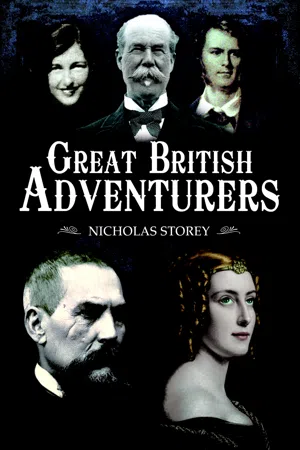
Great British Adventurers
About this book
In selecting my adventurers, I have had to find limits. The first has been to confine my selection to men and women who are (at least loosely) British and, even then, service and adoption have sometimes, as with Krystyna Skarbeka, taken the place of birth, and I have chosen to ignore such things as competing national claims for Tenzing Norgay. The second limit that I have set myself is generally to exclude heroic adventurers in battle, simply because there is (rightly), so much already written about them, but I have found place for certain (representative) secret agents of the Second World War, whose acts (in voluntary service, beyond the call of simple duty), surely took them out of the arena of straightforward battle and into the realm of the most individual and courageous adventure. The result of these decisions remains to be judged but the overall objective has been to renew interest in the lives of some of our real heroes and heroines, as representative of the many others that there are; in an age in which contemporary sporting and pop art heroes dominate the news and provide the only readily evident inspiration, and also an age in which addiction to the computer screen nearly robs the young of memories and dreams of high adventure; of which ripping yarns are born. The third limit is a limit of time: this speaks for itself; otherwise howwould Drake and Raleigh, Clive of India, General Woolf and Captain Cook not have found their places? There have to be such limits. The final limit has been to exclude those who are widely famed already: what more is there to say of General Gordon or Dr David Livingstone of Captain Robert Falcon Scott and Captain Laurence Oates; even though what has been said should often be repeated? Moreover, although Sir Edmund Hillary is acknowledged as the first conqueror of Mount Everest; Tenzing Norgay was there with him and what of George Mallory who, some time before had died, either going up or coming down?To those who might accuse me of having been obscure, I just plead that my purpose has been to bring back into ready remembrance certain men and women, not widely fted now, who had great impact upon the accrual of knowledge of: other peoples, their customs and their countries; or who have striven, often against various obstacles (including the odds), to promote exploration and, sometimes, even to preserve life and liberty for others. To the erudite, who might say that I shed little new light and that the coverage is uneven, I plead, in mitigation of sentence, that my principal purpose has been to remind of worthy lives that might still stir our blood; and to bring them together, as representative of our adventurous people, in one handy volume.James Brooke, Rajah of Sarawak 1803–1868Mary Seacole 1805–1881 Richard and John Lander 1804–1834; 1806–1839Jane Digby 1807–1881General Sir James Abbott 1807–1896Colonel John Peard 1811–1880John William Colenso, 1st Anglican Bishop of Natal 1814–1883Sir Richard Burton 1821–1890 and John Hanning Speke 1827–1854 Emily Hobhouse 1860–1926Mary Kingsley 1862–1900Sir Francis Younghusband 1863–1942Colonel Percy Fawcett 1867–1925 and, in his wake, Peter Fleming OBE 1907–1971Cecil Henry Meares 1877–1937George Mallory 1886–1924 and Andrew Irvine 1902–1924Dame Freya Stark 1893–1993Sir Francis Chichester 1901–1972Gladys May Aylward 1902–1970Amy Johnson 1902–1941Krystyna Skarbek-Granville GM, OBE, Croix de Guerre Avec Palmes, born ca. 1908–1952Sir Fitzroy Hew Royle Maclean 1911–1996Tenzing Norgay GM 1914–1986 Violette Szabo GC, MBE 1921–1945The Present and the Future[Colonel John Blashford-Snell b. 1936Sir Ranulf Fiennes b. 1944Alan Hinkes b. 1954Adrian Hayes (45)Kenton Cool b. 1973Dame Ellen MacArthur b. 1976Rebecca Stephens b. 1982Xanadu and William Dalrymple]
Information
Topic
StoriaSubtopic
Storia militare e marittimaChapter 1
Lady Hester Lucy Stanhope (1776–1839)
She left the web, she left the loom;
She made three paces thro’ the room,
She saw the water-lily bloom,
She saw the helmet and the plume,
She look’d down to Camelot.
Out flew the web and floated wide;
The mirror crack’d from side to side;
“The curse is come upon me,” cried
The Lady of Shalott.
She made three paces thro’ the room,
She saw the water-lily bloom,
She saw the helmet and the plume,
She look’d down to Camelot.
Out flew the web and floated wide;
The mirror crack’d from side to side;
“The curse is come upon me,” cried
The Lady of Shalott.
From The Lady of Shalott by Alfred, Lord Tennyson
LADY HESTER Lucy Stanhope was born on 12 March 1776 at Chevening, Kent. She was the eldest daughter of Charles Stanhope, Lord Mahon, heir to the Earl of Stanhope, and his first wife, Lady Hester Pitt, daughter of William Pitt The Elder (The First Earl of Chatham) and sister of William Pitt The Younger.
Hester’s mother died when Hester was four years old and her father married again. Hester was an independent and determined child and she grew up to become a commanding and magnificent woman.
She remained at Chevening until 1800, when she went to live with her grandmother. In 1803 Hester went to live with Pitt The Younger at Walmer Castle, Kent, where she helped to create the gardens. She moved with Pitt to London when he became Prime Minister in his second Ministry from 1804.
At this time, Hester was exposed to the top end of the social spectrum and was at the very hub of political power. She was devoted to the bachelor Pitt and helped him by acting as his hostess. Hester was attractive, lively and good company, but she always had a tendency to speak her mind which offended some people.
Unfortunately, Pitt The Younger died in January 1806–probably from complications arising from a consistent surfeit of port wine taken upon the advice of his doctors for his digestive problems. His personal debts of some forty thousand pounds were paid by vote of Parliament, which also gave Hester a pension of a miserable twelve hundred pounds a year.
Now Hester was outside the tent peering in; a person of no current importance. She found her position difficult and took it out on those around her.
In 1809 she suffered another setback in her personal life when both General Sir John Moore (to whom she had grown attached), and her half-brother were killed in the Napoleonic Battle of Corunna on 16 January.
Hester decided to sail first to Gibraltar and then to Malta to get away from it all. In Malta she met Michael Bruce, the son of a well-to-do businessman who was engaged in a tour. They fell in love and started living together.
The happy couple stayed in Malta for a while and then travelled to Constantinople. They were shipwrecked off the isle of Rhodes and eventually ended up in Cairo where they were received with honour by Mehmet Ali Pasha. They later took a tour of the Holy Land and the Lebanon. Hester was extravagant in her lifestyle and behaved as she wished.
Warned that when she entered ‘fanatical’, Islamic, Damascus she must behave as a local woman and veil herself, to the astonishment of observers, she instead dressed in male Turkish clothes and rode into town on horseback.
Hester stayed in Damascus for three months, attracting awe, rather than deprecation, and then decided she would be the first European woman to visit Palmyra (‘The Bride of The Desert’), an ancient and ruined Syrian city, dating from the second millennium BC.
On 17 March 1813, dressed as a Bedouin male, she rode into Palmyra at the head of a caravan of twenty-two camels and a small army of Bedouin Arabs to be greeted warmly by the Emir. She always claimed that they and the inhabitants of the adjacent, modern town, crowned her Queen of the Desert under a triumphal arch!
Hester now decided the time had come for Michael to return to England and his family. She was to stay in Syria. So, the affair over, she dumped him and he left for good on 7 October 1813.
Just after this, Hester probably caught the Plague, which was rife at the time, and she was nursed by her own doctor and later biographer (Dr Meryon), whom she had brought from England. Once recovered, but now without money from Michael Bruce’s family and just her small pension to sustain ‘The Queen of The Desert’ Hester was taken to the sometime convent of Mar Elias on the mountains behind Sidon in the Lebanon. After that, she lived for a while at Deir Mashmousheh.
In 1815 Hester persuaded the Ottoman government authorities to join her search for buried treasure at Ashkelon, a port north of Gaza, based on the directions of a medieval, Italian document she had obtained. The treasure was supposed to be buried in the remains of a mosque in the port. The Governor of Jaffa accompanied her, but all they found was a large, headless statue which, in a fury, Hester ordered to be smashed up and cast into the sea. However, this probably does count as the first archaeological ‘dig’ with documentary references in the Holy Land.
In 1816 Hester waged a vendetta against a group of villages to avenge the death of a friend who had been murdered in the vicinity. She found herself short of money as a result of these excursions and had to borrow more and more. After living some years at Mar Elias and Deir Mashmousheh, she moved to Dar Djoun, a remote spot higher in the hills–indeed, on its own strategic hill with a true, panoramic view. Here Hester repaired an old building, (called ‘Dahr El Sitt’), added others, laid out gardens, and fortified it all with a wall and gates. She lived here for the remainder of her life with a large (but gradually dwindling) household of servants, slaves and guards.
During the miniature civil wars for which the Lebanon is noted, and especially during the siege of Acre by Ibrahim Pasha of Egypt between 1831 to 1832, Hester gave sanctuary to numerous refugees–among them Druze, deserters and enemies of Ibrahim Pasha–and Emir Bashir Shihab II of the Lebanon (with both of whom she had previously been on good terms).
Despite threats and attempted persecution, she refused to surrender her authority or the men under her protection, guarded her fortress retreat and defied the world. Indeed, her local influence (borne out of strength of personality, rather than military might), was such that she did, more or less, rule the district around her.
Hester’s health deteriorated rapidly as she grew older. There were physical and psychological symptoms, and she started flying into rages which were followed by depression and melancholy. She gave up on contact with the outside world and bemoaned her fate to the few left with her inside her walls. Curious visitors would be treated at night to endless talk of the old days and of her occult and mystic beliefs.
Despite the fact that she was no longer living in luxury, Hester continued to borrow money until a main creditor asked Mehmet Ali Pasha to help him recover what was owed.
Mehmet Ali approached not Hester, but the British Consul-General, who sent the matter to England. The Foreign Secretary, Lord Palmerston, decided that Hester’s pension would have to be stopped in return for settlement of the debt.
She was given the decision by a letter dated 10 January 1838 and reacted with a last great flurry of angry correspondence. In August that year she arranged for publication of these letters in the newspapers but alas, it was to no avail.
Many of Hester’s servants had already left for want of pay, some taking her goods as ‘compensation’, and the rest she dismissed. She completely retired from the world.
Her days of magnificence long behind her, Hester, ‘Queen of the Desert’, became a complete recluse and died alone and in squalor, on 23 June 1839 at Dar Djoun, where she was buried. However, she was restless even in death because her remains were reinterred in the British Ambassador’s garden in Beirut on 2 February 1989. But even that was not the end of it because her ashes were finally scattered, amidst the ruins at Dar Djoun, on the anniversary of her birth, 23 June 2004.
Now, presumably, they will leave Lady Hester alone.
Chapter 2
Sir James Brooke KCB, DCL (Oxon), White Rajah of Sarawak (1803–1868)
Who is it that can tell me who I am?
King Lear 1.4.132, by William Shakespeare
THERE HAVE been Englishmen sought out by foreign lands to rule them–apparently on the basis that an English gentleman with a sufficient fortune can meet any case. Harold Harmsworth, the first Lord Rothermere, was offered (and declined), the throne of Hungary in 1927 as a result of his support for a revision of the Treaty of Trianon in Hungary’s favour. Academic, writer, publisher, diplomat and all-round sportsman, C. B. Fry claimed he had been offered the throne of Albania while attending the League of Nations in Geneva in 1920 but declined because he did not have a sufficient income to take it up. Apparently, Fry had a dry sense of humour and whether the offer was ever really made has never been substantiated by any official source. However, one man and the dynasty that followed him became, for a century, the absolute rulers of Sarawak, now one of two Malaysian states, on the northwest side of the island of Borneo. This original White Rajah even inspired Joseph Conrad’s novel Lord Jim.
James Brooke was born on 29 April 1803 at Secrore, Benares, India. His father was a judge in a court of the East India Company and James spent the first twelve years of his life with his parents in India. Then he was sent to England to stay with relatives in Reigate, Surrey. They put him to board at Norwich Grammar School which he detested, running away, with impunity. When his parents returned from India and went to live in Bath, Brooke joined them. Apparently receiving little further formal education, in 1819, aged sixteen, he too, entered the service of the East India Company as an ensign in the Bengal Native Infantry. Brooke was eventually promoted to Sub-Assistant Commissary-General in 1822. He was very seriously wounded when commanding a troop of irregular cavalry in the course of the First Anglo-Burmese War in January 1825. He was awarded a pension for his injuries and returned to England to recover over the course of the next five years. Although he tried, Brooke found he was unable to return to service in India before the expiry of his leave and resigned his commission with the East India Company. He visited various countries including China, Malacca and Singapore, before again returning to England.
Brooke then unsuccessfully tried a trading trip to China and decided his father’s suggestion that he was not cut out for trade was right. However, his father died in 1835 and left him the considerable fortune of £30,000. From this, and with his wilful nature and spoiled background, he bought a lightly-armed schooner which he named The Royalist. He recruited a crew and from late 1836 went on training missions around the Mediterranean Sea before setting sail for Singapore on 16 December 1838. He seems, at this time, to have had no set plan as to a particular endeavour, except to secure adventure. He certainly found it.
In Singapore, Brooke came across some British sailors who had been shipwrecked and had received assistance from Rajah Muda Hassim of Sarawak, the uncle of the Sultan of Brunei. The Governor-General of Singapore asked Brooke to go to Sarawak and thank the Rajah for his help. Maybe urged on by some thought of a main chance after learning that the Sultan of Brunei had been subject to a rebellion by disaffected Bidayuh antimony (mineral) miners on the island, Brooke accepted the commission. After sailing up the Sarawak River and anchoring at the capital, Kuching, he was received by the Rajah in August 1839. He learned about the nature of the rebellion from the Rajah and went on a fact-finding mission in the region, meeting local people, including Malays and Dayaks. At this stage, Brooke had evidently not found quite what he was looking for and he returned to Singapore.
However, in August 1840, he went back to Kuching where the rebellion was still raging. In return for a promise from the Rajah that, if he quelled the rebellion, the Rajah would secure his appointment as Governor of Sarawak, Brooke agreed to act.
Mustering his crew and the Rajah’s forces, Brooke routed the rebels from their headquarters on the Sarawak River. However, the Rajah was not fast in realising his end of the bargain and Brooke was forced to use the threat of force to assist his memory. On 24 September 1841, Brooke trained his ship’s guns on the Rajah’s palace. The Rajah then conceded and Sultan Omar Ali of Brunei confirmed Brooke’s appointment in July 1842. In August that year, and in the face of open opposition from the old regime, he was created (officially) the First White Rajah of Sarawak at Kuching. Rajah Hassim returned to Brunei where Brooke’s influence, backed-up with the threat of assistance from the Royal Navy, had him created the Sultan’s Chief Minister in October 1843.
Brooke was now effectively an absolute monarch of an oriental kingdom and he appointed a London agent, Henry Wise, to secure official recognition by Britain and to promote his financial interests. However, Wise had his own ideas, and in 1848 he purported to grant an unauthorised mining concession in Sarawak. For the time being, The White Rajah and Mr Wise parted company.
The ideals behind Brooke’s reign were those of a somewhat romantic orientalist: reform, stabilisation, modernisation, and an increase in free trade (avoiding the intercession of middlemen and mere profiteers), without disturbing local customs and traditions–except in the case of practices such as headhunting, piracy, and slavery, which offended his modern, humanitarian values and were gradually discouraged and then stamped out. Had he thought about it (and he probably did not), he might have seen himself as a kind of Platonic Guardian of the people in his charge. One thing is for certain, he would never have asked himself the question: ‘Quis custodiet custodes ipsos?’ (‘Who guards the Guardians themselves?’)
Accordingly, Malay was kept as the official language, and although Brooke was a Christian (who would later encourage Christian Missions in Sarawak for the sake of stabilising his regime), he decreed that Islam was to be respected as a religion. He also imported Brunei law which he overlaid with notions of English equity and fairness. Brooke recruited men from the British army to assist him in his government. He was fortunate in inspiring a loyal following, but he also relied on the native hereditary aristocracy to tow the line and help him to guide the people forward.
Brooke almost certainly regarded his policies as philanthropic. He lightly taxed the native population but heavily taxed commercial production of things such as opium and arrack (a distilled alcoholic drink) which was largely in the hands of the Chinese. Brooke also set about putting down coastal raiding parties perpetrated by alliances between certain Dayak tribes and Brunei tax collectors (of all people), and he secured the support of the Royal Navy to do so. In mid-1843 and mid-1844, Brooke and a Captain Keppel RN, attacked the longhouses of the Dayak pirates.
Brooke even took one of his chief opponents, former Governor, Pengiran Ali, prisoner. These activities all resulted in a territorial expansion of Brooke’s kingdom beyond the bounds of ‘Sarawak Proper’, and were recognised in a Treaty with the Sultan of Brunei in 1853. At Brooke’s behest, Admiral Cochrane RN, destroyed the pirate base at Marudu in August 1845. This further hit coastal raiding, but in early 1846 the Sultan of Brunei ordered the killing of allies of Brooke and Hassim in Brunei. Enlisting Cochrane’s help once again, Brooke secured the ceding to Britain, from the Sultan, of the island of Labuan.
In October 1847 Brooke returned to England where he found himself fêted as a self-motivated hero of empire and the celebrity of the moment. He was received by Victoria and Albert and honours were showered upon him (including an honorary DCL from Oxford University). He was made a Knight Companion of the Order of the Bath as well as being painted by Sir Francis Grant RA. Besides all this, Brooke was appointed Governor of Labuan and Consul-General for Borneo. He rested his own claims to legitimacy as Rajah on the agreement of senior Malay Chiefs, rather than on any Treaty with the Sultan of Brunei, and established an advisory council with Malay and European members, on which he was assisted by such as his private secretary (and later, biographer), Spenser St John.
Brooke was sensible enough to know that to reinforce his reforms–especially in relation to headhunting and piracy, as well as to educate the people–there should be the introduction of Christian Missions. He appealed to Oxford and Cambridge Universities and to the great Missionary Societies (the Society for the Propagation of the Gospel in Foreign Parts and the Church Missionary Society), for help, but none of them had the funds at the time to meet his requests. Accordingly, he established a new association, supported by his friends, called the ‘Borneo Church Mission’. This association sent out some missionaries, the first of whom was the Rev F. T. McDougall, who was later consecrated the first Bishop of Labuan and Sarawak in 1855.
When McDougall arrived at Kuching in 1848, the Rajah gave him a large piece of ground on which to build himself a house, church and school. That same year, John Brooke Johnson, Brooke’s elder nephew and heir apparent, also arrived to receive training in governing Sarawak. He changed his surname to Brooke and became Brooke Brooke. He had a son called Hope Brooke. James Brooke’s younger nephew, Charles Brooke, arrived in Sarawak in 1852 to assist his uncle in administration.
Brooke was anxious that the Dayaks, who lived out of town and had their home in the jungle, should also be taught. By this time, and after all his experiences, Brooke was keen to spread the Christian word. Accordingly, he sent for more assistance from England and a second...
Table of contents
- Dedication
- Title Page
- Copyright Page
- Table of Contents
- Acknowledgements
- Introduction
- Chapter 1 - Lady Hester Lucy Stanhope (1776–1839)
- Chapter 2 - Sir James Brooke KCB, DCL (Oxon), White Rajah of Sarawak (1803–1868)
- Chapter 3 - Richard Lemon Lander (1804–1834)
- Chapter 4 - Mary Seacole (ca. 1805–1881)
- Chapter 5 - Jane Elizabeth Digby (1807–1881)
- Chapter 6 - General Sir James Abbott KCB (1807–1896)
- Chapter 7 - Colonel John Whitehead Peard, ‘Garibaldi’s Englishman’ (1811–1880)
- Chapter 8 - John William Colenso, 1st Anglican Bishop of Natal (1814–1883)
- Chapter 9 - Sir Richard Francis Burton KCMG, FRGS (1821–1890)
- Chapter 10 - Sir Thomas Johnstone Lipton, 1st Bart. KCVO (1850–1931)
- Chapter 11 - Emily Hobhouse (1860–1926)
- Chapter 12 - Mary Henrietta Kingsley (1862–1900)
- Chapter 13 - Sir Francis Edward Younghusband KCSI, KCIE (1863–1942)
- Chapter 14 - Colonel Percy Harrison Fawcett (1867–1925) and, in his wake, (Robert) Peter Fleming OBE (1907–1971)
- Chapter 15 - Gertrude Margaret Lowthian Bell CBE (1868–1926)
- Chapter 16 - George Herbert Leigh Mallory (1886–1924)
- Chapter 17 - Dame Freya Madeline Stark DBE (ca. 1893–1993)
- Chapter 18 - Sir Francis Charles Chichester KBE (1901–1972)
- Chapter 19 - Amy Johnson CBE (1903–1941)
- Chapter 20 - Gladys May Aylward (1902–1970)
- Chapter 21 - Krystyna Skarbek-Granville GM, OBE, Croix de Guerre, born (ca. 1908–1952)
- Chapter 22 - Major-General Sir Fitzroy Hew Royle Maclean, of Strachur and Glensluian Bart, (1911–1996) KT, CBE, 15th Hereditary Keeper and Captain of Dunconnel Castle
- Chapter 23 - Noor-un-Nisa Inayat Khan GC, MBE, Croix de Guerre (1914–1944)
- Chapter 24 - Tenzing Norgay GM (1914–1986)
- Chapter 25 - Violette Reine Elizabeth Szabo GC, MBE, Croix de Guerre (1921–1945)
- Chapter 26 - A Note on the Present and the Future
- Bibliography
Trusted by 375,005 students
Access to over 1.5 million titles for a fair monthly price.
Study more efficiently using our study tools.
Frequently asked questions
Yes, you can cancel anytime from the Subscription tab in your account settings on the Perlego website. Your subscription will stay active until the end of your current billing period. Learn how to cancel your subscription
No, books cannot be downloaded as external files, such as PDFs, for use outside of Perlego. However, you can download books within the Perlego app for offline reading on mobile or tablet. Learn how to download books offline
Perlego offers two plans: Essential and Complete
- Essential is ideal for learners and professionals who enjoy exploring a wide range of subjects. Access the Essential Library with 800,000+ trusted titles and best-sellers across business, personal growth, and the humanities. Includes unlimited reading time and Standard Read Aloud voice.
- Complete: Perfect for advanced learners and researchers needing full, unrestricted access. Unlock 1.5M+ books across hundreds of subjects, including academic and specialized titles. The Complete Plan also includes advanced features like Premium Read Aloud and Research Assistant.
We are an online textbook subscription service, where you can get access to an entire online library for less than the price of a single book per month. With over 1.5 million books across 990+ topics, we’ve got you covered! Learn about our mission
Look out for the read-aloud symbol on your next book to see if you can listen to it. The read-aloud tool reads text aloud for you, highlighting the text as it is being read. You can pause it, speed it up and slow it down. Learn more about Read Aloud
Yes! You can use the Perlego app on both iOS and Android devices to read anytime, anywhere — even offline. Perfect for commutes or when you’re on the go.
Please note we cannot support devices running on iOS 13 and Android 7 or earlier. Learn more about using the app
Please note we cannot support devices running on iOS 13 and Android 7 or earlier. Learn more about using the app
Yes, you can access Great British Adventurers by Nicholas Storey in PDF and/or ePUB format, as well as other popular books in Storia & Storia militare e marittima. We have over 1.5 million books available in our catalogue for you to explore.