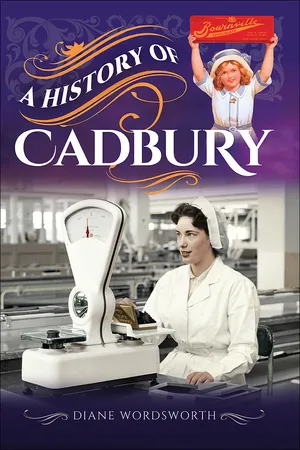
The history of the world-famous confectioner—maker of the Cadbury Creme Egg—from nineteenth-century shop to multinational brand.
When John Cadbury came to Birmingham in 1824, he sold tea, coffee, and drinking chocolate in a small shop on Bull Street. Drinking chocolate was considered a healthy alternative to alcohol, something Cadbury, a Quaker, was keen to encourage. By 1879, the Cadburys were ready to make their historic move to Bournville, where they established their famous "factory in a garden," built on the sprawling Bournbrook estate.
A History of Cadbury recounts the history of this beloved British chocolatier and looks at the social impact the company has had, both on the chocolate and cocoa business and on British culture at large. This is the story of how Cadbury began, how it grew, and how it diversified in order to bring its chocolates and candies to one generation after the next.
- 208 pages
- English
- ePUB (mobile friendly)
- Available on iOS & Android
eBook - ePub
A History of Cadbury
About this book
Information
Chapter 1
The Birth of a Dynasty
The Cadbury family originated in the counties of Devonshire, Dorset and Somerset, and it is from the Devonshire branch of the family that Richard Tapper Cadbury came. Richard was born in Exeter in November 1768. His grandfather, John Cadbury, was a member of the Society of Friends and he married Hannah Tapper in 1725. Hannah’s father, Richard Tapper, was one of George Fox’s converts to Quakerism. He was imprisoned in Exeter Gaol for this in 1693. Hannah Tapper and John Cadbury were the parents of Joel Cadbury, who married Sarah Moon as his second wife. Richard Tapper Cadbury was their son.
Richard Cadbury left Exeter in 1782 when he was 14. He went to Gloucester, where he was apprenticed to a draper. When his apprenticeship ended, he moved to London where he lived with linen drapers Jasper and Ann Capper:
In my nineteenth year I received wages of £20 per annum, out of which I respectably clothed myself, found my washing and pocket money, and always appeared so respectable as to be the invited guest amongst the first families of Gloucester. My wages gradually advanced to £40 per annum; I then lived in London at Jasper Capper’s and was 24 years of age. During that six years I not only maintained a respectable appearance, but in many cases was enabled to be generous, and purchased many books amongst which is Rees Encyclopedia, now in the book case. I may add that during that period I do not remember receiving 1s. from my father, and knowing that he was not opulent – having in the course of his life met with many losses and sustained many difficulties – it was delightful to me to reflect I had no need to press upon him, and made indeed very sweet the reflections instead of the many gratifications I deprived myself of.
Richard Tapper Cadbury, The Firm of Cadbury: 1831–1931
In 1794, Richard moved to Birmingham with his friend Joshua Rutter and in June of that year an associate of the two young men wrote to Matthew Boulton, an English manufacturer and business partner of the Scottish engineer James Watt, singing their praises and recommending them very highly. The friends set-up in business in Birmingham as drapers, and in 1798 Richard acquired a property in Bull Street in the town centre as both his residence and his place of business. This property was at 85 Bull Street, but was later re-numbered 92 Bull Street. Meanwhile, in 1796, Richard married Elizabeth Head, with whom he had ten children. The eldest of these, Sarah, was born at a house in Old Square, but all the others were born at Bull Street.

Poster advertising Cadbury’s, by Cecil Aldin, c1902. (Courtesy of Cadbury Archives and Mondelēz International)
Benjamin Head Cadbury, Richard and Elizabeth’s eldest son, was born in 1798. John, the third son, was born in 1801. A second son, Joel Cadbury, was born in 1799, and it was he who emigrated to the United States and founded the American branch of the family.
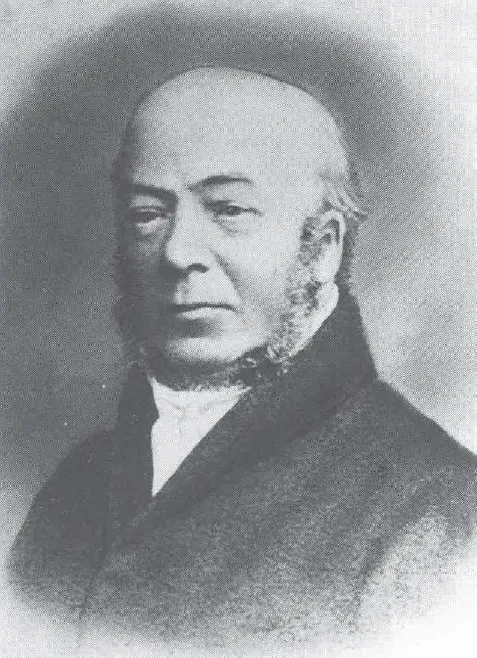
John Cadbury (1801–1889). (Courtesy of Cadbury Archives and Mondelēz International)
Richard Tapper Cadbury retired from his drapery business in 1828. His son, Benjamin Head Cadbury, continued with the business for a while with another brother, James, before joining his younger brother John.
John Cadbury (1801–1889)
Our story begins in March 1824, when John Cadbury opened his shop in Bull Street, Birmingham, selling tea.
In 1816, Richard Tapper Cadbury apprenticed his son John to a fellow Friend, John Cudworth, of Broadhead and Cudworth in Briggate, Leeds. Here John learnt about the retail business and tea-dealing. In 1822, he went to London for a year, where he gained further experience with the firm of Sanderson, Fox and Company. When John returned, his father gave him a sum of money with which he could ‘sink or swim’. John chose to swim and on 4 March 1824 he opened his own shop at 93 Bull Street.
In the early days cocoa and chocolate were not such a large part of John’s business as tea-dealing and coffee-roasting were so, at first, the shop concerned itself with the sale of tea and coffee. But cocoa beans were also on the list, although all John did with these was roast the ‘nibs’ and grind them with a pestle and mortar. The adulteration of chocolate came a few years later.
Being a devout and practising Quaker, John was heavily involved with the Society of Friends’ chapter that met in Birmingham. In 1817, when he was 15, his aunt, Sarah Moon Cash, wrote to his elder brother Joel, who had already been in America for about a year:
John is grown into a fine youth, he possesses a fine open countenance, is vigorous in body and mind, desires to render himself useful in the business or in any other way; he possesses a strong athletic form with energetic powers of mind, he appears very amiable but his character is not yet formed; I sincerely hope his mind will be illuminated with Heavenly Wisdom, in which case he will be an ornament to Society; he is not of negative cast.
In his youth, John had learnt to play the flute, but music was not highly regarded by the Society of Friends in those days, and so he gave it up. Instead he satisfied himself with two musical boxes, which he still possessed into his dotage.
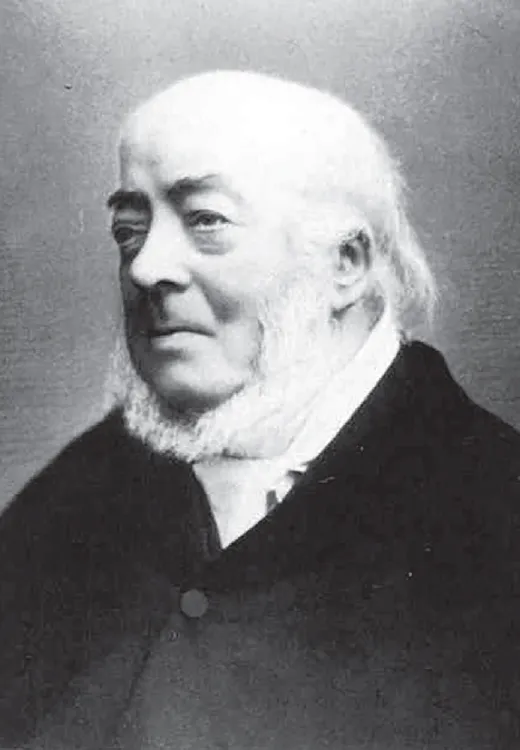
John Cadbury in 1885. (Courtesy of Cadbury Archives and Mondelēz International)
From his late 20s, John was involved in various committees and organisations, starting with the Board of Commissioners for Birmingham from the age of 28. His father, Richard, became chairman of this organisation, and John himself became chairman of several of its subcommittees. One of these was the Steam Engine Sub-Committee, which concerned itself with smoke abatement. A few years later John was appointed overseer of the poor in the city. The story goes that when he attended his first fine overseers’ dinner, John was shocked to see the heavily laden table while starving people waited outside for financial assistance. He challenged the practice of expensive dinners, funded by the public purse, and it was immediately abandoned from that day forward.
In 1832, John was one of only six men to attend the funeral of an Asiatic cholera victim who died in Bilston, less than 10 miles away from Birmingham. The others were the four coffin-bearers, the vicar and Henry Street, a friend who had supported John in the matter of the overseers’ dinners. A sketch by one Henry Newman shows the procession led by the vicar reading from his book and two of the coffin-bearers smoking pipes. The two men at the back are depicted in gentlemanly dress of the time, with John Cadbury wearing a frock coat.
Between 1829 and 1842, John went on three missionary visits to Ireland. By this time he had also been appointed clerk to the monthly meeting of Friends in Birmingham. He was interested in hospitals and was instrumental too in replacing chimney-sweep boys with mechanical devices. He also had an interest in savings banks. By 1842, the Cadbury family had already started to fund sickness and pension payments and later were instrumental in laying the foundations for the garden city movement.
John Cadbury’s chief social interest was the temperance movement. It was as an alternative to alcohol that John initially offered his chocolate drink. He himself became a pledged total abstainer in 1832, when he was 31. He co-founded the Birmingham Auxiliary Temperance Society, and he had converted his father to total abstinence by the time of Richard Tapper Cadbury’s death in 1860. When asked what should be done with all of the brewing barley, John started to take barley puddings to temperance meetings and hand them around for all to try.
It was said that John was such a devout Quaker that he didn’t sit in an easy chair until he reached the age of 70. He retired from his chocolate business in April 1861 and handed it over to his sons Richard and George, who were 25 and 21 respectively at the time. Right into his 80s, great interest in the firm, still visiting the factory in Bournville when he was a very old man. Sadly, though, on 11 May 1889, the founder of this great dynasty died and was buried in Witton Cemetery.
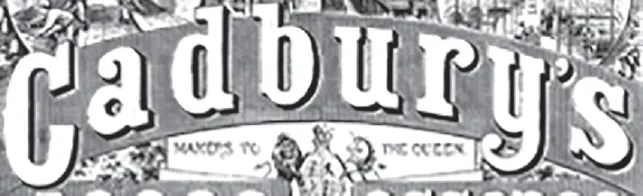
John continued to take a Cadbury’s logo, c1866.
Benjamin Head Cadbury (1798–1880)
Benjamin Cadbury was actually John’s older brother, the eldest child of Richard Tapper Cadbury. He was born on 27 July 1798. Benjamin held similar interests to John, such as temperance and the abolition of slavery, and he was also active among the Birmingham Friends and especially interested in the prevention of cruelty to animals. But he doesn’t feature as strongly in the business as other members of the family. However, he is mentioned here because he was one of the original Cadbury brothers.
In 1846, Benjamin Cadbury gave up the drapery business inherited from their father at 92 Bull Street, although his name does not appear in the Cadbury books at Crooked Lane. From 1847 to 1859 he is listed with his brother in paperwork relating to the Bridge Street property, and in 1847 the firm first became known as Cadbury Brothers. But Benjamin’s name disappears again after 1860 – a time when the company was not doing so well. However, he was still involved with the business and could still be seen in the offices right into the late 1870s. It does appear, though, that he ceased to be a partner around the time the firm was floundering.
Chapter 2
The Process and Manufacture of Chocolate and Drinking Cocoa
The Maya were an ancient race who lived in central America, where cocoa trees grow in the tropical rainforest. The native Mayans were the first to grow the trees and use cocoa beans. Primarily, they made a chocolate drink. But cocoa beans could also be used to barter with, instead of money. The beans were considered to be quite valuable. When the Maya travelled to Mexico to sell their cocoa, the knowledge was transferred to the Aztecs.
Like the Maya, the Aztecs enjoyed to drink chocolate in very large quantities. But they couldn’t grow the trees themselves, as their climate was too dry. Cocoa trees survive in the rainforest because they thrive in humid conditions. They can grow in the shade and this means the canopy does not have to be cut down. Cocoa trees grow to a height of around 30 feet, whereas rainforest trees grow to a height of around 200 feet. The Aztecs took cocoa beans as a kind of taxation from the people they conquered, or they acquired the beans through trade.
Christopher Columbus was the first to bring cocoa beans to Europe in the late 1400s. Don Cortés also brought them back in the early 1500s. Cortés learnt that drinking chocolate was a favourite beverage of the Emperor Montezuma, and he found out how to make it, adding water, maize, vanilla and chilli. The Spanish learnt to replace the chilli with cinnamon, nutmeg and sugar.
For more than a century the Spanish kept this new, luxury drink a close-guarded secret. Cocoa beans were rare anyway. But by the 1650s, the chocolate drink had found its way to England, although it was still very expensive. In those days, it would have been made from chocolate blocks imported from Spain.
When John Cadbury opened his shop in Birmingham in 1824, he sold ground-up cocoa beans. The resulting drink, he believed, afforded ‘a most nutritious beverage for breakfast’. Unfortunately, little evidence remains of his business or the production of chocolate from those very early days. However, a price-list does exist dating from 1842. Before this there are only letters between Cadbury and his customers, such as this one, which was written on 23 June 1841:

Early production. (Courtesy of Cadbury Archives and Mondelēz International)
RESPECTED FRIEND, – Thy favour of the 21 inst. came duly to hand with Bank Note value £10 – for which I am obliged and not less so for thy renewed order for Soluble Cocoa which will be sent off in a day or two – and the quality I am satisfied will continue to please.
I enclose my list of Cocoa & Chocolates and shall feel particularly obliged for thy further orders, thou mayest depend on my best attention to them – and also in bei...
Table of contents
- Cover
- Title
- Copyright
- Contents
- Acknowledgements
- Foreword
- Introduction
- Chapter 1. The Birth of a Dynasty
- Chapter 2. The Process and Manufacture of Chocolate and Drinking Cocoa
- Chapter 3. The Early Years
- Chapter 4. Cadbury Brothers – the Next Generation
- Chapter 5. Back in the Black
- Chapter 6. Advertising and Packaging
- Chapter 7. Travellers
- Chapter 8. Education and Training
- Chapter 9. Sport and Recreation
- Chapter 10. Workers’ Welfare
- Chapter 11. Pensions and Savings Schemes
- Chapter 12. Bournville – a New Garden City
- Chapter 13. Cadbury’s and the Slave Trade
- Chapter 14. Works Magazines and Corporate Communication
- Chapter 15. Two World Wars
- Chapter 16. Between the Wars
- Chapter 17. Voices from the Past
- Chapter 18. Takeovers, Mergers, the Future
- Author’s Note
- Appendix I: An Early Example of John Cadbury’s Philanthropy and his Concern
- Appendix II: ‘Visit to a Chocolate Manufactory’
- Appendix III: ‘The Production of Cocoa. Messrs Cadbury’s Action for Libel’
- Bibliography
- About the Author
Trusted by 375,005 students
Access to over 1.5 million titles for a fair monthly price.
Study more efficiently using our study tools.
Frequently asked questions
Yes, you can cancel anytime from the Subscription tab in your account settings on the Perlego website. Your subscription will stay active until the end of your current billing period. Learn how to cancel your subscription
No, books cannot be downloaded as external files, such as PDFs, for use outside of Perlego. However, you can download books within the Perlego app for offline reading on mobile or tablet. Learn how to download books offline
Perlego offers two plans: Essential and Complete
- Essential is ideal for learners and professionals who enjoy exploring a wide range of subjects. Access the Essential Library with 800,000+ trusted titles and best-sellers across business, personal growth, and the humanities. Includes unlimited reading time and Standard Read Aloud voice.
- Complete: Perfect for advanced learners and researchers needing full, unrestricted access. Unlock 1.5M+ books across hundreds of subjects, including academic and specialized titles. The Complete Plan also includes advanced features like Premium Read Aloud and Research Assistant.
We are an online textbook subscription service, where you can get access to an entire online library for less than the price of a single book per month. With over 1.5 million books across 990+ topics, we’ve got you covered! Learn about our mission
Look out for the read-aloud symbol on your next book to see if you can listen to it. The read-aloud tool reads text aloud for you, highlighting the text as it is being read. You can pause it, speed it up and slow it down. Learn more about Read Aloud
Yes! You can use the Perlego app on both iOS and Android devices to read anytime, anywhere — even offline. Perfect for commutes or when you’re on the go.
Please note we cannot support devices running on iOS 13 and Android 7 or earlier. Learn more about using the app
Please note we cannot support devices running on iOS 13 and Android 7 or earlier. Learn more about using the app
Yes, you can access A History of Cadbury by Diane Wordsworth in PDF and/or ePUB format, as well as other popular books in History & British History. We have over 1.5 million books available in our catalogue for you to explore.